Heads of the People exhibition NPG Canberra 2000

John Watt Beattie located his museum in Hobart but called it the "Port Arthur Museum" where he sold any fragment of any item as historical artefact of Tasmania's convict and aboriginal past, including reproductions.


John Watt Beattie ca. 1920
Archives Office of Tasmania Ref:30-430c


A visitor to Tasmania in 1916 with the South Australian Commission became so affronted by John Watt Beattie's commercialism when he "wandered into the Port Arthur Museum" in Hobart, the visitor was moved to write a letter to The Mercury newspaper. His letter was published on 3rd February, 1916:

He wrote:
"There are three rooms literally crammed with exhibits ... The question which pressed itself on my mind time and again was, how comes it that these old-time relics which formerly were Government property, are now in private hands? Did the Government sell them or give them away? The same query applies to the small collection in a curiosity shop at Brown's River. Whatever the answer may be, I hold the opinion that the Government would be amply justified in taking prompt steps to repossess them, even though some duplicates may be in the State Museum. Today the collection is valuable and extremely interesting. A century hence it will be priceless. It would surely be unpardonable to allow it to pass into the hands of some wealthy globe-trotter which is the fate awaiting it, unless action be taken to secure it to the State."
The Mercury 3rd February 1916, letter to the editor
from Edward Lucas, MLC, Legislative Council, Adelaide.

This visitor on government business in Tasmania could hardly have envisioned that the State itself would never be able to do the collection justice, because Beattie had already violated the integrity of the originals, despite making "some duplicates" and lodging them in the "State Museum", by which he meant the institution now known as the Tasmanian Museum and Art Gallery. This was one means whereby the TMAG acquired duplicates of Nevin's prisoner photographs. Two other sources are likely: estrays from the central police registry at the Hobart Town Hall (next door to the TMAG) where Nevin worked as a full-time civil servant in the years 1876-1880 and which housed the Municipal Police Office, cells in the basement and Office of the Inspector of Police, in addition to the Public Library upstairs. Beattie also sourced a number of prisoner photographs from the Sheriff's Office at the Hobart Gaol when the old photographers' room was demolished in 1915. The other source is the "borrowing" of originals and duplicates by staff at the TMAG in Hobart from Beattie's donated collection at the QVMAG in Launceston for an exhibition held at the Port Arthur prison site in 1983-1984. The TMAG acquired hundreds of stereographs, cartes-de-visite portraits of private clientele, and Hobart Gaol prisoner mugshots by Thomas J. Nevin from these sources.


Beattie's Port Arthur Museum in Hobart
QVMAG Ref: 1986_P_1223

The rooms in Beattie's Port Arthur Museum, 51 Murray St. Hobart,  looked like this:


Room 1: the red arrow points to prisoner records with photos by Nevin attached.


Room 2; Death masks at John Watt Beattie's Port Arthur Museum, Hobart, Tasmania (TMAG Collection)

Beattie offered for sale a number of original mounted and unmounted 1870s cdvs of "Types of Imperial Convicts" as he styled them in his 1916 Catalogue which looked like this:


The Catalogue for Sale of items from
John Watt Beattie's Museum, ca. 1916
(photographed from the NLA Microfiche, September 2007)


From the catalogue below in which this advertisement appeared, the tourist and collector could choose from a range of relics, curios, and photographs salvaged from across the State. The curiosity about Tasmania's convict past in these early years of the 20th century ensured that Beattie's business flourished. His photographic reproductions, as both cartes-de-visite prints and lantern slides from negatives of prisoner ID photographs taken for the police and prison authorities by the Nevin brothers in the 1870s-1880s was a lucrative niche market. Those extant cartes from his museum which are now in public collections may well be those which he did not manage to sell, or which he donated as Nevin's duplicates to the TMAG and QVMAG. What needs to be underscored here is that John Watt Beattie was never the original photographer of the Tasmanian prisoners portrayed in the extant "convict portraits" taken by Thomas Nevin and his younger brother Constable John Nevin between 1871 and 1886 at the Hobart Supreme Court, Hobart Gaol and the Port Arthur prison. Beattie arrived in Tasmania in the late 1880s as an amateur photographer, primarily of landscapes, and did not become a commercial photographer with government endorsement until he joined the Anson Bros. in 1892.


Port Arthur Museum (Beattie ca 1916) ,
Catalogue, Room 1.
John Watt Beattie's Port Arthur Museum, Hobart.
Catalogue dated ca. 1916

SOURCE: National Library of Australia
Author: Port Arthur Museum (Tas.)
Title: Catalogue of exhibits [microform]
Edition: [2nd ed.]
Publisher: [Hobart? : The Museum?, 1916?]
Printer: (Hobart : Critic Print)
Description: 15 p. ; 21 cm.
Notes: Cover title.
Reproduction: Microfiche. Canberra : National Library of Australia, 2004.
Call Number: mc N 2225 JAFp HIST 3072


TRANSCRIPT: Catalogue of Exhibits

ROOM NO. 1
1. Frame Containing Relics of Rev. R. Knopwood (20 exhibits),
2. Harmonium, bought at Sir Wm. Denison's sale.
3. Oil Painting of Old St. David's Church, Hobart, 1825.
4. Oil Painting of Macquarie Street, Hobart, 1825.
5. Frame of Needlework Figure Picture, from Rev. R. Knopwood.
6. Water Colour Picture, "Hobart from River," 1828.
7. Water Colour Picture, "Sandy Bay, Hobart," 1849.
8. Music Stand made by Convict for Rev. R. Knopwood.
9. The Organ used at the Church, Port Arthur.
10. Chair from Capt. Jas. Kelly's Residence (bought at Governor Arthur's sale, 1836).
11. Coloured Picture, Hobart from Kangaroo Point, 1856.
12. Ship's Figure Head, from a China Trader, broken up at Hobart.
13. Crayon Portrait of J. E. Bicheno, Colonial Secretary, under Governor Franklin.
14. Engraving of Hobart in 1822.
15. Engraving of Road to Richmond, by French artist.
16. The Port Arthur Church from the Avenue.
17. The Ground Plan, Port Arthur Church, 1835.
18. Longitudinal Elevation, Port Arthur Church, 1835.
19. Portrait of Bishop Nixon, First Anglican Bishop of Tasmania
20. Portrait of Bishop Wilson, First R.C. Bishop of Tasmania.
21. Brass Ornament from Port Arthur Church.
22. Picture of The Pulpit, Port Arthur Church.
23. Picture of the Tasmanian Rural Police, 1870.
24. Pottery Made at Port Arthur (40 exhibits).
25. Musical Clock brought to Australia is the very early times.
26. Key Stone Head, carved by a Convict. 1830.
27. Picture Frames, made at Port Arthur (7 exhibits).
28. Wood Moulds for Picture Frames, carved by a Convict (7 exhibits).
29. Bedstead from Doctor's Quarters, Port Arthur
30. Desk Top from Charge Room, Old Gaol, Hobart.
31. Despatch Box from Colonial Office, carved by Convict in Tasmania
32. Box from Port Arthur, the property of Captain Booth, the Commandant.
33. Wooden Bowl from the Hospital, Port Arthur
34. Chair from "Exile Cottage" Port Arthur, used by Mr. Smith O'Brien while confined at Port Arthur (3 exhibits).
35. Carved Ebony Desk, the property of Comptroller-General
36. Writing Desk, made at Port Arthur.
37. Tea Caddy, bought at Sir Eardley Wilmot's Sale

etc etc etc


Port Arthur Museum Catalogue (Beattie, ca 1916)

68. Glass Case containing -
1. Skull of the Macquarie Harbour Cannibal, Alex Pearce (Marcus Clarke's "Gabbet.")
2. Two Sketches made of Pearce after execution.
3. The Axe Pearce Carried, and with which the murders were committed.
4. Bolts and Lock Taken from the Cell where Pearce was confined, Old Gaol, Murray street.
5. "Sling Shot" taken from Matthew Brady, the celebrated Tasmanian Bushranger, when captured by John Batman in 1820.

69. Three Frames containing 40 photographs taken at Port Arthur, showing types of Imperial Prisoners there.
etc etc etc


Forty prints of 1870s Tasmania prisoners in three panels
Original prints of negatives by T. J. Nevin 1870s
Reprints by J. W. Beattie ca. 1915
QVMAG Collection: Ref : 1983_p_0163-0176

The originals of these forty (40) individual prints of Tasmanian prisoners photographed at the Hobart Gaol by the commissioned photographer Thomas J. Nevin in the 1870s, were intended to be pasted to the criminal record sheet of each prisoner. It was customary to photograph a person before conviction and after it, and again on discharge, by order of the Tasmanian Attorney-General from 1872 onwards, and since the men whom Nevin photographed were repeat and habitual offenders, the same glass negative was used again and again. The plates were handled repeatedly to produce duplicates for distribution to regional prisons and police stations, and for the many administrative copies required by the central Municipal Police Office at the Town Hall, the Supreme Court and the Hobart Gaol.

Photographs from the glass negatives were produced in various formats, first as uncut and unmounted prints as in these 40 prints, and again in carte-de-visite format within an oval mount, a practice which persisted in Tasmania through the 1870s, 1880s and into the1890s. The same cdv was sometimes overlayed again in an oblong mount when the glass plate became too damaged for further use. All three photographic formats appear on the criminal record sheets of prisoners bound together as the Hobart Gaol record books dating from the late 1880s onwards, held at the Archives Office Tasmania. Some of the earlier gaol record books of the 1870s have survived, now mysteriously missing the prisoners’ photographs. One possible explanation is that convictaria collector John Watt Beattie and his assistant Edward Searle removed the photographs or even destroyed the sheets in the early 1900s while trying to save the photographs, the bulk of which ended up at the QueenVictoria Museum and Art Gallery from their acquisition in 1930 of John Watt Beattie’s estate.

The glass plates themselves seem to have been disappeared altogether. They may have been shipped to Sydney, NSW, in March 1915 for an exhibition held at the Royal Hotel, Sydney to be displayed – reprinted and even offered for sale – as Port Arthur relics, alongside relics and documents associated with the convict hulk, Success. This newspaper report of the exhibition clearly states that the exhibitors – and this would have included John Watt Beattie as the Tasmanian contributor – collated original parchment records with duplicates, and also photographed original documents when duplicates were not available. Amongst the one ton of Port Arthur relics were dozens of original 1870s mugshots taken by Nevin, still attached to the prisoner’s rap sheet; many more were removed for re-photographing in various formats as Beattie prepared for this exhibition. The association of Marcus Clarke’s notes and novel with these photographic records for the exhibitors was de rigeur by 1915.


TRANSCRIPT
CONVICT RELICS. DOCUMENTS OF THE EARLY DAYS.
MEMORIES OF THE SYSTEM,
There is at present at the Royal Hotel, Sydney, an interesting collection of relics of early convict days. It has been brought over here by Mr. Fred McNiel, a member of a very old West Maitland family. Those relics are not exactly heirlooms, though they were handed to the family by a gentleman who had much to do with showing the world the social conditions of Australia 70 or 80 years ago. Mr. McNiel's uncle was Mr. John McNiel, who was associated with the infamous hulk Success when it was turned into a floating exhibition. It will be remembered that on the old convict ship many of the most notorious men who left England for England's good were caged like wild animals in a menagerie, and treated with a greater degree of severity by men who were more inhuman than the creatures they were called upon to guard. After a checkered career in Australia the hulk was taken to London and anchored in the Thames, when many people got their first ideas of Australian history from a visit to it. From there it was taken to America, and sank in New York Harbor.
Mr. John McNiel foresaw what would be the ultimate end of the old craft and its historical relics, so he gathered together all the duplicate copies of documents in the collection, and what were not duplicated he had photographed, He left this secondary collection with his nephew, together with a great mass of material relating to those early days which were the first links in our chain of history.
Included in this collection are innumerable instruments of discipline used in the penal establishment at Port Arthur, Tasmania, now a crumbling mass of ruins. These relics weigh almost a ton. Less awful in their construction than those of mediaeval ages and the days of the Inquisition, they are nevertheless evidence of the barbarism which existed a hundred years ago. Not the least interesting items in the collection are a number of absolutely, original parchments, age-stained, convict transportation notes, signed by the officers in charge of the ships. They were originally tied with blue tape-a material which is never used now either on legal or Government documents. It is interesting to read these documents and to note the triviality of the offences for which men and women were transported to penal servitude. There is one which tells of a man who got 14 years for poaching a rabbit! There is another which shows that an unfortunate housemaid was sent out for seven years for picking up a sovereign and claiming that finding was keeping. These documents were supplemented by others on the arrival of the ship at Van Diemen's Land....
 ... Marcus Clarke's book, "The Term of His Natural Life," originally appeared in serial form in the "Australian Journal" in 1870. The complete story in a bound volume is in this collection, and readers will find much to interest themselves in it, for it contains a mass of material which does not appear in the book. Some of the notes and many of the chapters do not attempt to conceal the characters of the story. In this connection it is interesting to point to relices of Martin Cash, who served long periods of time in Port Arthur and at Norfolk Island. The adventures of this man without doubt gave the material to Marcus Clarke for the chief character in his story. Cash died in 1877, a highly respected member of a community among which he lived the last years of his life as an orchardist ...etc etc
Source: CONVICT RELICS. (1915, March 13). Preston Leader (Vic. : 1914 - 1918), p. 5. Retrieved August 5, 2015, from https://nla.gov.au/nla.news-article92072991

HEADS of the PEOPLE EXHIBITION
National Portrait Gallery (Australia) 2000
These three frames of 40 photographs in total were included in the exhibition Heads of the People, held at the National Portrait Gallery, Canberra, June to October, 2000, with a doubly erroneous attribution. Beattie's name appears as the source, giving the impression that these are indeed his photographs, and that they were re-created by him "after" an earlier source, Adolarious Humphrey Boyd, the accountant and Commandant at the Port Arthur site from 1871-1873.


Although the contributor of these 40 images, Warwick Reeder, was fully aware that the A. H. Boyd attribution was merely idle speculation on the part of researcher Chris Long, originating as a rumour spread by Boyd's descendants and without substance, and to this day, without proof of any kind, his deference to Chris Long at that time (Reeder, MA thesis ANU 1995; Long, TMAG 1995) ensured that A. H. Boyd joined the ranks of photohistory, to be credited as the reputed photographer of convicts, and clearly that is a false premise based in deception.

Neither Beattie, who was a photographer nor Boyd who was not, was the original photographer who stood there in front of these men who were all photographed in the 1870s. Their photographs came into existence at the behest of the Attorney-General W.R Giblin, Thomas J. Nevin's family solicitor, as well as the Inspector of Police Richard Propsting at the Hobart Town Hall, and the Superintendents at the Hobart Gaol, John Swan, Thos. Reidy and Ringrose Atkins. Prisoners were photographed not because they had once been "Imperial Convicts" per se back before 1853, but because they became known as "Supreme Court Men" (The Mercury, 8 July 1882), active criminals with convictions in the Supreme Court who re-offended on a regular basis. They were photographed again on discharge with various conditions. They had become the responsibility of the Colonial Government by 1871, not the Imperial Government. Beattie selected their photographs on the basis of their notoriety with an eye to the tourist trade. He used Supreme Court convictions records in the first instance but the person who transcribed the wording "Taken at Port Arthur 1874" onto so many of the extant cartes originally taken by Nevin, merely used a generic date for all the versos, and Port Arthur as the generic prison, neither date or place according with the facts of each prisoner's date of conviction or place of incarceration at the time of the sitting for his photograph.

These photographs, one of which was pasted to the criminal's record (a blue form) were kept in a bound Hobart Gaol Records books, with duplicates circulated to police stations on the prisoner's discharge. More duplicates from Nevin's original negative taken at a a single sitting with the prisoner were kept in the Photo Books as a supplement to the police gazettes, called Tasmania Reports of Crime Information for Police. It was Beattie who salvaged these records from the Sheriff's Office at the Hobart Gaol in the 1900s, saw their commercial potential and reprinted an unknown quantity. In doing so, he divorced the original photographs from their contemporaneous references to the prisoner's criminal record sheet and references to other registers used by police, displaying them in his museum them with the verso transcription "Taken at Port Arthur" to enhance their historic appeal to tourists visiting his museum and the Port Arthur prison site where the film of Marcus Clarke's 1874 novel, For The Term of His Natural Life was in production.

Some of his acquisitions remained intact as complete records bearing the prisoner's carte, many were loose duplicates of cartes or became loose once he had removed them from the paper criminal sheet, and some were Nevin's glass negatives.  A.H. Boyd had nothing to do with these photographs. He was not a photographer, he had no reputation in his lifetime as a photographer, nor subsequently, no works by A.H. Boyd are extant today, and no official documents exist which associate him with a personal mandate to photograph prisoners.

HEADS of the PEOPLE Exhibition NPG 2000


Wrong attributions: Heads of the People exhibition, National Portrait Gallery,
Canberra, June-September 2000. Titles and attributions by the NPG curators.


Only these 40 photographs of "Imperial convicts" appear in the 1916 catalogue for Beattie's Port Arthur museum, although more can be seen in the top photograph lining the walls. Those on the walls were still intact, pasted to prisoner record sheets. The collection was acquired by the Launceston Council ca. 1927, donated to the QVMAG and exhibited in 1934 at the Mechanics Institute; this set of 40 resurfaced as a doco-artefact at the NPG in Canberra, 2000. They were re-photographed at the QVMAG in 1985 as uncut black and white prints of copies reproduced by Beattie from Nevin's original negative. They are now online at the QVMAG (2010).

The phrase "Taken at Port Arthur" is Beattie's wording here in the 1916 catalogue, and it is also the wording of the inscription on the verso of dozens of surviving cartes of Tasmanian prisoners: the date "1874" which appears together with the wording on many of the extant cartes, however, is missing from the catalogue, which is unusual as other items are meticulously dated. This small detail of the missing date may prove to be significant: if not recorded by Beattie here for his display, when was it written on the verso of so many cartes? After 1916, it seems. Several cartes by Nevin in the QVMAG, NLA and Mitchell Library NSW collections lack the reference to Port Arthur on the verso (e.g. Nutt, Smith, Mullins, Ogden etc) probably because these were acquired by private collectors before 1907 (eg. Davis Scott Mitchell, SLNSW Mitchell Collection). After 1916, Beattie and others in the business of tourism such as William Radcliffe at his museum called "The Old Curiosity Shop" at Brown's River in the 1930s ensured these prisoner photographs were hyped as photographs of the original "convicts" transported to Port Arthur in the grim days before transportation ceased in 1853. The ordinary facts of the prisoner's criminal career in the 1870s would not have sparked the same fascination. In other words, the date "1874" is a generalised date written decades later on the verso of the Tasmanian prisoners' photographs known now as "Convict Portraits, Port Arthur, 1874" (the title devised by the NLA cataloguist).


Verso of a cdv by Nevin of prisoner John Fitzpatrick
NLA Collection (carte inserted for display here).


THE PORT ARTHUR LABEL
With the intense promotion of Tasmania's penal heritage in the early 1900s, due largely to the release of the first of two films based on Marcus Clarke's 1874 novel, For The Term of His Natural Life (1908, 22 minutes), many Tasmanian prisoner ID photographs taken by Thomas J. Nevin on government contract to police and prison authorities in the 1870s were salvaged by John Watt Beattie and Edward Searle for display in Beattie's convictaria museum in the 1910s, called The Port Arthur Museum, although it was located in Hobart and not at Port Arthur.

Three prisoner photographs which were removed from the blue record sheets used by the Hobart Gaol were pasted into one of Edward Searle's family albums, devised as a memento of his work with Beattie 1911-1915. Searle captioned the images as "Types of Convicts - Official Prison Photographs from Port Arthur" such as this one of convict William Lee per the Neptune, taken on a prisoner discharge from the Brickfields Depot, Hobart, October 1873. He was regularly discharged thereafter as a pauper in 1874 and 1875.

The album leaf is labelled with  the wording - Official Prison photographs from Port Arthur - which both Beattie and Searle used to hype the commercial value they saw in promoting the penal heritage of both their museum objects and the State’s history. Just as they used the name of Port Arthur for the Hobart Museum, they used photographs such as this one of William Lee with the label “Port Arthur”. It had become a brand name, much as it is in today's aggressive promotion of the Port Arthur Historic Site as Tasmania's premier tourist destination. The very ordinary facts of Lee’s life as a prisoner and pauper in a city welfare depot would not have the same appeal without the caption, the brand name. The unspoken appeal to the tourist imagination, through their contemporary fascinations with character typologies, phrenology and eugenics, and the Tasmanian "convict stain", was to suggest that despite such humble beginnings, a transported felon could do well in the colonies, but a pauper's end-of-life story, if revealed, offered nothing.


Three unmounted prisoner mugshots of William Meagher, Charles Rosetta and William Lee,
Tasmanian convicts originally photographed by Thomas J. Nevin in the 1870s for gaol records
From Tasmanian Views, Edward Searle's album ca. 1911-15
Photos taken at the National Library of Australia, 7th Feb 2015
Photos copyright © KLW NFC 2015 ARR Watermarked.


The National Library has photographed and catalogued as single items the three photographs which appear on a single page in Searle's album. The other two photographs pasted with William Lee's are of prisoner William Meagher and Charles Rosetta, The original photographs were taken by Thomas Nevin between 1874-1876. These three photographs, unmounted, were originally pasted to a Hobart Goal Records book of sheets which has been lost, according to the Archives Office of Tasmania. Perhaps Beattie and Searle destroyed the original criminal sheets while trying to save the photographs.


National Library of Australia
Portrait of William Lee [picture].
Date1911-1915.
Extent 1 photograph : b&w, sepia toned ; 9.4 x 6.9 cm.
Context Part of Tasmanian views, Edward Searle's album of photographs of Australia, Antarctica and the Pacific, 1911-1915 [picture].
Photographer is uncertain. Possibly E.W. Searle.
Part of the collection of photographs compiled by Australian photographer E. W. Searle while working for J. W. Beattie in Hobart during 1911-1915.
On the photograph held, the image including the name of the subject appears in reverse.
"Official Prison Photographs from Port Arthur" and "Types of Convicts"--Inscription on page of album, below photograph.


Nevin's carte-de-visite of William Lees' original 1870s photograph printed in an oval mount is not recorded in the holdings of the QVMAG, the NLA, the TMAG, or the Archives Office of Tasmania, and the reason is this: it may never have been printed by Nevin, because paupers, as William Lee was in the 1870s, were not a police priority. William Lee was a pauper, detained only for a short time in 1872 for being idle and disorderly, and thereafter housed at the Brickfields depot in Hobart where he was discharged every year because he was too old and unfit to work. The police gazette gave his age in 1872 as 78 yrs old.

The first Rogues Galleries

ROGUES GALLERIES Britain, America and Australia
PHOTOGRAPHER T. J. Nevin
FORENSIC PHOTOGRAPHY

American collections
Some of the earliest integral collections of prisoner mugshots (1857) used as a Rogues Gallery are held in the New York Public Library:

Prisoner Marcom collection NYPL Prisoner Marcom collection NYPL

Thomas A. Larcom photographs collection, New York PL
1857-1866, Mountjoy Prison
Link: https://digitalcollections.nypl.org/items/510d47dc-95c2-a3d9-e040-e00a18064a99

British collections
While some prisons and jurisdictions in England had begun judicial and prison photography by 1859, the practice was not universal until 1872.

Extracts from pages 524-525, the Photographic News London 1866
PHOTOGRAPHING CRIMINALS
The credit which has been denied to photography on the score of art capacity must be conceded to its literal fidelity in rendering facts. That it is not imaginative, that it cannot modify or omit details from its presentments, becomes, in many cases, its cardinal virtue. If it nothing extenuate, it sets down naught in malice, and when it enters the witness-box, its evidence leaves little room for doubt. Hence it has taken an important place as an auxiliary to the administration of justice, both in civil and criminal cases. In multiplying indisputable fac-similes of important documents, in indicating pictorially the relative positions of disputed territory, its use is obvious. But it is in its aid to the discovery of identity in persons charged with crime that its legal use is most important. Nearly twelve years ago, Mr. J. A. Gardiner, Governor of Bristol Gaol, addressed a letter to the Governors of Her Majesty's gaols generally, pointing out the importance of preserving a photographic record of the prisoners under their charge—a veritable rogue's gallery! which might be a rare study to the disciples of Lavater. It was not with a view to the study and classification of physiognomical types that Mr. Gardiner proposed to secure sun drawings of bis enforced guests, but solely with a view to their identification when they visited gaol a second time. " It is well known to all," he said, " who have been concerned in criminal administration, that the most cunning, the most skilled, and the most daring offenders, are migratory in their habits ; that they do not locate themselves in any particular town or district. but extend their ravages to wherever there is the most open field for crime ;" the best planned robberies, he adds, being rarely conducted by the resident thieves in any district. This migratory, or Bohemian tendency, diminished the risk of identification in the exact ratio in which it brought the criminals within fresh judicial districts and under fresh official inspection, and often permitted expert professional thieves, hardened criminals, to pass off lightly as first offenders, only just stepping out of the path of rectitude. Written descriptions were rarely found sufficiently precise for identification, and hence Mr. Gardiner was induced to try photography, which he found most efficient for the purpose, and strongly recommended for systematic adoption to his brother governors. The success which attended the partial adoption of this plan induced a Select Committee of (The House of Lords, on whose Report the Prison Act of 1866 was framed, to recommend its universal adoption in Her Majesty's prisons. For some unexplained reason, the Secretary of State did not see fit to adopt the recommendation, and photography is only employed where the governors of gaols themselves see its importance...
Read the rest of this article here for examples taken at Millbank, Pentonville and Leceister held at the Bedford Gaol taken between 1859 and 1877.

Good Words 1869, By Norman Macleod, Donald Macleod,
"The public may not be aware that there is a photographic album at Scotland Yard, in which may be seen the carte of every ticket-of-leave man in the country ... One carte de visite is kept in the police album at Scotland Yard, another at the station-house of the division of the metropolis in which he may select to reside, and a third is forwarded to any country district he may wish to remove to ..."


Pages 62-63
https://archive.org/details/sim_good-words-and-sunday-magazine_1869_10/page/306/mode/2up?q=rogues+gallery

From the museum at the Metropolitan Police Heritage Centre UK:
https://www.met.police.uk/police-forces/metropolitan-police/areas/about-us/about-the-met/met-museums-archives/collections/
"From 1862, copies of photographs of criminals taken by prison governors were sent to Scotland yard, and formed a "Rogues Gallery". In 1864 the first murder on the railway occurred when a bank clerk named Briggs was killed. The suspect Muller escaped the country by sailing boat, but was eventually caught by detectives on a steamship. On 20th June 1869 the Home Secretary gave authority for the creation of a detective department. The tipstaves issued to plain clothes officers from 1867 were re-issued in 1870 engraved "Metropolitan Police officer in plain clothes".

Australian collections


Extant examples of Thomas J. Nevin’s photographs taken in the 1870s of Tasmanian prisoners – or “convicts”, the archaic term used in Tasmanian tourism discourse up to the present – number more than 300 in Australian public collections. Thomas J. Nevin was a government contractor for the Lands and Survey from 1868, commissioned by his family solicitor, Attorney-General W.R. Giblin, who extended the contract to photograph prisoners for the colonial administration of Tasmania in early 1872, less than a year after the government of NSW authorised the Inspector of Prisons, Harold McLean, to commence the photographing of all prisoners convicted in the NSW Superior Courts. The colony of New South Wales had already introduced the practice of photographing prisoners twice, firstly on entry to prison and secondly near the end of their term of incarceration by January 1872 when this report was published in the Sydney Morning Herald.

The purpose of the visit to the Port Arthur prison by Sir John O'Shanassy, former Premier of Victoria, and Howard Spensley, Solicitor-General of Victoria with photographer Thomas Nevin and the Tasmanian Attorney-General the Hon. W. R. Giblin on 1st February 1872 in the company of visiting British author Anthony Trollope, was to establish a similar system for processing prisoners through the central Municipal Police Office, Hobart Town Hall on their relocation from the dilapidated and dysfunctional Port Arthur prison to the Hobart Gaol in Campbell St. The few remaining prisoners at Port Arthur were returned to Hobart from mid-1873 to early 1874. Some were photographed by Nevin at Port Arthur, but the majority were photographed by Nevin on arrival in Hobart.


Photography and Prisons
The Sydney Morning Herald 10 January 1872

TRANSCRIPT
PHOTOGRAPHY AND PRISONS.-We understand that, at the instance of Inspector-General McLerie, Mr. Harold McLean, the Sheriff, has recently introduced into Darlinghurst gaol the English practice of photographing all criminals in that establishment whose antecedents or whose prospective power of doing mischief make them, in the judgment of the police authorities, eligible for that distinction. It is an honour, however, which has to be ” thrust ” upon some men, for they shrink before the lens of the photographer more than they would quail before the eye of a living detective. The reluctance of such worthies in many cases can only be conquered by the deprivation of the ordinary gaol indulgencies; and even then they submit with so bad a grace that their acquiescence is feigned rather than real. The facial contortions to which the more knowing ones resort are said to be truly ingenious. One scoundrel will assume a smug and sanctimonious aspect, while another will chastise his features into an expression of injured innocence or blank stupidity which would almost defy recognition. They are pursued, however, through all disguises, and when a satisfactory portrait is obtained copies are transferred to the black books of the Inspector-General. The prisoners are first ” taken” in their own clothes on entering the gaol, and the second portrait is produced near the expiration of their sentence. When mounted in the police album, the cartes-de-visite, if we may so style them, are placed between two columns, one containing a personal description of the offender, and the other a record of his criminal history. Briefer or more comprehensive biographies have probably never been framed. Copies of these photographs are sent to the superintendents of police in the country districts, and also to the adjoining colonies. To a certain extent photography has proved in England an effective check upon crime, and it is obviously calculated to render most valuable aid in the detection of notorious criminals. New South Wales is, we understand, the only Australian colony which has yet adopted this system ; but the practice is likely soon to become general.
Source: The Sydney Morning Herald. (1872, January 10), p. 4. Retrieved from https://nla.gov.au/nla.news-article13250452

Following the NSW government example, Thomas Nevin photographed men convicted in the Hobart Supreme Court who were housed on remand in the adjoining Hobart Gaol. Those men who were convicted in regional courts with sentences longer than three months were transferred to the Hobart Goal, Campbell St. He took at least two original photographs of the prisoner, on different occasions: the first, the booking shot, was taken on entry into the prison, sometimes when the prisoner was unshaved and in street clothing as soon as convicted; the second was taken fourteen days prior to the prisoner’s discharge. The same negative was reprinted if the prisoner was an habitual offender in and out of gaol year after year until the negative was beyond further use, or the prisoner's appearance had significantly changed. Additional prisoner photographs were taken by T. J. Nevin at the Port Arthur penitentiary between 1872 and 1874, and at the Cascades Prison for Males with the assistance of his younger brother Constable John Nevin in the unusual circumstance of the transfer of 103 prisoners from the Port Arthur prison to the Hobart Gaol at the request of the Parliament in 1873. Up to six duplicates were produced from each negative. Although the glass plates seem to have been lost, original unmounted prints from Nevin's 1870s negatives survive, principally in the QVMAG collection.

By 1875, the phrase "Photo in this office" was published next to warrant notices in the weekly police gazettes, Tasmania Reports of Crime Information for Police, especially for offenders from other colonial jurisdictions, and sometimes those photos depicting the suspect were obtained from family albums taken as personal mementoes rather than police mugshots taken previously for the judiciary. These photos were often displayed as a Rogues' Gallery in the windows of the local newspaper office as well as along the walls of the Hobart Town Hall Municipal Police Office.

See this extensive selection and links from the national collections:
All of these prisoner photographs from the 1870s were originally used by police and the judiciary in the course of daily surveillance, arraignment and discharge at the Hobart Gaol and pasted into the Photo Books, collated with the Hobart Municipal Police Office and Supreme Court registers. Numbering and inscriptions on the extant images indicate that more than 300 carte-de-visite were salvaged from the Sheriff's Office at the Hobart Gaol in the early 1900s by Beattie's studio for display and sale to tourists as part of the Tasmanian government's campaign to attract intercolonial visitors to the ruins of the Port Arthur prison. In the late 20th century, these "convict portraits" of 1870s prisoners have been recontextualised within two types of discourse: promotion to World Heritage status of Port Arthur using Tasmania's penal heritage as a theme park for the tourist industry; and modern and post-modern art history aesthetics (eg. Long, Crombie, Ellis 2007).


Prisoner William Ryan
See this post:
Photographer; Thomas J. Nevin (name, date, and "60" on verso, together with Ryan's name and ship)
At Tasmanian Museum and Art Gallery


Prisoners James Mullins and William Smith
Photographer; Thomas J. Nevin (his government contractor stamp on versos)
At the Mitchell Library State Library of NSW


Prisoner William Smith
Photographer; Thomas J. Nevin
At the Queen Victoria Museum and Art Gallery


Prisoner George Fisher
Photographer; Thomas J. Nevin
At the National Library of Australia's collection


Prisoner Hugh Cohen
Photographer; Thomas J. Nevin
The Hobart Gaol Photo books and Hobart Gaol camera
Photocopies of the QVMAG collection at TAHO,

The Parasitic Attribution
The crime museum at Scotland Yard dates the first rogues' galleries at 1862. Scotland Yard used commercial photographers from 1862 right through to 1901. The early reports of the efforts of prison governors such as Gardiner in Bristol from 1854 no doubt influenced by analogy a rather pretentious attempt at the misattribution of Thomas J. Nevin's Tasmanian prisoner photographs to the Port Arthur Commandant A.H. Boyd in 1874 (Chris Long, Gillian Winter, 1995). The analogy not only ignored the significant gap in photo-history between 1852 and 1874, but stretched the analogy to create a photographer "artist" of A. H. Boyd who was not a photographer by any definition of the term, who was not known as a photographer in his own lifetime, and no works in any genre are known to exist by A.H. Boyd today. See this article here on what can only be termed a parasitic attribution.

References


"Police and forensic photography."
The Oxford Companion to the Photograph. Oxford University Press, 2005

"Police and forensic photography serves the purposes, respectively, of identifying and documenting individuals suspected or convicted of committing crimes, and of detecting and presenting evidence needed to solve crimes and obtain convictions. The former has involved the compilation of rogues' galleries and albums; the latter, scene-of-crime photography and a range of scientific imaging techniques.

During the 19th and 20th centuries two developments were particularly important in relation to police and forensic photography. First, as state administrations became increasingly professionalized, more and more data about citizens were collected. Secondly, the organizational and technical modernization of criminal-justice systems brought science to bear on both police and judicial procedures. As far as identification and investigative photography were concerned, criminological, physiognomical, and anthropological theories were significant, but played little part in everyday practice. The main reason for eventual police and judicial adoption of photography, apart from the medium's increasing ubiquity, was the widespread belief in the unequivocal verisimilitude of the photographic portrait.

Police photography to 1890
Although photography was accepted from the beginning as the most precise method of depicting people and objects, its acceptance as a forensic instrument and means of identification took some time. The earliest evidence for the photographic recording of prison inmates comes from Belgium (1843-4) and Denmark (1851). Although in the 1850s the photography of detainees began in Switzerland (Prosecutor-General Jakob Amiet, 1854), the USA (San Francisco, 1854), and England (Bristol, 1852), and in the 1860s in many other states, including Germany, Spain, and Italy, it was on a purely experimental basis. It was not yet governed by any basic technical or legal principles, and there was no special training for photographers, policemen, or prison officials. Nor were there any sizeable portrait collections that could have facilitated systematic searches for suspects or escapees. The pictures were taken either by amateurs, such as prison governor Gardener in Bristol from 1852, or by commercial photographers like Carl Durheim in Bern, Switzerland (1852), or Emil Rye in Odense, Denmark (1867-78). Efforts to make prisoner portraits in the 1850s were not only scattered, but sometimes failed to win approval from above. Although in 1850s France the journal La Lumière several times discussed suggestions for prison photographs, there was no response until after 1871. (However, the Paris police took an early interest in photographic pornography, as their Dossier BB3 demonstrates.)

In the 1870s, when the authorities in many countries increasingly had delinquents photographed, it was by professional photographers who produced conventionally posed portraits. Although poses were gradually adapted to police requirements, this practice remained widespread until the end of the 19th century; until 1900, for example, the Berlin police presidency used the firm of Zielsdorf & Adler. This period also saw the emergence of the still widely accepted convention that—subject to police discretion—only individuals convicted of fairly serious offences should have their pictures taken and archived.

In practice, police and, particularly, forensic photography remained for a long time limited to big cities. Only there did the scale of police organization and the existence of a scientific infrastructure make it feasible to use photographic methods to record clues at crime scenes and evaluate them in the laboratory. But urban criminal investigation departments had to keep track of ever-increasing numbers of suspects. With the ‘rogues' gallery’, a means was found to classify criminals and sort their portraits in albums or card indexes according to types of offence. The earliest precursors of such collections have been identified in Birmingham, England (1850s-1860s), Danzig (1864), Odense (1867), and Moscow (1867). But systematic picture archives were first assembled in London (1870), Paris (1874), and Berlin (1876), the responsibility for them shifting from prison services to the police. The first attempts were also made to standardize the pictures. But although the anthropological practice of using profile and full-face shots was suggested, it took nearly two decades to be universally accepted. Another challenge was the sorting and classification of the collections, which in a few years swelled to many thousands of images and therefore became practically unusable.

The problem was solved by Alphonse Bertillon while he was employed in the Paris prefecture of police at the end of the 1870s. The Paris portrait collection was arranged according to sets of anthropometric data designed to guarantee reliable identification even when the name of an individual was unknown. In fact, the system was meant to replace the mug shot as a means of identification, but this did not happen, since photography was by this time too firmly established in police practice. Bertillon therefore worked out rules for a scientifically exact form of identification photography, which were published in Paris under the title La Photographie judiciaire (1890). For police purposes, an individual would be photographed full face and in profile, with the face well lit and, in the profile image, the ear clearly visible. Bertillon insisted that the conventions of commercial portraiture should be completely excluded from judicial photography. His physical measurement system and photographic rules gained acceptance and by the turn of the century had been introduced in nearly all states. While body measurements were replaced soon after 1900 by fingerprinting, the standardized method of making photographs endured, but was supplemented from the 1920s by the inclusion of a three-quarter portrait.

Since the early 20th century, identification data have been exchanged internationally, a practice that increased after the founding of Interpol in 1923. Whenever possible, lists of internationally wanted criminals have been accompanied by photographs.

Not only criminal investigation departments but special branch (political) sections made and used photographic portraits for identification and search purposes. As early as 1855, Berlin police president Karl Ludwig von Hinckeldey circulated photographs of ‘revolutionaries’ among his colleagues in other German states. In 1858 the WĂĽrttemberg political police used photographs in hunting for the Italian republican nationalist Giuseppe Mazzini. Collections of political portraits also grew rapidly. The National Library of Ireland holds an album of 204 pictures of Fenian (Irish Republican) conspirators compiled by Samuel Lee Anderson, a government intelligence officer, between 1865 and 1871; many more Fenian portraits exist in the Irish National Archives. At international level, from 1898 to 1899, a secret album of hundreds of portraits of wanted anarchists assembled by the Berlin political police was regularly updated by pictures of new suspects. The survival of this ‘anarchist album’ in numerous European archives indicates how far reaching such cooperation was.

Research on ‘criminal physiognomy’
Scientific examination of picture collections from an anthropological or physiognomical perspective was not actually done by the police themselves. Significantly, the two best-known users of criminal portraits, the Italian Cesare Lombroso (1836-1909) and the Englishman Francis Galton began their work before Bertillon's reform of police photography. Lombroso, a doctor and eventually professor of forensic medicine and hygiene in Turin, attempted in his book L'uomo delinquente (1876) to prove both that criminal tendencies were hereditary and that they could be identified from particular physical characteristics. To this end he had visited prisons, made body measurements of prisoners, and collected pictures of criminals. After the appearance of his book he continued to work on the subject, and by the turn of the century had a large collection of criminal portraits obtained from governments in Europe and overseas. Although his theory was heavily criticized, and was never accepted by experts, it became popular. So too with Galton, who began his research a few years after Lombroso. He too believed in the heritability of mental traits, grappled with the phenomenon of criminality, and used official pictures. His method was to make composite copies of portraits of different people in order to arrive at an ‘average’ deviant physiognomy. His major work, Inquiries into Human Faculty, containing papers written since 1869, appeared in 1883. But his theories also failed to convince his peers, and there were no further attempts to examine criminals or criminality on the basis of police portraits. Undeniably, however, a certain image of ‘the’ delinquent did emerge in the popular imagination, and persists as a visual code identifying certain characters as criminals in literature, comics, films, and tabloid newspapers.

Forensic photography
Alongside photography's role as a means of documenting individuals, it is an important tool in solving crimes. Narrowly defined, forensic photography serves to identify and document clues. Crime-scene photographs were made in Lausanne as early as 1867. Photographic exposure of forgery, and revelation of handwriting invisible to the eye, also took place before the end of the 1860s. But it took decades before such evidence became widely acceptable in court. Eventually in Germany, however, the forensic chemist Paul Jeserich from OlmĂĽtz and the Berlin court official Friedrich Paul formulated convincing procedures for photographic clue gathering; Paul's 1900 handbook, complete with gruesome images of murders and accidents, also provided a fascinating history of the whole subject and a review of current practices. Rodolphe Reiss, professor of judicial photography at Lausanne University from 1906, played an equally important role in Switzerland. After the turn of the century the celebrated Austrian criminologist Hans Gross (1847-1915) also lent his authority to the cause of forensic photography. In this more favourable climate an increasing number of police forces created their own studios or modernized existing ones, among them those in Vienna (1899), Berlin (1900), and London, where in 1901 Scotland Yard could finally give up using commercial photographers.

Such developments, reflecting the increasing professionalization and scientific sophistication of police work, have continued up to the present. Promising technical advances have been rapidly adopted by police specialists, while tasks unsuitable for police laboratories have been handled by outside institutes. At the beginning of the 21st century, conventional and digital photography continues to play an important role in police work, ranging from long-established, technically straightforward activities such as surveillance and traffic monitoring to the use of sophisticated equipment to show minute objects and invisible substances.

— Jens Jaeger

Bibliography
  • Paul, F., Handbuch der criminalistischen Photographie fĂĽr Beamte der Gerichte, Staatsanwaltschaften und der Sicherheitsbehörden (1900).
  • Regener, S., Fotografische Erfassung: Zur Geschichte medialer Konstruktionen des Kriminellen (1999).
  • Hamilton, P., and Hargreaves, R., The Beautiful and the Damned: The Creation of Identity in Nineteenth-Century Photography (2001).
  • Jaeger, J., ‘Photography: A Means of Surveillance? Judicial Photography 1850 to 1900’, in Crime, History and Society (2001)
  • Police and forensic photography." The Oxford Companion to the Photograph. Oxford University Press, 2005.

Rogues Gallery - external links

Laterality: the poses in Nevin's portraits

The National Library of Australia holds a collection of carte-de-visite photographs of Tasmanian convicts, taken originally by professional photographer Thomas J. Nevin in the 1870s-1880s of men at trial in the Supreme Court and adjoining Hobart Gaol, and of men released with conditions at the Town Hall Municipal Police Office. Of the eighty-two (82) images online, sixty-one (61) show the prisoner seated, with the right side of his face to the camera. Eleven (11) show the left side of the face to the camera, and the remaining nine (9) which were taken later than 1880, are full frontal portraits.

These cartes-de-visite prisoner identification photographs were produced on government contracts under tender and paid on commission to photographer Thomas J. Nevin who combined commercial practice with civil service and service to the police as special constable and prisons photographer. The earliest date from 1872, the later ones date to 1886, taken with the assistance of Thomas' brother Constable John Nevin at the Hobart Gaol. The photographs on glass negatives were printed in cdv mounts as conventional studio portraits, small enough to be pasted to the prisoner's record. The majority were taken at the Hobart Town Gaol on the occasion of the prisoner's sentence at the Supreme Court, or if sentenced in Launceston, on being "received" from a regional court. The "booking photograph" of the man in street clothes was taken on arrest, or on discharge and release. Most of the extant NLA photographs were taken of transported men (i.e before 1853) who had re-offended and were habitual criminals by the 1860s and 1870s, and were sentenced again to lengthy terms, many as absconders, some as rapists, murderers, and burglars.

Thomas J. Nevin used the same format as commercial photographer Charles Nettleton in Victoria in the 1870s to photograph prisoners (e.g. his Ned Kelly and Lowry prisoner identification cdv's): a half body shot of the prisoner, his sightlines to the left or right side of frame, produced in sepia and even hand-coloured in some examples of Thomas Nevin's prisoner cdv's ), and printed in an oval mount. The original capture on a glass negative was printed as either uncut or mounted as cdv, the latter pasted to the prisoner's rap sheet with duplicates circulated to regional police where the prisoner was sent to work.

Photo historians in recent years have judged these 1870s Tasmanian prisoner cdv's in terms that either attempt to aesthetise the photograph as an art history artefact (Chris Long, 1995), and therefore expect all the versos to display a studio stamp, for example, or situate them within a discourse of eugenics in similar manner to the appraisal of collections of Aboriginal portraits. In the 1990s some have attempted to impose a postmodern Marxist interpretation to underscore differentials of power and class, notably Isobel Crombie (2004) after Helen Ennis, (2000).

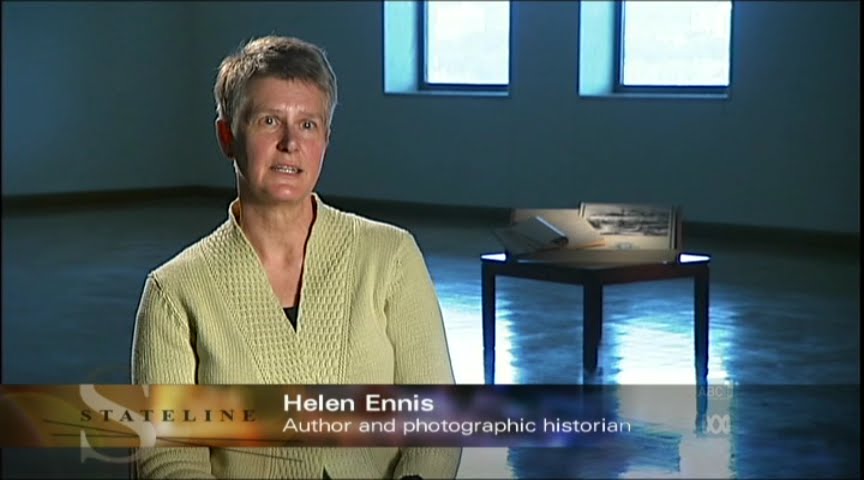
A recent example of postmodern discourse applied to Thomas Nevin's "convict portraits" was published as these statements by Helen Ennis (2007):


Helen Ennis
ABC TV snapshot 27 August 2010


Helen Ennis comments on pages 21-22:

Within the field of portraiture Australia was no exception in addressing the needs of the state. In 1874 the last remaining convicts and paupers at the Port Arthur penal settlement in Tasmania were photographed according to a set formula; each man was placed in front of a neutral background and photographed in three-quarter view. In contrast to the standard commercial portrait in which eye contact was a key component, the convict did not face the camera. His averted gaze reinforced the unequal power dynamics in the relationships between the subject and the photographer and also between the subject and the relevant authorities. These are photographs in which those photographed are assumed to have no personal or emotional investment; presumably the convicts never saw the final prints over which they had no claim.

Ennis 2007 page 21

Ennis 2007 page 22

Click on images for large view

Helen Ennis, pages 21-22 ,  
Exposures: Photography and Australia, Reaktion Books London 2007

None of these interpretative approaches has examined the context and tenor of the interpersonal relationship between the jobbing photographer (in this case, T.J. Nevin) and the prisoner who sat in front of him, and none to date has applied an empirical study of portraiture poses to the examination of these prisoner photographs. Nor indeed has any commentator attempted to contextualise the photographs with prisoner records, Treasury and Supreme Court documents, or indeed with comparisons to Nevin's other photographic portraits such as those of family members, private clientele, and public figures taken before 1880 currently held in public and private collections.

After the mid 1880's, the poses changed; the Bertillon method was introduced into prison photographic practice in Tasmania as elsewhere.

THE BERTILLON METHOD in Tasmanian prisons 1900s


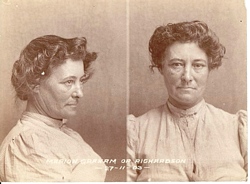
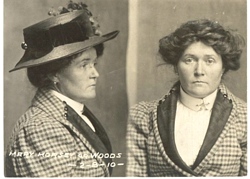
Women prisoners 1910: State Library of Tasmania eHeritage Collection

The photographs of these two women were taken in Tasmania according to the conventions of the Bertillon Method - one in profile, one full frontal. Alphonse Bertillon's system of criminal anthropometry (example below, 1888) included taking measurements of the individual which were recorded on a card accompanying the photograph:


Self-portrait: Alphonse Bertillon's measurement card, 
done according to his own system for criminal anthropometry
Date: 1888
Source: University College London, GP, 137/13


By contrast, the early examples of prisoner identification photographs taken by Thomas J. Nevin in the 1870s show a consistent pattern of the subject seated, with sightlines to either the left or right side of the frame. The final image pasted to the record was framed in an oval mount. This mid-Victorian convention of portraiture is also evident in Thomas Nevin's vignetted upper-body portraits of his own family members including himself in one self-portrait used as an ID photograph when visiting prisons and courts, and of his private clientele, including his patron and referee Attorney-General W.R. Giblin, where the subject's sightlines are diverted to lower left or right of frame. This pose was conventional; it was a commercial technique applied by Nevin to his commission for the 1870s convicts' identification photographs as well.

The pose was not the result of the social status, class and power differentials between photographer and convict, as Helen Ennis suggests (Exposures, Photography and Australia, 2007, pages 21-22), a suggestion which ignores this pattern in Nevin's technique; which assumes that Nevin was not familiar, nor even friendly, with these convicts, some of whom had travelled as Parkhurst boys with Thomas Nevin, aged 10, and his family to Tasmania in 1852 on board the Fairlie, eg. Michael Murphy; and which presupposes that at the point of capture (always dated at 1874 in the way the NLA has catalogued these as a series) , the convict was cowering under the gaze of a punitive individual such as the Commandant of the Port Arthur prison, A.H. Boyd, a furphy [erroneous story] created by Chris Long which has resulted in confusion and systemic misattribution, and has misled Ennis into publishing a statement that is coloured by such underlying misconceptions:
... In contrast to the standard commercial portrait in which eye contact was a key component, the convict did not face the camera. His averted gaze reinforced the unequal power dynamics in the relationships between the subject and the photographer and also between the subject and the relevant authorities. These are photographs in which those photographed are assumed to have no personal or emotional investment; presumably the convicts never saw the final prints over which they had no claim.[Helen Ennis, 2007:21-22]
Most of the convicts pictured in the NLA collection were photographed at criminal sittings of the Supreme Court or on SC arraignment, and many were photographed again at the point of discharge in Hobart. Why would those facing discharge be be cowering? The prisoner's "emotional investment" would have been relief at being released. And he would have seen the photograph taken of him, as the same photograph was on his record when he routinely had to report to the Town Hall Municipal Police Office as an ex-convict on release with various conditions. Prisoner photographs were also displayed to the public in the police office rogues' gallery in the event of a warrant issued for arrest. There are no facts, or substance or proof supported by original documentation behind Ennis' statements; worse, there is no understanding of the contexts in which police functioned. Instead, she gives an appraisal that is void of documentation, and full of the gaze of the late 20th century art historian.

The net effect is that these "mugshots" of Tasmanian prisoners have become "PORTRAITS" in her terms, merely aesthetic objects with a photographic misattribution to an alleged Sunday amateur suggested by propinquity alone to prisoners as A.H. Boyd was while Commandant at Port Arthur (May 1871-December 1873). Boyd had no reputation as a photographer in his lifetime, no official documents exist which associate him as a photographer of prisoners, and no works by him are extant, as the perpetrator of this "belief" about Boyd, Chris Long, now readily acknowledges. But to caress the postmodern discursive turn of power differentials into existence, these Boyd fantasists needed a man in power to conform to their thesis. Helen Ennis also advises the NLA (In a New Light exhibition 2000-3), and her influence continues to inform their absurd inclusion of Boyd's name on their Tasmanian convict photographs' full records. It's a legally questionable state of affairs which compromises the national heritage as a fictional reinvention because of a few "professional" commentators' anxieties about protecting their reputations in the face of a very obvious error.

Thomas Nevin's "convict portraits", posed and produced within conventional commercial studio portraiture techniques of the 1870s which are held at the NLA were taken in the Hobart courts, the Town Hall Police Office and the Hobart Gaol, and not at Port Arthur where sixty prisoners of the criminal class had already been transferred to Hobart by late 1872, and the remaining few by mid 1874 (tabled in the Parliament by A-G Giblin, July 1873). The NLA examples were acquired from a variety of sources, whether as government estrays donated by Dr Gunson in the 1960s, or as originals and duplicates forwarded from the Queen Victoria Museum and Art Gallery in 1982-1985. It was not until the late 1880s that the Bertillon method became standard prison photographic practice in Tasmania, by which time both Nevin brothers had ceased professional photographic practice.


Prison record of convict Williamson with carte T.J. Nevin still pasted to the parchment record, courtesy of the PCHS and State Library of Tasmania, eHeritage collection.


Michael Murphy per the Fairlie 1852, 
sentenced to 6 yrs at the Supreme Court Launceston 1871
photographed by T. J. Nevin on transfer to the Hobart Gaol 1871.


Originals taken by Nevin and copies held at the QVMAG Ref: 1985:P0120, and at the AOT, Ref: PH30/1/3217) "Tasmanian [Port Arthur] convicts photographs by Thomas Nevin" courtesy of the Archives Office of Tasmania.

EMPIRICAL RESEARCH

In this interview with Robyn Williams, Mike Nicholls puts the asymmetries of posing into historical perspective:

The expressive side of the face
Source: ABC Radio National Science Show 12 July 2008


TRANSCRIPT of interview

60% of people turn their head when asked to pose for a portrait. A prime example is that of Mona Lisa. So why does this bias exist? When people try to express emotion, they turn the left side of the face.

Mike Nicholls: Well, like most portraits, she's facing so that the left side of her face is showing more than the right side of her face. A few years ago a survey was done of portraits going from 1300 right up until now, and around about 60% of the portraits are turned so that they're featuring the left side of the face.

Robyn Williams: Why is that significant?

Mike Nicholls: I guess it's interesting, it could be either way. If you think about the face, it's pretty well symmetrical to look at, and it's interesting that this bias exists, and it makes you wonder why and whether it's the model choosing to do that or whether it's in actual fact the artist choosing to portray the left side of the face.

Robyn Williams: And what do you think, personally?

Mike Nicholls: There's a number of options. It could be to do with the handedness of the artist. Most artists are indeed right handed, but in actual fact if you look at the work made by left-handed artists you still get the same bias, and indeed if you look at photographic portraits you get the same bias. So it's not something simple to do with handedness.

Robyn Williams: Leonardo, by the way, was left-handed, wasn't he?

Mike Nicholls: Yes, that's right. So you always hear there's more left-handers amongst artists but in actual face when you look at the hard data there's not much there, most of them still are right-handed.

Robyn Williams: Tell me, what have you been doing to study this phenomenon?

Mike Nicholls: We wanted to get to the bottom of this and so actually we wanted to see if it was the artist determining the bias or whether it's the model themselves. So we had a bunch of university students sit down and we got them to pose in two ways. In one condition we said to them, 'This is a portrait, you're an important scientist and it's going to hang in the Royal Society gallery, but you don't want to look smug or proud,' so we had them trying to conceal their emotion and not show any emotion at all.

In the second condition we had people posing and in this case said to them, 'It's a portrait for your family, you want to show your love and as much emotion as you can,' so we've got an emotional condition and a non-emotional condition. We then had people pose simply for the portrait and we took their photograph. What we found was that in the non-emotional condition there was no bias, people didn't tend to turn one way or the other, but when people were trying to express their emotion they turned the left side of their face, like most portraits indeed do.

This is interesting because it ties in with the fact that females in general are more likely to turn the left side of the face when having a portrait taken than males are, and you wonder why that is. It's most probably because most females are showing more emotion, they're naturally more emotional than males, and so it most probably reflects that.

Robyn Williams: Of course Professor John Bradshaw from Monash in Ockham's Razor did describe this laterality in the face in terms even of newsreaders who were rather more significant if you watch their faces on the right-hand side when they were speaking. So you address the right-hand side to get information, and the left-hand side, as you were suggesting, is more a kind of emotional signaller. Does that make sense to you?

Mike Nicholls: I think it does boil down to what the two sides of the brain are doing. So when people are turning the left side of the face, the left side of your face is indeed controlled by the right side of your brain, and your right side of the brain is dominant for the expression of emotion. So when we smile, when we look fearful, we tend to do it slightly more strongly on the left side of the face. So it suggests that people somehow know that the left side is more emotionally expressive, and indeed they're turning that side.

And in contrast, as you were saying, while the left side might be
more important for emotional expression, the right side is more important for verbal expression. So when we're lip-reading it seems...and you can see this in newsreaders all the time, look at the right side of the mouth, it's generally the side which is moving more and that's because the right side of the mouth is controlled by the left side of the brain.

Robyn Williams: I had no idea I actually looked at a mouth except full on. I can't imagine just looking at one little part of it, but we do apparently.

Mike Nicholls: Yes, that's right. With the research I did with John we were looking at which side of the mouth people do look at, and not only do we move the right side of the mouth but when we're actually looking at someone trying to lip-read we attend to that side of their mouth more as well.

Robyn Williams: Why is this sort of thing important, do you think, this sort of study?

Mike Nicholls: I think its interesting. Symmetries are naturally interesting. We could so easily, like most other animals, be symmetrical. Most other animals are for the most part, at least in terms of the way their brain is organised, fairly symmetrical. There are exceptions too; things such as birds can have quite asymmetrical brains. But of the mammals we have the most asymmetrical brain. So I guess it gives you an insight into what it is to be human and how important it is for the brain to be asymmetrically organised in its function.

Robyn Williams: And how are you taking this next?

Mike Nicholls: We're moving on to looking at asymmetries in attention and how we pay more attention to one side of the space, and we recently were looking at collisions and finding that people collide more on one side. We over attend to the left and are more likely to collide with things on our right.

Robyn Williams: How worrying!

Mike Nicholls: Yes, it could have quite a lot of real life impact. We've been getting people to get in a wheelchair and negotiate an obstacle race and find that people do collide more to the right-hand side, and that happens whether they're walking, in a wheelchair or whatever. But it could have quite a few implications for manoeuvring ships. The Lake Illawarra, when she hit the Tasman Bridge down in Tasmania, she hit to starboard, so there could be...if you start to look at the incidence of these collisions, they may be asymmetrical.

Guests
Mike Nicholls
University of Melbourne
https://www.psych.unimelb.edu.au/people/staff/NichollsM.html


Presenter
Robyn Williams

Featured Post

Captains, emigrants and convicts: the summer of 1842-1843 in Hobart, VDL

Captain Edward GOLDSMITH on the Janet Izzat Lt. Charles HEXT on the Cape Packet PRISONERS on the Emily and Moffatt George O'BRIEN, s...