Showing posts with label Ships and Captains. Show all posts

Captain Edward Goldsmith, Captain Andrew Haig and merchant George Bilton 1840s

Voyages of merchant mariner Captain Edward GOLDSMITH to Hobart, VDL 1840s
Financial difficulties of merchant mariner Captain Andrew HAIG in Hobart, VDL 1840s
Failure of the Derwent Ship Buidling Company 1841 and agent George BILTON 1840s-50s

Captains Andrew Haig & Edward Goldsmith
The story of Andrew Haig (1793-1871) and his contemporaries deserves a wider audience and greater contextual scope, given the recent opportunities for research with the digitisation (2023) of his journals  subjoined to newspaper reports and archival documents of the day. Volumes 1 and 2 of his journals, held at the Archives Office of Tasmania, are available online at the house Andrew Haig built in Hampden Road, Battery Point, now a museum called "Narryna - The Merchant's House".

Captain Andew Haig's financial difficulties as a Hobart merchant are best appreciated in his own words. His journals paint a very unhappy picture of his downfall while doing business with the profiteering agents, merchants, bankers and ship owners who drove him to financial ruin. Although chiefly remembered these days as the owner of the house museum NARRYNA, Hampden Road. Battery Point (near Hobart) and a competent mariner and merchant with a warehouse at New Wharf (Salamanca Place) up to the 1830s, Haig was reduced to carting coal and water on a barge to ships moored in the Derwent by the mid 1840s.

Merchant mariner Captain Edward Goldsmith (1804-1869) is mentioned often in Andrew Haig's journals in relation to the failure of the Derwent Ship Building Company (DSBg,1841), together with another of its shareholders, merchant George Bilton, who was Haig's nemesis in business until Bilton's own insolvency and departure from the colony. If Andrew Haig had considered Captain Edward Goldsmith an ally in business during the late 1830s whom Bilton had swindled as well, by January 1843 he thought of him only as "a fairweather friend" who had deserted him.

The other bête noire in their relationship was banker Cornelius Driscoll (1782–1847). On 1 Oct 1840 (Volume 1) Andrew Haig was already defaulting on his loan of £1800 at 17 ½ % p.a. borrowed from Driscoll's newly formed Colonial Bank so he could fund his share in the Derwent Ship Building Co. By 2 Nov 1840, Driscoll had raised the interest to 20% p.a.

1840, Oct 1:
After trying in every way to get Money for the Co
I was obliged to submit to give (my Name α Biltons to Driscoll for other bills
(particulars as under) to 17 ½ per % for 2 years on £1800 or the Co.
could not meet its engagements : I have had no small share of
trouble α vexation with this Cos affairs for
nothing

1840, Nov 2:
Driscoll of the New Colonial Bank, is now lending
his Money @* 20 per % for 2 years. per Annum

When Captain Edward Goldsmith questioned these conditions and "an alledg’d deficiency in the Cos books about the money borrow’d from Driscoll" concerning the loans, Driscoll threatened to detain him, noted by Haig in his journal entries of 6 and 24 November 1842 (Volume 2). By December 1843, Cornelius Driscoll was forced to close the Colonial Bank. He sent George Bilton into insolvency by acquisition of the indentures on Bilton's warehouses on Hunter Street, and died in 1847, whereby his (Driscoll's) executors sold those properties at auction. Somehow, by sheer determination not to leave his family totally destitute, Andrew Haig avoided bankruptcy. The last journal entry cited here, dated 16 July 1852, shines with a renewed optimism that he can again raise a profit by repairing an abandoned boat called the "John" and once more relying on Captain Edward Goldsmith's generosity, "Take her to Goldsmiths Yard brush her up paint her αc sell her..." . No longer a fairweather friend, apparently.


Sea Chest. Teak & Brass in 2 parts with carrying handles
Property of Capt. Andrew Haig
Photo taken at "Narryna" Hampden Road, Battery Point, Tasmania 2014
Copyright © KLW NFC Imprint 2014-2025

While Andrew Haig sat at his desk (eg his sea chest in photo above) in Battery Point in the years 1834-1852 recording day by day in detail his deepening depression and despair as he faced down the impossibility of declaring insolvency to save his wife and seven children, on the other side of town across the harbour of Sullivan's cove, Captain Goldsmith was enjoying the fruits of his star status. Over two decades from the 1830s-1850s he was praised affectionately for his mariner skills in bringing well-heeled passengers and their luxury goods safely to the colony. He was honoured for his contributions to the horticultural advancement of the colony, he was celebrated by a playwright and roasted by a vaudevillian troupe on stage at the Royal Victoria Theatre as he sat in the audience, and he was given top billing when invited to fine dining at Government House with his good friend Sir John Franklin. He was also appreciated for his generosity in offering free passage back to England for those with depleted resources, raising subscriptions to aid their survival on arrival. Andrew Haig mentions the offer Captain Goldsmith made to take Mrs Haig and the children back to England when he felt he had reached the nadir of his existence in VDL (Feb 24, 1841).

Two men of social standing, Captain Goldsmith, the visiting merchant mariner with extensive land holdings in Kent (UK), and Captain Haig the reluctant colonist with diminishing assets and mounting debts: their experiences with Hobart's banking and merchant elite could not have differed more, although both suffered financial loss with the failure of the Derwent Ship Building Company [DSBg Co.] in 1841. Substantial losses over investment with Messrs Goldsmith, Bilton, Meaburn and Williamson had a lasting impact on Andrew Haig. His entanglement with one of its member shareholders in particular, merchant George Bilton, sent him and his family close to insolvency.

1833: Bilton-Rickett family arrives on the "George Hibbert"
The Bilton family of five children, two parents, one servant and a cousin, Miss Rickett, sailed from Gravesend on 4 December 1831, arriving at Hobart, Van Diemen's Land (Tasmania) on 27th April 1832 on the George Hibbert, Captain Lusk, master, 340 tons, 4 guns and 22 crew.

John Littlechild and his wife Mary (Rickett) Littlechild departed Portsmouth (UK) on 3rd March 1838 aboard the barque Wave, Captain Edward Goldsmith master, arriving at Hobart, Van Diemen's Land (Tasmania) via Cape of Good Hope (South Africa) on 17th July 1838.

Mary (Rickett) Littlechild's three sisters married three brothers in the Bilton family. Her sister Elizabeth married George Robert Bilton on 2 March, 1820 (England). He was born ca. 1797, Kent, England and died, 54 years old, on 9 September 1851 soon after arrival at San Francisco, California, USA. His first wife Mrs Elizabeth (Rickett) Bilton (b.1796-1843) died on 19 February 1843, 47 years old, at Claremont, Hobart Tasmania. In some accounts, nine children were born to George and Elizabeth Bilton, and three with his second wife Mary Halstead.

This account of one of those brothers, George Robert Bilton (1797-1851), details the consequences of his dishonest conduct in business on others, notably on the fortunes of Captain Andew Haig, and ultimately on himself and family that led to his premature death.


Left: John Littlechild (1797-1863)
Right: Mary (Rickett) Littlechild (1795-1867}, wife of John Littlechild
Photographer: Frith Bros
Location and Date: 1858 - early 1860s, 19 Murray St. Hobart, Tasmania
Provenance: Sydney Rare Books Auctions, 2019


Source: SHIP NEWS. (1833, April 30). The Colonist and Van Diemen's Land Commercial and Agricultural Advertiser (Hobart Town, Tas. : 1832 - 1834), p. 2.
Link: https://nla.gov.au/nla.news-article201158587

TRANSCRIPT
APRIL 27. - The barque George Hibbert, 340 tons, Capt. Lusk, from London 4th December, with a general cargo. - Passengers, Mr. and Mrs. Bilton and five children and servant, Miss McRae, Miss Rickett, Miss Mackton, Mr. McAkister, M. amd Mrs. Hackshall, Mr. amd Mrs. Gall, Mr. and Mrs. Sams, Messrs, Carland, Gardiner, Clark, Watchhurst, Day, Borden, Steel, Mr. amd Mrs. Milwood.

PORT OFFICER'S LOG


Mr and Mrs Bilton and 5 children, arrival from Gravesend on the George Hibbert, 23 July 1833
Link:https://libraries.tas.gov.au/Digital/MB2-39-1-1/MB2-39-1-1_1P190
Link:https://libraries.tas.gov.au/Record/NamesIndex/406394

1838: Littlechild-Rickett family arrives on the "Wave"
The pivotal years which would either save or sink Andrew Haig's fortunes were 1838-1841. Captain Edward Goldsmith arrived at Hobart, Van Diemen's Land (Tasmania) on the barque Wave on 7th July 1838 via the Cape with general cargo, 16 crew, and 17 passengers disembarking at Hobart. Among those passengers of significance to Andrew Haig's future dealings with George Bilton who was Captain Goldsmith's agent together with John James Meaburn for this arrival of the Wave were members of the Ricketts and Littlechild families, George Bilton's in-laws.

The Wave was a 343 tons vessel carrying 4 guns. The voyage from Portsmouth, departing on 30th March 1838 to arrival at Hobart took just under four months.


Port Officer's Log
Arrived in Hobart from Portsmouth barque Wave 17 July 1838
E. Goldsmith Ship's Master Wave 17 July 1838
Archives Office of Tasmania Ref: MB2/39/1/4 P100

Bent's News and Tasmanian Register reported that European settlers at Cape Town had suffered incursions from local "Caffres" - i.e. "Kaffirs" - the term now considered offensive which denoted Bantus in South Africa in the 18th century - and that food was extremely scarce when Captain Goldsmith touched there on the Wave in mid 1838 bound for Hobart, hoping to provision his crew and passengers.


TRANSCRIPT

Cape of Good Hope.
When the Wave touched at the Cape, for provisions, the greatest distress was experienced by the inhabitants. The devastating incurtion of the Caffres [sic], added to a bad season, had made every article of food extremely scarce; and of the few sheep, which the Wave obtained, more than half had died, before they were a week at sea. The Wave, however, spoke two brigs, from London, laden with wheat, and belonging to the same owner as that vessel, so that, with the expectation of a good harvest in December, and of more immediate supplies from England, there it no prospect of any advantage accruing from the exportation of wheat, or other articles of provisions from this Colony.

Source: Bent's News and Tasmanian Register (Hobart Town, Tas.), Friday 10 August 1838, page 4
Link: https://nla.gov.au/nla.news-article233325576

ARRIVAL at HOBART
Arrived in Hobart from Portsmouth on the barque The Wave 17 July 1838
Goldsmith Ship's Master Wave 17 July 1838 MB2/39/1/4 P100


TRANSCRIPT

HOBART TOWN SHIP NEWS.
ARRIVALS.
July 17 - the barque Wave, 343 tons, Goldsmith, from London 30th March, with a general cargo, - Bilton & Meaburn, agents - passengers, Mr. and Mrs. Aldridge, Mrs. and Miss Ricketts [sic], Miss Southam, Mr. and Mrs. Littlechilde, Mrs. Grubb, Messrs. Price, Barnett, Perkins, Pooke, S. and H. Littlechilde, Howe, Brown, Beale, Atkins, and F. Tolmey. The Wave called at the Cape, from which port the brigs Alice and Shernes had sailed for this colony, laden with wines &c. previous to her departure.

Source: Commercial Journal and Advertiser (Sydney, NSW ) Saturday 4 August 1838. p.2
Link; https://nla.gov.au/nla.news-article226461238

Three months later, Captain Edward Goldsmith departed Hobart for London on October 10, 1838, with seven passengers - "Captain Mackenzie and Lady, Mrs Stewart, Miss Spurling, Mr H. Archer, W. Black, Mr P. Gibbs", touching at the Falkland Islands for supplies.

He arrived in London on 12th February 1839 just in time to see his dying father, Richard Goldsmith snr and sign the codicils to his father's last will and testament. Richard Goldsmith snr died on the 19th March 1839 and was buried in the graveyard of St Mary Rotherithe, known as the Mayflower Church.

The following week, Captain Edward Goldsmith submitted a report to the Association for the Colonisation of the Falkland Islands which was formed by his friend Lt. Capt. Wm Langdon in VDL and others who were urging the British government to establish a naval base and penal colony on the islands. His letter confirming the views of Association was published in the Colonial Gazette of the 6th April (and the Sydney Gazette, 27 July) , stating from his point of view the obvious need of a supply depot midway en route to the Australian colonies:
I cannot imagine how our Government could, for so long a time, have overlooked so valuable and important a place not only as a naval depot, but as a Colony and resort for our numberless merchantmen requiring supplies in that quarter....
Source: The Sydney Gazette and New South Wales Advertiser (NSW : 1803 - 1842) Saturday 27 July 1839 p 2
Article ADVANCE AUSTRALIA SYDNEY GAZETTE.
Link: https://nla.gov.au/nla.news-article2544465

1839: The Derwent Ship Building Co.
By September 25, 1839 Captain Goldsmith was once again back in Hobart in command of the Wave, (AOT ref. MB2/39/1/4 P351). Within weeks of arrival he formed the Derwent Ship Building Company with Messrs Bilton, Haig, Meaburn and Williamson and purchased the land on offer at Secheron Bay with intentions of constructing a patent slip.

Messrs Bilton and Meaburn were shipping agents; Captain Haig had completed a warehouse on his river frontage in 1834, with plans for extension, and shipwright William Williamson had tendered for the construction of a dry dock. They purchased the private strip of land adjoining the stone wall boundary of the Secheron estate which included a house and premises, originally in the ownership of Henry W. Mortimer, butcher and gunsmith. William Williamson's tender was successful. He went ahead with the building of three wooden cargo schooners there between 1837-1839.

TRANSCRIPT
LAND.-The property of Mr H. W. Mortimer, sold on Wednesday last by Mr W.T. Macmichael, realized the following prices, viz.-an allotment fronting the Derwent, 115 feet, £5 5s per foot, £903 12s do do. 115 feet, £9 10s, £1092 10s; and the dwelling house and premises, £625.-Messrs Bilton & Meaburn, and Captain Goldsmith of the Wave were purchasers, and we have been informed it is their intention to lay down a patent slip, which Captain Goldsmith will bring with him next voyage.

Source: Southern Australian (Adelaide, SA : 1838 - 1844) Wed 6 Nov 1839 Page 3
V. D. LAND EXTRACTS
Link: https://nla.gov.au/nla.news-article71685631

TRANSCRIPT
SHIP BUILDING. - A Ship Building Company, composed of Messrs. Bilton, Goldsmith, Haig, Meaburn, and Williamson, are just about to commence, on the ground lately purchased from Mr. Mortimer, where an extensive and well sheltered building yard, and patent slip, are to be erected; an enterprise very much required, and deserving of encouragement. The parties are all gentlemen of practical knowledge, a qualification very much calculated to give general satisfaction, and to ensure success, for the attainment of which they have our best wishes.

Source: Classified Advertising. (1841, March 5). The Courier (Hobart, Tas.), p. 3.
Link: https://nla.gov.au/nla.news-article2956876

1841: The Derwent Ship Building [DSBg] Company disbanded
George Bilton acted as proxy for John James Meaburn in the dissolution of the enterprise "The Derwent Ship Building Company” dated March 3rd, 1841, witnessed by Captain Goldsmith’s neighbour in Davey St. Hobart, Robert Pitcairn.


TRANSCRIPT
NOTICE.- The Copartnership hitherto carried on by the undersigned, under the style or firm of "The Derwent Ship Building Company, " has been dissolved as on this date.

George Bilton
for John James Meaburn
Andrew Haig
E. Goldsmith
Wm. Williamson
Witness- Robert Pitcairn
Hobart Town, March 3. [1841]
Source: Classified Advertising. (1841, March 5). The Courier (Hobart, Tas. : 1840 - 1859), p. 3.
Link: https://nla.gov.au/nla.news-article2956876

Captain Andrew Haig's investment in the short-lived enterprise "The Derwent Ship Building Company" with shareholders Captain Edward Goldsmith, agents John James Meaburn, George Bilton, and ship builder William Williamson rendered Haig and his family close to destitution. The last mention of Captain Goldmith in Volume I of Haig's Journals refers to the dissolution of the DSBg Co., his (Goldsmith's) resources depleted - "without either the Ship or funds". The ship he invested a third share in with Goldsmith and Meaburn was the Louisa, at a cost of £1525 (August 31, 1838. Vol. 1, p.80). With each year following this loss, George Bilton's double-dealing in particular sabotaged any successes Andrew Haig might have gained in profiting from the resale of merchants' cargo unloaded and assigned at New Wharf from Haig's own warehouse.

The Journals of Captain Andrew Haig
Captain Andrew Haig mentions Captain Edward Goldsmith by name as well Goldsmith's ships commanded from London - the Wave and the Janet Izat - in these two volumes. In VOLUME 1: 1834-1840 there are 11 mentions and in VOLUME 2: 1841-43 and 1852 there are 19 mentions.


Narryna Heritage Museum, Hampden Rd Battery Point
Photo copyright © KLW NFC Imprint 2016

Volume 1: 1834-1840
Source:https://static1.squarespace.com/static/5bb5800251f4d4e80c0eb197/t/67b00c68cdc9b1250fdf1f50/1739590777548/Haig+Volume+1+-1834-40.pdf

There are TWO sets of entries extracted here, taken from in Volume 1: 1834-1840 which are not sequential. Set A summarizes events in relation to Cpt Goldsmith, with a selection in his own words regarding George Bilton. Set B are extracts in Haig's own words. There are 4 mentions of Cpt  Goldsmith by name in this volume, with an additional 7 mentions of his ship the Wave. Six extracts of the 33 mentions of Bilton allude here to his shrewdness in buying up all the tobacco, sugar, pork and selling at a profit, and corruption in knowing in advance the Government's wants.

ABBREVIATIONS
This abbreviation is frequently used : @ : to mean 'at'; also 'to'
Symbols used include α (and) , αc (etc), ye, ye (the) and ſ: the long-s,
The DSBg Co is The Derwent Ship Building Company.

VOLUME 1, SET A:
There are 11 mentions of Cpt Goldsmith and the Wave

Page 18:
1835, 8 March: Wave arrived

Page 80:
1838, 31 Aug Bought the Louisa in 1/3rds with Cap Goldsmith α Mr Meaburn £ 1525 α gave them for their
bargain £70 apiece _140_
1665 £
Terms 15 per % down the remainder @ 3 and
6 Mo with Bank Interest.
Put my Name down for 20 Shares in y
e New Marine Insce Co
Enlarging the Cottage with a view to have the
Children back from School and in treaty with Luckman
for a plot more of Ground.
No Letters by the late arrivals from my uncle
the Nautilus Female Prison Ship having arrived
direct

Page 154:
1839, 26 Sept: Wave letters

Page 155-6:
1839, 19 Oct Yesterday despatch'd the Indemnity for So Australia
having arrived the day before : No alternative owing
to the Glut of Grain in ye Market —
Shipping the first of our Oil on ye Wave @ 5/5
α 5 per %
Having taken a Share in ye
Ship building Co
making arrangements accordingly. G Bilton
Goldsmith
Meaburn
A Haig
W Williamson

The Market for every thing may now soon be
expected to fall rapidly for every thing
All kinds of Naval Stores are still very hig
Oct: shipping oil on Wave

1839, 18 Oct. HUNTS [?] per Wave

Page 184:
1840, 24 Oct: letter announcing arrival ofWave

Page 188:
1840,Dec 6
I am convinc'd there is now afavorable opening for an
establishment @ N Zealand
and should like much to go down with the Sidmouth to
see what could be done, but I fear I cannot
owing to the posture of my affairs α the
engagements under to ye DSB Co which I fear
must be dissolved : Goldsmith has come out
without either the Ship or funds

Page 190:
1840, 29 Nov: Wave arrived from London

There are 33 mentions of George Bilton

Page 39:
1835, Nov 21
Bilton has again bought all the Pork by
the Eldon as well as the Butter, Double rose Cork, and Dunbars Pork

Page 145:
1836, 3 Feb:
I am certainly what they call in this place a fool
I had only a sufficiency of Sugar to sell myself
I might then have made enquiries before I let
Bilton have it .
Wheat it is said is now up to 10/ a bushel
Memo
The fluctuations in this Market.
Query : I wanted Money : I made £20 of it
α Bilton made £50.

Page 176:
1840, 25 May: No Money. Bilton declines coming into
business again. What to do I know not.
[Bilton not wanting to deal with Haig, has no money now]

Page 185:
1840, Oct, 25:
No Sales can be effected here now. I have no
money to get on with α must in all probability
sell off and get out of business, if not ruined
entirely. I am now without a sop of ready money
for Current expenses

The trouble α Chagrin with the above, and this
Building Co of Biltons Manoeuvring, has brot on a fit of the Gout
which I first felt in
my left Great Toe joint on Tuesday last the
day after we got into the House. I am now getting better:
Jacobs Birth day having
completed his fourth year

Page 193:

1840, Dec: [large debts owing to Bilton and the bank]
This last Week : The Clarence was sold to Kelly
for £250. 340£ We had an idea of buying her for
the Co but our affairs being at a Stand still
for want of Money, we shall be under the
necessity of dissolving it. We are now
without a penny to go on with α cannot sell
either Ships or Ground

This last Fortnight has been the hottest we have
yet experienc’d in 6 y
rs α the drought very destructive
to Wheat Potatoes Vegetables α fruit
Wheat in consequence is again up to 10/ α the flour
from Rio that was sold @ 25/ is now @ 35/ brl
a month since

VOLUME 1, SET B:
By 1840 Haig realizes his lost investment in the Derwent Ship Building Company is leading him to a  financial ruin, and it is affecting his health (eg gout).

Page 80:
1838 Augst 31
29th At Noon arrived the Adelaide, having been
nearly two Months on this trip and bringing nothing
back
The Hulk Duke of York sold for £25 and
the Govt Schooner new α Copper'd about 15 Tons
fetch'd 207£
Bought the Louisa in 1/3rds with Cap Goldsmith
α Mr Meaburn
£ 1525 α gave them for their
bargain £70 apiece _140_
1665 £
Terms 15 per % down the remainder @ 3 and
6 Mo with Bank Interest.
Put my Name down for 20 Shares in ye New Marine Insce Co
Enlarging the Cottage with a view to have the
Children back from School and in treaty with Luckman
for a plot more of Ground.
No Letters by the late arrivals from my uncle
the Nautilus Female Prison Ship having arrived
direct.
As I am resolved to make my uncle remittances in
some way or other, I may now probably lay on the
Louisa for London and the Brougham for Port
Philip, Keeping the latter and Adelaide as Colonial
Traders, α ye Louisa a regular Trader for London
once a Year, To do this if I cannot effect Sales
I must Mortgage.
I have now commenc'd launching out with
a view to pay my Uncle finish my house and
probably retire from business : Query Plan
of operations

Page 125:
1838
Augst 6th
The place is now being inundated with Oil
Butts which are down to 4£ per Old
Tun and New Ones can be made
here of very superior quality @ 85/–-
Last Year about this time Oil Casks sold as high
as £15 a Ton : now the Market is glutted and I
can buy good Casks in Shooks --- @ 60/ old Tun
or 65 -- 6 Mo credit renewing the bills.

15th Cap Sn promised to lend me £2000
on Mortgage for 2 or 3 years @ 12 ½
per %
I must take it to satisfy my Uncle
by sending home money. ( See Letter of his
Per Wilmot

27 This day agreed with Kelly and Hewitt
for 100 Tuns Black Merchantable Oil
α decided on sending the Brougham home
as a remittance

31st
Bought the Louisa for
£1525 in Co with
Meaburn α Goldsmith α gave them 140
£1665

Sep 10th
There are two China Ships in the Port
just now and Tea is down to £4
Sugar about £25 —
Hambro' Pork has been tender'd to ye Govt @
4d a lb that is £3. 6. 8 per brl

On the Jury for a Week
Page 155:
1839 Octr 2nd
Receiv’d the Rent from Paterson due 29th
always unwilling to pay. Grumbling and
threatens not to pay until 30 days next time.
Nos veremos

8th
Rice fine Patna is now down to 3d a lb retail
α 30/ by the Bag
See arrivals of the Indus from Bombay Wheat α Rice
Marian Watson – Rice – Sydney
Galliardon Calcutta, Wheat Sugar
α Rice
And the Indemnity from Sydney – 380 Tons of
Rice —
By the arrival of the Bolina @ Launceston
a/c Sales of Oil per Brougham have arrived, but
no communication to me.

19
Yesterday despatch'd the Indemnity for So Australia
having arrived the day before : No alternative owing
to the Glut of Grain in ye Market —
Shipping the first of our Oil on ye Wave @ 5/5
α 5 per %
Having taken a Share in ye Ship building Co
making arrangements accordingly.
G Bilton
Goldsmith
Meaburn
A Haig
W Williamson
The Market for every thing may now soon be
expected to fall rapidly for every thing
All kinds of Naval Stores are still very high

Page 192:
1840
Sunday
Decr
Tuesday 8th
equal to
28/6 brl
6 continued. I am convinc'd there is now a
favorable opening for an establishment @ N Zealand
and should like much to go down with the Sidmouth to
see what could be done, but I fear I cannot
owing to the posture of my affairs α the
engagements under to ye DSB Co which I fear
must be dissolved : Goldsmith has come out
without either the Ship or funds —
Since Saturday the Wr has been excessively hot
People getting in their Hay : I bought some
flour on Saturday of ye Yankee @ 30/brl offg
5 per % for Cash : α flour of DeGraves @ £18 but
in consequence of this heat ! it cannot now be had
at that price.
I have determined on sending the Sidmth to N Zealand
and have arranged with Cap Swanston to bring up
emigrants.
9th Cap S ___ to relieve me proposes to take a Mortgage
on my property for £5000 for no particular period
@ 12 ½ per % ! but in the shape of a Cash Credit
I having submitted to him a Statement of my
affairs.
I have no money to carry on business
α get out of it I must : The Bandicoot
α Water Witch have arrived from So Australia
but no remittances . I must also get out
of this DSBg Co for we cannot get our
bills discounted one upon the other
although quite unconnected with that concern
The Emigrants are coming up here from
New Zealand.

Volume 2: 1841-43 and 1852
Source:https://static1.squarespace.com/static/5bb5800251f4d4e80c0eb197/t/67b00c9d29ab1059a05817fc/1739590835395/Haig+Volume+2+-+1841-43+and+1852.pdf

Virtual Hobart 1828 Hunter St

Above: Virtual reality imagining George Bilton's properties on Hunter Island, Hobart Town, Van Diemen's Land 1828, 3D models, 360 degrees
Hobart Town in Virtual Reality, https://www.virtualhobart-town.com.au/app-1
John Stephenson, Digital Heritage Studio

Andrew Haig mentions Captain Edward Goldsmith 19 times by name in Vol. 2, each voicing greater reliance on the financial support he sought as he faced destitution. He perceives George Bilton to be a ruthless dealer in these highly complex economic arrangements, mentioned more than 70 times in the second volume.

Page 11:
1841 January 18th
It is really distressing to witness the want
of Money, Scarcely any body in common
circumstances can pay their way. Insolvencies
every day : One is worried to Death
for every small Sum that may be owing
Avoid an accumulation of small
bills at this Season (Xmas) in
future if possible.
No offers yet for any of my Landed
property as advertised
Ready money would now purchase an
estate for half its value.
Goldsmith even by having some can
discount good bills @ 15 per % which
if not due before he starts he can leave
put in the Bank for collection
Who could stand against this sudden
recal of support by the withdrawal of
all the Capital with worse than no
notice ; being run to the expense of an
establishment for such consignments
as the Whaler αc αc. αc.
P.M. Arrd the Truganina fr Pt Philip
The Eamont still discharging Coals
and making water.
Boyd and all of them coming
back : Wood down to 14/ there: no money
no remittances : Rumours that Garratt
α Fisher have fail’d ; if my Drafts on
them come back protected God Knows
what we shall do
Much trouble to raise the wind for the Co
Rumours about Hewitt α Warham being
hard up α that I am giving up business

Page 16:
1841
Feby
24
11 AM 25 x Goldsmith wish’d
her [Mrs Haig] to go with him
Cap Swanston Mr Kerr α about 8 others of the
Creditors have sign’d the General trust deed
the rest were call’d upon, but were absent.
I believe it is proposed that I should wind
up or rather assist in winding up the concern
I got Dr Learmonth α Mr Sloane to speak
a good word for me to Captain Swanston
Result not yet known think of writing to
Sir Jno
Mr Sloane call’d α said Cap Swanston had
no objection to my going into the Cottage
so long as the rent or interest of the Mortgage
56£ a year was paid α that he thought the
Trustees would not object inasmuch
as it was likely it would not for some
time sell for more than the Mortgage
£500. 0. 0
Excepting Lowes I have met with
Kindness α sympathy from almost
every body. He wants to do us out
of the Transfers Cargo, in which event
I shall lose a friend in Mr Spark
God preserve us from these Ground Sharks
XMrs Haig will not hear of going home
or sending the 4 eldest Girls –
So I cannot go to Sea at least on a long
Voyage α leave them here

26 Declined going into the Cottage for fear
of the Creditors thinking I was removing
clandestinely
De Graves declines signing the Trust Deed
at least until he has seen all the papers
and accounts.

Saty 27 Nothing particular done, a few Names got to the
Trust deed

Sundy 28th Miserable in the extreme. G.B in town

Page 17
Monday
1841
March 1st
Went down again to the Store ; Bilton overlg
the Cos accounts.
Waited on Cap Swanston submitting to him a
proposal of compounding which he declined
G.B. wishes me to put myself in the hands
of the Auction Co
All I have yet seen sympathize with me.
Stokell they say is gone α half the Town is
ruined
I am now even more bewilder’d than
ever, I fear insolvency will be the result
after all and then my friends at home
will get nothing ; if this property is sold
subject to the Mortgage.
All my misfortunes have come upon me at
once.

2nd Having asked Cap Swanston’s opinion as
to compounding with my Creditors @ 10/
I went to the Auction Co who will
undertake to pay my Colonial Creditors
the above Sum in my putting all my
property in their Hands, Goods Ships
Houses α Lands, reserving the Hampden
Road Property, my private Traps
α Debts @ Adelaide α P
t Philip and
a few odds α ends to get on with
Lowes will not give up the proceeds
of the Transfers Cargo

3 rd
This day agreed at a meeting at
Pitcairns to dissolve the DSBg Co
My loss 550
Goldsmiths 700 α a bonus to G B of £500
W Wm
600
1850
G. Bilton undertaking to receive α pay
every thing
The Lord Sidmouth laid up
1841
March 6th
Wrote to Cap Parke advising him of the
Box stating my difficulties α enclosing
an Essex £5 Note to pay Charges
Cap Goldsmith promising to deliver the same
to him.
Said I wish’d to God my family were at home
for what would become of us in this dredful
Country α that I feard I should not
easily recover the Shock I had receiv’d
I was grossly abused this day by Cap Munro
of the Transfer whose mind has been
poison’d against me ; He acknowledg’d
that it had previous to his arrival
He said that some of the Sugar had been
sold @ 20£ a Ton since he came here
It was but only the broken α rejected
bags, the purchaser of the Lot refusing to
receive them. Very like Volum
If I do not compound with my creditors
now Cap Goldsmith will be detain’d
α the Biltons Co α self done up immedly
after all I see no hope of escaping
insolvency
: for I shall remain under a Cloud
as to Lowes
Spark
Milward α the So Australian
Bill α home creditors.
α lastly from the People at home –
Mean time all my ready money will be
fritter’d away, but we save something by
remaining in the House where all our traps α provisions are.

COMMENT: The issue in these entries is the fallout from Haig's investment in the failure of the short-lived Derwent Ship Building Company (DSBb Co) 1839 -1841 with Meaburn, Bilton, Goldsmith and Williamson all losing money: Goldsmith lost 700 and 500, Haig lost 600, Bilton and Williamson 600 and 1850.

Captain Goldsmith is mentioned by name 19 times
Cpt Goldsmith's ships the Wave and Janet Izat are mentioned 7 times:
1841, 14 March sailed the Wave
1842, 30 October arrived Janet Izat
1843, Dec 19 arrived Janet Izat

George Bilton and his brother John Bilton are mentioned 73 times:

Page 17:
1841, 3 March:
This day agreed at a meeting at
Pitcairns to dissolve the DSBg Co
My loss 550
Goldsmiths 700 α a bonus to G B of £500
W Wm 600 1850
G. Bilton undertaking to receive α pay
every thing

Page 21:
1841, 14 March
Goldsmith sailed on the Wave
Much ill feeling
between Goldsmith α Bilton ; the
former saying he was swindled

Page 14:
1842, 6 Nov:
Goldsmith arrived on Janet Izat
This last Week Goldsmith
has arrived in the Janet Iz
but there are no Letters from
anybody for us
Driscoll has threatend him

Mrs Haig has seen Lady Franklin and was favorably receiv’d
The Coal business is nearly done
Goldsmith has never call’d upon us
Nothing further yet from
Bilton Driscoll.

Page 132:
1842, July 2:
G. Bilton insolvent ; Receiv’d
notice from Driscoll of dishonour
of our acceptances for interest of money
Jas Murdock spoken of

Page 148:
1842, Nov 24:
On the 17th I receiv’d a Summons from Driscoll
about the 1800£ bill of the Co α interest
Bilton has played a deep Game α by some
means has got Pitcairn on his side
He sold the Spars just previous to his failure
Sinclair Williamson has poison'd Goldsmiths mind as to an alledg’d deficiency in the
Cos books about the money borrow’d from
Driscoll ; this arose with Pitcairn and
I daresay it will turn out that Blackguard Williamson had a hand in it.

Page 153:
1843, 22 Jan:
Cap Goldsmith spoke to Chapman in my favour re - re-questing him to continue me as Lloyds Surveyor, he declines doing so I may therefore give up all hopes
of retaining that birth owing to my misfortunes which continue to accumulate.

Goldsmith, Headly, McPherson, and all our Fairweather friends, have deserted us. Not one of them have paid us a Visit.

Page 153:
Goldsmith sailed 25 March 1843

Page 220:
1852, 16 July:
Goldsmith's yard to refurbish a boat called the John
If the Master leaves her to me Why should I not engage him or anybody else I can get hold of, take in all the Casks and Gear bot at Launceston and every thing belonging to her and proceed to Hobn with her
Accept the abandonment pay the Amount in ye Policy
Take her to Goldsmiths Yard brush her up paint her αc sell her on a/c of the Insurers or put her by Auction and let her go for what she would fetch without repair "Supposing she is got off α patch'd up here"
If repair'd at our expense it could be done for materials and Stores at least full 25 per % less at Hobart Town than Launceston. Ballast with fire Wood Pebbles Casks fill'd αc.

Source: The colonial journals of Captain Andrew Haig : master mariner and merchant of Hobart Town, Van Diemen's Land.
Title of Volumes: The Colonial Journals of Captain Andrew Haig
Volume 1 1834-1840
Volume 2 1841 – 1843 & July 1852
Author/Creator: Haig, Andrew, Captain, 1793-1871, author.
Publication: Battery Point, TAS : Narryna Heritage Museum Inc., [2023]
Copyright notice date: © 2023
Physical description: 2 volumes (211 ; 231 pages) : illustrations, portrait ; 30 cm.

Two additional scripts:
REMARKS OCCURRENCES &C &C HOBART TOWN 1841 – 1843
The Haig family’s female convict servants Part 3
Link: https://www.narryna.com.au/journals-of-captain-andrew-haig

Notes from the Project's transcribers:-

Page 3:
"Captain Andrew Haig (1793 – 1871) lived in Hobart with his family from January 1835 until he died at home in Cromwell Street, Battery Point. Haig’s journals, also referred to as Memorandum Books, shine a light on some of the challenges inherent in global and inter-colonial trade in the nineteenth century. They include critiques of the activities of some of the colony’s power brokers – especially bankers, merchants and shipping agents."

Page 6:
"Captain Haig manages to find fault with almost everyone he deals with – his uncle Jacob in England who has no patience and no appreciation for how Haig is ‘slaving' to make his business a success; the local merchants – these ‘sharp rascals’ who ‘pretend friendship but do not hesitate to take me in’, a solicitor who practises ‘humbug and roguery’; his employees and the captains and crew members of his ships who are stupid, useless, drunk or trying to cheat him in some way; and of course bankers, especially those associated with the Derwent Bank (Charles Swanston et al) – ‘a proud set of greedy mean Scotchmen’."

Copyright © Narryna 2023
Link: https://www.narryna.com.au/journals-of-captain-andrew-haig
Published by Narryna Heritage Museum Inc., 103 Hampden Rd, Battery Point TAS 7004

1840s-1850s: George Bilton's grant on Hunter St.
This simplified map dated 1840 shows the line of buildings along Hunter Street at top left.George Bilton's two grants were 19 pers and 29 pers.


Map - Hobart 19 - Sullivans Cove and part of Hobart Town
Item Number: AF394/1/171
Further Description:90421
Start Date: 01 Nov 1840 End Date: 30 Nov 1840
Creating Agency: Lands and Surveys Department (TA69) 01 Jan 1804 23 Dec 1970
Series: Hobart Maps (AF394) 01 Jan 1800 31 Dec 1959
View online: https://stors.tas.gov.au/AF394-1-171

Callouts:
The two red arrows upper right on this map (below) of the Hobart docks at Sullivan's Cove indicate the two grants to George Bilton on Hunter Street.
The lower red arrow points to notes regarding the "Kangaroo" ferry wharf where Captain Edward Goldsmith wanted to build a patent slip in the 1840s. He built the "Kangaroo" instead at his slipyard on the Queen's Domain in 1854, handing over the lease to the McGregor brothers on his permanent departure in 1855.

Askin Morrison took over the operations of the "Kangaroo" ferry from Captain Goldsmith in 1857, underwritten by the colonial government.

In 1862 Captain James Taylor purchased the "Kangaroo" and sought a subsidy under contract to maintain its operations, which he managed over the next four decades, selling it to the O'May Bros in 1903. He paid the Marine Board a nominal rent in 1864 to use the former coal yard while the "Kangaroo" ran a ferry service, according to the note indicated here.


Detail of map below callouts:
Hunter Street: Two grants to George Bilton 19 pers and 29 pers [1 perch = 5.03 metres]
Commissariat wharf:

"The small building at C. and the plot of ground at D (used as a Coal Yard) now in the occupation of the proprietor of the ferry boat 'Kangaroo' handed over to the custody of the Marine Board; to remain however as at present occupied, at a nominal rent so long as the Steamer runs as a Ferry boat. CT's app.1 21 Ocr. 1864, on Master Wardens apptn of the 7th."


Map - Hobart 92 - Plan of Sullivans Cove, Hobart, showing Hunter Street Wharf, Franklin and Market Wharfs, Constitution Dock and surrounding streets
Item Number: AF394/1/93
Archives Office of Tasmania
View online: https://stors.tas.gov.au/AF394-1-93

These 3D virtual images approximate the location of George Bilton's grant and warehouses on Hunter Island, known also as the Old Wharf.


Hunter Island, Hobart Town, Van Diemen's Land 1828, 3D models, 360 degrees
Hobart Town in Virtual Reality, https://www.virtualhobart-town.com.au/app-1
John Stephenson, Digital Heritage Studio

1843: Death of Elizabeth Bilton


Death from "Lingering Disease" of Elizabeth Bilton, 47 yrs old, wife of George Bilton, 12 February 1843, Hobart, Tasmania
Archives Office of Tasmania
Link: https://libraries.tas.gov.au/Record/NamesIndex/1185244

1850: Auction of George Bilton's properties at Hunter Street by executors of Cornelius Driscoll's estate.
Founding director of the Colonial Bank in 1840, Cornelius Driscoll (1782–1847) was forced to close the bank in December 1843 through internal dissesion of its shareholders. Andrew Haig wrote in his journal entry dated 6 November 1842 that Driscoll had threatened Captain Edward Goldsmith who had accused Driscoll of shortfalls and other irregularities in the loans to establish the failed Derwent Ship Building Co. He summoned shareholders Haig and Bilton for defaulting repayment to the bank, sending Bilton bankrupt. Driscoll took over the indentures on Bilton's properties at Hunter Street as a consequence; his (Driscoll's) executors on his death sought their sale in 1850 as decribed in the following notice of auction:

George Bilton's insolvency and auction of properties, November 1850:
INSOLVENCY DEBTS
INSOLVENCY CASES
For hearing before Edward Macdowell, Esq., the Commissioner of Insolvent Estates.
THURSDAY, 18th APRIL.
George Bilton, adjourned special meeting for proof of debts.

Source: Courier (Hobart, Tas.), Wednesday 17 April 1850, page 2


TRANSCRIPT

SALES BY AUCTION.
PURSUANT to the proviso for that purpose contained in an indenture oí mortgage bearing date the 24th day of July in the year 1843 and registered the 7th day of August in the same year and made or expressed to be made between Andrew Crombie therein described as of Hobart Town in Van Diemen's Land solicitor and Joseph Gellibrand Jennings therein also described as of the same place banker of the first part George Bilton therein also described as of the same place merchant of the second part Robert Kerr therein also described as of the same place merchant (permanent assignee of the insolvent estate and effects of the said George Bilton) of the third part John James Meaburn therein also described, as of Hobart Town aforesaid merchant of the fourth part and Cornelius Driscoll therein also described as of Hobart Town aforesaid banker of the fifth part. Notice is hereby given that default having been made in payment of the principal and interest moneys secured by the said indenture it is the intention of the executors under the will of the said Cornelius Driscoll to SELL by PUBLIC AUCTION the land and hereditaments thereby mortgaged and which land thus intended to be sold is described in the said indenture as follows (that is to say):

"ALL that ALLOTMENT or PIECE of LAND situate and being in Hobart Town aforesaid, containing twenty-nine perches or thereabouts, and bounded on the South-West by sixty links and one half link along Hunter Street, on the North-West by three hundred, links along another allotment now or heretofore occupied by or belonging to the said George Bilton, on the North-East by a South-Easterly line, and on the South-East by a South-westerly line of three hundred and twenty links extending to Hunter Street aforesaid, together with all buildings thereon erected."

And notice is hereby given that such sale will be effected by Messrs. HAY & IVEY of Hobart Town aforesaid Auctioneer on TUESDAY the fourteenth day of January next ensuing at their sale rooms situate in Elizabeth-street in Hobart Town aforesaid at two of the clock in the afternoon of that day - Dated this eleventh day of November 1850.

WM. Geo. HARRIS, Of Stone Buildings, Attorney for the Executors of the said Cornelius Driscoll. 2700

Source: Classified Advertising (1850, November 13). The Courier (Hobart, Tas.), p. 3.
Link: https://nla.gov.au/nla.news-article2961822


Title:Stoney, H. Butler & Wood, A & Smith, Elder, and Co. (1856). Old Wharf, Hobarton
National Library of Australia
Link: https://nla.gov.au/nla.obj-135883974

1850: George Bilton and son Thomas Haig Bilton to San Francisco
George Bilton voyaged to San Francisco with his son Thomas Haig Bilton in 1850. On his father's death within a year of arrival, Thomas Haig Bilton went to the Californian goldfields, then Washington and Virginia before settling in the Riverina district of NSW. In this letter to the Editor published in the Hobart Mercury, 3 June 1921, Thomas Haig Bilton reminisced:


Source: OLD TIMES (1921, June 3). The Mercury (Hobart, Tas. : 1860 - 1954), p. 8.
Link: https://nla.gov.au/nla.news-article23516353

TRANSCRIPT
OLD TIMES To the Editor of "The Mercury."
Sir, - Please allow me to correct an error as to our united ages, not individually mentioned in the report of the laying of the Soldiers' Memorial foundation stone at Sorell. Mr. Crocker and I are each 86 this year, born in 1835, I in June, he in November. Mrs. Reardon is 89 years old, but there are two older members of our family both over 90. I was born at Beaulieu House, corner of New Town and Augusta-road, subsequently the residence of John Swan and H. R. Brent, and have a keen recollection of everything since I was five years old. My uncle, Henry Bilton, of Claremont House, came out first, and being an importer, lived at Rock House, which I well remember. The steeple of St. George's Church was partly built and finished in my time. T. D. Jennings had a cooperage at the corner of Liverpool street. Crisps had a timber yard opposite Hofwyl House; James Bouwrick's school, where I was. My father had a store on the old wharf, and afterwards on the new, near Aiken, Morrison, Ker, Bogle, and Co. We went to San Francisco in 1850, when I went to the goldfields. Altogether I was four years in Washington and Virginia, California, City Mountain, and twenty years engaged in pastoral pursuits in the Riverina. Richard Leven and Sons had their drapery establishment at the corner below "The Mercury" office, subsequently the original Hutchins School, where I was a scholar under the Rev. J. R. Buckland.
- Yours, etc.,
THOMAS HAIG BILTON. Sorell.

Source: OLD TIMES (1921, June 3). The Mercury (Hobart, Tas. : 1860 - 1954), p. 8.
Link: https://nla.gov.au/nla.news-article23516353

Addenda:

1. Bill of exchange made out to Cornelius Driscoll
Van Diemen’s Land Commissariat Office Bill (Third) of Exchange 1842
To C (Cornelius) Driscoll for One Hundred Pounds


Source: Sterling and Currency
This bill was issued at a time of monetary upheaval in Van Diemen's Land. Bills of exchange are of interest to collectors as they one of the few forms of “circulating” paper currency from Australia’s colonial days that remain readily available. Such notes were largely used in commercial transactions between merchants, and as such vary quite widely according to:
  • The date they were issued;
  • Where they were issued;
  • Their value; as well as
  • The merchants and government officials who were involved.
This particular third of exchange was made out to Cornelius Driscoll, who at the time was "...a founding director and first manager of the Colonial Bank. It started at a time of great financial difficulty and although Driscoll won a small share of the government account, the bank was forced to close in December 1843 through the internal dissension of its shareholders. Contrary to general expectation nearly all the subscribed capital was realized and Driscoll obtained the confidence of the public for his integrity and ability. In January 1845 he became an original trustee of the Hobart Savings Bank."The endorsement by Driscoll on the back of the bill clearly shows that these bills of exchange were not just records of specific transactions between wealthy members of the colony at that time, but also acted as a medium of exchange.

2. Captain Andrew Haig: a history as told in the 1950s.
Former Honorary Adviser in Australian Bibliography to the State Library of Tasmania, W.E.L.H. Crowther, presented an account to the Royal Society of Tasmania in 1971 of Captain Andrew Haig's worries and woes in Hobart during the years 1835-1844. Crowther drew liberally from a press article written by Amy Rowntree in 1957 (Saturday Evening Mercury Jan. 12, 1957 p.4.).

MISCELLANEOUS VOYAGES - INTERCOLONIAL AND ON THE HIGH SEAS, ESPECIALLY FOR WHALES by W.E.L.H. Crowther, F.R.A.C.P.
Papers and Proceedings of the Royal Society of Tasmania, Volume 107.

TRANSCRIPT
Section V: Captain Andrew HAIG (1793-1871)
TRADING AND EXPLORING FROM INDIA TO THE WESTERN COAST OF N. AMERICA AND VAN DIEMEN'S LAND. 1816-1870.

INTRODUCTION
For this outline of Capt. Andrew Haig in Hobart Town, the writer has drawn heavily on an account of his career in Tasmania by Miss Amy Rowntree (Saturday Evening Mercury Jan. 12, 1957 p.4).

In the period 1835-1838 Haig had built the freestone fronted house in Hampden Road, later called "Narryna" and now the Van Diemen's Land, Memorial Folk Museum [sic - i.e. in 1955]. In June 1824 Haig, then a merchant and ship owner at Calcutta, had, on a trading voyage by the brig Snipe to the west coast of S. America, touched at Hobart Town. He stayed only a few days but was apparently attracted by the prospects of the little settlement, and purchased the allotment on which "Narryna" was later built. He also acquired part of Cottage Green (Knopwood's Estate). This area, plus the allotment, carried his land down to the new wharf frontage, where in the late 'thirties his warehouse was built. The fine two-storey, freestone-fronted building, now 103 Hampden Road, is still in good preservation ....

Period 1834-1837. Volumes IV and VB

Volume IV commences as a journal of the voyage of the Sir John Rae Reid, Andrew Haig, Master, on passage from the United Kingdom to Hobart Town. The first 4-5 pages have been cut out and the stubs remain. Haig would appear to have gone to the United Kingdom after his Mauritius visit (Vol.III) and probably his uncle, Mr. Jacob Mill, provided the ship, the Sir John Rae Reid, and its cargo, so that Haig might commence anew in business at Hobart Town.

The log opens on Dec. 4, 1834, with the sighting of Tristan da Cunha - some 70 days from the dropping of the pilot at the "Downs". Haig estimates arrival at his destination in 120 days, but records that the main topmast is badly sprung and is thus obliged to carry less sail. As the end of the year approaches, he balances the items of his possessions and values his assets at £10,110. 6.6. against which he owes some £5,460. Of actual capital at his disposal there appears to be very little.

On Jan. 20, 1835 the ship arrived safely at Sullivan's Cove, V.D.L., 17 weeks from St. Catherine's Dock and 116 days from the Downs. Unfortunately, Haig found his warehouse unfinished.

The following pages of the journal are concerned with Haig' s prospects and possible ways to earn a living. He appears to have drifted into the position of merchant and shipowner without sufficient capital to make his plans effective.

On April 11, 1835, Haig's wife bore him a daughter to be called Jane Mill, presumably after Haig's uncle and benefactor, Jacob Mill. June to .July 1835 was a major whaling season and Haig alludes in notes for that year to the loss of James Kelly's brig, with her cargo of oil. Apparently he had missed a chance for a good deal with Kelly for this oil. Haig mentions also a missed deal with Watson (a prominent ship builder) for certain salvage from the wreck of the George III. During this period also he plays with the idea of sending his small ship the Vansittart to the Pacific Islands after pigs and such island produce as tortoise shell.

Financially, in 1835, Haig did not prosper. He finished the year in a state of deep depression, reflecting sadly on missed opportunities and poor prospects.

Period 1836-1838. Volume V

By May 1836 Haig had settled with his family in his store on the New Wharf as his freestone-fronted house in Hampden Road had yet to be built. Then, by September, a "persecution phobia" had gripped him in regard to his business associates. He indicates Mr. Bilton especially, but is equally bitter about the Scottish members of the community, whom he regards as antagonistic to both himself and his interests. In Oct. 1836, Haig records the departure of Governor Arthur on board the Elphinstone,"amidst the groans, hisses and cheers of the populace".

In January of the next year, Haig notes the arrival of Sir John Franklin and the attendant celebrations. Then in March he records the sale of the Vansittart to the Government for £900. In August, mention is made of his purchase of the Adelaide from Captain Swanston, Mr. Gellibrand and Mr. Batman. After purchase Haig had to postpone her first trip to Port Phillip because the fore-end was found to be defective. Also the bottom of the vessel had to be patched with 32 sheets of copper, a new topmast provided and caulking and other repairs carried out. After this the Adelaide joined another of Haig' s vessels, The Lady Franklin in the Port Phillip trade.

During 1837 Haig got away his ship the Sir John Rae Reid (his principal asset) on a venture to Albany, Calcutta and thence to England, where her owner, Jacob Mill, Haig's uncle, caused her to be sold at Liverpool. The venture made a loss and Haig estimates his personal loss because of the sale of the vessel at £500 per annum.

Period 1838-1840. Volumes IV, VA and VB

In this period the sad story of Haig's endeavours to make a success as a merchant, agent and shipowner, is continued. He finds himself completely without friends, with no help from his fellow Scots in the community, his scanty capital tied up and a series of bad debts.

He seems to have a part interest in a number of ships, though any profits came from the trade of small vessels to Albany, W. A., Adelaide and Port Philliip. He did fit out a sperm whaling venture in the Lord Sidmouth after that ship had lain idle for several years. The venture seems to have been financed by his uncle, Jacob Mill, and London friends, but it was a failure. Haig complains of the poor quality of the Master and his crew and this vey possibly was right. Everything in such ventures did depend on these factors, and especially on the mates and boatsteerers the Captain selected.

Further to this failure, Haig's transactions in small landed properties in Hobart Town did not succeed and his new free-stone fronted home in Hampden Road, completed in October 1840 added to his liabilities. His family, by 1840, of seven small children, a son and six daughters, were, of course, too young to be of any help. In fact they were a cause of much expense. Indeed it was only in the latter part of this period when Haig approached Captain Swanston of the Derwent Bank for advice, that matters became a little easier for him.

Period 1841-1843. Volume VI

The journal of this period concludes the memoranda books of Captain Haig. It is harrowing indeed to read. The Colony was, itself, desperately insecure politically and with its trade. Bay whaling was less and less profitiable and indeed the constant killing off of the cow whales had almost stopped their annual migration. Sperm whaling was not really established in the community and the changeover from the assignment system to the Probation Stations had not helped production or trade. In this depression, which also affected the other colonies, Haig found his own position impossible.

He was without help locally, nor did assistance come from India or England. His large family did not permit him to go to sea again himself as Master of a vessel, and he found himself alsmost destitute. Mr. Pitcairn, his lawyer, does not seem to have been of much assistance. Haig wished to meet his creditors, but also to keep intact his home and some land to provide for his wife and children and so could not declare himself insolvent.

His whaler the Lord Sidmouth was a constant liability, and his smaller ships carried very little. He found himself reduced to two flat bottomed barges with which he contracted to carry ballast for ships, and watert to fill their waters casks; also he had an occasional job of surveying a ship on behalf of Lloyds. Somehow he existed.

The journal comes to an end in 1843 with Haig still in difficultiies. He was to live in spite of his complaints of poor health until he died in 1871. Little is known about the last 30 years of his career; only a rare mention in the daily press. The rest is silence.

Transcribed from pp 41-42 below:


Source: Crowther, WELH (1973). A survey of the ships' logs and journals and maritime material in the State Library of Tasmania, Part III.
SECTION V: CAPTAIN ANDREW HAIG (1793-1871)
University of Tasmania. Journal contribution.
Link: https://doi.org/10.26749/rstpp.107.33

RELATED POSTS main weblog

Rape, fraud, stabbing, perjury and a smoking jury: the Supreme Court Hobart 10-12 February 1876

Stephen SPURLING, charged with false pretences
Patrick LAMB, charged with wounding
John NOWLAN as Dowling, charged with rape
Eliza Ann McKENZIE and Honora TRACEY, charged with perjury

Supreme Court Hobart Tas 1870s

Supreme Court building extreme foreground with horses and carriages waiting outside in Murray Street
"Murray Street, Hobart, looking towards waterfront and New Wharf; shows Treasury and Supreme Court buildings"
Format: photograph, unattributed, no date [1880s?]
Creating Agency: Bayly Family (NG364); Archives Office Tasmania
Link: https://libraries.tas.gov.au/Digital/NS87-1-3/NS87-1-3

Five arraignments
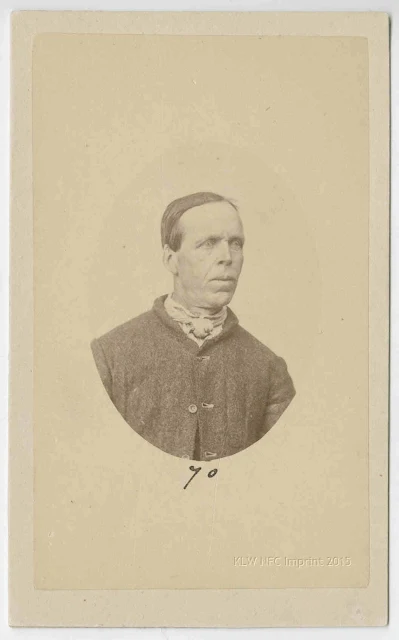
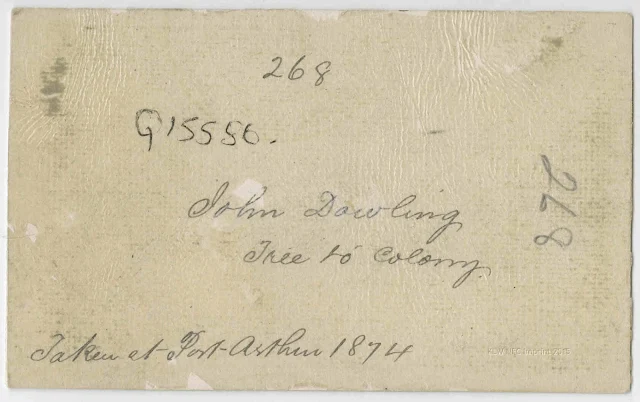
Professional photographer Thomas J. Nevin was more than a little interested in proceedings at the Supreme Court, Hobart on Thursday 10th February and Friday 11th February 1876. As assistant bailiff and government contractor his duties were to provide mugshots of prisoners who faced incarceration at the Hobart Gaol. Of the five who were arraigned, two were women, Honora Tracey alias Borland and Eliza Ann McKenzie. Neither would require a sitting with Nevin since women imprisoned in Tasmania were not formally photographed until the 1890s. Of the three men, Nevin had already photographed the first, John Nowlan alias Dowling on discharge from the Hobart Gaol in December 1874 and reconviction in February 1875, so he would not need another sitting; his existing mugshot would simply need reprinting. The second male, Patrick Lamb was a first offender, so he would be photographed within the next week. The third man in the dock was a fellow photographer, Stephen Spurling senior, the first in a dynasty of photographers named Stephen Spurling (I, II and III - see Burgess, C. 2010 below). His financial difficulties had led him to court.

Two of these five prisoners - Honora Tracey, charged with perjury and Stephen Spurling snr, charged with fraud, were both released on remand and bail respectively. Patrick Lamb received the lightest sentence of three years for stabbing a man over some "peas"; John Nowlan as Dowling was sentenced to death for rape of a 10yr old girl; and Eliza Ann McKenzie was sentenced to seven years for perjury. She claimed she was raped by two men - the Captain and the Chief Officer - on board the Bella May resulting in the birth of her son 9 months later. In court were the reporters for the Hobart Mercury and Tasmanian Tribune; their accounts of proceedings on those two days - 11th and 12th February 1876 - would bring some of their readers to tears, and others to mirth.

POLICE GAZETTE NOTICE, 10-12 Feb 1976


Source: Tasmania Reports of Crime for Police (weekly police gazette) Gov's printer J. Barnard

Arraigned in the Supreme Court, Hobart Town 10-12 February 1876 were the five prisoners with these details:

Patrick Lamb, 35 years old, transported to VDL on the ship Siam, FC = free with conditions, sentenced to 3 years for the offence of wounding with intent.

Eliza Ann McKenzie, 20 years old, native = born in Tasmania (not transported), free, sentenced to 7 years for the offence of perjury.

John Nowlan alias Dowling, 45 years old, arrived at Hobart on the ship Bangalore, FC = free with conditions, sentenced to death for the offence of rape.

Stephen Spurling, 55 years old, ship unknown, i.e. how he arrived at Hobart is not recorded here (see Burgess below), FC = free with conditions, on bail for the offence of obtaining credit by false pretences.

Honora Tracey, transported as Boland, 46 years old, arrived at Hobart on the Midlothian, FS =free in service, remanded for the offence of perjury.

Press Reports, 11-12 February 1876

THE CHARGES

TRANSCRIPT

SUPREME COURT.
Thursday, Feb. 10th.

(His Honor Sir Francis Smith, Chief Justice, presided in the First Court, and Mr Justice Dobson in the Second Court.)

Stephen Spurling was charged with obtaining goods by means of false pretences.

The jury retired, and as they had not agreed on a verdict at 7.15 p.m., the Court was adjourned until 10 o'clock tomorrow morning.

The other cases on the calendar are — John Nowlan, Bellerive, rape. Patrick Lamb, Franklin, wounding. Robert Hopper, Oatlands, robbery and wounding. Patrick Powell, Oatlands, housebreaking. Honora Tracey, Hobart Town, perjury. Eliza Ann McKenzie, Hobart Town, perjury. Patrick Walsh, Oatlands, breaking into a store and larceny. William Sainsbury and Harriet Sainsbury, Oatlands, housebreaking. Ellen Waller, Franklin, perjury.

Source: Cornwall Chronicle (Launceston, Tas. : 1835 - 1880), Friday 11 February 1876, page 2
Link: https://nla.gov.au/nla.news-article72522140

THE DECISIONS

TRANSCRIPT

Criminal Sessions.-The sessions were continued yesterday. ln the First Court, before the Chief Justice, the jury, in the case of Stephen Spurling, sen., being unable to agree, were discharged. Patrick Lamb was found guilty of wounding with intent one Patrick Roach, at Franklin, and was remanded for sentence. In the case of Honora Tracey, charged with perjury, the jury were unable to agree, and were discharged. The Second court presided over by Mr. Justice Dobson, was occupied during the whole of the day in investigating a charge of perjury preferred against a young woman named Eliza Ann Mackenzie. The case arose out of a police court trial in which the defendant charged the captain and mate of the barque Bella Mary with committing a rape upon her during a voyage to and from Auckland in 1874. Her evidence at the trial was proved to have been entirely false, and Mackenzie was found guilty, and sentenced to seven years' imprisonment. Mr. Moriarty defended the prisoner. One more case remains for trial this morning.

A LIVELY JURY.-It was rumoured on Thursday night that the jury in the case of Stephen Spurling, senr., had been playing up high jinks in the retiring room, and as it was well-known that that was the reason why the Chief Justice ordered them to be locked up for the night, there was considerable speculation as to how the jury had been spending their time during the alleged disturbance. When they were brought up yesterday morning, His Honour, before discharging them, as they had been unable to agree, asked them whether they had any explanation to make of their conduct in the jury room. The foreman, Mr. J. W. Palmer, of Bagdad, said the jury sincerely regretted that any disturbance should have taken place, and tendered an explanation. It was to the effect that the jury were divided on the smoking question. The smokers naturally indulged in their favourite pastime, and the non-smokers, not being at all partial to the weed, suffered severe qualms. The result was that, after submitting to be enveloped in smoke for some time, the non-smokers determined to open the window. They were prevented from doing so, and a little scuffling ensued ; but eventually the window was forced open, and one of the shutters broken. The mysterious part of the affair however is that somebody threw one of the chairs out of the window, a feat respecting which nothing was said by the foreman, and we are left to infer that at one time matters had risen to a high pitch of excitement. At all events, His Honor accepted the apology, and was kind enough to say that, on consideration, no one could be guilty of bringing deliberate discredit upon an institution which was the pride of Englishmen all over the world.

THE DISAGREEMENT of JURIES.-The frequency of juries not being able to agree is becoming a serious matter. Yesterday, the Chief Justice was compelled to discharge two juries who were unable to come to a unanimous decision. In the case of Honora Tracey, tried for perjury, the jury were locked up until 10 o'clock last night, and when brought in were so positive as to there being no chance of any unanimity, that it was evident they were afraid of being confined for the night. His Honor noticed this, and told them that it was his duty to see that the facilities of discharge were not such as to make them an impediment to justice. In olden times, he added, juries were locked up till they did agree, and that without anything to eat and without fire - a piece of information which caused the jury men to look as if they expected to be treated in a similar manner. His Honor, however, was lenient, for, after expressing an opinion that if this difficulty continued, it would be necessary to consider whether juries should be allowed to separate at all before coming to some decision, he discharged the jury.

The Convict Nowlan.-In reporting that the Chief Justice had "passed" sentence of death on Nowlan, for criminal assault on a child, an error was made. It should have been that sentence of death was "recorded," a very different thing, in so far as the convict is concerned.

Prisoners Patrick Lamb and Eliza McKenzie sentenced, Stephen Spurling and Honora Tracey as Borland discharged, John Nowlan as Dowling, sentence of death recorded.
Source: THE MERCURY. (1876, February 12). The Mercury (Hobart, Tas. : 1860 - 1954), p. 2.
Link: https://nla.gov.au/nla.news-article8943037

Other key documents
COURT RECORDS with names of jurors
Stephen Spurling, John Nolan, Patrick Lamb, Eliza Ann McKenzie
Link: https://libraries.tas.gov.au/Digital/SC32-1-9/SC32-1-9P235
Link: https://libraries.tas.gov.au/Digital/SC32-1-9/SC32-1-9P236
Link: https://libraries.tas.gov.au/Digital/SC32-1-9/SC32-1-9P237

GAOL RAP sheet
McKenzie gaol record and discharge 1 Feb 1880
Link: https://libraries.tas.gov.au/Digital/CON42-1-1/CON42-1-1P146

PRESS account
Honora Tracy - press report of her perjury
Link: https://nla.gov.au/nla.news-article8943031


Source: Henry Dobson (1841–1918) ADB- https://adb.anu.edu.au/biography/dobson-henry-5986
In: Members of the Parliaments of Tasmania - no. 236 / photographed by J.W. Beattie.
Allport Library and Museum of Fine Arts, State Library of Tasmania.
Link: https://libraries.tas.gov.au/Record/Library/SD_ILS-621674


Stereograph - New Post Office and Supreme Court, Hobart.
Photographer: Samuel Clifford, 1860s
Source: Archives Office Tasmania
Link: https://libraries.tas.gov.au/Digital/LPIC147-3-170/LPIC147-3-170


CASE 1: ship's passenger Eliza Ann McKenzie
Eliza Ann McKenzie was born at Hobart (VDL) Tasmania in 1855 to parents Elizabeth Wood (19 yrs) and John McKenzie (23 yrs), general goods dealer, who were married on 29 March 1854 at the Chalmers Free Church, Hobart, witnessed by Elizabeth Wood's sister Eliza Wood (her aunt whose name she was given) and John McKenzie's brother Duncan McKenzie.*
(*Source: https://libraries.tas.gov.au/Digital/RGD37-1-13/RGD37-1-13P232).

It was not made clear in both press reports of the hearing and the trial of Eliza Ann McKenzie in 1875 and 1876 why she embarked on a voyage to Auckland, New Zealand on the trader barque Bella Mary from Hobart in 1874. In all likelihood she responded to an advertisement in the Hobart Mercury of 23 June 1874 placed by the ship's captain George McArthur. The advertisement sounded too good to be true: Captain George McArthur was offering three young women a free return passage to Auckland, New Zealand on the Bella Mary; they would have jobs as barmaids; and they would receive good wages. Excited at the prospect of adventure on a working holiday, Eliza would have stepped onto the Bella Mary before noon that Tuesday morning and found herself thoroughly charmed by the captain promising her a wonderful time at his expense. :

TRANSCRIPTS
WANTED THREE RESPECTABLE YOUNG WOMEN as BARMAIDS to proceed, per "Bella Mary" for Auckland. Good wages will be given, and a free return, passage
Apply to CAPTAIN McARTHUR, (between the hours of 11 and 12 o'clock this morning) on board "Bella Mary".

Source: Advertising (1874, June 23). The Mercury (Hobart, Tas. : 1860 - 1954), p. 1.
Link: https://nla.gov.au/nla.news-article8930703

Two weeks' later Eliza Ann McKenzie departed Hobart on the Bella Mary as a cabin passenger in the company of Mr and Mrs Hinton and Jane Hammond who would later contradict Eliza's evidence in court that she too was raped by the Captain on the voyage to Auckland. It may have been evident to Jane Hammond that the captain wanted sexual services in exchange for his promises, but not to Eliza, who was so devastated by the experience she was prepared to make very public the criminal aspect of his sexual behaviour.

CLEARED OUT.-July 4.
Bella Mary, barque, 270 tons, G. McArthur, for Auckland, N.Z. Passengers - Cabin : Mr Frederick Hinton, Mrs. Hinton, Miss Annie Thera Jane Hammond, Miss Eliza Mckenzie . Agents - Bayley and McGregor.

Source: SHIPPING INTELLIGENCE. (1874, July 6).The Mercury (Hobart, Tas. : 1860 - 1954), p. 2.
Link: https://nla.gov.au/nla.news-article8930948

Birth of son 24 May 1875
The Bella Mary departed Hobart for Auckland on 4 July 1874 and returned to Hobart on 21 August 1874. Eliza Ann McKenzie alleged the captain George McArthur raped her on the voyage to Auckland and held her down while the chief officer John Fuge also raped her on the return voyage. She found she was pregnant as a consequence. She gave birth to a son at Hobart whom she named Richard McArthur McKenzie nine months later, on 24 May 1875. The name of child's father was not registered but she made sure he would be remembered forever after by registering his surname "McArthur" as her son's middle name. The birth was registered on 3 July 1875 by (the child's?) grandfather Greg McKenzie, of Bathurst St. Hobart.

McKenzie, Richard McArthur
Record Type: Births
Gender: Male
Father: McKenzie, Name Not Recorded
Mother: McKenzie, Eliza Ann
Date of birth: 24 May 1875
Link: https://libraries.tas.gov.au/Record/NamesIndex/976867


McKenzie v. McArthur 21 August 1875
In the Police Court of Hobart Town on 20th August 1875, Eliza Ann McKenzie made three allegations: that George McArthur, the captain of the barque Bella Mary committed a series of rapes on her on the voyages to and from Auckland in July and August 1874; that the captain held her down while chief officer John Fuge also raped her on 21st August: and that the captain had raped another young woman on the voyage to Auckland, Jane Hammond, in July 1874. Her three allegations made in this first hearing, were reported by the press in these terms (21 August 1875): -

TRANSCRIPT

AFFILIATION. McKenzie v. McArthur.— When this case was called on for hearing the complainant handed to the Police Magistrate a written statement as she had directed her counsel to do. A lengthy discussion then ensued between the Police Magistrate and Mr. Moriarty as to the proper course to pursue in laying the information, the Magistrate still contending that the criminal case should take precedence. Mr. Jackson said that his client, Mr. McArthur, was not only willing, but anxious to proceed with the matter in any form. The complainant ultimately intimated her intention on proceeding with the criminal case first, and the affiliation case was accordingly ordered to stand over. FELONY. McKenzie v. McArthur.—The defendant Geo. McArthur, was charged with the commission of a criminal offence on Eliza Ann McKenzie, on the 21st of August of last year [1874]. The defendant pleaded not guilty. Mr. Moriarty appeared for the prosecution, and Mr. Jackson for the defence. The Police Magistrate ordered the Court to be cleared. The complainant, Eliza McKenzie, was then called, and stated the particulars of the alleged offence, but they were of a nature unfit for publication. The cross-examination of this witness was not proceeded with by Mr. Jackson, and the case was adjourned at half-past one till the next morning.

Source: LAW. (1875, August 21). The Tasmanian Tribune (Hobart Town, Tas.), p. 2.
Link: https://nla.gov.au/nla.news-article201487160

The Port Officer's Log recorded the names of two cabin passengers on the Bella Mary on arrival back at Hobart on 21 August 1874: Miss McKenzie and Mr. Laurence. Whoever Mr Laurence may have been,  he was not called into the court for his opinion.


Cabin passengers on the Bella Mary, Ms McKenzie and Mr Laurence
Reports of ships arrivals with lists of passengers
Archives Office Tasmania
Link: https://libraries.tas.gov.au/Digital/MB2-39-1-34/MB2-39-1-34P086

Why was this young woman not believed?
Eliza Ann McKenzie was charged with making false allegations to the Police Court in 1875 of having been raped by both George McArthur and John Fuge on board the Bella Mary at sea on voyages to Auckland from Hobart and from Auckland to Hobart in July and August1874. The jury at the criminal trial in February 1876 took little more than 35 minutes to return a verdict of guilty of perjury. Eliza Ann McKenzie was sentenced to seven years' imprisonment. Her defence attorney Mr Moriarty argued that on the basis of probabilities - without directly referring to the nine-months of her pregnancy from when the series of rapes occurred to  May 1875 when her son was born - her claim was probably truthful. Justice Dobson agreed that "someone had certainly wronged her" but he was not going to send good men to the gallows on the basis of her evidence. Even so, the court was cleared to allow full description of the events by Eliza Ann McKenzie and her counsel, the details of which were so shocking they were deemed unfit for publication. 

The accused rapist Captain George McArthur, married in 1868  to Isabella Emma Lovell* who sometimes accompanied him as a passenger on his Hobart- Auckland voyages (on 6 February 1874, for example), was supported by a crowd of reputable witnesses who testified to his impeccable character. His co-accused chief mate John Fuge deposed that Eliza Ann McKenzie seemed happy when she disembarked at Hobart. The other alleged victim of their assault, Jane Hammond, was brought from Auckland to testify that she was not raped by either of these men.
(*Source: https://libraries.tas.gov.au/Digital/RGD37-1-27/RGD37-1-27P167)

TRANSCRIPT

SECOND COURT
Before His Honor Mr Justice Dobson
The Attorney-General prosecuted on behalf of the Crown.

PERJURY
Eliza Ann McKenzie pleaded not guilty to a charge of having committed perjury in the Police Court of Hobart Town on the 20th August last

Mr MORIARTY defended the prisoner,
Jury : Messrs. W. C. Sharland (foreman), R. Winter, A. Flexmore, C. Colvin, R. Goldsmith. N. Ray, T. Gase, H. Gage, T. Stump, G. Watt, H. J. James, and E. Lipscombe.

The Attorney-General, in opening the case, said the defendant was charged with having committed perjury, on an information containing three counts, first, by swearing that George McArthur, captain of the barque Bella Mary, committed a series of rapes upon her on the voyage of that vessel to Auckland in August, 1874, and, also, on the return voyage ; second, by swearing that Captain McArthur forcibly held her down while the chief officer, John Fuge, outraged her ; and third, by swearing that Captain McArthur, during the same voyage, committed rape upon another girl, a fellow passenger, named Jane Hammond. The case, the Attorney-General said, was one of the most remarkable, and, in some respects, one of the most painful that he had ever met with since he had any knowledge of criminal proceedings. He then detailed the circumstances of the case, with the main facts of which the public are already familiar, and dwelt at length on the enormity of the offence of perjury, especially when, as in this case, the life and liberty of two men had been placed in jeopardy.

The evidence was not such as will bear publication. The following witnesses were called for the prosecution :- Capt. McArthur, John Fuge, Samuel Weir, Jane Hammond, and Thomas Large. The depositions of Milford McArthur and Walter Williams, seamen, on board the Bella Mary were put in. The only fresh evidence was that of Jane Hammond, who had been brought from Auckland for the purpose. She denied that any outrage had been committed upon her by Captain McArthur, as stated by the defendant, and stated that during the voyage she never heard or saw anything that would support the allegations of the defendant with respect to the captain and chief officer of the vessel.

Mr. Moriarty addressed the jury for the defence, his main point being that the jury should look not so much to the evidence given as to the probabilities, and the probabilities, he urged, were entirely in favour of the truth of the defendant's story.

For the defence, he called the mother of the defendant, Mr. Superintendent Propsting, Mr. A. McGregor, Dr. E. L. Crowther, Mr. James Robinson, and Mr. George Crisp. The last two were called on witnesses to the character of Captain McArthur and the defendant respectively.

His Honor summed up with great minuteness, and from his remarks it appeared that the tenor of the evidence was decidedly adverse to the defendant's case.

The jury then retired, and after an absence of 35 minutes, returned into Court with a verdict of guilty on all three counts.

The prisoner, in reply to the usual question, said she had nothing to say why sentence should not be passed upon her.

Mr. Sargent (for Mr. Moriarty, who had been called away to Launceston) asked the Judge to pass as light a sentence on the prisoner as possible on account of her youth and inexperience.

His Honor, addressing prisoner, said he was afraid she did not understand the position in which she had placed herself. [Prisoner : I do not.] He thought not. Had she known it, she would have known that had her evidence at the police court been believed, Capt. McArthur and his mate might both (and a few years ago inevitably would) have suffered death upon the gallows. A man who stabbed another, or took his life by violent means, was much more merciful than one who coolly and deliberately swore away his life in a court of justice. The defendant was young, some one had certainly wronged her, and he felt the position in which she was placed. At the same time it was a duty he owed to society, whatever his own feelings might be, to mark an offence of this kind very severely. He had the power to send her to gaol for 21 years, but that would be a barbarous punishment, and he would pass upon her the full sentence of only one of the three counts upon which she had been found guilty. It was a heavy penalty, but it was necessary to inflict a heavy penalty upon a woman who, having arrived at years of discretion, had deliberately, by a wilfully false statement, jeopardised the life of a fellow-creature. The sentence of the Court would, therefore, be that the defendant be imprisoned for seven years.

The prisoner did not seem to feel her position very acutely.

Source: CRIMINAL SESSIONS. (1876, February 12). The Mercury (Hobart, Tas.), p. 2.
Link: https://nla.gov.au/nla.news-article8943031

The only allegation which was upheld and examined after the testimonies by both John Fuge and Jane Hammond were dismissed was Eliza Ann McKenzie's claim of rape by George McArthur, the penalty for which was death by hanging (Act 1863, Section 45, Offences against the Person):

Rape, Abduction, and Defilement of Women.
45 Whosoever shall be convicted of the crime of Rape shall be guilty of Felony, and being convicted thereof shall suffer Death as as Felon.

READ the FULL ACT here {pdf}
An Act To Consolidate And Amend The Legislative Enactments Relating To Offences Against The Person (27 Vic, No 5) Austlii Database


Despite a solid defence and witnesses of premier social status for Eliza Ann McKenzie (apart from her mother) including her legal counsel Sylverius Moriarty; the Superintendent of Police, Richard Propsting; the shipowner Andrew McGregor with Charles Bayley of the Bella Mary; and medical practitioner Dr E. L. Crowther, she was sentenced to seven years' imprisonment at the Supreme Court, Hobart on 10 February 1876 on one count of perjury. Eliza Ann McKenzie's prison records state only that she was well behaved during incarceration at the Cascades Factory. She was discharged after serving 4 years of a 7 year sentence in 1880, her date of death yet to be determined.


Source: Archives Office Tasmania
Link: https://libraries.tas.gov.au/Digital/CON42-1-1/CON42-1-1P146


CASE 2: "no peas" Patrick Lamb
Patrick Lamb's Hobart Gaol record shows only that he arrived free to the colony (Tasmania) on the ship Siam (no date given, but possibly as a former soldier of H. M. 70th Regiment of Foot). He married Jane McKinsie on 13 May 1869 at Chalmer's Church, Hobart (see Addenda 2 below) , his occupation listed as "soldier". His occupation was listed as "splitter" (a timber worker) when she gave birth to a son, unnamed at registration, in January 1871 at Franklin, Tasmania. Two years later, she gave birth to a daughter, Susan Lamb, on 9 April 1873 also at Franklin. She died from incessant vomiting after a difficult parturition in September 1876. Exactly nine months earlier, in January 1876, her husband Patrick Lamb confronted Patrick Roach with the accusation that "he had no peas for him" before stabbing him for the fourth time (according to Roach). Patrick Lamb was tried at the Supreme Court Hobart on 10th February 1876 for "wounding with intent to do grievous bodily harm" to Patrick Roach and sentenced to three years' imprisonment at the House of Corrections (Hobart Gaol). He was discharged on 11 May 1878.


Tasmanian prisoner Patrick Lamb per Siam, taken at the Hobart Gaol
Verso inscription: Patrick Lamb "Siam"
Photographer: T. J. Nevin , 1876-1878
Mitchell Library SLNSW (PXB 274) - not online
Link: https://collection.sl.nsw.gov.au/record/YzOgQ689
Photo copyright © KLW NFC Imprint 2009

TRANSCRIPT
WOUNDING
Patrick Lamb was charged with having, on the 15th January, at Franklin, wounded Patrick Roach, with intent to do him grievous bodily harm.
The prisoner pleaded not guilty, and was defended by Mr. BROMBY.
The SOLICITOR-GENERAL prosecuted.
Jury : Geo. Inge (foreman), Jos Pedder, Jas. Johnstone, C.E. Knight, Thos. Jenkins, Jno. Thomas, R.C. Read, S. Large, F.N. Spong, W. Davis, H.P. Bailey, W. Cowburn.

The SOLICITOR-GENERAL briefly stated the case, and called -
Patrick Roach a labourer, residing at Franklin, deposed that on the night of the 15th January he was drinking at Brown's public-house. The prisoner came in a little after witness, and without saying a word he kicked witness. They had a few words, and then prisoner was removed. In about a quarter of an hour he returned, and having pulled witness down to a half- stoop, he stabbed him four times in and near the thigh. This was about 9 o'clock. Witness could not have been drunk, because he had not been there long enough. When the prisoner returned he stood at the end of the counter and said to witness that he had no *peas for him. Witness asked him what his peas or himself had to do with him (witness). Thereupon the prisoner without another word, stabbed him. There was a number of persons present and none of them tried to stop the prisoner. Witness saw the prisoner stab him the fourth time.

Ellen Roach the wife of the last witness, corroborated the most of her husband's statement. She added that only herself and Mr Brown went to her husband's assistance when he was being stabbed.

James Daly deposed to being in the public-house on the night in question. Roach and prisoner began to fight, and two quart pots were being used against the prisoner by Mrs. Roach and some one else. After the fight, Roach said to the prisoner, "If you touch me again I will stab you." The prisoner stood quiet for about a minute, and then rushed upon Roach and struck him three or four blows.

Esther Brown, the landlady of the public house; Elijah Brown, the landlord; Acting Chief District Constable Wheeldon, and Dr. W. Smith also gave evidence. A knife, which it was stated the prisoner had acknowledged to be his, was also produced. The medical testimony was conclusive as to the prosecutor having been stabbed.

Mr BROMBY addressed the jury, and called Sergeant Mitchell, who, however, did not appear.

HIS HONOR summed up, and the jury, after a short absence, returned with a verdict of "guilty." The prisoner was remanded for sentence.

Source: CRIMINAL SESSIONS. (1876, February 12). The Mercury (Hobart, Tas. : 1860 - 1954), p. 2.
Link: https://nla.gov.au/nla.news-article8943031

*HE HAD NO PEAS FOR HIM: not readily understood nowadays, it could be 19th century British rhyming slang, as in "bees and honey" meaning money, but from which region or register?

Or, taking it literally, he was referring to peas that grow in the garden, as the victim Patrick Roach appears to have taken Lamb's accusation about peas - i.e. as ownership of some garden or vegetable variety of pea - in this criminal session, February 10-12, 1876, in reference to the incident of 15th January the previous month when Patrick Lamb stabbed him. The fact that Lamb stabbed him in the thigh (and groin area) might signify cuckoldry involving his wife and Roach, a common type of assault enacted by an aggrieved husband seeking revenge.

Patrick Lamb's wife Jane Lamb had experienced "a difficult parturition" (pregnancy-labor-childbirth) and died of "incessant vomiting" in September 1876, exactly nine months after the date of her husband's stabbing of Patrick Roach in January 1876. As no one appears to have registered the birth, in all likelihood the child was either not born or had not survived past childbirth. Her husband's suspicions about Patrick Roach's role in her pregnancy, his grief at the loss of the child, and her subsequent incessant vomiting leading to an agonising death may well have been linked in his mind. Was he accusing Patrick Roach of poisoning his wife by feeding her with "peas" which had caused his sudden rage? On the other hand, perhaps he was saying "no peace" and his pronunciation was misinterpreted by the Mercury journalist. Probabilities could and should have been raised in this case as well.

TIMELINE

1869: MARRIAGE
On the 13 May 1869, Patrick Lamb married Jane McKinsie in the Manse of Chalmers' Free Church in the District of Hobart according to the Rites and Ceremonies of the Presbyterian Free Church. He was 28, a soldier and she was 21, registered as a "spinster" to indicate she had not previously married. Neither signed with their names; both marked the registration form with an "x".


Name: Lamb, Patrick
Record Type: Marriages
Gender: Male
Age: 28
Spouse: Mckenzie, Jane
Gender: Female
Age: 21
Date of marriage: 13 May 1869
Registered: Hobart
Source: Archives Office Tasmania
Link: https://libraries.tas.gov.au/Record/NamesIndex/871393

1876: PARTURITION and DEATH of WIFE
The death of Patrick Lamb's wife Jane Lamb nee McKinsie was registered in the district of Franklin (Tasmania) on the 11 September 1876. She was 27 years old. Cause of death: "Incessant vomiting after difficult parturition".... So, in the months leading up to labor and in the days following, was she poisoned with eating Roach's "peas"? What sort of peas could do that? Possibly one of these varieties:


Lathyrus odoratus ‘Mammoth Navy Blue’
SWEET PEA
Beautifully scented and particularly large Sweet Pea flowers of stunning deep navy blue. Long stems of very large flowers on 1.8m. climber. Tolerates hot weather better than most Sweet Peas. Continues producing over a long period. Great cut flowers. Sear cut end of stem with flame to prolong vase life. Good perfume. Prefers Full Sun. Grow in good, well worked garden soil on a frame, tripod or fence.
CAUTION – NOT EDIBLE – POISONOUS IF EATEN
Source: https://www.seedscape.net.au/product/lathyrus-odoratus-mammoth-navy-blue-sweet-pea/?v=b870c45f9584

TOXIC: Lathyrus sativus - sweet pea; Lathyrus odoratus - ditto; Abrus precatorius - Rosary pea - 3rd most poisonous plant, also called jequirity beans, these seeds contain Abrin, a protein. Rosary peas are native to tropical areas. The poison is stored inside the seeds so they are not poisonous if intact, but can be lethal if they are scratched, broken, or chewed. Like Ricin, Abrin prevents protein synthesis within cells and can cause organ failure within a few days; and Gastrolobium poison pea.


Adults exposed to sweet pea toxins may experience neurological symptoms such as paralysis or convulsions due to the presence of lathyrogens. Breathing difficulties and labored breaths are also telltale signs of poisoning. In severe cases, ingestion can lead to a condition known as lathyrism, characterized by paralysis below the knees.
Source:https://greg.app/sweet-pea-toxic-to-humans/

Toxicity
Unlike the edible pea, there is evidence that seeds of members of the genus Lathyrus are toxic if ingested in quantity. A related species, Lathyrus sativus, is grown for human consumption but when it forms a major part of the diet it causes symptoms of toxicity called lathyrism.[8]
In studies of rats, animals fed a diet of 50% sweet pea seeds developed enlarged adrenals relative to control animals fed on edible peas.[9] The main effect is thought to be on the formation of collagen. Symptoms are similar to those of scurvy and copper deficiency, which share the common feature of inhibiting proper formation of collagen fibrils. Seeds of the sweet pea contain beta-aminopropionitrile that prevents the cross-linking of collagen by inhibiting lysyl oxidase and thus the formation of allysine, leading to loose skin. Recent experiments have attempted to develop this chemical as a treatment to avoid disfiguring skin contractions after skin grafting.[10]

Source: Wikipedia- https://en.wikipedia.org/wiki/Sweet_pea


Death of Jane Lamb, 27 yrs old, on 11 Sept 1876 from incessant vomiting after difficult parturition
Link: https://libraries.tas.gov.au/Digital/RGD35-1-45/RGD35-1-45P77

1876-1878: THE CRIME, IMPRISONMENT and DISCHARGE
Patrick Lamb was 35 years old when he was tried at the Supreme Court Hobart, sentenced to three years at the Hobart Gaol on 10 February 1876 for "Wounding with intent to do grievous bodily harm". Noted in remarks: "per Siam, Free to Colony, Governor in Confidence 4/3/78 ... To be discharged 10 May 1878 - Discharged 11.5.78."


Patrick Lamb per Siam, free to colony.
Link: https://libraries.tas.gov.au/Digital/CON37-1-10/CON37-1-10P612

SUPREME COURT HOBART ROUGH CALENDAR


Trial: Lamb, Patrick
Record Type: Court
Status: Free
Trial date: 11 Feb 1876
Place of trial: Hobart
Offense: Feloniously wounding Patrick Roach with intent to do grievous bodily harm.
Verdict: Guilty
Link: https://libraries.tas.gov.au/Record/NamesIndex/1521178

POLICE GAZETTE NOTICES


Patrick Lamb, discharged 15 May 1878, F.C. free with conditions, residue of sentence remitted
Source: Tasmania Reports of Crime for Police (Police gazette) J. Barnard Gov. printer

1878: Patrick Lamb remarries
Patrick Lamb was photographed by police photographer Thomas J. Nevin at the Hobart Supreme Court on Lamb's arraignment and sentencing to 3 years' imprisonment, 10th February 1876. Nevin would have been more than a little interested in proceedings since fellow photographer Stephen Spurling I (1821–1892) was also arraigned in the same session, on trial for obtaining credit under false pretences (see Case 4 below). Patrick Lamb was discharged at the Hobart Gaol in the week ending 15 May 1878.

Soon after his release from prison, Patrick Lamb, widower, married 21 year old Mary McGinley* on 31 August 1878 at Hobart. (*Source: https://libraries.tas.gov.au/Digital/RGD37-1-37/RGD37-1-37P149).


CASE 3: John Nowlan as Dowling
This prisoner stated that he arrived free to the colony of Tasmania as a sailor on the Bangalore with the name John Dowling, but he might have arrived as a convict with the name John Nowlan on the transport London in March 1851. Shipping documents testifying to his arrival on the Bangalore at any port and under any circumstance unfortunately, if true, are not extant. He was previously sentenced for indecent assault on a girl under 12 years to five years' incarceration in March 1870 as John Dowling.

The Legislation
Under the ACT of 1863 - AN ACT to consolidate and amend the Legislative Enactments relating to Offences against the Person. [31 July, 1863.] - John Nowlan alias Dowling was sentenced to five years in 1870 for the indecent assault of Deloranie Boss, a girl under 12 years of age. The first count - intent to commit a rape - would have incurred a sentence of ten years, but he was sentenced instead on the second count of indecent assault which should have incurred the full sentence of seven years instead of five: see Clauses 48, 49, and 50 of the Act.

Six years later, when found guilty of having committed a rape on Caroline Agnes Welch, 10 years of age in 1876, the full force of the law - Clause 45, the death sentence - was applied, yet a reprieve followed. The sentence of death on John Nowlan alias Dowling was commuted to life in prison. There were increasingly urgent protests from the public and the press to cease sentencing prisoners to death, but that in itself was not the reason for his reprieve, the details of which were kept from the public.


THE CONVICT NOWLAN.- In reporting that the Chief justice had "passed" sentence of death on Nowlan, for criminal assault on a child, an error was made. It should have been that the sentence of death was "recorded", a very different thing, in so far as the convict is concerned.

Source: THE MERCURY. (1876, February 12). The Mercury (Hobart, Tas. : 1860 - 1954), p. 2.
Link: https://nla.gov.au/nla.news-article8943037


Prisoner DOWLING, John, also recorded as John NOWLAN
Tasmanian Museum and Art Gallery Collection Ref: Q15586
Photographer: Thomas J. Nevin, December 1874


Verso: Prisoner DOWLING, John, also recorded as John NOWLAN
Not "Taken at Port Arthur"; taken at the Mayor's Court, December 1874
Tasmanian Museum and Art Gallery Collection Ref: Q15586
Photographer: Thomas J. Nevin


Details:
"Supreme Court, Hobart Town. List of prisoners arraigned at the above-named Court on the 10th, 11th and 12th of February, 1876. Names, Nowlan John, as Dowling; Age 45; Ship Bangalore; Conditions F.C.; Offences Rape; How Disposed of; Death recorded."
Source: Tasmanian Reports of Crime for Police (police gazette), J. Barnard, Gov't printer

This prisoner was photographed as John Dowling by T. J. Nevin on release from the House of Corrections, Hobart Town in December 1874. Dowling was convicted again in February 1875 for larceny. A year later, in February 1876 he was convicted at the Supreme Court, Hobart, for rape of a girl between 10-11 yrs old, this time as John Nowlan, alias John Dowling. The sentence for rape was death, commuted to life imprisonment. John Nowlan alias John Dowling was sent to the Port Arthur prison 60 kms south of Hobart on 25th February 1876 and transferred back to the House of Corrections, Hobart Gaol, Campbell St. on 17th April 1877. A prisoner who called himself John Dowling died at the New Town Charitable Institution, Hobart in 1906 of senilis

The Mugshot
Thomas J. Nevin's photograph of John Dowling was taken at the Mayor's Court, December 1874 on Dowling receiving a certificate of freedom. Just one photograph of the prisoner appears to have survived, suggesting Nevin used the 1874 negative to produce reprints for Dowling's sentencing in 1875 and again in 1876. This photograph by Nevin of John Dowling is now held in the Tasmanian Museum and Art Gallery Collection (Ref: Q15586). It was originally acquired by convictarian and landscape photographer John Watt Beattie from government estrays in the early 1900s for display in his "Port Arthur Museum" located in Hobart and for inclusion in travelling exhibitions associated with the fake convict hulk "Success" to Sydney, Melbourne, Adelaide, and Hobart.

J. W. Beattie's collection of more that 300 Tasmanian prisoner mugshots, taken originally by T. J. Nevin in the 1870s, including this one of John Nowlan as Dowling, was acquired by the Queen Victoria Museum and Art Gallery, Launceston, Tasmania (QVMAG) in the 1930s. The capture by Nevin on glass in the one and only sitting with Dowling in 1874 was reprinted as a sepia cdv in a buff mount to be pasted to the prisoner's charge sheet in the first instance, its principal use. When Beattie organised exhibitions of these mugshots in the early 1900s, the versos of at least two hundred mugshots were duly inscribed with this fake information - "Taken at Port Arthur 1874" - purely to whet the appetite of tourists taking penal heritage tours to Port Arthur. As artefacts associated with Marcus Clarke's novel, For The Term of His Natural Life, published in 1874, two silent versions of which were filmed on location at the Port Arthur prison in 1907 and 1927, these mugshots were re-invented with false information to heighten the tourist's experience - a commercial imperative which has certainly waxed rather than waned in recent decades. Read more about John Nowlan alias Dowling here in this post


CASE 4: photographer Stephen Spurling snr
The reporter for the Tasmanian Tribune (12 Feb 1876) quietly stated a disturbance had taken place in the jury room during the trial of photographer Stephen Spurling. It was much more than a disturbance, according to the Mercury's report of 12 February, 1876. It was "high jinks" and scuffles rising "to a high pitch of excitement". It was the non-smokers forcing a window open, of broken shutters and a chair thrown out onto the street in a desperate attempt to escape the stench of the smokers' "weed".

TRANSCRIPT

CRIMINAL SESSIONS.
Friday,11th February, 1876.

FIRST COURT.
Before His Honor, Sir Francis Smith, Chief Justice.

OBTAINING GOODS BY FALSE PRETENCES.
The jury in the case of Stephen Spurling, sen. having been locked up for the night, were brought in, and in reply to the usual question, the foreman (Mr T W Palmer ) stated that they had not agreed, nor was there any prospect of them doing so.

His Honour said he supposed he might take it that the jury had given the case that consultation which the law required. He did not feel justified in discharging them on the previous night in consequence of the reported disturbance in the jury room making it quite clear that some part of the time had not been passed in deliberation,

The jury was then discharged.

In reply His Honor the Attorney-General said he did not propose this session to proceed further with the charge, but he should have time to consider the case.

The defendant was accordingly released on bail, himself in £30, and his two sons in £25 each.

Source: LAW. (1876, February 12). The Tasmanian Tribune (Hobart Town, Tas. : 1872 - 1876), p. 2.
Link: https://nla.gov.au/nla.news-article200369705

THE MERCURY REPORT
A LIVELY JURY.-It was rumoured on Thursday night that the jury in the case of Stephen Spurling, senr., had been playing up high jinks in the retiring room, and as it was well-known that that was the reason why the Chief Justice ordered them to be locked up for the night, there was considerable speculation as to how the jury had been spending their time during the alleged disturbance. When they were brought up yesterday morning, His Honour, before discharging them, as they had been unable to agree, asked them whether they had any explanation to make of their conduct in the jury room. The foreman, Mr. J. W. Palmer, of Bagdad, said the jury sincerely regretted that any disturbance should have taken place, and tendered an explanation. It was to the effect that the jury were divided on the smoking question. The smokers naturally indulged in their favourite pastime, and the non-smokers, not being at all partial to the weed, suffered severe qualms. The result was that, after submitting to be enveloped in smoke for some time, the non-smokers determined to open the window. They were prevented from doing so, and a little scuffling ensued ; but eventually the window was forced open, and one of the shutters broken. The mysterious part of the affair however is that somebody threw one of the chairs out of the window, a feat respecting which nothing was said by the foreman, and we are left to infer that at one time matters had risen to a high pitch of excitement. At all events, His Honor accepted the apology, and was kind enough to say that, on consideration, no one could be guilty of bringing deliberate discredit upon an institution which was the pride of Englishmen all over the world.

Source: THE MERCURY.(1876, February 12). The Mercury (Hobart, Tas.), p. 2.
Link: https://nla.gov.au/nla.news-article8943037

THE CHARGES
OBTAINING GOODS BY FALSE PRETENCES.—Stephen Spurling, senior, was charged by Thomas Edgar Creswell, solicitor, with having on the 27th February, 1875, unlawfully, and knowingly, falsely pretend that Stephen Spurling, his son, was indebted to him in a large amount, to wit, over £100, by means of which false pretence, he obtained from Messrs. P. O. Fysh and Co. certain goods on credit, whereas, in truth, the said Stephen Spurling, junior, was not in any way indebted to the said Stephen Spurling, senior. The prosecution was under the 13th section of the Debtors Act.
Mr. Crisp appeared for the prosecution, and Mr. Bromby for the defence.
Philip Samuel Seager, clerk to the Registrar of the Supreme Court, produced the order of adjudication of Stephen Spurling the elder, which was taken on the 12th August last. He was adjudicated a bankrupt upon the petition of Stephen Spurling the younger. Witness produced the affidavit of debt of Stephen Spurling, junior, and one of Messrs. P. O. Fysh and Co.
Thomas Edgar Creswell, solicitor of the Supreme Court, deposed that he was trustee in the proceedings against the defendant. He produced the order of adjudication.
By Mr. Bromby: Messrs. Burgess and Fysh were the two creditors who were anxious to prosecute the defendant. The majority of the creditors did not wish to take proceedings.
Robert Walker deposed that he was confidential clerk to Messrs. P. O. Fysh and Co. He was present at several interviews between the defendant and Mr. Fysh, relative to the purchase of goods by defendant. On the 27th February, 1875, the defendant incurred debt for goods to the amount of £90. The defendant was then already indebted to the firm in the amount of £38 10s. When a debtor wanted further accommodation it was usual for him to make a statement as to his position and prospects of payment. Witness heard defendant tell Mr. Fysh that his son in Launceston had to send him a large sum of money, which he received at the rate of £30 per month. Defendant did not say what the amount was which his son owed him. He certainly led witness and Mr. Fysh to believe that his son owed him money. On previous occasions the defendant had stated that his son's removal to Launceston had been a great expense to him. It was on the strength of these statements that the goods were delivered to the defendant.
By Mr. Bromby: I have been in Mr. Fysh's employ for sixteen years, for nine years of which the defendant has had transactions with the firm. The goods in the last order were ordered about nine months before they were delivered. It is generally the custom to forward the invoice of the goods ordered to the customer on its arrived by the mail. On the arrival of the goods a further account, with charges added, is rendered to the purchaser. It is also a custom to send an invoice after the delivery of the goods. Witness could not say whether notice was given to the defendant of the arrival of the goods. The bill for £38 10s. had been several times renewed, and was due on the 4th January, so that the defendant had called between that day and the 27th February about the renewal of this bill. The bill for £38 10s. was renewed for the 4th of April. For the goods arranged for on the 27th February, it was agreed that one-half should be covered by a bill at four months, and the other half at six months.
Re-examined: By the defendant's statements we knew that he was getting money from his son, and up to the 27th February he stated that his son had to send him money.
By the Bench: The bills at four and six months were not signed until the goods had been delivered.
Mr. Spurling became a debtor of the firm from the time of the delivery of the goods and not before.
Stephen Spurling jun., deposed that he was a son of the defendant. Witness removed to Launceston in 1873. At that time, the defendant was responsible for witness's bills which he (the defendant) afterwards paid. During the period witness had been in business in Launceston witness had become the defendant's creditor for cash and goods to the amount of £200. Accounts were never balanced between witness and the defendant when witness left Hobart Town. Defendant was then indebted to witness for wages whilst defendant was responsible for witness's debts. Witness sent his father during two years about £300. The bills which the defendant paid for witness amounted to £50. Witness was not aware that these bills were not mentioned in his father's books. Witness did not owe his father £200 during February, 1875, or for nine months before that time, but he could not say whether he owed the defendant anything then. The defendant had been witness's debtor in some amount for 18 months.
By Mr. Bromby: My father partly set me up in business in Launceston, and has acted well to me. It was always understood that I should assist him in every way. I sent him sums of money from the beginning of 1875 till the time he was bankrupt and would have sent him more had he asked for it, and I had had it.
The case was adjourned until Friday next.
Source: CITY POLICE COURT. (1876, January 13). The Mercury (Hobart, Tas.), p. 3.
Link: https://nla.gov.au/nla.news-article8942378

SUPREME COURT RECORD


Source: https://libraries.tas.gov.au/Digital/SC32-1-9/SC32-1-9P235 Image 214

TRANSCRIPT

No. 1 Crt
Stephen Spurling = plea not guilty
Jury - [12 names listed]
[Annotation illegible next to] 27 Feb 1875 - unlawfully obtg goods by false pretences from R. V. Fysh (representing his son Stephen Spurling owed him £200) and Ct obtg goods by false pretences
Verdict -[ blank - but  Nolle prosequi recorded]

[No. 1 - commuted to imprsmt for life - John Nolan - sentence death recorded.]

Dept Sheriff reported the misconduct of the jury
At 10 o'clock the jury not being agreed they were ordered to be kept together until 10 o'clock tomorrow morning- they were given in charge of John Lewis Thos Cook Fred Thornhill & Richd Walker
The prisoner was discharged on bail till 10 o'clock tomorrow himself in £50.. .Stephen Spurling & Fred Spurling in £25 each [two sons of Stephen Spurling]

Crt adjourned till 10 o'clock tomorrow morning

Friday 11th February 1876
The Court met this morning at 10 o'clock
No. 1 Crt
Re Spurling The jurors answered to their names & the defendant placed in the dock - The jury not being agreed they were discharged & the prisoner admitted to Bail till next session himself in £50 & his two sons in for £25 each.

Biography: Stephen Spurling 1 (1821–1892)

... By 1875 Stephen 1st was once again facing bankruptcy. During the subsequent sale of his assets, fellow photographer Alfred Winter purchased his negative collection. For the next decade, Winter advertised Spurling portrait and landscape prints and enlargements for sale.

From 1875 onwards, Stephen 1st’s career was in decline. In 1881, he attempted to re-establish his studio, but this venture proved unsuccessful. By 1886, the deterioration in his mental health, combined with his impending paralysis, led to his admission to the asylum at New Norfolk. It is possible he was suffering from the long term effects of chemicals, such as mercury, which he had used during his early photographic experiments. He remained incarcerated until his death, from congestion of the kidneys, at the age of seventy, on 13 April 1892.

Source: Christine Burgess, 'Spurling, Stephen (1821–1892)', Obituaries Australia,
National Centre of Biography, Australian National University,
Link: https://oa.anu.edu.au/obituary/spurling-stephen--1578

Additional Resources

1. C. H. Burgess, The Spurling Legacy and the Emergence of Wilderness Photography in Tasmania, PhD thesis, University of Tasmania, 2010. Link: https://doi.org/10.25959/23211710.v1
2. 'Insolvent Court', Mercury (Hobart), 3 October 1861, p 2
3. 'Supreme Court: Bankruptcy Jurisdiction', Mercury (Hobart), 16 October 1875, p 2.
4. 'City Police Court: Obtaining Goods by False Pretences', Mercury (Hobart), 13 January 1876, p 3


Burgess, Christine (2024) Photographs by Spurling's: A Treasure Trove of Tasmanian Images
(Forty South Publishing Pty Ltd. fortysouth.com)
Page 1: cdv of Stephen Spurling 1
Photo copyright © KLW NFC Imprint 2024
(Many thanks for your acknowledgement, Christine).


CASE 4: Honora Tracey alias Borland
The jury was dismissed since no unanimity was reached among them as to Honora Tracey's guilt in the charge of perjury. As noted by the press, they were locked up until 10 o'clock on the night of the case, presumably to retire to their respective homes and when they returned the next day -

- they were so positive as to there being no chance of any unanimity, that it was evident they were afraid of being confined for the night. His Honor noticed this, and told them that it was his duty to see that the facilities of discharge were not such as to make them an impediment to justice. In olden times, he added, juries were locked up till they did agree, and that without anything to eat and without fire - a piece of information which caused the jury men to look as if they expected to be treated in a similar manner. His Honor, however, was lenient, for, after expressing an opinion that if this difficulty continued, it would be necessary to consider whether juries should be allowed to separate at all before coming to some decision, he discharged the jury
Source: THE MERCURY. (1876, February 12). The Mercury (Hobart, Tas. : 1860 - 1954), p. 2.
Link: https://nla.gov.au/nla.news-article8943037

Honora Tracey

TRANSCRIPT
PERJURY
Quodling v. Tracey.— This was an information charging Honora Tracey with having committed wilful and corrupt perjury in her evidence in a case heard before the Police Bench on the 11th inst., wherein James Tracey was, charged with having wounded one Emma Bridges on the head by fracturing her skull with a stone. The case was partially heard on the previous day, and Mr Bromby appeared for the accused. After hearing a large amount of evidence, for and against, the Bench committed the woman Tracey to take her trial at the next Criminal Sessions.

Source: LAW. (1875, December 18). The Tasmanian Tribune (Hobart Town, Tas.), p. 2.
Link: https://nla.gov.au/nla.news-article200367243

Addenda

1. The ship "Bella Mary"


Source: Maritime Museum of Tasmania
Link: https://ehive.com/collections/3906/objects/207119/clock-from-the-bella-mary-captain-copping
Name/Title Clock from the Bella Mary, Captain Copping
Bella Mary was named after Bella Mary Copping, niece of Captain R. Copping.
Measurements 250mm Object number A_1984-377

Bella Mary, a barque built 1862 at Tatamagouche, Nova Scotia, tonnage 266, was registered to Edward Lucas and others, Hobart Town and traded regularly to New Zealand under command of Captain Richard Copping until Captain George McArthur took over in 1871.

In August 1873, a year before skipper George McArthur was tried and acquitted of raping Eliza Ann McKenzie, a shipment of salmon trout ova sent from Tasmania on the Clematis, was accompanied by Stephen Budden on behalf of the Canterbury Acclimatisation Society, departing 29th August, and a second shipment of 500 brown trout ova destined for the Auckland Climatisation Society left on the Bella Mary on the 23rd August 1873. This advertisement from the Auckland Star, September 1874 among many others in the same issue indicates that the usual freight from Tasmania to New Zealand was varieties of apples, tins of jams from Peacock's and Creswell's, hops, almonds, bark, palings etc etc.


On a voyage to Auckland in 1875, the Bella Mary took a Tasmanian devil to show New Zealanders a native animal, but it jumped ship at anchor and disappeared into the bush. The Bella Mary was wrecked at Fiji in 1886: (SMH 18 March 1886; Harry O'May 1978:110-111).

TRANSCRIPT

WRECK OF THE BARQUE BELLA MARY.
By the A. S. N. Company's steamship Gunga, which arrived in port last night from Fiji, news has come to hand of the wreck of the barque Bella Mary, belonging to Mr. G. J. Waterhouse, of this city. The Gunga also brings the commander and crew of the Bella Mary, which, it appears, struck on a reef about 16 miles from Suva, on the 2nd instant, at 8.30 p.m., and became a total wreck. At the time of the accident she was on a voyage from Suva to Levuka, having left the former port at 2 p.m. on the 2nd instant. The Bella Mary was a wooden vessel of 243 tons register, and was built in Nova Scotia in 1862. The wreck of the ship was sold for £7 10s,, and the cargo for £30.

Source: WRECK OF TUE BARQUE BELLA MARY. (1886, March 18). The Sydney Morning Herald (NSW), p. 10.
Link: https://nla.gov.au/nla.news-article13614498


Source: National Gallery of Australia
Title: Samuel Clifford, Tasmanian bush 'devil'
Stereograph, Hobart, Tasmania, Australia, 1870s acquired by Nigel Lendon by 1983 -
- who sold it to the National Gallery of Australia, Canberra, 1983
Link: https://searchthecollection.nga.gov.au/object/6407

2. Chalmers Free Church, Hobart, Tasmania
Patrick Lamb married Jane McKinsie on 13 May 1869 at Chalmer's Church, Hobart, his occupation listed as "soldier".


Chalmers Free Church, Hobart, ca. 1890 [frame cropped]
Source: https://libraries.tas.gov.au/Record/Archives/NS3503-1-14

A BRIEF HISTORY
A split in the Church of Scotland in 1843, the so-called “Great Disruption”, played out across the Empire. In Tasmania not one of the Church of Scotland ministers supported the Free Church which led to a number of individuals at Hobart applying to the Free Church of Scotland to send a minister to the colony.

Supporters of the Free Church of Scotland erected the Chalmers churches in Hobart and Launceston, named after their Scottish leader, Thomas Chalmers. Chalmers Church at Hobart opened in 1852 followed by Chalmers Launceston in 1860.

In April 1851 Reverend W. Nicolson arrived at Hobart and commenced preaching at the Mechanic’s Institute Hall, where he drew a significant following. This led to an appeal to build Hobart’s first Free Church of Scotland. The foundation stone for a church was laid in October 1851.

The opening of Hobart Chalmers Church was reported by the Hobarton Guardian:
“The work is in the modern Gothic style, and according to a very chaste and tasteful design. The building is most creditable both to the architect and contractor, and will be a great improvement to the city where it stands. It accommodates about 750 persons, and, we understand, a great portion of the sittings were let in the course of a few hours, on the first day appointed for that purpose. The cost will be about £2000, the greater part of which has been already raised—having been entirely accomplished by voluntary subscription. Mr. Nicolson is also supported by the voluntary liberality of his hearers, and receives no pay from the Government. The foundation stone of this handsome church was laid on the 3rd October last, on which occasion Mr. Nicolson gave an exposition of the principles of the Free Church. The Church stands at the corner of Harrington and Bathurst-streets, in an elevated situation, and commanding a view of most beautiful scenery…”

“The interior is fitted up in a style of tasteful elegance—the pulpit is ornamental Gothic, and has a remarkably chaste and beautiful appearance: it, as well as the galleries, was hung with crimson drapery. During the evening service, the church was illuminated by several elegant chandeliers…. The congregations, both in the morning and afternoon, were very numerous, but in the evening, a dense crowd filled the sacred edifice. It was indeed a goodly sight to witness so many congregated together to offer adoration to the Most High—young and old, rich and poor, learned and illiterate, all joining in praising Him to whom all praise alone is due; and what enhanced the pleasure was to know that many were not of the Free Church of Scotland—this is as it ought to be…”

Born out of division, Chalmers' end came out of union. Over the course of the 19th century efforts were made to promote union between the two Presbyteries in Tasmania. This was finally accomplished in 1896, with the Presbyterian Church of Tasmania uniting all congregations of an undivided Church. In 1935 Chalmers’ congregation united with St Andrew’s Church to form Hobart’s Scots Church. Initially services alternated between the two churches but in 1949 services were limited to the Scots (St Andrew's) Church.

With the end of services at Chalmers, the building was put up for sale in 1952 and purchased by the Neptune Oil Company. The church was demolished in 1955 and the site was used to build a service station. Several stained glass windows were taken from the Chalmers church before its demolition and were later installed in the gallery of the Scots Church. The Scots Church pulpit sits on stone taken from Chalmers church while the stone font is also from Chalmers Church.

Source: https://www.churchesoftasmania.com/2019/04/no-399-chalmers-free-church-hobart-born.html

RELATED POSTS main weblog