Showing posts with label Police Records. Show all posts

Sarah (Rothwell) Crouch at Thomas J. Nevin's studio ca. 1867-1871

Photographers Alfred BOCK, Thomas J. NEVIN, and H. H. BAILY
Portraits of Thomas and Sarah (Rothwell) CROUCH 1860s-1870s, and Robert Stanton ROTHWELL ca. 1870
SHOOBRIDGE estate and grave sites, West Hobart, Tasmania

Sarah Rothwell Crouch photo T. Nevin 1868

Sarah (Rothwell) Crouch (1806-1876), cdv by Thomas J. Nevin, ca. 1867-1871
Copyright © KLW NFC Imprint Private Collection 2026

Alfred Bock's sennotypes of Thomas and Sarah Crouch
Alfred K. Bock (1835 -1920) inherited his father Thomas Bock's daguerreotype establishment at 22 Campbell Street Hobart Town in April 1855 and announced his own photographic business. By July 1855 he had moved to Elliston's premises at 78 Liverpool Street, formerly occupied by the photographers Duryea and McDonald where he built a "Crystal Palace" studio and purchased photographic equipment from Ross of London. Financial difficulties ensued, and Bock moved several times.

In 1857 Alfred Bock was at 18 Macquarie Street. But on 6th February, 1858, he was insolvent. Later that year, Bock re-established himself at 140 Elizabeth Street, Hobart Town - a business he called The City Photographic Establishment - and stayed there until 1865 when he was again declared insolvent (Kerr, ed. 1992: 77-78). In late May 1865, Alfred Bock's wife gave birth to a daughter (Mercury, 23 May 1865). This event too may have precipitated Bock's decision to sell up and leave Tasmania.

Financially bruised by a dispute with photographer Henry Frith about the origins and rights to the sennotype process, the stock-in-trade of Bock's studio at the City Photographic Establishment was advertised at auction on August 2nd, 1865. Thomas J. Nevin bought the lease of the studio, the shop, the stock of negatives, camera equipment, backdrops and furniture, including the glass house/gallery installed at the end of the cart path adjacent to the studio, listed as 138½ Elizabeth St. on valuation rolls.

These two fine portraits of Thomas J. Crouch and his wife Sarah (Rothwell) Crouch were produced by Alfred Bock at the City Photographic Establishment in the early 1860s using the method of assemblage called the sennotype process which consisted of two albumen prints sandwiched under glass, the top one waxed for transparency and usually hand-coloured, resulting in blacker shadows and greater tonal range.


Left: Under-Sheriff Thomas. J. Crouch (1805-1890)
Right: Sarah Crouch (1806-1876) nee Rothwell
Sennotypes by Alfred Bock ca 1860
Tasmanian Museum and Art Gallery Collection

Biographical Notes: Sarah and Thomas Crouch
Biographical Notes by Peter Bolger
Australian Dictionary of Biography
Link: https://adb.anu.edu.au/biography/crouch-george-stanton-3346

Thomas James Crouch (1805-1890), under-sheriff, was born on 22 October 1805 in London, the eldest son of James Crouch of Hertfordshire and his wife Sarah, née Marston, of Shropshire. His parents had moved to London before their marriage in 1804 at St George's, Hanover Square, and his father was, among other business projects, proprietor of public baths in Cannon Street. Thomas's education at various small city schools was interrupted by ill health and convalescence at Worthing and Barmouth, and he later became clerk to a barrister at Lincoln's Inn. He was friendly with Dudley Fereday, who was appointed sheriff of Van Diemen's Land. Crouch agreed to become his clerk and arrived at Hobart Town in the Phoenix in January 1825. He was a successful clerk in various commissariat offices, specializing in legal matters until he was appointed under-sheriff in 1836; he held the post until he retired on a pension in 1868.

On 20 February 1832 at St David's Cathedral Crouch married Sarah Rothwell, from Limehouse, London, whom he had met when she passed through Hobart as governess to the family of Rev. Joseph Orton. The Crouch family had been Anglican but in 1826 Thomas had become attached to the Wesleyan Methodists and was an active Sunday school teacher. Sarah was also a Wesleyan but their cottage became the lodgings of the missionaries James Backhouse and George Washington Walker, and she adopted Quaker manners and attended their meetings. Crouch helped to initiate the schools of the Hobart Wesleyan circuit and was a trustee of the Melville Street Church for fifty-eight years. With James Bonwick and G. W. Walker he organized the first local temperance society in 1833 and in 1843 signed the pledge. He was a prominent founder of the Tasmanian Temperance Alliance and chaired its 34th annual meeting on the evening of his death on 28 May 1890. He was also a founder of the Hobart Town Benevolent Society in 1860, a committee member for thirty years and its secretary for seventeen years. For many his greatest claim to fame was his part in the recognition and capture of Martin Cash in Hobart in 1843.

Crouch's wife [Sarah Crouch], after seven years of paralysis, died on 16 January 1876 in her seventieth year. She remained loyal to the Society of Friends and was buried in their ground at Providence Valley. Sarah had shared in her husband's religious and temperance activities, organized a female petition for a Maine Liquor Law in the colony and another to forestall Sunday licensing, and served on the committees of the Maternal and Dorcas Society and of various societies such as the Van Diemen's Land Asylum for the Protection of Destitute and Unfortunate Females, which Walker had promoted in 1848. She was one of the Ladies Visiting Committee which each week inspected female paupers at New Town, Cascades and the Brickfields, and was reputed to have kept her own dispensary where she gave medicines to the needy. Perhaps her greatest contribution to the welfare of Hobart poor was her Servants' Home in High Street, which only closed in her final illness.

Crouch and his wife had at least eight children, most of whom died in childhood. One daughter, Mary, was married to Robert S. Caseley, Wesleyan minister in South Australia in 1863, and another, Ann, to Robert Shoobridge in 1871. The eldest son, Thomas James [Crouch], became an architect, designing among other work the General Post Office in Melbourne; there he died on 4 December 1889.

The second son, George Stanton [Crouch] (b. 1 May 1834), was educated like his brother at Bonwick's and Hutchins Schools. They were active in Wesleyan Sabbath school and temperance work at St Kilda after failing at the diggings. George was a farmer at Kangaroo Valley, near Hobart, from 1854 until 1863 when he sailed with his wife for New Zealand. His job at Invercargill as clerk and book-keeper at the Southland News ended in 1870 when he became part-owner of both it and its rival, the Southland Times. In these years he advocated total abstinence and was a prominent Wesleyan. He returned to Hobart in 1871 and ran an auctioneer's salesroom until 1905. In 1883 he was elected alderman of the City of Hobart and served for twelve years, being mayor in 1892, but was prevented from becoming a justice of the peace by his Quaker-like refusal to take the oath. He gained ambivalent repute as the 'Teetotal Mayor' and startled Saturday night revellers by regular inspections of public houses, always with a police bodyguard... [extract]

Source: https://adb.anu.edu.au/biography/crouch-george-stanton-3346

The Rothwell and Crouch families were closely involved with the operations of the Sheriff's Office at the Hobart Gaol from the 1830s to the 1880s. Sarah (Rothwell) Crouch's brother, John Rothwell (1812-1885) gained the position of second clerk to the Sheriff in 1836 through her husband's influence, advancing by degrees until he was appointed chief clerk in 1841 and Under-Sheriff in 1868 on the retirement of brother-in-law Thomas J. Crouch, a position he held until retirement, 71 years old, in 1883, having served the office with "fidelity and justice" under Judges Pedder, Montagu, Fleming, Home, Smith, and Dobson, according to his Obituary in the Mercury, 19 Sept 1885. He supervised the execution of Job Smith aka Campbell on 31st May, 1875, at the Hobart Gaol; Thomas J. Nevin's photogaph taken at his only sitting with Job Smith is extant in several public collections, one was even hand-tinted, another was poorly reprinted in the 20th century.

In 1838 John Rothwell married Celia Rebecca Smith in Hobart. Her sister Sarah Anson (d. 1858) was the mother of Hobart photographers Joshua (b. 1821) and John (b. 1835) Anson. John and Celia Rothwell had a large family of children (15 are listed at familysearch.org), and apart from their first-born daughter Sarah who died in 1924, their eighth child, son Robert Stanton Rothwell (1850-1902), Sarah (Rothwell) Crouch's nephew in effect, was the last of their sons still living by 1900. He died of neurosyphilis in 1902 at the New Norfolk Lunatic Asylum. When, as a young man barely 20 years old, he visited the studio of T. D. Webb, St. John's Street, Launceston, Tasmania to be photographed wearing his finest (ca.1870), he dedicated his portrait to Miss Ellen Bayles of Ross, signing it verso "With R.S.R.'s compliments, to Ms E. Bayles, Auburn, Ross".

If the history of ownership of his portrait (below) could be established beyond the 1870s when Ellen Bayles first placed it her family album, some light might be shed as to why this young man, Robert Stanton Rothwell was misidentified by its vendor at Leski's auction (Melbourne) in May 2026 as the brother of photographer Thomas J. Nevin, William John Nevin (1852-1891). While both Nevin brothers worked at the Hobart Gaol from the early 1870s with Under-Sheriff John Rothwell - Thomas as photographer of prisoners who were received, incarcerated and discharged from Supreme Court convictions, and his brother Constable John (W. J. aka Jack to the family) Nevin as warder and messenger - and while the Rothwell, Crouch and Nevin families shared many connections including their respective farms at Kangaroo Valley (Hobart), their Wesleyan faith, Lodge membership and civil service, there is nothing about this carte-de-visite which would invite such a misidentification (more to come in a future post).

Robert Stanton Rockwell 1870

Robert Stanton Rockwell 1870

Portrait of Robert Stanton Rothwell by T. D. Webb, Launceston, Tasmania ca. 1870
Inscribed verso "With R.S.R.'s compliments, to Ms E. Bayles, Auburn, Ross"
Misidentified by vendor at auction (Leski's May 2026) as William John Nevin, brother of photographer T. J. Nevin.
Purchased from Leski's (Melb) for © KLW NFC Imprint Private Collection, 31 May 2026.

Departure of Alfred Bock to Victoria


Alfred Bock's trade advertisement in Walch's Tasmanian Almanac, 1864

The City Photographic Establishment and the house next door were premises consisting of two house-and-shop properties owned by Abraham Biggs snr at 138-140 Elizabeth St. Hobart, They were still "unfinished" in 1853 according to the Hobart Valuation Rolls. By 1854 Biggs was listed as the proprietor with his son, builder Abraham Edwin Biggs. By 1857 they had let the premises at 140 Elizabeth St. to photographer Alfred Bock which he operated as a studio with his (step) brother William Bock until 1865. On Alfred Bock's departure to Victoria, commercial photographer and government contractor Thomas J. Nevin continued the business with the firm's name, The City Photographic Establishment, 140 Elizabeth Street, Hobart Town. He operated the studio in partnership with Robert Smith under the business name of Nevin & Smith briefly between 1866-68, vacating the shop, residence, glass house and studio a decade later, in 1876, to take up his appointment in full-time civil service with residency at the Hobart Town Hall.

Photographer Thomas J. Nevin was a member of the Loyal United Brothers' Lodge and their official photographer. He was also an affiliate of the Benevolent Society and Wesleyan Church with senior members of the Crouch, Nevin and Genge families. Thomas' father John Nevin snr leased an acre of land from the Wesleyan Trustees of Ancanthe at Kangaroo Valley (Lenah Valley) from the early 1850s and remained there to his death in 1887. His daughter Rebecca Jane Nevin died there in 1865 and his wife Mary Ann (Dickson) Nevin died there in 1875. Eldest son Thomas James Nevin married Elizabeth Rachel Day at the Wesleyan Chapel there in 1871, and his only surviving daughter Mary Ann Nevin married John Carr there in 1877. John Nevin snr also taught class at the Wesleyan Chapel, Kangaroo Valley in 1875. His second marriage in 1879 after the death of his wife in 1875 was to widow Martha (Genge) Salter, daughter of Wesleyan lay preacher William Genge of the Methodist Church and meeting rooms, Melville Street, Hobart. William Genge's death occasioned a poem written as a lament by John Nevin in 1881.

Thomas J. Nevin's portrait of Sarah (Rothwell) Crouch
Thomas J. Nevin stamped his mostly commonly used commercial studio backmark in blue ink on the verso of this carte-de-visite, his portrait of Sarah (Rothwell) Crouch, which would indicate she visited his studio sometime ca. 1867-1871. He used sepia or black ink on later portraits after 1872. See examples here of both backstamps in blue and black ink at the National Gallery of Victoria's collection of eleven (11) cdv's of Nevin's portraits donated by John McPhee in 2020.

Sarah (Rothwell) Crouch was experiencing the early effects of paralysis which would claim her life in 1876 when she visited Nevin's studio. His capture of her facial expression might have unintentionally betrayed the pain she was enduring, and not just from her illness. The tight whalebone corset she was wearing had completely flattened the natural line of her bosom, undoubtedly causing further discomfort.

This is an unusual photograph in that Thomas J. Nevin positioned the sitter closer to his camera than he otherwise seemed to prefer in sittings with women clients. His use of the newer lenses here, which allowed shorter focal range and a larger image of the face and hands without sacrificing clarity, became his trademark when he commenced the photographing of prisoners with Supreme Court convictions on government contract soon after Sarah Crouch's brother John Rothwell succeeded her husband Thomas J. Crouch to the position of Under-Sheriff. This photograph, the first to be printed off the glass negative and like many which Nevin produced at the Hobart Gaol of prisoners for inclusion on their rap sheets, was printed initially with the whole upper body visible. The next print, if requested, would have been the same image formatted as a carte-de-visite, framed in an oval mount, showing the face but not the hands. If this same image of Sarah Crouch was ever produced as a carte-de-visite, it has yet to surface in public or private collections.

Sarah Crouch photo T. Nevin 1868

Sarah Crouch photo T. Nevin 1868Sarah Crouch photo T. Nevin 1868 verso

Above: Portrait of Sarah (Rothwell) Crouch, cdv by Thomas J. Nevin, taken ca. 1867-1871
Item: Carte-de-visite on buff mount, sepia albumen print
Subject: Sarah (Rothwell) Crouch (1806-1876)
Photographer: Thomas J. Nevin (1842-1923)
Location: City Photographic Establishment, 140 Elizabeth St. Hobart
Verso studio stamp: [blue ink] T. Nevin, late A. Bock, City Photographic Establishment, 140 Elizabeth St. Hobart. Further copies can be obtained at any time.
Provenance: estate of the Late Alexander Renwick
Per Leski's Auctions, Melbourne, May 2026 online.
Copyright © KLW NFC Imprint Private Collection 2026

Thomas J. Nevin photographed prisoner George Leathley seated in similar fashion to Sarah Crouch. Both sat with sightlines deflected to right of frame, their faces turned to look past the photographer standing quite close to their left, and each with folded hands resting on their lap. He printed both photographs in rich sepia from the negative, but pasted the full upper-body print of Sarah Crouch to a plain mount, whereas his print of Leathley was produced in carte-de-visite format for police and prison records. One cdv was pasted to the prisoner's rap sheet, another was included in the Photo Books held at the Municipal Police Office, Hobart Town Hall, and others were forwarded to regional and rural police stations wherever the prisoner was sent to work. Although Nevin's original negative taken in the one sitting in the early to mid 1870s was commonly used for further prints if the prisoner was again convicted after release (e.g. Leathley's No.14 printed 1872, reprint in 1874, No. 226), another sitting was required if the negative was too damaged, as was most likely the case with Nevin's second and quite different photograph of George Leathley taken on discharge in 1876.


Left: Prisoner George Leathley
Thomas Nevin's original print from his glass negative, 1874
Reprinted by John Watt Beattie on a panel for sale, 1916
Held at the QVMAG Ref: 1983_p_0163-0176

Right: Prisoner George Leathley No's. 14 and 226
National Library of Australia collection
Title: George Leathley, per ship Blundell
Creator: T. J. Nevin 1874.
Inscription: “Nos. 14 & 226”–On reverse
Taken at the National Library of Australia, Feb. 2015
Photo copyright © KLW NFC Imprint 2016.

THE SERVANTS' HOME
Sarah (Rothwell) Crouch was a committee member of the Maternal and Dorcas Society when she sought subscriptions and donations for the establishment and on-going support of a home for servant girls in High Street, North Hobart. The street was renamed Tasma Street in 1921 to avoid duplication with High Street, Sandy Bay, named after the novelist Jessie Catherine Couvreur, nee Huybers (1848-97), whose pseudonym was "Tasma".

These notices were published in the press at the beginning of Sarah Crouch's campaign in September to November 1856.


Extract, full transcript below:

TRANSCRIPT
SERVANTS' HOME
SEVERAL Ladies having been long impressed with the desolate state of females occupying the sphere of domestic servants on leaving their situations while seeking others, the following ideas have been suggested: -
"That a society of ladies be formed, the design of which shall be to protect ALL lone female servants, and afford such advice as experience dictates and by judicious care and oversight prevent exposure to many evils which strangers in the colony are subject to; and also to provide a "Home" to ALL female servants willing to avail themselves of its privileges at a rate within the reach of their limited means. The "Home" will be conducted as much as possible in accordance with similar Institutions in London.

Such a home will preclude the necessity of the well-intentioned taking up their abode with persons whose object is gain to themselves, though it should be the destruction of their supporters.

With this view the ladies have taken a house in High-street, near the New Town Road (a respectable neighbourhood) at a very moderate rent, in which there is a sitting-room, with table requisites for the use of the inmates, and all necessary utensil for cooking, washing, &c - the dormitories furnished with beds, bedding, and everything necessary to the comfort of those desirous of placing themselves under the guardianship of the ladies.

The ladies feel the time has arrived when such an institute is required, and will be valued in town and country, both by servants and employers. By this provision, when it is known in England and elsewhere, the ladies believe encouragement will be given to the virtuous to emigrate, and the comfort and convenience of the community generally increased, while much vice and its consequent pauperism will be prevented.

The Ladies have great confidence in appealing to the Public for aid in this philanthropic undertaking, feeling assured they will not appeal in vain. There is no doubt the want of such a Home has been lamentably felt by many a friendless girl, who may at this time be pining in poverty and woe; who would have been, under other circumstances, an useful member of society, and an ornament in the station she was designed to fill.

Particulars may be obtained at the "home" or of the undersigned, by whom Subscriptions and Donations will be gratefully received.

S. CROUCH, Secretary. Argyle-street
Servants' "House", High-street. 14th of 10th Month, 1856."

Source: SERVANTS' HOME. (1856, November 1). The Courier (Hobart, Tas. : 1840 - 1859), p. 1.
Link: https://nla.gov.au/nla.news-article2506506

THE RULES No's. 1-5:


FEMALE SERVANTS' HOME, HIGH -STREET. (1856, November 26).
The Tasmanian Daily News (Hobart Town, Tas. : 1855 - 1858), p. 3.
Source: https://nla.gov.au/nla.news-article202389475

TRANSCRIPT
Female Servants' Home, High-street.
Various rumours being abroad as to the conditions on which servants are admitted into the " home," the committee have determined to publish the rules for the information of the public generally, and at the same time to thank those ladies and gentlemen both in town and country who have come forward so kindly and generously with subscriptions to aid in establishing this institution.
The rules to be observed by the inmates of the servants'-" home."
1st. Admission rule— Each person must produce her own character.
She must also signify her intention to conform to the following rules by signing them in a book kept for that purpose.
2nd. That each person so admitted must pay to the housekeeper three shillings per week (in advance) which will entitle her to a bed, the use of the fire, and other necessaries for cooking, washing, &., with the accommodation of the sitting room.
3rd. That each person will be required to deposit one shilling with the housekeeper, which sum will be returned on her leaving the establishment, provided nothing is destroyed which was appropriated to her individual use.
4th. In the event of any female leaving before her week is expired, so much of the three shillings will be returned as will amount to the payment of sixpence each night she shall have occupied the lodging.
5th. The doors of the building will be closed at nine o'clock, when each person is expected to be in, and the lights out at ten o'clock. No intoxicating drinks will be allowed on the premises ; but no further restraint will be used, or undue influence exercised in the choice of situation or otherwise.

S. Crouch, Secretary.

N.B.— Any inmate preferring to take her meals off the housekeeper can procure either at nine pence per meal.

FEMALE SERVANTS' HOME, HIGH -STREET. (1856, November 26).
The Tasmanian Daily News (Hobart Town, Tas. : 1855 - 1858), p. 3.
Source: https://nla.gov.au/nla.news-article202389475

H. H. Baily's portrait of Sarah (Rothwell) Crouch
One way of looking at this photograph is to see it as a piece of cardboard on which is printed an image. Perhaps it has commercial value only because of age, condition, and provenance. Another way is to step into the scene and participate as the photographer might while talking to his sitter. Still another way is to trace the journey of each element in the picture from any known context in which it has appeared up to the present, in which case the familiar object in this portrait of Sarah Crouch by H. H. Baily is the carpet with a pattern of large dark lozenges rimmed in white. It was formerly used by Alfred Bock as one of his studio carpets, then by Thomas Nevin for one of several set-ups for taking portraits in the same studio in 1868, and finally the same carpet was used in this portrait of Sarah Crouch by Henry Hall Baily, that is, if he photographed her before her death in 1876. Note that Sarah Crouch wore her velvet jacket over her dress for her sitting in the Alfred Bock and H. H. Baily photographs, but had taken it off for her sitting with Thomas J. Nevin.

On the other hand, is this just a piece of cardboard which was reprinted by Henry Hall Baily from an original capture taken by Alfred Bock before 1865; then reprinted by Thomas Nevin, operating as Nevin & Smith between 1865-1868; or, later, reprinted by Thomas Nevin again from 1868-1875 when both Bock's stock and Nevin's negatives were reprinted by Samuel Clifford to 1878; and lastly, reprinted by Henry Hall Baily ca. 1880? Reprints were mostly at the request of the client and family. All three photographers - Alfred Bock, Samuel Clifford, and Henry Hall Baily - were close friends and colleagues of Thomas J. Nevin from the early 1860s to his retirement in 1888. To further complicate matters of copying, from the early 1860s the source of their studio carpets, tables, drapes and backsheets was the family warehouse of Charles A. Woolley, the most senior photographer of their Hobart cohort. His studio furnishings and photographic paraphernalia were passed around among members of that cohort when times were hard, which was more often than not.


Photograph of Sarah Crouch,
University of Tasmania Library Special and Rare Materials Collection
Link: https://eprints.utas.edu.au/7214/
Photograph of Sarah Crouch, wife of Thomas James Crouch, under sheriff of Van Diemen's Land. The photographer was Henry Hall Baily who had studios in Elizabeth and Liverpool Streets, Hobart from 1865-1918.


Verso: Photograph of Sarah Crouch
University of Tasmania Library Special and Rare Materials Collection
Link: https://eprints.utas.edu.au/7214/


Woolley's Carpets and Upholstery Warehouse, Macquarie St.
Series: Photographs and Glass Plate Negatives collected by E R Pretyman (NS1013)
Archives Tasmania Ref: NS1013_1_1895

Providence Valley Burial Ground
In 1836 the Society of Friends (Quakers) established a cemetery on ground purchased from William Shoobridge's Providence Valley Farm. Sarah Crouch was buried there in 1876, so too was her husband Thomas Crouch in 1890. About 60 people, including members of the Propsting, Mather, Benson, Bell, Rowntree and Walker families used the cemetery until its closure in 1912. The former burial ground is now called the Friends' Park, Hill Street. The headstones of Sarah Crouch and others were retained and displayed around the park's perimeter.

Sarah Crouch tomsbstone Tasmania

Gravestone of Sarah Rothwell Crouch at Providence Valley Farm
Source: UTAS, eprints.utas.edu


Friends' Park
Source: G. Ritchie, photos and text
Link: https://ontheconvicttrail.blogspot.com/2014/04/friends-park-west-hobart.html
Friends Park is a small park in West Hobart that started life as a burial ground for the Society of Friends (Quakers). The land had originally been granted to William Shoobridge in the early 1820's and he had set up a farming enterprise. Although Shoobridge was a practicing Methodist, he found himself supporting the work of a number of Quaker missionaries who had visited Van Diemen's Land in the early 1830's. As a show of his support, he agreed to give the Society of Friends a half acre portion of his farm land in order for the Society to establish a burial grounds for themselves. As it turned out, following the establishment of the burial ground, Shoobridge himself became the first person to be buried there after he passed away in 1836.

The burial ground continued to provide for the Quakers into the 1900's. Even after the Cornelian Bay cemetery was opened in 1872 and many of Hobart's numerous suburban burial grounds were closed, the Society of Friends burial ground was able to continue operating because it fell outside the Hobart municipal boundary. Following the rezoning of the region into the new Greater Hobart municipality, the burial ground was finally closed in 1908.

It just remained as an unused burial ground until 1937 when the Hobart City Council negotiated with the Friends Society for the transfer of the land to the council so that it could be converted to a community recreation space for the growing West Hobart community.

Under the terms of the transfer agreement, the park was to be renamed Friends Park and the headstones were to be repositioned and re-erected around the walls of the new park. This was subsequently completed and the newly named Friends Park has continued to provide the local community with a beautiful recreational space. One with a very interesting past.

Source: https://ontheconvicttrail.blogspot.com/2014/04/friends-park-west-hobart.html

The Nevin and Shoobridge families
Shortly before Thomas J. Nevin's death in 1923 at his home, 270 Elizabeth St. Hobart, his eldest daughter known as May Nevin (1872-1955) made arrangements with her close friend Winifred Shoobridge, daughter of Annie Crouch and Richard Shoobridge, grand daughter of William Shoobridge of Providence Valley, to move with her brothers George, William, and Albert into the property at No's 23-29 Newdegate St., or Queen Street as it was then called until 1925, formerly Providence Valley, where they would remain until the death of May Nevin in 1955. Her other two siblings - Minnie Drew nee Nevin and Tom "Sonny" Nevin - were both married and living elsewhere by 1907. Each of the four remaining adult siblings set up a business on the Newdegate St. property: May did dressmaking; George sold vegetables from the garden; William ran a furniture removal business, and Albert trained a stable of pacers. In 1925 Queen Street was renamed Newdegate Street after Governor Sir Francis Newdegate (1917-1920) to avoid duplication with Queen Street, Sandy Bay.


The house at 23 Newdegate St. North Hobart, formerly Queen St. and Providence Valley (on the Shoobridge estate).Children of Albert Nevin, grandchildren of Thomas J. Nevin and Elizabeth Rachel Nevin nee Day out front, 1930s.
Signage of W. J. Nevin, carrier, son of Thomas and Elizabeth Nevin at left.
Copyright © KLW NFC 2006-2009 Private Collection ARR.


Metropolitan Drainage Board Map. No. 58 ca. 1908
The property 23-29 Newdegate St. formerly Queen St. where Thomas and Elizabeth Nevin's adult children settled from c 1923 to the late 1950s.
Queen St. North Hobart was renamed Newdegate St. after Governor of Tasmania Francis Newegate (1917-1920).
Source: Archives Office of Tasmania Ref: 628270


No. 23 Newdegate St. North Hobart Tasmania
The units on either side of the house and cottage were built with the sale of part of the property in the 1960s.
Google maps 2019

Updated 29 August 2026
Copyright © KLW NFC Imprint 2020-2026


RELATED POSTS main weblog

Mugshots of Women Prisoners, Tasmania 1897-1910

Elizabeth ORLANDO, murder charge and MUGSHOT
Booking shots of WOMEN in hats, 1890s-1910, HOBART GAOL
MARION camera, Hobart Gaol 1890s

Marion Camera Hobart Gaol 1900s

Marion's Excelsior Camera, 22 & 23 Soho Sq., London WW1D 3QR
The firm operated from this address between c.1866 - 1913.
Held at Penitentiary Chapel Historic Site, Campbell St., site of the former Hobart Gaol and Supreme Court.
Photos copyright © KLW NFC 2015 ARR

This camera was used by the (as yet) unidentified photographer at the Hobart Gaol from the 1890s. Prior to the 1890s, prisoners were photographed by Constable John Nevin who was resident and salaried at H.M. Gaol until his death from typhoid fever in 1891, working with his brother, commercial photographer, government contractor and civil servant Thomas J. Nevin who attended the gaol and Supreme Court Oyer and Terminer sessions on a monthly and quarterly roster. One of two rooms used by the photographers at the Hobart Gaol was located above the women's laundry. Before it was demolished in 1915, government contractor John Watt Beattie salvaged the majority of photographs taken by Thomas J. Nevin in the 1870s from the laundry and the Sheriff's Office. He displayed them at his "Port Arthur Museum", located in Hobart, and toured them at intercolonial exhibitions from the Royal Hotel, Sydney, 1916 in conjunction with convictaria exhibited on the floating museum, the fake convict ship Success.

1897: Elizabeth Orlando aka Eliza Poole
In 1887 Elizabeth Orlando stabbed to death her husband Victor Orlando at the breakfast table in Mrs Parker's lodging house, Campbell St. Hobart, Tasmania. She was sentenced to life in prison. She was previously known to police as Eliza Poole, charged with minor offences.

1887: sentenced to life

TRANSCRIPT
THE INQUEST.
An inquest touching the death of Victor Orlander, or Orlando, was hold this afternoon before Mr. P. W. Mitchell, coroner, and a jury of seven, of whom Mr. G. F. Hiddlestone was foreman.

The jury viewed the body, after which the following evidence was elicited.
Dr. C. J. Parkinson deposed that the cause of deceased's death was loss of blood from a deep wound behind the left ear.
Mrs. Mary Parker deposed she was proprietress of Parker's lodging-house in Campbell-street, where she resided with her husband; deceased and his wife had been staying in witness's lodgings; last Monday week deceased went there alone and lodged, and the following Monday his wife went there also; and they boarded and lodged together until that morning; they sometimes quarrelled they would go out sober and return under the influence of drink, and then quarrelled. Mrs. Orlander used to aggravate deceased, who seemed a very quiet man; on Thursday night they quarrelled more than usual, and thinking they had better be separated, witness between 12 p.m. and 1 am. that morning separated them, taking Mrs. Orlander into her own room and leaving deceased down stairs; when witness arose at 8 that morning deceased and his wife had left the house; at 8.45 they returned deceased went into the kitchen and asked for breakfast; so did accused; the table was already laid, knives, forks etc., being upon it; Orlander and his wife were sitting at the table, the wife being on his left hand; upon Mrs. Orlander also asking for breakfast, deceased said three times -" No, she shall not have any;" witness said to Mrs. Orlander, "Take no notice, he is only joking;" she then served Mrs. Orlander's breakfast, and then turned her back to where they were sitting, in order to attend to the household work at another table; she next went to the door, and was going to an adjoining room, when, hearing a scuffle, she turned round, and saw Mrs. Orlander with a table knife in her hand, though still sitting down; she appeared to be prodding deceased in the neck; witness thought at first that Mrs. Orlander was doing this for a lark, but on the third thrust she noticed blood spurt, and exclaimed, "Oh my God, the man is stabbed ;" she could not say that at the first or second thrust the knife entered deceased's neck, but she saw the third thrust enter the flesh, and saw Mrs. Orlander pull the knife out from the wound; a man named Clark was in the room at the same time, sitting at another table; witness raised the alarm, and some lodgers came out of an adjoining room, and took deceased to the hospital; deceased said nothing; nor made any noise whatever; witness took the knife, which was stained for 4in. in blood and wiped it; she subsequently gave it to the police; after deceased was removed Mrs. Orlander was like a mad woman about the house, and in ten minutes time went up stairs where she remained until the police came; when deceased came in to breakfast they did not appear much under the influence of drink : they knew what they were doing; the wife appeared more sober than the husband, who was perhaps half drunk; she had never heard Mrs. Orlander use any threats or acts of violence against her husband beyond the fact that she would strike him, which she did with her closed hand.
To the Coroner - No time elapsed between the three thrusts; they being made immediately after each other.
John Edwards deposed he was a licensed victualler residing at Bothwell; he knew Mrs. Orlander for between four and five years, and deceased for about three or four years; deceased was a labourer; they lived together as man and wife at Bothwell, where they were married three years ago; they were absent from Bothwell for 11 months, but returned to Bothwell three months ago; they lived a very unhappy life ; witness attributed their unhappiness to drink on the part of the wife; he never knew any violence occur between them;; he saw them together in Bothwell about 16 days ago; Mrs. Orlander there received a sentence of 14 days imprisonment for abusive language towards another female, and was sent to the Hobart lock-up; deceased remained in Bothwell for two or three days, and then witness missed him; he next saw them together on Thursday morning, about 10 o'clock, in a hotel in the city; he saw them again that (Friday) morning; between 8 and 9 that morning deceased was walking up Campbell-street towards Parker's lodging-house; he appeared to be perfectly sober; witness also saw Mrs. Orlander sitting in the bar of Clay's Union hotel smoking a pipe, and she seemed to be quite stupid from drink; he had often seen her in liquor; when in that condition she seemed to become perfectly mad.
John Clark, a labourer, deposed he lodged and boarded in Parker's lodging house; he was in the same room as the Orlander's when they were having breakfast that morning, but he was not observing them; hearing Mrs. Parker scream, he looked round and saw Mrs .Orlander draw a knife away from the neck of deceased, from which blood was spurting.
Richard Webb, a cook lodging at Parker's lodging-house, deposed to that morning hearing cries of "she has stabbed him" repeated twice, coming from the direction of the kitchen ; he hurried to the spot, and saw deceased sitting at the table and blood issuing from a severe wound in the neck, and also from his mouth; he then, with the assistance of others, conveyed him to the hospital.
Mr . P. Pedder, superintendent of police, deposed to arresting Mrs. Orlander at Parker's house. She was in a half stupid state; there was a quantity of blood on her hands; with Constable Chomley he took her to the police-station ; she asked where her husband was; witness replied that her husband was dead, and he would charge her with the murder; she became distressed and said her husband had been kind to her.
This concluded the evidence, and the coroner summed up. The jury, after a few moments retirement, returned a verdict of " guilty of manslaughter." Mrs Orlander was present during the taking of the evidence but asked no questions . The inquiry commenced at 4.30 pm. and terminated at 8 pm.

PRESS REPORTS
THE INQUEST. (1887, February 26). Launceston Examiner (Tas. : 1842 - 1899) p. 3.
Link: https://nla.gov.au/nla.news-article39527652
SHOCKING TRAGEDY. (1887, February 26). Launceston Examiner (Tas. : 1842 - 1899), p. 3.
Link: https://nla.gov.au/nla.news-article39527649

1897: sentence commuted
Elizabeth Orlando aka Eliza Poole was tried and imprisoned for murder at the Supreme Court Hobart, sentenced to life on 29 March 1887. Her Hobart Gaol rap sheet shows she was photographed (in prison dress) on 22 December 1897 and discharged on 23 December 1897. The photo's registration number was "793" and dated "22 .12. 97". The annotation in red ink at the foot on this record, not quite legible, is - Dis ? charged to the Probation - ? Launceston - see "Ticket of Leave".

Elizabeth Orlando prisoner Tasmania 1897


Orlando, Elizabeth identical with Eliza Poole
Record Type: Prisoners
Year: 1895-1897
Record ID:NAME_INDEXES:1450014
Resource: GD128/1/2
Link: https://libraries.tas.gov.au/Record/NamesIndex/1450014

1890s: discharged but "Photo not taken"
In this Hobart Gaol series - Book No. 1 GD63/2/1 - the records of men and women prisoners showing their discharge dates in the 1890s are listed in the same volume. Many of the men's records include a full-frontal mugshot with arms folded across their chest.

The women's records have a pencilled note written in the Remarks column - "Photo not taken" - which may have been written years, even decades later, including this record for Elizabeth Orlando aka Eliza Poole dated 22 December 1897. Yet she was photographed on discharge, as the record above clearly shows. A number of women, and a few were violent offenders like Elizabeth Orlando, must have been photographed on admission and discharge from the Hobart Gaol in the 1870s-1890s, but their photographs are yet to surface. Elizabeth Orlando's photograph has survived probably because she was released on probation with a ticket-of-leave. The last contemporary note in the Remarks column on her record states: "To freedom by Ticket of leave: 22 December 1897."


Discharged: prisoner Elizabeth Orlando
Pencilled inscription: Remarks - "Photo not taken"
Murder conviction SC on 29 March 1887, sentenced to life, commutation
"To freedom by Ticket of leave: 22 December 1897"
Link: https://libraries.tas.gov.au/Digital/GD63-2-1/GD63-2-1P146JPG

1906-8: women prisoners in hats
Mugshots taken of women imprisoned at the Hobart Gaol were commonplace by the early 1900s. They were routinely photographed even if their sentence was little more than a week, a fortnight or month, and for the most minor offences such as indecent language and riotous behaviour.  The pose and dress of the prisoner in these series differ only slightly. Many wore their own hats, some wore the prison standard issue striped dress and straw boater. The dress code of the era proscribed a hat as a customary item of clothing, a social marker of personality and propriety, and retained as such to aid further identification in booking shots. Clearly, by this decade, the Bertillon method of posing the prisoner for two photographs, one in profile and one full-frontal facing the camera, was conventional procedure, augmented with a numerical classification of the prisoner's fingerprints. 

SERIES (1904-5):
Archives Office of Tasmania POL708-1-1
Link: https://libraries.tas.gov.au/Record/Archives/POL708-1-1


Prisoner Susan Brooks, or Williams
Photo: Inscribed Susannah Brooks, 19-6-1912, i.e. dated 19 June 1912
Discharged from the Hobart Gaol 26 April 1913, record date 12 May 1913
Link: https://libraries.tas.gov.au/Digital/POL708-1-3/POL708-1-3P08JPG

In this series for the years 1906-1908, the booking shot in many cases showed each woman still dressed in her own clothes and wearing her own hat in profile, but bare-headed for the full-frontal pose. Some showed the backs of their hands if tattooed. Mugshots taken two years earlier, in the years 1904 and 1905, showed women already wearing the striped prison dress, no hats, in both the full frontal and profile shots.


Prisoner May Evans, sentenced to 7 days for indecent language, Hobart Police Office
Date when photo was taken: 28 April 1908, stamped 26 May 1908
Link:https://libraries.tas.gov.au/Digital/POL708-1-1/POL708-1-1P19J2K


MORE EXAMPLES:
Link: https://libraries.tas.gov.au/Digital/POL708-1-1/POL708-1-1P35J2K
Link: https://libraries.tas.gov.au/Digital/POL708-1-1/POL708-1-1P76J2K
Link: https://libraries.tas.gov.au/Digital/POL708-1-1/POL708-1-1P89J2K
Link: https://libraries.tas.gov.au/Digital/POL708-1-1/POL708-1-1P107J2K
Link: https://libraries.tas.gov.au/Digital/POL708-1-1/POL708-1-1P136J2K
Link: https://libraries.tas.gov.au/Digital/POL708-1-1/POL708-1-1P147J2K
Link: https://libraries.tas.gov.au/Digital/POL708-1-1/POL708-1-1P149J2K


Prisoner Lily Lavelle, prostitution, riotous behaviour
Photo dated 28 August 1905, discharge stamped 1 Feb 1907
Link: https://libraries.tas.gov.au/Digital/POL708-1-1/POL708-1-1P150J2K

MORE EXAMPLES
Link: https://libraries.tas.gov.au/Digital/POL708-1-1/POL708-1-1P154J2K
Link: https://libraries.tas.gov.au/Digital/POL708-1-1/POL708-1-1P161J2K
Link: https://libraries.tas.gov.au/Digital/POL708-1-1/POL708-1-1P208J2K
Link: https://libraries.tas.gov.au/Digital/POL708-1-1/POL708-1-1P226J2K
Link: https://libraries.tas.gov.au/Digital/POL708-1-1/POL708-1-1P237J2K 1905 no hat prison dress 
Link: https://libraries.tas.gov.au/Digital/POL708-1-1/POL708-1-1P258J2K ditto


Prisoner Margaret Steele, sentences from 1902 to 1905
Photo dated 1st April 1905, wearing prison dress
Record: POL708-1-1P278J2K

MORE EXAMPLES
Link: https://libraries.tas.gov.au/Digital/POL708-1-1/POL708-1-1P278J2K
Link: https://libraries.tas.gov.au/Digital/POL708-1-1/POL708-1-1P279J2K ditto
Link: https://libraries.tas.gov.au/Digital/POL708-1-1/POL708-1-1P286J2K
Link: https://libraries.tas.gov.au/Digital/POL708-1-1/POL708-1-1P304J2K 1904 no hat prison dress

ANOTHER SERIES
Series: GD63 PRISONERS RECORD BOOKS.
Item Number: GD63/1/1 (Book No. 2).
Further Description: Start Date: 01 Jan 1892. End Date: 31 Dec 1894
Link:https://stors.tas.gov.au/GD63-1-1


Prisoner Ellen Wilson alias Jones, sentences between 1893 and November 1919
Photo dated 10 January 1910
Record: GD63-1-1P747


Prisoner Isabella Keating, sentences from 1894 to 1914
Photo dated 1911 wearing prison dress and hat
Record: GD63-1-1P427


Prisoner Harriet Hardwicke or Cooper, sentences from 1994 to 1906
Photo dated 15 October 1906
Record: GD63-1-1P432


Prisoner Margaret Smith, sentences from 1892 to 1907
Photo dated 11 February 1907
Record: GD63-1-1P011


Prisoner Ann Kegan, sentences 1990 and 1993
The photo has been removed.
Record: GD63-1-1P248


"YOU MUST PROVE US PROSTITUTES"
Michael Lennen wrote this letter to the Superintendent of Police in May 1876 about two "little prostitutes" soliciting "boys" in Goulburn Street, Hobart Town. He claimed the girls were known - not only to him because one lived next door and the other opposite - they were also "well-known to all the men in the force" . Since, as he claimed, one of the girls called Lilias lived in a brothel, that brothel was either next to his house or opposite in the same street. His intention might have been to suggest to the Superintendent of Police that he was witness to policemen frequenting the brothel at their personal pleasure. Possibly, or simply that he wanted the two girls arrested, the brothel shut down, and peace restored to his street. All he needed, quoting the girls themselves - "you must prove us prostitutes" - was proof. If not proven, they could be charged with "riotous behaviour" and "indecent language", or being "idle and disorderly", sentenced to 7 days, a fortnight or a month in prison. The weekly police gazettes - Tasmania Reports of Crime for Police - do record a handful of female teenagers with these offences who faced court in Hobart from May to November 1876.

Letter to police 1876

TRANSCRIPT (punctuation not the writer's strongpoint) 

1876
Michael Lennen

Hobart Town
Monday 15 May 1876

Sir
I have to report for your information that I was in Goulburn street on Monday the 8th May I saw two females misconducting themselves I cautioned them I said you little prostitutes get away from this and let the boys go about their business they answered you must prove us prostitutes I said I could easily do that I have had to speak to yous on many occasions they then went away I know the girl Lilias to live in a brothel and they are both bad characters


TRANSCRIPT cont ...

well known to all the men in the force I make this statement as truth as one lives next door to me and the other opposite

Yours most Respectfully
Michael Lennen

The superintendant
of Police
Hobart Town

Source: Draft Minutes of the Police Committee
MCC16/63/1/1
9 Nov 1867-17 Feb 1879
Accessed 31 March 2014
Archives Office of Tasmania
Photos copyright © KLW NFC Imprint 2014

Women detained under the Licensing Act, UK 1902.
Whether in Tasmania or London or Birmingham, women prisoners were uniformly photographed wearing their own hats in the first decade of the 20th century. These women were processed under the Metropolitan Police District Habitual Drunkards Licensing Act 1902.


Sources: Library of Birmingham and National Archives UK
Link:https://www.search.birminghamimages.org.uk/details.aspx?ResourceID=11596

Prisoner Charles J. GARFORTH said he would make Superintendent Adolarious H. BOYD pay dearly, 1875

C. J. GARFORTH, constable, musician, husband and prisoner
A. H. BOYD, prison officer Port Arthur penal establishment
Mary Ann LARKIN, bounty emigrant: marriage and children

The photograph of Charles Garforth by T. J. Nevin 1875


Recto image and numbers:
Prisoner Charles Garforth, the name also spelt as Garfitt and Garfoot per M S Elphinstone 2, 1848.
Photographed by government contractor Thomas J. Nevin at the Hobart Gaol before the trial while the prisoner was under remand, January 1875.

This carte-de-visite was acquired by the QVMAG in the 1930s from the estate of collector John Watt Beattie who salvaged 300 or so mugshots taken for police by T. J. Nevin, 1870s, from police records, criminal rap sheets and photo books.The number "174" was inscribed on the mount below the image when listed as part of Beattie's collection at the QVMAG in the 1970s-1980s. It was not one of the 50 or so mugshots removed from Beattie's collection in 1983 which were exhibited at the Port Arthur Heritage Site and returned to the TMAG in Hobart instead of being returned to Beattie's 1900's original collection in Launceston.

Verso cdv Charles Garforth

Verso inscriptions:
Top left: QVM: 1985: P: 0111 (black and white copy reproduced from sepia cdv at the QVMAG in 1985)
Sideways on right: 18..? : 78: 22 (very faint date archived at QVMAG )
Sideways on right: QVM FILE NO. 147 | 283 over 7 (in stamp box listed in 1970s for exhibition)
In centre, and below: inscription dates from 1900s by Beattie et al for sale and display:
"283 / Charles Garfitt/Garfoot/Garforth per M. S. Elphinstone 2 (1848)
Taken at Port Arthur 1874
"
Source: Queen Victoria Museum and Art Gallery, Launceston, Tasmania
Link: https://collection.qvmag.tas.gov.au/fmi/webd/QVMAGweb

Charles Garforth's history with A. H. Boyd
The Hobart Town Advertiser on Saturday 28 June 1862, page 2 reported that the Municipal Council had received a letter from Mr. Boyd announcing that John Garforth had been appointed a constable. But just two months later, in August 1862, Adolarious Humphrey Boyd was advising the Mayor's Court to fine Charles Garforth for being drunk on duty, and recommended his discharge from the constabulary.

1862: Boyd v. Garforth


Mercury (Hobart, Tas. : 1860 - 1954), Friday 8 August 1862, page 8

TRANSCRIPT
MAYOR'S COURT.
THURSDAY, AUGUST 7TH. BEFORE the Right Worshipful the Mayor and Mr. Alderman Risby.
BOYD V. GARFORTH.
This was an information against Charles John Garforth, a constable of the City Police, charging him with misconduct in being drunk on his beat, on the 3rd instant.
The defendant, a respectable looking young man, pleaded guilty, when Acting-Serjeant Vaughan explained the particulars of the case.
The Mayor said that he regretted to see so respectable a young man in his present position. He had only been recently received into the force, and ought to have behaved better. However, His Worship had only one duty to perform, as the regulations were strict and peremptory.
The defendant was fined 10s., with a recommendation to be dismissed from the force.
Source: Mercury (Hobart, Tas. : 1860 - 1954), Friday 8 August 1862, page 8
Link: https://nla.gov.au/nla.news-article8809470

1870: clerk at Port Arthur penal establishment
Despite A. H. Boyd's call for Garforth's dismissal from the constabulary in 1862, he must have acquitted himself well in Boyd's estimation to have gained employment as a clerk in the Port Arthur penal administration by 1870. Garforth's musical ability on the piano ensured his attendance at important functions presided over by A. H. Boyd, suggesting a relationship at a personal level had developed which would account for Garforth's bitter reaction to Boyd's loss of trust in him at trial in 1875 when he accused Garforth of embezzlement.


Page119: Colonial Penal Establishment, Port Arthur
Clerk, C. J. Garforth,, Walch's Tasmanian Almanac
Created/Published Hobart, Tas. : J. Walch & Sons, 1870-[1971]
National Library of Australia, (1870).
Link: https://nla.gov.au/nla.obj-2898240000

1871: Charles Garforth plays the piano at official event

TRANSCRIPT
PRESENTATION at PORT ARTHUR-The officers of the penal establishment Port Arthur, assembled on Tuesday evening last, the 12th instant, at the public reading room, for the purpose of presenting an address and testimonial to Mr James Lawson, head keeper of the Insane Depot, previous to his retirement from office. The pleasing ceremony was preceded by some music, Mr Garforth presiding at the piano. The Civil Commandant, A. H. Boyd, Esq., lead the address, which he prefaced by expressing the gratification he felt in being able to bear public testimony to the excellence of Mr Lawson's character, and further stated that he really believed he had never met with a more upright and conscientious officer in the whole course of his experience - an eulogium which all present felt to be as well merited as it was graceful and appropriate. The address and reply will be found in another column. The testimonial consisted of a handsome tea service, which will remind Mr. Lawson, when far away, of the many years he has spent in the care of the unfortunate, and of the esteem and friendship of those he leaves behind. Music and singing were continued till about 10 o'clock, the Rev. W. Fitzgerald, Mr. J. L. Hill, and others taking part, and a most agreeable and pleasant evening was spent. Mr. Boyd proposed the health of the guest of the evening, which was responded to most heartily, and briefly, but feelingly, acknowledged.


Source: THE MERCURY. (1871, December 16). p. 2.
Link: https://nla.gov.au/nla.news-article8868654

1875: Garforth threatens Boyd in court
Employed as a clerk at the Cascades prison for females, Charles Garforth was charged in the City Police Court with the theft of £10, a charge he claimed his employer, prison superintendent Adolarious Humphrey Boyd, had confected, for which Garforth swore he would make Boyd pay dearly.

TRANSCRIPT
CITY POLICE COURT.
Thursday, January 14th, 1875. Before the Police Magistrate. ...
STEALING MONEY.- Charles John Garforth was charged with stealing £10, monies belonging to the Queen.

D. C. M'Guire stated that the prisoner had been under remand for embezzlement, but that charge had been withdrawn, and one of petty larceny substituted.

The prisoner pleaded not guilty,

Adolarius Humphrey Boyd deposed that he was superintendent at the gaol for females at the Cascades. The prisoner was engaged at that establishment as under-gaoler and clerk. On the last day of last month, witness gave him £l to complete certain moneys which had to be paid into the Treasury. The prisoner had moneys in hand before that. Witness gave him distinct instructions to pay the money into the Treasury on that or the following day. The sum that prisoner had been entrusted with was in all about £10. On Monday, the 4th instant, the prisoner quitted the establishment without leave, and did not return until the following Saturday evening. In consequence of information received, witness broke open the private drawer in prisoner's room, in presence of the matron and Mr. Seagar; there was no money there, only the two empty money bags. On the morning following the prisoner's return he was given into custody. Witness did not see him. The cheque which witness gave prisoner was one that had been received from Dr. Turnley, and was for £1. It was the business of the prisoner to have paid the money at once into the Treasury, as he received it for no other purpose; he had no authority from witness to convert the money to his own use.

In reply to the prisoner, Mr. Boyd stated that he had heard the reason why the prisoner left the establishment, which he mentioned, but as it was only hearsay, it could not be received as evidence. Mr. Boyd said the prisoner had served under him at Port Arthur ; he never had cause to doubt his honesty; there, nor was he ever absent from duty. Never had cause to doubt prisoner at the Cascades prior to this.

George William Fletcher deposed he was clerk in the Treasury, and it was his duty to receive moneys paid in there for the revenue. Did not know the prisoner ; he did not at the end of last month pay any money to witness on account of the Cascades Establishment. The last money paid in on account of the Cascades was on the 30th December, when Mr. Service paid in £24 8s. 10d. If the prisoner had stated that he had paid money into the Treasury about that time, he had stated that which was not true.

Mr. Boyd was recalled, and said that the money paid in by Mr. Service had nothing whatever to do with the prisoner ; it was for the washing account. Mr. Service was the collector of that money, and paid it in monthly.

Elizabeth Turner deposed that she was the wife of John Turner,and resided with him at the Dennison Hotel, Macquarie-street. Knew the prisoner, and remembered him coming to their house on the 30th December. That was the first time he had been there. He asked witness to lend him some money, and witness let him have £8 10s. Prisoner did not say what he wanted the money for ; he promised to repay the amount by seven o'clock that same evening, and he came about eight and repaid the money. It was in notes, gold, silver, and a cheque for £1. Did not have any conversation with prisoner about the cheque ; prisoner told witness it was Dr. Turnley's, but witness did not look at the signature. Witness afterwards paid the cheque to Mr. Biggins, collector for Mr. Walker, the brewer.

To the prisoner : The prisoner told witness he wanted the money because his wife was near her confinement, and be wanted to get some necessary articles. He told her that he could get the money. elsewhere, but he had not time to go to the wharf. The prisoner repaid witness four sovereigns, three £1 notes, a cheque for £1, and 10s. in silver, and said that he brought back the money untouched, except as to 20s. in silver, for which he had substituted a cheque for £1.

District Constable Bellany deposed that he apprehended the prisoner at the Cascade Factory on Sunday morning last. Told him that he was charged with embezzling money belonging to the Queen. The prisoner in reply, said it was quite a mistake ; he had paid the money into the treasury, and Mr. Midwood took it there. He further said that he would make Mr. Boyd pay dearly for this.

This was the case for the prosecution.

The prisoner, in defence, said that on the Monday he left his house from private motives, He could not say he left the establishment ; but from a domestic disagreement he had with his wife, in consequence of a letter sent to him by one of the female warders, he went away and returned on the Saturday evening. With respect to the cheque which Mrs. Turner spoke about, if he did wrong in paying it to her, he did it innocently. It was not his duty personally to pay money into the treasury ; it was usually sent down by a messenger. On the 30th ult., on the day the late Sheriff paid his last visit, he (the prisoner) was very busy, and put the money into an open box for the messenger to take, should he (the prisoner) be absent ; but he had so much to do that day that he never thought of looking to see if the messenger had taken it or not. The prisoner, called the following witnesses :-

Walter Scott deposed he was the messenger at the Cascades. Remembered the morning of the 30th ult., when the late Sheriff was there. Went to town about 1 o'clock, after getting some letters from prisoner, who took them out of the box. Returned about three o'clock, and went again to town between then and four o'clock, but did not find any letters in prisoner's box at that time. In the morning, prisoner gave witness all the letters that were in the box.

Thomas Todd deposed he was gatekeeper at the Cascades. Knew that every one had access to the office at the Cascades whether the clerk was there or not. Witness used to be in the office about six hours a day. There were two women employed about the offices to clean them out, and no one remained about the offices but those women while they were being cleaned out.

To the Bench: There was a desk in the office, which was kept by the prisoner under lock and key ; it was found locked after he left.

The Police Magistrate : In 1865 you were charged with a similar offence and committed for trial, receiving a sentence of four years' penal servitude, is that so ?

The prisoner : It is, your Worship, but since that time I have endeavoured by all means in my power to regain my character.

The Police Magistrate said the magistrates could have no doubt whatever as to their duty in this case. The evidence against the prisoner was so clear that any jury in the world would convict him upon it. The prisoner was entrusted with money for the special purpose of paying into the Treasury; but that money had not been paid into the Treasury, and had never been accounted for, and it was quite evident that the prisoner had converted the £1 cheque to his own use. It seemed impossible for the magistrates to do otherwise than convict the prisoner of the charge made against him. He was one of those clever men who seemed to be devoid of all principle, and when placed in positions of trust could not resist the temptation to convert money entrusted to him by fears for this was the second time he had done it. If the magistrates had chosen to commit the prisoner to the Supreme Court he would have received a heavier sentence than it was in their power to impose. As it was, the prisoner would be sentenced to two years' imprisonment with hard labour.
Source: CITY POLICE COURT. (1875, January 15). The Mercury, Hobart p. 2.
Link: https://nla.gov.au/nla.news-article8934680

Garforth's Court and Prison Records 1865-1878
Name:Garford, Charles
Record Type:Convicts
Also known as:Pollock, John
Ship:Antipodes
Remarks: Free to colony. Tried Hobart Oct 1865
Index number:80430
Record ID:NAME_INDEXES:1394413
Archives Office of Tasmania
Link: https://stors.tas.gov.au/CON37-1-10$init=CON37-1-10p273
Link: https://stors.tas.gov.au/CON94-1-1

ALIAS 1865 John Pollock
Link: https://stors.tas.gov.au/CON37-1-10$init=CON37-1-10P273
Link: https://stors.tas.gov.au/CON94-1-1$init=CON94-1-1P338
Link: https://stors.tas.gov.au/CON94-1-1$init=CON94-1-1P339


Recorded as John Pollock, alias Charles Garforth
Source: Archives Office of Tasmania
Link:https://stors.tas.gov.au/CON37-1-10$init=CON37-1-10p273


Source: Archives Office of Tasmania
Link: https://stors.tas.gov.au/CON94-1-1 Image 338, p. 157

Charles Garforth, the name used as his real name by police in later convictions,is listed as his alias here, and John Pollock is the name under which he was sentenced to 4 years for larceny on 24 October 1865, per ship Antipodes, and sent to Port Arthur, arriving there on 10 November 1865. This is an error corrected in red ink: although John Pollock is still listed as his name, and Charles Garforth as his alias, the note in red states he was free to to the colony. The note also states he was discharged to the private service of Mr. Will Todd.

1873: 8 years for housebreaking
Court Records
Archives Office of Tasmania
Link: https://stors.tas.gov.au/SC32-1-9$init=SC32-1-9P184
Link: https://stors.tas.gov.au/AB693-1-1$init=AB693-1-1_103
Link: https://stors.tas.gov.au/SC32-1-9$init=SC32-1-9P185
Imprisoned for 8 years
Garfoot, Charles
Record Type: Court
Status: Free by servitude
Trial date: 18 Feb 1873
Place of trial: Hobart
Offense: Housebreaking and larceny
Verdict: Guilty
Prosecutions Project ID: 113654
Record ID: NAME_INDEXES:1521254
Resource: AB693-1-1 1873
SC32-1-9 Image 163
SC32-1-9 Image 164
The Prosecutions Project


Police gazette, 28th January to 3rd February 1873: Charles Garfoot, free in service, was sentenced to 8 years imprisonment for housebreaking.


1875: Garforth alias Pollock

REPORTS OF CRIME
8 January 1875
WARRANTS ISSUED, AND NOW IN THIS OFFICE.

HOBART TOWN.—On the 8th instant, by William Tarleton, Esquire, J.P., for the arrest of Charles J. Garforth, alias Pollock, charged with having, on or about the 4th instant at Hobart Town, fraudulently embezzled the sum of twelve pounds fourteen shillings and four pence, the property of the Tasmanian Government.

Description. About 45 years of age, 5 feet 9 inches, high, dark eyes, dark hair, black grizzly whiskers, thin features, smart appearance, a clerk. Formerly employed as constable and clerk at Port Arthur, and lately as clerk at Cascades, a Yorkshireman.
Source: POL 709/1, Archives Office of Tasmania

So what happened next? Did Garforth carry out his threat to make Boyd pay dearly?
Charles Garforth/Garfitt was discharged from the Hobart Gaol on 28 August 1878. Two years later, on 14 December 1880, he was tried again at the Supreme Court Hobart for breaking and entering a dwelling. He was discharged from the Hobart Gaol on 12 December 1885. Presumably, his threat to make A. H. Boyd pay dearly for a betrayal of trust as he saw it, which sentenced him to two years' hard labour in 1875 on Boyd's testimony, did not eventuate, at least not in the public domain. Charles Garforth was certainly not the first to express hatred of A. H. Boyd, nor indeed the last. A. H. Boyd was despised by the public throughout his career - as administrator of the Orphan School where he was dismissed for misogyny (1864), as Commandant of the Port Arthur Penitentiary where he was forced to resign for embezzlement of Public Works funds (1873), and as a short-lived administrator of the Cascades Asylum for Paupers where he was again reviled by staff and feared by inmates (1875-1877) - evidence of which proliferates in Parliamentary Papers seeking his dismissal, and in newspaper articles of the day decrying his bullying of staff and misuse of public funds. He died while drunk in a fall from his horse at Franklin (1827-1891). But he lived on the hopes of his descendants who wished to bring him up from history smelling of roses in the 1980s with an "artist photographer" attribution of the so-called "convict portraits, Port Arthur" (NLA ). Those original mugshots were correctly recognized and authenticated, of course, as the work of government contractor Thomas J. Nevin until Boyd's apologists sought his redemption. No photographs by A. H. Boyd are known or extant: he did NOT photograph prisoners, nor indeed anyone or anything in any other genre (KLW Imprint 2007, KLW NFC Group 2024, Kerr & Stilwell, 1995).

Marriage and children

1861: arrival of Mary Ann Larken (var. Larkens, Larking)
Mary Ann Larking arrived at Hobart, Tasmania on 26 October 1861 on board the bounty ship Antipodes with 102 other female immigrants. She married Charles Garforth in June 1862.

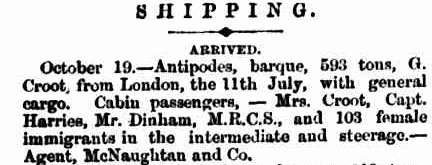
Bounty ship Antipodes 1861

Arrival of 103 female immigrants on the Antipodes
Mercury Monday 21 October 1861, page 2

TRANSCRIPT
SHIPPING.
ARRIVED.
October 19.-Antipodes, barque, 593 tons, G. Croot, from London, the 11th July, with general cargo. Cabin passengers, - Mrs. Croot, Capt. Harries, Mr. Dinham, M.R.C.S., and 103 female immigrants in the intermediate and steerage. Agent, McNaughtan and Co.


Name: Larking, Mary Ann
Record Type: Arrivals
Arrival date: 26 Oct 1861
Ship: Antipodes
Record ID: NAME_INDEXES:1469883
Resource: CB7/12/1/10 p201-202
Archives Office of Tasmania
Link: https://stors.tas.gov.au/37508688-5c26-45f0-ab79-10426a040992

1862: Marriage to Mary Ann Larken (var. Larkens, Larking)
Charles Garforth was 32 years old, a bachelor and a policeman when he married 22 year old bounty immigrant Mary Ann Larken at New Town on 26 June 1862.


Garforth, Charles John
Record Type: Marriages
Gender: Male
Age: 32
Spouse: Larken, Mary Ann
Gender: Female
Age: 22
Date of marriage: 26 Jun 1862
Registered: Hobart
Registration year: 1862
Record ID: NAME_INDEXES:862131
Resource: RGD37/1/21 no 216
Archives Office Tasmania
Link: https://stors.tas.gov.au/RGD37-1-21$init=RGD37-1-21P122

1862: birth of daughter Mira
Charles Garforth's occupation was listed as seaman when the birth of this child, Mira Catherine, was registered by a friend in September 1862.

.

Name: Garforth, Mira Catherine
Record Type: Births
Gender: Female
Father: Garforth, Charles
Mother: Larkins, Mary
Date of birth: 10 Sep 1862
Registered: Hobart
Registration year: 1862
Record ID: NAME_INDEXES:966964
Resource: RGD33/1/8 no 5444
Archives Office Tasmania
Link: https://stors.tas.gov.au/RGD33-1-8$init=RGD33-1-8-P270J2K

1864: birth of son John
Charles Garforth was listed as a mariner of Warwick St Hobart when his son John Garforth was born on 9 October 1864.


Garforth, John Edward
Record Type: Births
Gender: Male
Father: Garforth, Charles John
Mother: Mary, Ann
Date of birth: 09 Oct 1864
Registered: Hobart
Registration year: 1864
Record ID: NAME_INDEXES:1064763
Resource: RGD32/1/4 no 5878
Source: Archives Office of Tasmania
Link: https://stors.tas.gov.au/RGD32-1-4$init=RGD32-1-4P44

1866: son and daughter admitted to Orphan School
A daughter Catherine Garforth (b. 10 Dec. 1863), and a son John Garforth (b. 9 October 1864), were admitted to the Queens Orphan School on 1 st June 1866, application made by their mother Mary Ann Garforth, address Goodwin Court, Molle St. Hobart.


Garforth, Catherine
Garforth, John
Record Type: Health & Welfare
Description: Application for admission 1 June 1866; father Charles Garforth or Pollock, mother Mary Ann Larkins
Property: Queen's Orphan School
Record ID:NAME_INDEXES:1473490
Resource:SWD26/1/9 Image 291 (5 pages)
Source: Archives Office of Tasmania
Link: https://stors.tas.gov.au/SWD26-1-9$init=SWD26-1-9P292

1871: unnamed female birth
An unnamed female child was born to the couple and registered on 24 March 1871. Charles Garforth's occupation was listed as constable, Port Arthur. The birth was registered by an aunt of the child, Isabella Downes.


Garforth, Given Name Not Recorded
Record Type: Births
Gender: Female
Father: Garforth, Charles
Mother: Larkin, Mary Ann
Date of birth: 15 Feb 1871
Registered: Tasman
Registration year: 1871
Record ID: NAME_INDEXES:931332
Resource: RGD33/1/49 no 1668
Source: Archives Office of Tasmania
Link: https://stors.tas.gov.au/83ba670a-ee45-42df-9cfb-1d5455204a8e

1873: unnamed male birth
An unnamed male child was born to the couple while still working at Port Arthur as a clerk.


Garforth, Given Name Not Recorded
Record Type: Births
Gender: Male
Father: Garforth, Charles John
Mother: Larkin, Mary Ann
Date of birth: 20 May 1873
Registered: Tasman
Registration year: 1873 Record ID: NAME_INDEXES:942719
Resource: RGD33/1/51 no 1729
Source: Archives Office of Tasmania
Link: https://stors.tas.gov.au/a85d62fc-191e-472c-9a09-20319cd8e076

1875: son John admitted to Boy's Home
A son, John Edward Garforth, was born to Charles Garforth and Mary Ann Larken [sic] on 9 October 1864. In 1875, the ten year old child was admitted to the Kennerly Boys Home because his father, 44 years old, was serving a two year prison term for larceny. The child was discharged to his mother on 1st September 1876.


Archives Office Tasmania
Garforth, John Edward
Record Type: Health & Welfare
Age: 10 years, 4 months
Father: Garforth, Charles John Mother: Garforth, Mary Ann
Father occupation: Steward
Property: Kennerley Boys Home
Admission dates: 05 Feb 1875
File number: 50
Record ID: NAME_INDEXES:1777095
Resource: NS6493-1-1_052
Source: Archives Office of Tasmania
Link: https://stors.tas.gov.au/NS6493-1-1$init=NS6493-1-1_052

1875: birth of Lucy
Lucy was born in April, three months after her father was imprisoned in January 1875. His occupation was listed as clerk.


Name: Garforth, Lucy Henrietta
Record Type: Births
Gender: Female
Father: Garforth, Charles John
Mother: Mary, Ann
Date of birth: 12 Apr 1875
Registered: Hobart
Registration year: 1875 Record ID: NAME_INDEXES:976728
Resource: RGD33/1/11/ no 1132
Archives Office of Tasmania
Link: https://stors.tas.gov.au/RGD33-1-11$init=RGD33-1-11-P611

1875: Mary Ann Garforth and Richard Kirby
With her husband Charles Garforth serving two years at the Hobart Gaol, sentenced in January 1875, his wife Mary Ann Garforth  was residing at Elphinstone Street, Hobart by August 1875 in a house with garden, stores, sheds and stables owned and occupied by Richard Kirby. Charles Garforth was released with remission of his two year sentence on 13 November 1876. On 14 December 1880 he was tried again at the Supreme Court Hobart for breaking and entering a dwelling.  He was discharged from the Hobart Gaol on 12 December 1885.


Source: TASMANIA. LEGISLATIVE COUNCIL.
VALUATION OF PROPERTY. HOBART TOWN AND LAUNCESTON.
REPORT OF THE COMMISSIONERS.
Laid upon the Table by Mr. Chapman, and ordered by the Council to be printed, August 10, 1875.
Source: Parliament of Tasmania
Link: https://www.parliament.tas.gov.au/__data/assets/pdf_file/0023/36149/lc1875pp43.pdf


RELATED POSTS main weblog