Constable Blakeney's revenge on Thomas Nevin 1880

Constable Blakeney:"You have a nose on me, and now I have got you."
"Nevin was asked by the Mayor if he would, 'as a last chance', state who his companion was, but he persisted in declaring his innocence, saying he saw no figure at all, and attributed his arrest to some ill feeling which existed between Blakeney and himself."
The Launceston Examiner, 6 December 1880


Hobart Town Hall with figure at front, probably the keeper, photographer Thomas Nevin
No date, 1876-80, unattributed, half of stereo?
Archives Office of Tasmania
Ref: PH612 high resolution image


Dismissal, revenge and the ghost
Throughout December 1880 and into January 1881, Tasmanian and intercolonial newspapers reported at length on photographer Thomas J. Nevin's sudden dismissal from his position as Hobart Town Hall keeper, a decision reached by the Mayor because of an incident involving Nevin and three constables on Thursday evening, December 2rd, 1880. Nevin was seen in Davey St in close proximity to the "ghost", a person who had been terrorising citizens on Hobart streets wearing a phosphorescent white sheet. Nevin was also seen in company in various hotels during the evening while ostensibly still on duty, and when apprehended on suspicion of acting in concert with the "ghost", was found to be inebriated.

The readers of The Mercury's account of what took place that evening were given a partially accurate report of the meeting of the Police Committee next day where Nevin and Constables Blakeney, Oakes and Priest gave their versions of the events. The Mercury referred to Nevin's stated belief that Constable Blakeney had arrested him as revenge for an incident which took place two months earlier, in October 1880,when Nevin reported Blakeney for being drunk and asleep on duty to Sergeant Dove, who took the matter to Superintendent Pedder and the Mayor. Blakeney's counsel refuted Nevin's claim that Blakeney had said to Nevin these words as clear intention of retaliation:
By the Mayor: When arresting Nevin, witness [i.e. Blakeney] did not say, "You have a nose on me, and now I have got you, or use any words to that effect.
The phrase used by Blakeney was curiously put: " - you have a nose on me" - by which he meant stalking or surveillance, smelling alcohol on someone found in improper circumstances, and resulting in payback in kind - "and now I have got you". The Launceston Examiner referred more directly to Blakeney's action of arresting Nevin as retaliation for his demotion, by reporting that Nevin attributed his arrest to some ill feeling which existed between Blakeney and himself.


TRANSCRIPT
THE HOBART TOWN GHOST
... Shortly afterwards Oakes and Priest heard cries from two women whom they met that the ghost was in Salamanca Place, and they at once proceeded there, when they saw a figure in white near the Guano Store, and a man (Nevin) on the footpath, struck a light, much more brilliant than a match, and displayed the figure clearly. Constable Blakeney, who arrived upon the scene at the time, arrested Nevin, and the other constables pursued the ghost, but were unable to overtake him. Nevin was asked by the Mayor if he would, "as a last chance," state who his companion was, but he persisted in declaring his innocence, saying he saw no figure at all, and attributed his arrest to some ill feeling which existed between Blakeney and himself. Nevin, who had been repeatedly warned, was dismissed from his situation for drunkenness. The whole affair is still, to a great extent, shrouded in mystery, and the witnesses examined differ as to the precise time that the events narrated took place, but it is believed that the police have now sufficient reason for hoping that they will be able to clear the whole matter up before too long.

[No heading]. (1880, December 6). Launceston Examiner (Tas. : 1842 - 1899), p. 3. Retrieved July 30, 2014, from http://nla.gov.au/nla.news-page4705106

Constable Blakeney: drunk and asleep on duty at 3 am
Constable John Blakeney was hoping to make the rank of Sergeant when his dereliction of duty - being drunk and asleep at 3am in the first week of October 1880 - was reported by Nevin to the Police Office and Mayor as a potential risk to the Hobart Town Hall's security. Housed in the Town Hall were not just the full administrative records of the Mayor's court and business dealings of the City Corporation Council; the Hobart Municipal Police Office where criminal registers were kept was also housed there on the ground floor; and the Town library containing valuable volumes was upstairs, while downstairs in the basement were prison cells housing recently arrested offenders.


Sergeant Dove reported Constable Blakeney to Supt Pedder on October 6th, 1880, in this letter, which curiously bears the word "Matter" underscored in red followed by exclamation marks.

Ref: TAHO, MCC16/63/1/2
Draft Minutes of the Police Committee
21 Feb 1879-25 March 1898
Photos copyright © KLW NFC 2014

TRANSCRIPT
Hobart Town
October 6th 1880
Sir I respectfully report for your information that I found Constable Blakeney asleep on his beat at half past three o'clock this morning, Blakeney was under the influence of drink, and admitted that he had a pint of ale, I bring this matter under your notice as a matter of duty and respect, Trusting that you will deal leniently with the matter as Blakeney is a very willing constable
I remain Sir your obedient W Dove Sergeant
Fr Pedder Esq
Supt of police


Superintendent Pedder requested the Mayor to summon Constable John Blakeney to appear before him and the Police Committee on 6th October 1880, because of the complaint lodged by Sergeant Dove. The Mayor approved Blakeney's demotion to 2nd class.


Minutes of the MCC: As a result, Constable Blakeney was demoted from 1st class to 2nd class.
Constable Blakeney was reinstated to 1st class 3 weeks later, on 26 November 1880.

Ref: TAHO, MCC16/63/1/2
Draft Minutes of the Police Committee
21 Feb 1879-25 March 1898
Photos copyright © KLW NFC 2014

Blakeney's reinstatement and revenge


Last entry in the MCC police committee minutes:
Constable Blakeney was reinstated to 1st class on 26 November 1880 after demotion on October 6, 1880

Ref: TAHO, MCC16/63/1/2
Draft Minutes of the Police Committee, 21 Feb 1879-25 March 1898
Photos copyright © KLW NFC 2014

Within a week of being reinstated, Blakeney was intent on compromising Nevin. He had most likely coerced the other two constables, Oakes and Priest, to invent the story that "the ghost" had appeared in Nevin's company, since their witness accounts were not consistent. Nevin denied having seen anyone dressed in a white sheet. Blakeney's demotion was the result of intoxication, and he was intent on making Nevin suffer the same fate when he sought out Nevin on the night of the arrest.

According to the Mercury's report, on Thursday night, 2nd December 1880, Constable John Blakeney told the Police Committee in Nevin's presence that he had arrested photographer and Hobart Town Hall keeper Thomas J. Nevin "because he thought he [Nevin] had some apparatus for producing the phenomenon of a ghost" (Mercury, Saturday 4 December 1880, p.2). Nevin had been seen earlier that evening in the company of fellow photographer Henry Hall Baily, carrying photographic equipment.

In front of the Police Committee
Nevin was taken to the police watch house by Blakeney, and searched for photographic items. He was found to have none and was released by Sub-inspector Connor without charge. The next day, Friday, 3rd December 1880, he appeared at a special meeting of the Police Committee held at the Town Hall in the presence of the Mayor, Aldermen Harcourt and Espie, and Superintendent of Police F. Pedder. Proceedings began with derogatory comments about Nevin's coloured photography -"ornaments of different colour" - (read the full article here) which may have been a reference to his hand-coloured cartes-de-visite mugshots of prisoners, eg. Job Smith, Walter Bramall, James Sutherland etc. The three constables, Oakes, Priest and Blakeney, gave witness accounts.

During proceedings, Constable Blakeney addressed Thomas Nevin with this snide comment, reprised and denied by his counsel  Alderman Harcourt:

To Nevin : You then wore the same clothing that you do now. I have no ill-feeling against you.'

By the Mayor : When arresting Nevin, witness did not say, " You have a nose on me, and now I have got you," or use any words to that effect.

In other words, Constable Blakeney lied to the Mayor and Police Committee, denying he was out for revenge because of Nevin's complaint leading to his demotion two months earlier. Nevin was adamant he was being framed by the "ghost" story:

Thomas Nevin: “I hope that you have not got it in your mind that I am implicated with the ghost“.

Excerpt: The Mercury 4th December 1880
John Blakeney, constable in the City Police, deposed that he was on duty on the wharf as acting-sergeant, the previous night. While walking in the direction of Mr. Knight’s stores, he saw two men at the corner. He walked over to them to ascertain who they were. As he was approaching them, both began to walk up Salamanca Place towards Davey-street. One split off into the middle of the road, and the other remained on the path on the left hand side, near the stores. Witness did not know who they were. The man in the centre of the road threw a reflection upon the one alongside the wall. The reflection was also upon the wall for a height of about 7 ft. Witness walked quickly towards the man in the road, and at the same time two men came stealthily out of George-street. Witness then commenced to run. One of those who came out of George-street said, “Come back, George.” Witness replied, “Don’t you see this fellow playing the ghost?” when the man in the middle of the road again threw a reflection upon the ghost. Witness arrested this man, who proved to be Nevin. The other two me pursued the man who had been acting as ghost. Nevin was taken to the police station, where he was searched at his own request. There was nothing that would account for the appearance of the ghost found upon him. 
By Mr. HARCOURT: Nevin might have thrown anything that he had away before being searched. 
By the MAYOR: Witness arrested Nevin because he thought he had some apparatus for producing the phenomenon of a ghost. The light that was ignited was not similar to that produced by a match, but was much more brilliant. Witness arrested Nevin between half-past 12 and a quarter to 1 o’clock. Nevin was under the influence of liquor.
To Nevin: You then wore the same clothing that you do now. I have no ill-feeling against you. 
By the MAYOR: When arresting Nevin, witness did not say, “You have a nose on me, and now I have got you,” or use any words to that effect. 
Sub-inspector Connor, who was on duty when Nevin was taken to the police station, stated that after searching Nevin at his own request, he discharged him. His reasons for doing so were that nothing was found upon Nevin which would account for the appearance of the ghost, and that Constable Blakeney did not make a specific charge against Nevin. Witness knew that the “ghost” business had given the police a lot of trouble. He considered that Blakeney simply brought the man Nevin to the station in order to obtain his (Mr. Connor’s) advice. Witness felt embarrassed about the case. Nevin was under the influence of liquor.
Read the full article here and at Trove
Source: THE "GHOST.". (1880, December 4). The Mercury (Hobart, Tas. : 1860 - 1954), p. 2. Retrieved July 30, 2014, from http://nla.gov.au/nla.news-article8990885

Sub-Inspector John Connor


John Connor had enjoyed just a few months of promotion to the rank of Sub-Inspector when he found himself being admonished by the Mayor in front of the Police Committee and three constables for releasing Thomas Nevin from the watch house on the night of 2 December 1880. John Connor was sympathetic to Nevin's situation, and considered him a friend. The Mercury report of the Mayor's meeting (4 December 1880) said that John Connor (viz, witness quoted below) "felt embarrassed about the case. Nevin was under the influence of liquor":
The MAYOR: Don’t you consider that, in view of the excitement occasioned by the appearance of the ghost, and the dangerous circumstances which might arise in consequence of children, and especially women, being frightened by it, that a man arrested under the circumstances under which Nevin was apprehended, ought to be detained and locked up? 
Witness: Unquestionably so, if a distinct charge had been made against him. It was, however, principally owing to the fact that I knew Nevin well and the position that he occupied, and further, that if released and he should afterwards be required, he might readily be found to answer to any charge.


Letter written by John Connor to the Mayor etc expressing gratitude for his promotion.
Ref: TAHO, MCC16/63/1/2
Draft Minutes of the Police Committee
21 Feb 1879-25 March 1898
Photos copyright © KLW NFC 2014

TRANSCRIPT
Police Station
Hobart Town
April 12th 1880
The Right Worshipful the Mayor and Aldermen in Council
Gentlemen
I beg leave most respectfully to convey to you my most grateful thanks for having been pleased to promote me to the rank of Sub-Inspector in the City police and to reassure you that I will use my best endeavours to give satisfaction by a faithful discharge of my duty.
I remain
Gentlemen
Your Obt Servant
John Connor
Sub-Inspector

Aftermath
The dismissal from the position of Hall keeper was in some respects a relief for Thomas Nevin and his family. There were the good times when the Hall was filled to capacity with crowds visiting the bazaars, moving panoramas, and concerts, but there were the bad times when the Chiniquy riots resulted in damage to the building and violent confrontations with protesters. Their third child Sydney John died in January 1877 at the Hall just four months after birth.

The Mayor's Committee expressed deep regret at the dismissal (reported in The Mercury late December and early January 1880-1881), and mindful of his growing family, the Council decided to retain Nevin's photographic services to police. Assisted by his younger brother Constable John Nevin at the Hobart Gaol, Campbell St, Thomas Nevin was re-assigned with warrant and photographic duties as assistant bailiff with The Municipal Police Office, Hobart Town Hall. Working principally in the City Police Court, the Hobart Gaol, and Supreme Court Hobart as assistant to Sub-Inspector John Dorset(t), Nevin continued to provide identification photographs of prisoners up until 1889, a service he had provided for the Prisons Department and MPO since 1872. Many of these mugshots were collated with the Municipal Police Office issued warrants; two death warrants with Nevin's photographs of the condemned man attached (e.g. Sutherland 1883; Stock 1884) now survive intact in the Mitchell Collection at the State Library of NSW. But the incident with Constable Blakeney had clearly affected his opinion of the police. As he was reported to say at a meeting at the Hall in 1888 when government legislation pertaining to police administration was signed as a resolution on the occasion of a bill to be introduced in the House of Assembly to effectively centralise the various municipal and territorial forces:

"Mr. Thos Nevin was under the impression that the police should be under stricter supervision."
The Mercury, 19 July 1888

Constable John Nevin 1880

Constable John (W. J.) Nevin ca. 1880.
Photo taken by his brother Thomas Nevin
Copyright © KLW NFC Group Private Collections 2009 ARR

RELATED POSTS main weblog

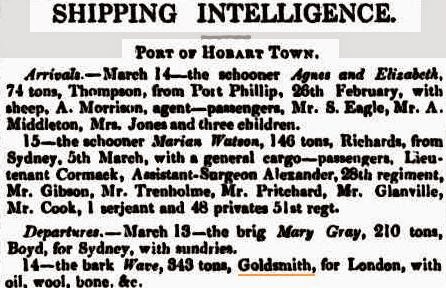
Captain Goldsmith's humorous remark at Wm Bunster's dinner 1841


Title: Currie's Family Hotel
Publisher: [Hobart, Tas. : s.n., between 1876 and 1890]
Description: 1 photographic print mounted on cardboard : sepia toned ; 11 x 19 cm ; on mount 26 x 31 cm
Format: Photograph
ADRI: AUTAS001126251487
Source: Allport Library and Museum of Fine Arts
Notes: Exact measurements 106 x 182 mm
"Hobart Currie's Hotel, Murray Street [at the site of] Carr Field House built by George Carr Clark on this site in 1824. The Union Club Hotel took over this building (the one at the back of the picture) and it later became Currie's Commercial Hotel in 1873 and later still in 1890 the Metropolitan Hotel. Eventually the site for Johnston & Miller Ltd and later Myer"

Captain William Bunster (1793-1854) - a successful merchant and one of the earliest colonists of Van Diemen's Land - was given a convivial farewell dinner at the Union Club in Hobart, Tasmania, which The Mercury reported in some detail on March 2nd, 1841. The occasion was to mark his final farewell to the colony; he was not to know at that dinner that he would be returning within two years.

Among the 35 or so members at the dinner was Elizabeth Rachel Nevin's uncle, Captain Edward Goldsmith, master and commander of the barque, the Wave on which the Bunster family (his wife Anna and four sons) would voyage to England, departing on 14th March and arriving on 22 July 1841.


Departed on the Wave, Cpt Goldsmith, 14 March 1841
SHIPPING INTELLIGENCE. (1841, March 16). The Courier (Hobart, Tas. : 1840 - 1859), p. 2. Retrieved April 21, 2014, from http://nla.gov.au/nla.news-article2956816

The Club Dinner
William Bunster was not the only funster to be feted with cheering and laughter during the toasts and speeches. Captain Goldsmith said he would be happy to take them all home back to England, which was greeted with great mirth, and the newly appointed Solicitor-General Horne took the opportunity to bask in the company's praise while refuting his detractors. Beneath the sentiments of these speeches, however, lie the undertones of political tensions in the colony affecting each dinner attendee associated with the increasing unpopularity of the Union Club's patron and governor of VDL, Sir John Franklin. His dismissal of senior officials from key government posts, including the colonial secretary Montagu, the previous solicitor-general Jones, and the convict discipline manager Forster, was the subject of vituperative attacks in the press amidst other charges of petticoat domination by his wife Jane Franklin from her alleged improper influence in government business. Little wonder that Captain Goldsmith would not only suggest but offer these powerful men a convenient exit, and not entirely in jest. By 1843, Sir John Franklin would be censured and recalled, and Captain Goldsmith would live to recount his affections for the Franklins in his retirement (1856) to his most attentive neighbour Charles Dickens  at Gadshill, Kent, scraps and morsels of which would appear in fellow literati Wilkie Collin's drama of John Franklin's disappearance in the Canadian Arctic, The Frozen Deep (1856). Their performances in the play bookend the 2013 film The Invisible Woman  (dir. Ralph Fiennes).


Captain Goldsmith's humorous remark about repatriation at the Union Club
The Courier, 2 March 1841

The Vice-president gave "Captain Goldsmith, and success to the Wave" - (cheers.)
Captain Goldsmith returned thanks, and in conclusion humourously remarked, that he should be glad to take home to England with him all parties present - (great cheering and laughter.)
TRANSCRIPT
UNION CLUB.
ON Friday last a number of gentlemen, members of the Union Club and private friends of W. Bunster, Esq., entertained that gentleman to dinner, previously to his departure for England, in order to mark no less their personal regard for him, than the high esteem in which they hold his character as one of the oldest colonists of Van Diemen's Land. Although the day was very unfavourable, there were about thirty-five members present, who sat down to dinner at about half-past six; W. Walkinshaw, Esq., acted as Chairman, and T. Hewitt, Esq., as Vice. On the cloth being removed, the following is the order of the toasts, which were drank with all honors:
"The Queen and Prince Albert."
"His Excellency Sir John Franklin, Patron of the Union Club."
"Lady Franklin and the Ladies of Van Diemen's Land."
The chairman then rose and said - It now became his duty to propose a toast which was intimately connected with the occasion of their meeting that day, and which he was sure would be very gratefully received by all who then heard him, not however unmingled with some feeling of regret, that they were about to lose from amongst them the object of that toast - one whom they had known so long, and esteemed so much for his private worth and for the independence and honesty which had ever marked his character - he meant the health of William Bunster - (great cheering.) He trusted, however, that they would again have the opportunity of seeing him in Van Diemen's Land - not that they did not wish him and his amiable family all health and happiness wherever they went (cheers) - but because they could but ill spare so good a fellow-colonist from their ranks - (great cheering.) He could but renew that expression of his own, and the wishes of all present, for his welfare and that of all his family, no matter in what clime, and begged at once to propose the health of their brother member and fellow colonist, William Bunster, - (renewed cheering, which lasted for several minutes.)
W. Bunster, Esq., rose, apparently much moved, and said - Mr. Chairman and gentlemen, I did intend to have said something in return for the honor you have done me, but I feel overpowered at your kindness and the thought of losing so many friends. (The worthy gentleman sat down amidst the hearty salutations of all present, upon whom the plain language of the heart told with greater effect than could the most moving eloquence.)
The vice-president subsequently proposed the health of Mrs. Bunster, which was very cordially received.
Mr. Bunster said, that having rallied a little, as it was only becoming he should in the cause of the ladies, he begged to return them his most hearty thanks for the manner in which they had drank Mrs. Bunster's health. "Believe me," said he, "I shall always feel great pleasure in remembering Van Diemen's Land when I am far from you; my only regret is, that I am leaving it at all; but that is neither here nor there; calls of duty must be obeyed, no matter at what sacrifice of personal feeling. I have lived in this colony for twenty-five years; therefore I may be supposed to know something about it, (some one here cried out, 'You will be a friend to its reputation in England'); yes, that I will," continued Mr. Bunster, "I could not be otherwise. I am a plain man, and can at all events speak with the feelings of a father - I have a pride, and an honest pride, in Van Diemen's Land. I have lived long enough to see a young race springing up in the colony, and a finer race does not exist in the world - (cheers.) I think I stated in this club on some former occasion, that a finer race of children is to be found in no other part of the globe, and the daughters of Tasmania may compare in beauty with those of their parent country - (cheers.) We shall not allow our sons or our daughters to be abused or traduced by a parcel of jobbers. I have tried to steer an independent course. I owe nothing to Government, or any man. When I see, therefore, so many friends around me, I am bound to believe they approve that line of conduct, and if I who deserve so little get so much of your approbation, after all it must be said that honesty is respected in Van Diemen's Land - (cheers.) I have known my friend in the chair for upwards of twenty years, and under various circumstances, but whether in prosperity or the reverse, he has been the same; for however the times might change, his principles were ever fixed, firmly fixed, upon the foundation of honor, (great applause), and I rejoice exceedingly to see him here this day, as well as all of you present. Reciprocating your kind wishes expressed towards myself and family, I beg to drink all your good healths - (great applause.)
The Chairman begged to propose a toast. He was happy to perceive amongst them Mr. Horne, the Solicitor General, whose health he was about to give - (great cheering.) All of them had long known and respected him as a fellow-colonist, and an able member of the bar. Without further comment he would now propose his health as Solicitor-General of Van Diemen's Land. (Loud cheers followed upon this announcement, which were continued for some time, and it seemed that all parties were the most anxious to evince their feelings towards Mr. Horne, in consequence of the infamous attacks lately levelled against him from a contemptible quarter.)
The Solicitor-General returned thanks. He said that so unexpected was the honour that had just been conferred upon him, that although he of all men could not avail himself of the plea of being unaccustomed to public speaking, yet he was really at a loss for words to express his sentiments on this occasion. It was, however, a matter of infinite gratification to him to find that, surrounded as he was by so much of the wealth, intelligence, and public virtue of this Island, his name had been received in so flattering a manner. He should, indeed, never cease to remember the occasion with feelings of gratitude. (Mr. Horne sat down amidst loud cheers.
The Vice-president gave "Captain Goldsmith, and success to the Wave" - (cheers.)
Captain Goldsmith returned thanks, and in conclusion humourously remarked, that he should be glad to take home to England with him all parties present - (great cheering and laughter.)
Mr. T. MacDowell gave "Mr. Rand and the Agricultural  Interest of Van Diemen's Land."
In the absence of Mr. Rand, Mr. Francis Bryant returned thanks.
The Solicitor-General, in an able speech, gave "The Mercantile Interest of Van Diemen's Land"
Mr. Bilton returned thanks.
The healths of the President and Vice-President were subsequently proposed, and received with all honours; after which the festivities of the evening were prolonged to a late hour.
Source: UNION CLUB. (1841, March 2). The Courier (Hobart, Tas. : 1840 - 1859), p. 2. Retrieved April 21, 2014, from http://nla.gov.au/nla.news-article2956930


Dinner service (bowl with lid) used by the Union Club, embellished with the motto "Ships, Colonies, Commerce". Manufactured by Minton & Boyle (mark underneath).
This item is held at the Allport Museum, State Library of Tasmania
Photo copyright © KLW NFC 2015

The Bunster Family
For a comprehensive account of William Bunster and his family, the fate of his house called Hollydene at 33 Campbell St. Hobart and his estate holdings, visit the website Heaven and Hell Together.


Hollydene, 33 Campbell St, Hobart Tasmania
Postcard ca. 1900
TAHO Ref: AUTAS001612539547
http://stors.tas.gov.au/AUTAS001612539547

The carte-de-visite below of postage stamp sized portraits of the Bunster and Young families (unattributed) was most likely the work of William Bock.


An unattributed novelty carte-de-visite with postage stamp sized portraits, probably the work of William Bock , 1863, while apprenticed to his brother Alfred Bock at the City Photographic Establishment. As Alfred Bock’s financial circumstances worsened and the dispute with Frith over the sennotype claims deepened, he advertised a greater variety of formats and novelties. His brother William Bock, who would devote the rest of his life to the production of stamps, may have devised the novelty of autograms, or postage stamps portraits, advertised on 19th October 1863.

Title: Photograph - various portrait of men (unidentified)
Description: 1 photographic print
Format: Photograph
ADRI: NS3210-1-27
Source: Archives Office of Tasmania
Series: Photographs of the Bunster and Young Families, 1850 - 1919 (NS3210)

Captain Edward Goldsmith in Davey Street, Hobart 1854

Paternal uncle and benefactor of photographer Thomas J. Nevin's wife, Elizabeth Rachel Day, was the much respected merchant mariner Captain Edward Goldsmith (1804-1869) who first arrived in Van Diemen's land in 1830, returning every year until his final farewell in 1856, never to return. He retired to his estate at Telegraph Hill, Gad's Hill, Higham, Kent, UK, where novelist Charles Dickens became a neighbour in 1857 on settling his purchased of the house at No. 6 Gadshill Place.

Contributions to the development of VDL
Captain Goldsmith did not become a colonist, nor did he profit directly from convict transportation. His many and varied services and contributions - some at his own expense - during those years to the mercantile, horticultural and shipping development of the colony were inestimable. He built a patent slip on the Queen's Domain and a vehicular steam ferry, the SS Kangaroo in 1854, sat on civic committees, established a marine insurance company, and set up a permanent residence for his family at lower Davey Street, Hobart, although he was away at sea for most of every year. The playwright and journalist David Burn who met him in Sydney in 1845, noted in his diary that Captain Goldsmith's turnaround was eight months (SLNSW Call No: B190) : from England via the Americas or the Cape of Good Hope to the Australian colonies for a single a round trip took just eight months, and during all those voyages not one major incident was reported except for his very first command on the James to Fremantle, Western Australia in 1830 - see this article.


Title:[St. David's Cemetery]
Publisher:[ca. 1870]
Description:1 stereoscopic pair of photographs : sepia toned ; 9 x 18 cm. (mount)
Format: Photograph
ADRI: AUTAS001125299511
Source: W.L. Crowther Library

This stereograph shows the tombstone of Stuart Jackson Dandridge who died of "low fever" aged 31 yrs, on 16 June, 1861. He was a member of the Second Rifles, Southern Tasmanian Volunteers. Unattributed, possibly taken by Thomas J. Nevin in the late 1860s (the photographing of tombstones was one of his services e.g. TMAG Collection Ref; Q1994.56.20.1 ), it also shows Captain Edward Goldsmith's three-storey building directly facing St David's Burial Ground, now St David's Park, in lower Davey Street, Hobart. The building itself was not simply a residence for Captain Goldsmith, his wife Elizabeth (Day) Goldsmith and sons Richard Sydney Goldsmith and Edward Goldsmith jnr, it also functioned as offices for lawyers, shipping and insurance agents, marine merchants, and auctioneers. The address of the building was "19 Davey Street", listed as Captain Goldsmith's at the time of auction of his household goods in mid 1855 in preparation for his family's permanent departure from Tasmania on the Indian Queen in February 1856. In March 1854, the weather board cottage located between Stewart's Brewery and Captain Goldsmith's residence opposite the Burial Ground, was sold to Mr. Lee.


The Hobart Courier 30 March 1854

TRANSCRIPT
Commercial and Markets
Hobart Town, March 27
Mr. T. Y. Lowes sold, on Friday, a weather board cottage residence with premises, 85½ links frontage and 200 depth, between Mr. Stewart's brewery and Capt Goldsmith's residence, in Davey-street, opposite the Burial Ground, for £1350; the purchaser being Mr. Lee, of Victoria.


Hobart Courier 8 August 1855
Auction of household goods at Capt Goldsmith's house, 19 Davey St

Referred to as Captain Goldsmith's house or residence in newspapers of the period, the building pre-dated the Congregational Church, erected in 1857, and the Royal Tennis Court, erected in 1875. Photographs taken of Davey Street in the 1870s show all of these buildings in a row, facing St David's Park, and many are still standing today, but by 1854, only six or so landmarks existed:

1. the Waterloo Inn, favoured by sea captains visiting the town - on the corner of Murray and Davey Streets, now the offices of the legal firm, Butler, McIntyre & Butler;

2. a weather board cottage sold to Mr Lee of Victoria in 1854, which sat between Captain Goldsmith's house and Stewart's Brewery;

3. photographer Douglas Kilburn's house, now known as Kilburn House

4. the Odd Fellows' Hall, also photographed by Thomas Nevin in July 1871 which was labelled the "Tasmanian Hall" on early maps, located at the corner of Davey and Harrington Streets. The present building was founded by Monsieur Camille Del Sarte as a concert and music hall, designed by Mr. F. Thomas, and opened officially in May 1860.


The Waterloo Inn on the corner Davey and Murray Sts - "a favourite with the sea captains visiting the town" - now the offices of the legal firm, Butler, McIntyre & Butler. Courtesy ePrints UTAS.

Captain Goldsmith's neighbours 1853-54
The premier city residential address for proximity to the harbour was undoubtedly lower Davey Street Hobart in the 1850s. Two neighbours figured prominently in Captain Goldsmith's life in these years. Firstly. the photographer Douglas T. Kilburn, brother of William Edward Kilburn, photographer to Queen Victoria, who photographed Captain Goldsmith in Sydney in 1849, and most likely moved to Hobart as a consequence of this encounter. His photographs of the houses in Davey Street were exhibited at the Paris Exposition of 1855. Secondly, marine merchant F. A. Downing, who bought ships and shipwrecks, and found himself in court with Captain Goldsmith over the failure to return a Siebe Gorman & Co. diving apparatus he had borrowed from Captain Goldsmith to salvage wreckage from the Catherine Sharer.


Captain Edward Goldsmith (1804-1869) ca. 1849
Daguerreotype by Douglas T. Kilburn, Sydney
Copyright © Private Collection KLW NFC Imprint 2014

TRANSCRIPT
THURSDAY AFTERNOON, NOVEMBER 9.
TASMANIAN CONTRIBUTIONS TO THE PARIS EXPOSITION.
D. T. Kilburn, Esq., of Davey-street, exhibits five calotype views of different localities in Hobart Town. (1.) A view of Macquarie-street, from above Mr. Crisp's residence, looking down towards the Domain, and including within range St. Joseph's (R. C.) Church, the Cathedral of St. David's. &c. (2.) The New Market Place, Hobart Town. (3.) St. David's Cathedral. (4.) View of Macquarie-street, including the Bank of Australasia, Macquarie Hotel, &o. &c. (5.) View of the houses in Davey-street, opposite St. David's Cemetery.

Source: THE COURIER. (1854, November 9). The Courier (Hobart, Tas. : 1840 - 1859), p. 2. Retrieved March 27, 2014, from https://nla.gov.au/nla.news-article2242479


Above: Reproduction of an earlier photographer's portrait of Douglas T. Kilburn, who died in 1871, aged 58 yrs, more than a decade before John Watt Beattie arrived in Tasmania and reproduced these Members of Parliament portraits ca. 1895.

Title: Douglas Thomas Kilburn
In: Members of the Parliaments of Tasmania No. 95
Publisher: Hobart : J. W. Beattie, [19--]
Description:1 photograph : sepia toning ; 14 x 10 cm
Format: Photograph
ADRI: AUTAS001136191202
Source: Allport Library and Museum of Fine Arts


Photo copyright © KLW NFC 2014
Thanks to Astrolabe Books Salamanca Place Hobart

From the Hobart Town Gazette 1853: Captain Edward Goldsmith, landlord of a house at Davey Street, valued at £120, rates at £6 per annum. Douglas T. Kilburn's house next door was listed as "empty" in 1853 because the Kilburns were resident at Claremont House, 254 Elizabeth St, constructed on John Mezger's original land grant in 1838.
BIRTH.
On the 19th inst., at her residence, Claremont House, Elizabeth-street, Hobart Town, the lady of Douglas T. Kilburn, Esq., (late of Victoria,) of a son.
Source: Family Notices. (1853, January 27). The Argus (Melbourne, Vic. : 1848 - 1957), p. 4. Retrieved March 27, 2014, from https://nla.gov.au/nla.news-article4789299

The house on the other side of Captain Goldsmith's was owned by Lt Nunn of the 99th Regiment who married Ann Pedder. Neighbours in 1853 were:

F. A Downing - store
Robert Walker - house and store
J. James and G. Moore - Office and cellar
Robert Pitcairn
Wilson's estate and Wilson's brewery
Lieutenant Nunn and William Bayles
Capt Goldsmith
- Kilburne [sic]
Peter Oldham
John Dunn
William Roberston
Thomas Gardner
Frederick Packer
Miss Dixon
Mrs Walch etc etc


Photo copyright © KLW NFC 2014
Thanks to Michael Sprod, Astrolabe Books Salamanca Place Hobart

From the Hobart Town Gazette 1854: Captain Edward Goldsmith, landlord of a house at lower end of Davey Street, valued at £120, rates at £6 per annum. His neighbours were:

Frederick A. Downing
Empty
Peter Nichol
John Ferguson
George Moore
Robert Pitcairn
John Leslie Stewart
William Bayles
Edward Goldsmith
Douglas T. Kilburn
Frances Gill


Captain Goldsmith's residence, Davey St. Hobart
Photo © KLW NFC Imprint 2014

Kilburn House
The site next to Captain Goldsmith's building is now The Trades Hall Building component of the Edward Braddon Commonwealth Law Courts, 39-41 Davey St, Hobart. In 1855, Captain Goldsmith's house was No. 19 Davey St. Douglas Kilburn's house, which is still standing, was No. 22, but is now Kilburn House, 51 Davey St.


Kilburn House, now a three storey building with red roof - next to poplar trees, Davey St. Hobart
Photo © KLW NFC Imprint 2011

According to the Australian Heritage Database, Kilburn house is a large free-standing townhouse in Colonial neo-Renaissance style owned by Douglas Thomas Kilburn in 1858, let to William George Lempriere, and which is "marred by third level addition. Glazing bars to windows are missing."

The Trades Hall site, as the Australian Heritage Databasebnotes, was Stewart's Brewery: -

The earliest European occupation of the building was in 1847, with the Trades Hall building being occupied by John Leslie Stewart who owned the building until the1860s as part of the Brewery Complex.
Millionaire W.J.T Clarke owned the building from 1863 - 'he owned it for a dozen years and for the last five of those his tenant was Alexander Ireland who conducted his boy's school, the Collegiate Institution'.
The property was then purchased by Samuel Smith who established the adjoining Hobart tennis court, and club in 1875 (Hobart Real Tennis Club 2008). Travers owned the property until his death in 1888 and leased the building to Dr Turnley. From 1899 to 1924 the building was used as a Girl's Industrial School, and then as a Trades Hall from 1924 until it was acquired by the Commonwealth in 1974.

The Congregational Church and Real Tennis Court


Detail of -
Title: [Hobart Town] / A.C. Cooke, delt
Creator: Cooke, A. C. (Albert Charles), 1836-1902
Publisher: [Melbourne : Wilson and Mackinnon], 1879
Description: 1 print : woodcut ; sheet 33 x 53 cm
Format: Print
ADRI: AUTAS001128189651
Source: Allport Library and Museum of Fine Arts
Balloon's eye view
Published in the Australasian sketcher with pen and pencil, 10 May 1879 - printed and published at the Argus Office for Wilson and Mackinnon, 1879

The foundation stone of the Congregational Church, highlighted in this detail of Cooke's balloon's eye view of Hobart 1879 and visible in this photo on the right, was not laid until in 1857, and the Real Tennis Court (Royal Tennis) was built next to it in 1875.


Davey St looking west: Image courtesy ePrints, University of Tasmania


Charles Abbott: Congregational Church, Davey St. Kilburn House is partially visible on extreme left. Image courtesy ePrints, University of Tasmania.

The Tasmanian Hall or Odd Fellows Hall


Courtesy University of Tasmania Library Special and Rare Materials Collection.
"Photograph of Davey Street, Hobart, looking east, in about 1876. The photograph is taken from the intersection with Harrington Street and Oddfellows Hall is in the foreground. The photographer was Henry Hall Baily who had studios in Elizabeth and Liverpool Streets, Hobart from 1865 until 1918."

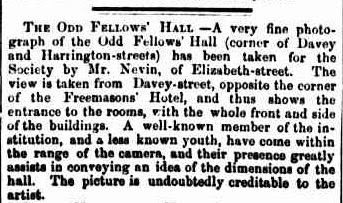
The slightly different photograph below is unattributed, taken at another time. Thomas Nevin's photograph(s) of the Odd Fellows Hall were praised in the press of July 1871.


The Hobart Mercury 25 July 1871

TRANSCRIPT
THE ODD FELLOWS' HALL - A very fine photograph of the Odd Fellows' Hall (corner of Davey and Harrington-streets) has been taken for the Society by Mr. Nevin, of Elizabeth-street. The view is taken from Davey-street, opposite the corner of the Freemasons' Hotel, and thus shows the entrance to the rooms, with the whole front and side of the buildings. A well-known member of the institution, and a less known youth, have come within the range of the camera, and their presence greatly assists in conveying an idea of the dimensions of the hall. The picture is undoubtedly creditable to the artist.

A fortnight earlier, on July 12, 1871, Thomas J. Nevin married Elizabeth Rachel Day (1847-1914), niece of Captain Edward Goldsmith, daughter of master mariner Captain James Day and Rachel Pocock, brother of Captain Goldsmith's wife Elizabeth (Day) Goldsmith.


The Oddfellows Hall, formerly Delsarte’s building and the IOOF Lodge
Photo © KLW NFC 2011 ARR

Professional photographer Thomas J. Nevin became a member of the LOYAL UNITED BROTHERS LODGE, A. & I.O.O.F. (Australian and International Order of Odd Fellows) in 1869 and fulfilled several roles within the Society, including official photographer, committee member for the Anniversary Ball held at the Bird and Hand Hotel, and agent for the Secretary. During September 1875, he placed an advertisement in the Mercury soliciting members of the medical profession to render services to Lodge members and their families.

St Mary's Hospital & Dr Edward Bedford


Davey Street Hobart 1870s: on the left where three men are standing, is St. Mary's Hospital; on the right, Captain Goldsmith's two-storey house - bearing the Collegiate School name by the 1870s - facing St. David's Cemetery (Burial Ground). Image courtesy ePrints, University of Tasmania

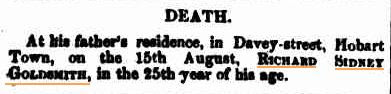
On the opposite side of (lower) Davey Street, adjoining the Burial Ground, was St Mary's Hospital, erected in 1847.When elder son Richard Sydney Goldsmith fell gravely ill with fever in 1854, he was attended by Dr Edward Samuel Pickard Bedford (1809-1876) at the hospital. Edward Bedford was the medical officer for the City in 1852, on whose committee Captain Goldsmith served when Bedford campaigned for election in February 1855. But on 15 August 1854, at his father's house, Richard Sydney Goldsmith died, aged just 24 yrs old. He was born to Elizabeth Goldsmith only days after her arrival at Fremantle, W.A. in May 1830, on board the ill-fated brig the James alongside her very young husband Captain Edward Goldsmith on his first command since their marriage in 1829 at Liverpool, UK. Richard Sydney Goldsmith was baptised on 11 November 1830 at the Garrison church St. Philips, Sydney, NSW. At the time of his death, he was a cashier of the Union Bank of Van Diemen's Land, located in Macquarie Street, Hobart. He was buried in St David's cemetery opposite the family home.


Richard S. Goldsmith 1854
Photographer: Henry Frith?
Private Collection; TAHO copy


Richard Sidney [sic] Goldsmith (1830-1854)
Obituary, The Courier Hobart 15 August 1854


RGD 35/04. Deaths, 19 May 1853-19 Jun 1855
https://familysearch.org/pal:/MM9.3.1/TH-1961-35350-19767-29?cc=2125029&wc=M93C-94V:2003527580


Title: Photograph - Hobart - Macquarie Street - Union Bank
Description: 1 photographic print
Format: Photograph
ADRI: PH1-1-32
Source: Archives Office of Tasmania


Title: Photograph - Hobart - St Mary's Hospital, later Lands Dept (Beattie photo)
Description: 1 photographic print
Format: Photograph
ADRI: PH30-1-5605
Source: Archives Office of Tasmania

Dr Edward Bedford published "On the epidemics of 1852-3" (1854)


Title: Dr. Edward Bedford 1874
Publisher: [1874]
Description: 1 photograph : silver albumen print ; 8 x 6 cm
Format: Photograph
ADRI: AUTAS001125882340
Source: Allport Library and Museum of Fine Arts
Notes: Exact measurements 75 x 53 mm
Title inscribed in pencil on verso in unknown hand


TRANSCRIPT
LIST OF DR BEDFORD'S COMMITTEE, with power to add to their number :
Anson, J Lawrence, John Brown, Thomas Lovell, S. Butler, Henry. M.L.C Levy. S, Burgess and Barrett Momsnn, A., M.L.C Bailey, J. G. Maning. A. H. Barnett, Mr. Meikle, Robert Bales, William Mc Kay, A. B. Cook, Henry Milne, George Chandler, Edward Manson, David Dunn, John, M.L.C. Nicholas, Alfred Flegg, C. Orr, Alexander Forster, John Perkins, John Fearnley, James Pitt, William Farrelly, P. Bernard Priest, J. Goldsmith, Edward Pain, Henry Graves J. W. Seabrook, H W. Green, H. J. Stuart, J. W. Hamilton, Mr. Sly, James Hornby, William Turner, James Haywood, C. Walch, J. H. B. Lewis, Richard Watchorn. W. Lewis, Neil Wilson, Henry Lipscombe, Alderman Wilson, Robert Lowes, T.Y. White. J.
The Committee meet every evening at seven o'clock (Saturday and Sunday excepted), at Messrs. Meager and Basstlian's, Argyle-street.
559 Fred. CANE, Secretary.
Biographical Extract sourced from ABD

"... Dr Bedford's duties as surgeon to the Commissariat Department included attendance on the sick in the Colonial Hospital, various penitentiaries, the Orphan Schools, convict road-gangs and the constabulary. From 1841 he served on the Medical Examiners' Board and made the recruitment of doctors a special interest. Realizing that the sick poor of Hobart loathed the Colonial Hospital with its convict discipline and associations, he started St Mary's in Campbell Street as a subscription hospital; in 1847 the foundation stone was laid for the unpretentious, but charming, building in Davey Street, Hobart, which was used as public offices after St Mary's closed. By 1856 Bedford had planned in detail a medical training school at St Mary's with Thomas Arnold as its classical and mathematical lecturer and himself teaching surgery. The scheme was unsuccessful, for the Royal College of Surgeons refused its recognition, and Hobart was left with few scholars when prosperity declined after 1856. Some young men did, however, make their first steps in a medical career with Bedford before going to British universities, but none of them returned to Tasmania.

Bedford was active in social affairs. In 1856 he was elected to the first Legislative Council under responsible government and held his seat until 1859 but revealed no particular talent for politics. He was prominent in the Royal Society and showed a diversity of interest in his three papers: 'Observations upon the condition of young marsupial animals' (1842); 'On the epidemics of 1852-3' (1854) and 'On the origin of nervous force' (1863). He was an early and enthusiastic collector of local art and acquired several water-colours by John Skinner Prout and Thomas Wainewright. He sponsored art exhibitions and lectured to the Mechanics' Institute on 'The Grecian Statues' and 'Expression with reference to the Fine Arts'. He was a founder of the Tasmanian Club in 1861.

His enthusiastic local patriotism evaporated with the depression of the 1860s, when the government closed his private hospital. In 1863 he migrated to Sydney and the congenial company of his brother-in-law, Sir Alfred Stephen. Appointed medical adviser to the New South Wales government, he vigorously promoted legislation to enforce the use of vaccination against the smallpox which during 1869 was in the front of every mind because of the outbreaks in neighbouring colonies. Bedford attended the public meeting on 20 March 1868 which accepted the proposal for a new hospital to commemorate the Duke of Edinburgh's narrow escape from assassination and he seconded the motion to name it the Prince Alfred Hospital. He was on the first working committee to gather subscriptions for this hospital and continued active in its affairs for some years. He took an interest in the Sydney Infirmary and in 1872 was nominated its honorary surgeon. He died in Sydney on 24 February 1876. On 14 January 1836 at Hobart he had married Mary Selby of Wilmington, Kent. He was survived by two daughters and seven sons, five of whom attended the Hutchins School."
Select Bibliography
Votes and Proceedings (House of Assembly, Tasmania), 1861 (34)
Royal Prince Alfred Hospital Gazette, 26 Apr 1918, hospital jubilee
Empire (Sydney), 22 Oct 1870, 21 Mar 1871, 7 Feb 1872
Sydney Morning Herald, 26 Feb 1876
St Mary's Hospital, Report, 1856 (Archives Office of Tasmania)
Hutchins School, Admission Register, 1846-92 (Archives Office of Tasmania)
Colonial Secretary's letters (Archives Office of Tasmania).

Early Maps of Hobart Town, VDL


1851 Plan PWD 2661786


Map of Hobart 1854


Map of Hobart 1858
All maps courtesy of Archives Office Tasmania

RELATED POSTS main weblog

Captain Edward Goldsmith and the land at Lake St Clair 1841

CAPTAIN Edward GOLDSMITH and George BILTON, conveyancing
LAKE ST CLAIR Van Diemen's Land (Tasmania)

"This part of the country unknown" north of the Great Lake was printed on the Surveyor-General's map of Van Diemen's Land in 1824. Of course that part of the country - as every other part - was known to the Aboriginal inhabitants of Tasmania since their arrival sixty thousand years ago right up to the period before colonisation at the beginning of the 19th century. The decimation of their numbers within a few decades of the British establishing the colony they called Van Diemen's Land (1804) is widely regarded as genocide (Robert Hughes, James Boyce, Lyndall Ryan etc)


Tasmanian Heritage and Archive Office
Title: Chart of Van Diemen's Land from the best authorities and from actual surveys and measurements / by Thomas Scott Assistant Surveyor General ; engraved by Charles Thompson (Cross) Edinburgh
Creator: Scott, Thomas, 1800-1855
Map data: Scale [ca. 1: 545,000]
Publisher: [London : s.n.], 1824
Description: 1 map : col. ; 83.5 x 59 cm
Format: Map
Notes: "from the original survey brought by Captain Dixon of the ship Skelton of Whitby 1824"
Map of Tasmania with land grant, distances from Hobart, comment on topography and settlement. Relief shown by hachures and bathymetric soundings
Table of references with grants and owners


The Derwent Ship Building Company
By 1840, master mariner Captain Edward Goldsmith had acquired 100 acres from Thomas Drew in this area of Van Diemen's Land, now known as the Lincoln Land District of Tasmania. He was well aware of the success of The Van Diemen's Land Company (also known as Van Dieman Land Company) in the north-west, and envisaged a similar operation in the Falkland Islands. The Van Diemen's Land Company was founded in 1825; it received a royal charter and a grant of 250,000 acres (1,000 km2) in 1826. The company was a group of London wool merchants with plans to supply the British textile industry. Captain Edward Goldsmith was aware of disputes with the VDL Company's white servants over Aboriginal women which had escalated into the Cape Grim Massacre of 1828. The Falklands did not present such problems. In a letter to the Sydney Gazette, July 1839, he wrote: -
I am satisfied that the Falklands, from their position and internal resources, and being free from natives, will, under a company, thrive much faster than Van Dieman's Land. Sheep will do well, and may be easily imported from New South Wales.
Source: The Sydney Gazette and New South Wales Advertiser (NSW : 1803 - 1842) Saturday 27 July 1839 p 2 Article ADVANCE AUSTRALIA SYDNEY GAZETTE.

Coincidentally, there is a road called the Gad's Hill Road which runs through the Mersey Forest (7304), due east of Lake St. Clair, which Captain Goldsmith may have named after his estate, Gad's Hill, at Higham, Kent. He may have visited the region before conveying it to George Bilton in February 1841. Bilton's co-partnership with Edward Goldsmith, Andrew Haig and William Williamson in The Derwent Ship Building Company was dissolved a few weeks later, in March 1841.


Lincoln Land District is one of the twenty land districts of Tasmania which are part of the cadastral divisions of Tasmania. It was formerly one of the 18 counties of Tasmania. Its south-eastern tip is surrounded by the River Derwent on one side, and the Nive River on the other. It is bounded to the north by the Pieman River. It includes Cradle Mountain, the Overland Track, Lake St Clair and most of the Cradle Mountain-Lake St Clair National Park.
Source; http://en.wikipedia.org/wiki/Lincoln_Land_District


TRANSCRIPT
George Bilton, 100a., Lincoln, originally Thomas Drew, who conveyed to Edward Goldsmith, who conveyed to the applicant; claim dated 20th January, 1841.-Bounded on the east by 40 chains southerly along Lot .'350 located to Thomas Burnett, on the south by 25 chains westerly along Lot 358, on the west by 40 chains northerly along Lot 359, and on the north by 25 chains easterly also along Lot 359 to the point of commencement.
Source: Classified Advertising. (1841, February 12). The Courier (Hobart, Tas. : 1840 - 1859), p. 1.
Link: https://nla.gov.au/nla.news-article2957066


Memorial to Lieutenant Thomas Burnett
St David’s Park, Hobart, Tasmania
Photo copyright © KLW NFC 2014 ARR

The land at Lake St Clair in the county of Lincoln, VDL, conveyed by Captain Goldsmith in February 1841 to George Bilton was bounded on the south by land allocated to Lieutenant Thomas Burnett, who had drowned four years earlier, on 21 May 1837 while conducting hydrographic surveys of the D’Entrecasteaux Channel aboard the colonial cutter Vansittart. Lieutenant Burnett had accompanied the newly-appointed Lieutenant-Governor of the colony, Captain Sir John Franklin on the voyage to Hobart on board the Fairlie just months before he (Burnett) drowned, arriving on 6th January 1837. He was buried with full naval honours in St David’s cemetery, where his monument still stands. Designed by John Lee Archer, Colonial Architect, the monument stands on the stone plinth intended as the main stand for an observatory for Burnett.


Detail: Memorial to Lieutenant Thomas Burnett
St David’s Park, Hobart, Tasmania
Photo copyright © KLW NFC 2014 ARR

George Bilton acted as proxy for John James Meaburn in the dissolution of the enterprise “The Derwent Ship Building Company” dated March 3rd, 1841, witnessed by Captain Goldsmith’s neighbour in Davey St, Robert Pitcairn.


TRANSCRIPT
NOTICE.- The Copartnership hitherto carried on by the undersigned, under the style or firm of "The Derwent Ship Building Company", has been dissolved as on this date.
George Bilton
for John James Meaburn
Andrew Haig
E. Goldsmith
Wm. Williamson
Witness- Robert Pitcairn
Hobart Town, March 3. [1841]
Source: Classified Advertising. (1841, March 5). The Courier (Hobart, Tas. : 1840 - 1859), p. 3. Retrieved April 21, 2014, from http://nla.gov.au/nla.news-article2956876

The company was originally established in 1839 once the acquisition of land at Secheron Bay, Battery Point, was settled, with Captain Goldsmith's expressing his intention of establishing a patent slip there. The local press reported the venture with considerable optimism:
LAND.-The property of Mr H. W. Mortimer,sold on Wednesday last by Mr W.T. Macmichael, realized the following prices, viz.-an allotment fronting the Derwent, 115 feet,£5 5s per foot,£903 12s do do. 115 feet, £9 10s, £1092 10s; and the dwelling house and premises, £625.-Messrs Bilton & Meaburn, and Captain Goldsmith of the Wave were purchasers, and we have been informed it is their intention to lay down a patent slip, which Captain Goldsmith will bring with him next voyage.-

Source: Southern Australian (Adelaide, SA : 1838 - 1844) Wed 6 Nov 1839 Page 3 V. D. LAND EXTRACTS.
SHIP BUILDING. - A Ship Building Company, composed of Messrs. Bilton, Goldsmith, Haig, Meaburn, and Williamson, are just about to commence, on the ground lately purchased from Mr. Mortimer, where an extensive and well sheltered building yard, and patent slip, are to be erected; an enterprise very much required, and deserving of encouragement. The parties are all gentlemen of practical knowledge, a qualification very much calculated to give general satisfaction, and to ensure success, for the attainment of which they have our best wishes.
Source: Colonial Times, Tues 29 October 1839, page 7, Domestic Intelligence

Early visual records of Lake St. Clair
Artists such as John Glover (in 1834) and Skinner Prout (in 1845) had travelled in the region and represented Lake St Clair and surrounding mountains in sketches, but it was not until the 1860s when photographs taken by Morton Allport of his party's excursion to Lake St Clair made the region a better known traveller's destination.


Glover, John. (1834). [Four Tasmanian views]
NLA Catalogue online: http://nla.gov.au/nla.obj-138917890


In: Excursion to Lake St. Clair February 1863 No. 12
Publisher: Hobart : M. Allport, 1863
Archives Office of Tasmania
https://stors.tas.gov.au/AUTA001126254101$init=AUTA001126254101P34

RELATED POSTS main weblog

Prisoner Ephraim DOE 1874

Charged with murder of John Harris 1867
Tasmanian Times (Hobart Town, Tas. : 1867 - 1870), Tuesday 22 October 1867, page 3
LAUNCESTON SUPREME COURT.
CRIMINAL JURISDICTION. THURSDAY, 16TH OCTOBER, 1867. (Before His Honor Sir-Francis Smith, Knight, Puisne Judge.)

MURDER. Ephraim Doe and Bridget Doe were charged with having on the 14th of August last, at Mountain Vale, near Bishopsbourne, wilfully and maliciously murdered one John Harris. The Attorney-General prosecuted. Mr. Rocher, sen., for Ephraim Doe, and Mr. Rocher, jun., for Bridget Doe. Prisoners pleaded not guilty. The particulars of this case were fully given in our columns, in connection with the coroner's inquest. The jury retired at 4.40 p.m., and returned into Court at a quarter to six with a verdict of " guilty of manslaughter" against Ephraim Doe, and a verdict of " not guilty" in the case of Bridget Doe. His Honor sentenced the prisoner to fifteen years imprisonment.
Source: Tasmanian Times (Hobart Town, Tas. : 1867 - 1870), Tuesday 22 October 1867, page 3
Link: https://nla.gov.au/nla.news-article232856100

Prisoner Ephraim Doe per ship Layton 3 was sentenced to 15 years for manslaughter at the Supreme Court Launceston on 17 October 1867. He was 67 years old, 5ft 5ins tall, with grey hair. He had the letter "E" on his right wrist. Ephraim Doe received a conditional pardon (CP) and was photographed by T. J. Nevin on discharge in the week ending 18 March 1874.

Police identification photograph 1874


Prisoner Ephraim Doe
Photographed by T. J. Nevin 18 March 1874
QVMAG Ref: QVM1985_P_0066


The phrase "Taken at Port Arthur 1874" is misinformation inscribed on the verso in the late 1890s -1900s for display and exhibition of Tasmania's penal heritage in the name of tourism at John Watt Beattie's convictaria museum in Hobart.

A paper copy is held at the Archives Office of Tasmania, Hobart.


Police Gazette Record 1874


Source: Tasmania Reports of Crime for Police (weekly police gazette) J. Barnard Govt printer

Ephraim Doe per ship Layton 3 was sentenced to 15 years for manslaughter at the Supreme Court Launceston on 17 October 1867 and discharged in the week ending 18 March 1874.