Pages

With Jean Porthouse GRAVES 1870s West Hobart

THE LEGAL FRATERNITY
CALDEW, WEST HOBART
JOHN WOODCOCK GRAVES jnr


Lawyers, barristers, magistrates, politicians, police superintendents, detectives, their families and their prisoners were photographed by Thomas J. Nevin from the late 1860s to the 1880s. As government contractor from 1868 to the legal fraternity and the Hobart City Council, Thomas Nevin's photographs of people are especially interesting because of his access to all social classes of the British colony of Tasmania which he had entered in 1852 as the ten year-old child of soldier, journalist, teacher and poet, John Nevin snr.

At Adventure Bay, Tasmania 1872
Several photographs taken by Thomas J. Nevin of the families of government official Lukin Boyes, barrister Robert Byron Miller, and solicitor John Woodcock Graves jnr,of Caldew, West Hobart, have survived in public and private collections. This group was photographed at Adventure Bay on 31st January 1872. .One copy is held at the Tasmanian Museum and Art Gallery. Another copy was retained in a family album by Jean Porthouse Graves, the eldest daughter of John Woodcock Graves jnr. who is pictured reclining at extreme lower left.


One of four extant photographs taken on 31st January 1872 and printed in various formats from Thomas J. Nevin's series advertised in The Mercury, 2nd February, 1872, as the Colonists' Trip to Adventure Bay (Bruny Island).

[From lower left]: John Woodcock Graves jnr, solicitor; his daughter Jean Porthouse Graves; above her, R. Byron Miller, barrister; on her left, Sir John O'Shanassy, former Premier of Victoria;
[Centre top]: Lukin Boyes, son of auditor and artist G. T. W. Boyes, leaning on stone structure
[Extreme lower right]: James Erskine Calder, former Surveyor-General, Tasmania

Single unmounted carte-de-visite photograph of large group
From the Miller and Graves family album
Photos recto and verso: copyright © KLW NFC Imprint 2015 Private Collection


Verso: One of four extant photographs taken on 31st January 1872 and printed in various formats from Thomas J. Nevin's series advertised in The Mercury, 2nd February, 1872, as the Colonists' Trip to Adventure Bay (Bruny Island).
Verso with T. Nevin late A. Bock , 140 Elizabeth St. Hobart Town commercial stamp
Verso inscriptions include these identifiable figures at the "Picnic":
Father = John Woodcock Graves jnr,
Sir John O'Shanassy = former Premier of Victoria,
Self = Jean Porthouse Graves, daughter of John W. Graves,
L. Boyes = Lukin Boyes (?), son of G.T. W. Boyes
From an album compiled by the families of John Woodcock Graves jnr and R. Byron Miller
Private Collection © KLW NFC Imprint 2015

Thomas Nevin reprinted this group photograph of John Woodcock Graves jnr and company as an oval stereograph on a buff mount, with his blindstamp impress on recto at centre between the two images. This copy is held at the Tasmanian Museum and Art Gallery.


One of four extant photographs and duplicates in various formats from Thomas J. Nevin's series advertised in The Mercury 2nd February, 1872, as the Colonists' Trip to Adventure Bay (Bruny Island), taken on 31st January 1872:
[From lower left]: John Woodcock Graves jnr, solicitor; his daughter Jean Porthouse Graves; above her, R. Byron Miller, barrister; on her left, Sir John O'Shanassy, former Premier of Victoria;
[Centre top]: Lukin Boyes, son of auditor and artist G. T. W. Boyes, leaning on stone structure
[Extreme lower right]: James Erskine Calder, former Surveyor-General, Tasmania
TMAG Ref: Q1994.56.5 [scan 2015]

At Caldew, West Hobart, Tasmania


Group portrait of two male adults, one boy and three girls, members of the Graves, Miller and Boyes family taken by Thomas Nevin ca. 1870 at Caldew, West Hobart.
Stereograph in arched mount on yellow card
TMAG Ref: Q16826.10

Possible identification as follows:
Frederick Lukin Boyes: the boy seated on the grass who died in 1881, aged 16 yrs, son of Lukin Boyes.
Lukin Boyes, Customs Officer: the man seated on right in light clothing who is patting a goat or deer.
Jean Porthouse Graves (born 1858): the teenage girl sitting next to Lukin Boyes, daughter of John Woodcock Graves jnr (not pictured here).
Robert Byron Miller, barrister: sitting on the same bench, whose son Francis Knowles Miller later married Jean Porthouse Graves.
Two more of John Woodcock Graves four daughters: the two other girls, one sitting on a chair at extreme left, and the other seated on the grass, were possibly Mimi (born 1862), Trucaninni (1864) or Mathinna (born 1859).  The latter two were given Aboriginal names at birth.

Possible location:
Two tall thin metal statues of a beggar and a harlequin flank the group on either side. Their significance and provenance is not known. Perhaps they were cast by a local sculptor for private decorative use, or they may have featured as props in a theatrical production, or even confiscated by Lukin Boyes at the Customs and Tariff Office.  But it is the lion statue which is the focal point at the foreground of the image. It belonged to John Woodcock Graves' family of Caldew, West Hobart. A later photograph taken of Jean Porthouse Graves ca. 1877 shows it placed near the doorway of the house (see below). This stereograph taken by Thomas Nevin and the one immediately below it were possibly taken on the same day, ca. 1870 and in the same location, at the back of Caldew when West Hobart was still a sparse "wilderness" (see newspaper accounts below).


Verso: Group portrait of two male adults, one boy and three girls, members of the Graves, Miller and Boyes family taken by Thomas Nevin ca. 1870 at Caldew, West Hobart.
Stereograph in arched mount on yellow card
TMAG Ref: Q16826.10


The back of the photograph above was stuck to the front of this photograph below, i.e. the stereographs had been kept one on the top of the other, front up. When someone separated the top one from this one placed underneath, they tore off a strip of the left hand image, notably the detail of a house in the background. Both photographs feature the same man in a white hat, probably R. Byron Miller, and because they were stored together, they were most likely taken on the same day and in the same location.


Photographer: Thomas J. Nevin ca. 1870
Stereograph in arched mount on yellow card
TMAG Ref: Q16826.21 [scan 2015]

As above, Robert Byron Miller again in a white hat and one of the daughters of John Woodcock Graves, possibly Jean Porthouse Graves, seated on a log, at the back of some cottages with a deer, a cow and a dog. The deer licked her face and the dog rolled just as Nevin took the photograph, resulting in a blur. The location is possibly the back garden of Caldew, West Hobart. A semi-circular remnant of the front of the stereograph below (TMAG Ref: Q16826.21) has stuck to the verso on separation.


Verso: Robert Byron Miller again in a white hat and one of the daughters of John Woodcock Graves, possibly Jean Porthouse Graves, seated on a log, at the back of some cottages with a deer, a cow and a dog. The deer licked her face and the dog rolled just as Nevin took the photograph, resulting in a blur.
The location is possibly the back garden of Caldew, West Hobart. A semi-circular remnant of the front of the stereograph below (TMAG Ref: Q16826.21) has stuck to the verso on separation.
Photographer: Thomas J. Nevin ca. 1870
Stereograph in arched mount on yellow card
TMAG Ref: Q16826.21 [2015]

Included in Jean Porthouse Graves' family album is this photograph of the same location as the stereograph above, showing a wider view of the cottages and the paddock where Thomas Nevin had photographed Byron Miller with one of the Graves' sisters, together with the deer, the cow and the dog. Jean Porthouse Graves had pasted this photograph into her album with the words " Raw country original photograph arrival convicts". This photograph was taken at some distance, giving a view of the hills and one or two substantial residences, but the cottages in the foreground are the same, and the animal enclosure at the corner of the fence, visible in the stereograph above, is discernible at lower right.


Items 3 and 7 with same title: Raw country original photograph arrival convicts
From the Graves and Miller family album
Photo copyright © KLW NFC Imprint 2015 Private Collection

The Lion Sculpture
Here again is the lion sculpture greeting visitors on the steps of Caldew, first photographed by Thomas Nevin ca. 1870 as a stereograph (above) with Byron Miller, Lukin Boyes, Frederick Boyes, and sisters Jean, Matte, and Truca Graves. This photograph (below) was taken of Jean Porthouse Graves about seven years later, noted as "self" along the edge of the page on which it was pasted in her family album. She stood in the doorway of Caldew ca. 1877, gazing directly at the photographer. Her father, solicitor John Woodcock Graves jnr by this time was deceased. He had died suddenly in 1876 of congestion of the lungs and pneumonia, leaving a widow, pictured here seated in the doorway and four daughters. Listed as present here by Jean are two of her sisters, Trucaninni (Truca) and Mathinna (Matte), with their father's former colleagues R. Byron Miller standing next to Jean, and Lukin Boyes, seated with one of the Graves' daughters. Lukin Boyes was a witness at the marriage of John Woodcock Graves to Jessie Montgomerie in 1857.

Inscribed on page: "Caldew, Hobart, Mother, Matte, Mister Miller, Lukin Boyes, Truca, self"


Inscribed on page: "Caldew, Hobart, Mother, Matte, Mister Miller, Lukin Boyes, Truca, self"
From the Graves and Miller family album, complete page below
Photos copyright © KLW NFC Imprint 2015 Private Collection


Inscribed on page: "Caldew, Hobart, Mother, Matte, Mister Miller, Lukin Boyes, Truca, self"
From the Graves and Miller family album
Photos copyright © KLW NFC Imprint 2015 Private Collection

Reminiscences of Caldew, West Hobart 
During the early to mid 1900s the Mercury published a series of reminiscences of former residents at West Hobart who not only commented on the wilderness aspect of the area during the time the family of John Woodcock Graves jnr lived at the house he built there, named Caldew, they also remembered the sporting events he mounted, the native animals and the deer he brought to the property, and the relics of colonial times amassed by old Mr John Woodcock Graves senior, renowned as the author of the song "D'ye Ken John Peel".


The Mercury 10 February 1936

TRANSCRIPT
LANSDOWNE CRESCENT
Mr. Gourlay has a retentive memory, and recalls many features of old Hobart. "In my early days," he said in an interview, "the Lansdowne Crescent district was an open space. Only about 11 houses could be seen, the principal ones being that of Mr. Piguenit, the father of the well-known artist, and Caldew, where lived the lawyer, J. W. Graves, son of the poet, John Woodcock Graves, who lived in Forest Road, and whom I knew well. I remember when the lawyer Graves, with Walton and Whitton conducted horse racing on his property.
Annual sports were also held on the ground. Mr. Joseph Moir had almost all the Crescent in big fields. He had great farm buildings between what is now Allison Street and the Crescent Road as far as Pine Streeet. I clearly remember hay making and harvesting, and putting the hay into the big barns."


John Woodcock Graves snr, author of the song "D'ye Ken John Peel".
Tasmanian Archives and Heritage Office
Photos copyright © KLW NFC Imprint 2015


The Mercury 27 December 1930

TRANSCRIPT
WILDERNESS TO THRIVING SUBURB
When the late Mr. J. A. Cuthbertson was a boy, Mr. John Woodcock Graves and his confreres used to hunt deer along Lansdowne Crescent and the wilds of Knocklofty, and he often used to recall the stirring sight which the red-coated huntsmen and their hounds made.  In those days, of course, West Hobart was little better than a wilderness, and even when Mr. Cuthbertson was grown to manhood it consisted of nothing more than paddocks and bare hills. A great event which used to be held was the West Hobart sports, which were held on a spot not far from the Crescent, and a feature of them used to be calf races, in which youngsters of the district rode calves along a course.


The Mercury Illustrated 10 October 1929

TRANSCRIPT
CALDEW
For some years Graves lived with his son, J. W. Graves, solicitor, at Caldew, Cavell Street, West Hobart, now the home of ex-Alderman J. A. Cuthbertson. Before it was built over the property was of considerable extent, and was stocked by J. W. Graves junior with native animals, such as kangaroos, emus, wallabies, opossum and some English game. In the garden is still to be seen the cage built for the pheasants, and the stables are still in good order. On the walls, under the paper, are hunting scenes sketched by the old man, and doubtless having reference to the Hobart Hunt Club, which was founded by the son, and used to meet there. When old St. David's Cathedral was pulled down he took the rims of the old clock, measuring about eight feet across, and put them round his flower beds, where they are still to be seen The father's fondness for animal life led him to bring the sparrow to Tasmania. He thought it was the hedge-sparrow, but it turned out to be the house-sparrow, and has not failed to increase and multiply in the land. He also brought foxes, but happily the danger was sensed in time, and they were killed. A photograph of the house taken many years ago shows the old verandah with posts of Huon pine, but otherwise there are few changes to be noted in the illustration on this page showing Caldew as it stands today. Mr. Cuthbertson took over many relics and papers with the estate. There is an evening slipper bearing within it the name of Lady Franklin.


Photographs published in the Tasmanian, 1920s, of the house, Caldew, at Cavell Street, West Hobart, built by John Woodcock Graves in the 1860s.
Photos copyright © KLW NFC Imprint 2015 Private Collection.


Photographs published in the Tasmanian, 1920s, of the house, Caldew, at Cavell Street, West Hobart, built by John Woodcock Graves in the 1860s.
Photos copyright © KLW NFC Imprint 2015 Private Collection.


Caldew today, 39 Cavell St. West Hobart, Tasmania
Photo copyright © KLW NFC Imprint 2015 ARR

The last photograph
This unattributed photograph of Tasmanian Aboriginal woman Truganini seated, with John Woodcock Graves the younger standing over her, was taken shortly before her death, aged 73 yrs, on 8th May 1876. He died six months later, aged 47 yrs, on 30th October 1876 of congestion of the lungs and pneumonia.


[Above]: Truganini and John Woodcock Graves jnr
Reprint by Alfred Winter late 1870s
Photographed at the Tasmanian Archives and Heritage Office 2015
Photo copyright © KLW NFC Imprint 2015 ARR

Prisoner William KELLOW 1872

EXHIBITIONS and copies, 1915, 1938 and 1983
ORIGINAL PRINTS from negatives, T. J. Nevin 1870s


Original print of negative by T. J. Nevin 1870s
Reprised and collated by J. W. Beattie ca. 1915
QVMAG Collection: Ref : 1983_p_0163-0176

The TMAG copy


Prisoner William KELLOW
Photographer: Thomas J. Nevin
Photographed on arraignment September 1872, rephotographed on release from the Hobart Gaol February 1875.
Originally held at the QVMAG, now held at the TMAG
TMAG Ref: Q15601


Verso: Prisoner William KELLOW
Photographer: Thomas J. Nevin
Photographed on arraignment September 1872, rephotographed on release from the Hobart Gaol February 1875
Originally held at the QVMAG, now held at the TMAG
TMAG Ref: Q15601

The QVMAG copies


[Above]: Black and white print reproduced at the QVMAG in 1985 from the original print below from Thomas Nevin's original negative, scratches removed and cleaned up.

QVMAG Collection
Filename: 1985_P_0138
Camera: Canon Model: Canon EOS-1D Mark II
ISO: 100 Exposure: 1/125 sec
Aperture: 14.0 Focal Length: 100mm


Detail from frame below
Prisoner William Kellow, top row second from left
QVMAG Collection: Ref : 1983_p_0163-0176


One of three frames containing forty prints of 1870s Tasmania prisoners
Original prints of negatives by T. J. Nevin 1870s
Reprised and collated by J. W. Beattie ca. 1915
QVMAG Collection: Ref : 1983_p_0163-0176

The originals of these forty (40) individual prints of Tasmanian prisoners photographed at the Hobart Gaol by the commissioned photographer Thomas J. Nevin in the 1870s, were intended to be pasted to the criminal record sheet of each prisoner. It was customary to photograph a person before conviction and after it, and again on discharge, by order of the Tasmanian Attorney-General from 1872 onwards, and since the men whom Nevin photographed were repeat and habitual offenders, the same glass negative was used again and again. The plates were handled repeatedly to produce duplicates for distribution to regional prisons and police stations, and for the many administrative copies required by the central Municipal Police Office at the Town Hall, the Supreme Court and the Hobart Gaol.

Photographs from the glass negatives were produced in various formats, first as uncut and unmounted prints as in these 40 prints, and again in carte-de-visite format within an oval mount, a practice which persisted in Tasmania through the 1870s, 1880s and into the 1890s. The same cdv was sometimes overlayed again in an oblong mount when the glass plate became too damaged for further use. All three photographic formats appear on the criminal record sheets of prisoners bound together as the Hobart Gaol record books dating from the late 1880s onwards, held at the Archives Office Tasmania. Some of the earlier gaol record books of the 1870s have survived, now mysteriously missing the prisoners’ photographs. One possible explanation is that convictaria collector John Watt Beattie and his assistant Edward Searle removed the photographs or even destroyed the sheets in the early 1900s while trying to save the photographs, the bulk of which ended up at the Queen Victoria Museum and Art Gallery from their acquisition in 1930 of John Watt Beattie’s estate.

This carte-de-visite of William Kellow, one of the extant hundreds of Tasmanian prisoners taken in the 1870s and printed in an oval mount, is held at the Tasmanian Museum and Art Gallery, Hobart. It was originally held in the Queen Victoria Museum and Art Gallery, Launceston, together with another three hundred or more 1870s mugshots taken at the Hobart Gaol by government contractor Thomas J. Nevin which were acquired by the QVMAG as part of the bequest from the estate of John Watt Beattie in the 1930s. When this cdv, along with 55 more now at the TMAG, were removed from Beattie's collection and taken down to Port Arthur for an exhibition in 1983, it was not returned to the QVMAG. It was deposited instead at the TMAG . The QVMAG list (2005) showed a total of 199 mugshots, but only 72 were physically held at the QVMAG when the list was devised. A total of 127 mugshots were missing by 2005. This carte-de-visite of William KELLOW is one of those listed as missing, number 143. See the list here.

POLICE RECORD


Prisoner William Kellow, 43 years old and locally born, was sentenced at the Supreme Court Hobart on 10 September 1872 to 3 years, convicted of feloniously receiving. He was photographed at the Hobart Gaol by T. J. Nevin prior to relocation to the Port Arthur prison, and was returned to the Hobart Gaol in late 1873 where he was discharged in the week of 10th February 1875.

Source: Tasmania Reports of Crime Information for Police, J. Barnard Gov't printer

RELATED POSTS main weblog

"Salting" quartz to make fake gold: John POPE and son 1881

Fraudsters John POPE and son make FAKE GOLD
Defence barrister Byron MILLER


Prisoner John Pope snr per Flinders, F.C. [free to colony] sentenced to 2 years, Supreme Court, Hobart
Photographed at the Hobart Gaol (Tasmania) 26 July 1881
Photographers: Thomas J. Nevin with Constable John Nevin
Tasmanian Museum and Art Gallery Collection Ref: Q15624

John W. Pope and his son by the same name, John Pope the younger, attempted to pass off several hundred weight of quartz which had been salted by inserting particles of alluvial gold in the interstices of the stone, and fixing it there with American cement. They floated a company and defrauded investors of £950. John Pope snr was sentenced to two years, his son John Pope jnr to nine months. This photograph of John Pope snr was taken in 1881 at the Hobart Gaol by government contractor Thomas J. Nevin with the assistance of his brother Constable John Nevin (William John Nevin, 1852-1891).

Timeline: press articles

April 1881:

GOLD. (1881, April 26). Launceston Examiner (Tas. : 1842 - 1899), p. 3.
Source: https://nla.gov.au/nla.news-article38221755

BAND OF HOPE COMPANY. For some days past very unpleasant rumours have been floating about town with reference to the Band of Hope Company, whose claim is situated at North Mount Cameron, and it would now appear that four persons, named John Pope, sen., John Pope, jun., E. Mewton, and William Digby Coleman, have conspired to defraud the public by deliberately " salting"' a "duffing" claim with quartz and gold obtained from some other locality. From the particulars we have been able to gather it seems that the parties have been engaged in tin mining, and have resided near North Mount Cameron for some time past. Pope and his son recertly took up a ten acre section, about two miles from the township at North Mount Cameron, under a gold mining lease, and J Pope jun., and Coleman each took up adjoining sections on the line of reef. Coleman then confidently communicated to Mewton that a splendid find of a reef showing a gold freely had been made on the prospectors' section, and Mewton mentioned the matter to Mr P. M'Intyre, who had known him for some time, and had no reason to suspect him of any duplicity. Mr M'Intyre at once visited the locality, and was shown the reef by Pope and his son. He found claims marked off on the line of reef by different parties, a prospecting shaft put down, and a cross-cut put in, and upon breaking out specimens of stone from the reef shown him, gold could be seen in the stone, and portions not showing any gold gave good prospects when crushed in a mortar. He was quite satisfied of the genuineness and of the value of the affair, and the result was that in conjuntion with Mr P. Barrett he arranged to give the prospectors £800 for the claim.

A company was then floated, called the Band of Hope Co.. to work the claim, and owing to the rich specimens exhibited from the reef, and the favourable opinion Mr. M'Intyre was able to give as the result of his inspection, the promoters' shares went off pretty freely. After the Company was formed, however, certain rumours came to Mr M'Intyre's ears which, made him visit the claim again and. make a more careful examination, and the result not being satisfactory, he employed two men to cross-cut the reef to see how the shoot of golden stone ran. Their labours led to a conviction that a deliberate swindle had been perpetrated by the prospectors, and Mr M'Intyre at once returned to town and informed the shareholders. Some, however, would not believe but that the reef was all it was originally represented, while others were too ready to believe the worst, and.a meeting of shareholders held at the Mechanics' Institute on 19th inst. was a rather stormy one. It was, however, then decided to obtain the services of Mr Payne, mining manager of the Royal Mint Company, to inspect and report upon the claim. After a thorough examination of the claim and its surroundings, Mr Payne (we are given to understand) came to the conclusion that a case of salting had taken place, and that a deliberate imposition had been practised on the public. He found that the fraud must have taken many weeks to execute, as several, hundred weight of quartz had been salted by inserting particles of alluvial gold (of a much richer quality than any of the gold found at North Mount Cameron) in the interstices of the stone, and fixing it there with American cement, a composition which resembles pipeclay to outward appearance. In close proximity to the carefully-prepared body of salted stone was a well-defined quartz reef, but in this no gold could be discovered.

Besides the £800 received, from the promoters of the Band of Hope Company, Pope, sen., had received £150 from Messrs. Heaps and M`'Kimmie for a half interest in an adjoining section taken up by his son. After the receipt of Mr Payne's report by the Avon on Sunday, the matter was placed in Mr Superintendent Coulter's hands, and warrants were issued yesterday for the apprehension of the parties believed to be the perpetrators of the fraud. Pope was found to be missing, and it was at first believed he had got away to Melbourne, taking the booty with him. Yesterday morning Pope, jun., and Coleman, were arrested and brought up at the Police 'Office yesterday on a charge of conspiring with others to defraud Mr P. M'Intyre of £500, and were remanded for a week. Shortly after. midday a telegram was received from Hobart, stating 'that Pope, sen., had been arrested there, and that in his possession were found £26 in cash,' a bank-book showing that £150 was. placed to his credit, and a bank draft for £740, thus making up a total of £916 out of the £950 Pope is known to have received. Our Hobart correspondent telegraphed last night that the draft found on Pope was on the Union Bank of Australasia, Daylesford, Victoria. Pope, sen., will be forwarded to Launceston to-day.

It is said that Coleman was concerned in a similar case at Ballarat some years ago.

A meeting of purchasers of promoters' shares in the Band of Hope Company is convened for this evening at the Mechanics' Institute, to receive Mr Payne's report upon the claim.

It is a matter for congratulation for all concerned in the mining interests that this salting case has been so promptly discovered, and that such prompt action has been taken to sheet the offence home to the perpetrators, instead of permitting' them, as in another recent and very suspicious case, to escape with impunity.

July 1881:

1. Mercury (Hobart, Tas. : 1860 - 1954), Friday 22 July 1881, page 2
Source: https://nla.gov.au/nla.news-article8999191
CRIMINAL SITTINGS
The Supreme Court will sit in its Criminal Jurisdiction on Tuesday next. The following is the calendar: -
John Pope, John Pope, jun,. Wm Digby Coleman, and Josiah Thomas Rabling, conspiracy.
Martha Jane Painter, breaking into a shop.
Michael Hackett, breaking into a building and stealing,
William Fisher, bribery, George Miles, bribery
Robert Berry, assault with intent.
Henry Clarke, stealing from the person

2. Hobart Herald (Tas. : 1880 - 1882), Wednesday 27 July 1881, page 4
Source: https://nla.gov.au/nla.news-article264796886
SECOND COURT.
Before Mr Justice Dobson.
John Pope, senr., John pope, jun., W. D. Coleman, and Josiah T. Rabling, were charged with obtaining by false representation from Peter Mclntyre the sum of £800, a second count charged them with salting the mine.

Peter M'lntyre deposed to visiting Pope's claim, and testing some specimens, which he thought was satisfactory. Afterwards made an offer to Pope and paid for three sections of ground. Mr Barrett was appointed agent in Launceston, after making arrangements sent five men to work the claim, all the specimens got were crushed without any result, then set two men cross cutting the reef, during the operations young Pope seemed anxious to receive the money, and said that if the money was banked in his father's name he would get it out, when in Launceston saw the elder Pope, and asked him to refund the money, Pope refused to do so, and promised not to leave the country until the witness went back to tbe Mount, and got a Mining Manager to examine the reef, when he returned to Launceston, found Pope had left.

Peter Barret proved that the gold was put in the stone artificially. W. H. Philbeen said he examined the stone, and found the gold fastened in with cement. E. W, Woodgate Analytical Chemist, proved that the gold in the quartz was alluvial and could be brushed away.

Mr Byron Miller ably defended the prisoners. At the time of our going to press the jury were unable to agree.

3. Mercury (Hobart, Tas. : 1860 - 1954), Wednesday 27 July 1881, page 2
Source: https://nla.gov.au/nla.news-article8999371
THE MERCURY.PUBLISHED DAILY.
WEDNESDAY MORNING, JULY 27, 1881.
The Hon. Mr. Justice Dobson presided in the second Court. John Pope, John Pope, jun., W. D. Coleman, and J. T. Rabling pleaded not guilty to a charge of salting a mine known as the Band of Hope claim, Mount Cameron, in order to defraud Mr. Peter Mcintyre out of £800. Mr. Miller defended the prisoners, and the Solicitor General prosecuted on behalf of the Crown. A number of witnesses for the prosecution were examined and cross-examined, and the Court was adjourned until 10 o'clock to-day, when other evidence will be taken.

The defense: Robert Byron Miller 
Robert Byron Miller (1825 - 1902) was a barrister who served the colony of Tasmania as Attorney-General for four years (1863-1866). He was photographed on several occasions by Thomas J. Nevin, as indeed were the prisoners he represented, including John W. Pope, ably if not quite succesfully, in this trial.


Barrister R. Byron Miller (1825 - 1902)
Photographer George Cherry (1820 - 1878) taken in late 1860s
Inscribed verso by Miller family member "My Father ... Judge in Chambers Essex St ..."
Photo © Copyright KLW NFC Imprint & KLW NFC Private Collection

John Pope's prison mugshot
There is no number inscribed on the recto of this photograph, unlike the fifty or so in the TMAG collection of prisoner cartes-de-visite in oval mounts which were removed from the QVMAG, Launceston in 1983 for an exhibition at the Port Arthur prison heritage site for the Port Arthur Conservation and Development Project (PACDP), and returned instead to the TMAG, Hobart.


Prisoner John Pope snr per Flinders, F.C. [free to colony] sentenced to 2 years, Supreme Court, Hobart
Photographed at the Hobart Gaol (Tasmania) 26 July 1881
Photographers: Thomas J. Nevin with Constable John Nevin
Tasmanian Museum and Art Gallery Collection Ref: Q15624
Verso: Flinders, F.C. [free to colony]  2 years (446)

The number verso (446) may be related to admission or discharge from one of the welfare depots, Cascades or Brickfields (see the hand-tinted cdvs of John Brittain and David Clark also held at the TMAG). If so, the photograph would have been reprinted from Nevin's original negative taken in July 1881, to be used again for offenses after the prisoner was discharged from the Hobart Gaol in May 1883. The verso gives no indication of the name of the prisoner, but from the inscribed details, this prisoner fits the physical description of John Pope, the ship on which he arrived in Tasmania, the Flinders, the sentence served of 2 years, and discharged free in May 1883.

This photograph was not reprinted by John Watt Beattie in the 1900s for display and sale to tourists at his convictaria museum in Murray St. Hobart. It appears to be Nevin's original negative, or a duplicate of his own cdv produced for gaol records from his single sitting with the prisoner in 1881. Its verso shows it was removed from paper, probably the prisoner's criminal record sheet. Many of the later Hobart Gaol records books bound as rap sheets dating from the mid 1880s retain the prisoner's mugshot(s) intact (held at the Archives Office Tasmania), but the earlier 1870s mugshots taken by contractor T. J. Nevin have survived mostly only as loose duplicates, so this loose cdv is unusual in that respect. This photograph's late date of production, 1881-83, is possibly one reason it appears to be an original prisoner identification photograph by Nevin, a typically formated commercial portrait which he produced on government contract for police administration records from 1872 until 1886, with the assistance of his younger brother Constable John Nevin at the Hobart Gaol from 1876.

Police Gazette Notices
The warrant for the arrest of John Pope per Flinders was published in the weekly police gazette of 28 April 1881 on charges of obtaining by false pretences from one Peter Barrett the sum of £300.
These notices indicate his arrest, his arraignment in July 1881, his sentence to two years, and his discharge in May 1883.


TRANSCRIPT
LAUNCESTON: - On the 23rd instant, by Thomas A. Murray, Esquire, J. P., for the arrest of John Pope, charged with having, on the 16th instant, at Launceston, obtained by false pretences from one Peter Barrett the sum of £300.
Description
About 56 years of age, 5 feet 4 or 5 inches high, swarthy complexion, looks slightly pockmarked, stout build, dark hair turning grey, a Cornish or North of England man; wore felt hat and tweed suit, Since arrested by Detective Kemp, of the Hobart Municipal Police.


John Pope, 50 yrs old, per Flinders, was arraigned on 26 July 1881 at the Supreme Court Hobart, sentenced to 2 yrs for obtaining money by false pretences and photographed by Thomas J. Nevin on incarceration at the Hobart Gaol.


John Pope was discharged from the Hobart Gaol on 30 May 1883. There is a misprint in this notice: he was tried on 26 July 1881 not 26 July 1883.

Source: Tasmania Reports of Crime Information for Police, J. Barnard Gov't printer

Supreme Court and Hobart Gaol records

The trial, verdict and sentencing

1. Monday 26 July 1881, Supreme Court Hobart before Justice Dobson


The trial:
John Pope was charged with false pretences, John Pope the younger was charged with conspiracy. Two others were charged. A twelve-man jury was present and sixteen witnesses were listed to appear. Representing John Pope, John Pope the younger and a third man was Mr Byron Miller.

Source: https://libraries.tas.gov.au/Digital/SC32-1-10/SC32-1-10P045JPG

2. Wednesday 27 July 1881, before the Hon. Mr. Justice Dobson


Source: https://libraries.tas.gov.au/Digital/SC32-1-10/SC32-1-10P045JPG

The verdict:
John Pope was found guilty and sentenced to two years imprisonment. John Pope the younger was sentenced to nine months imprisonment. Charges against the other two men were discharged.
Restitution sought for £800.


Source: https://libraries.tas.gov.au/Digital/AB693-1-1/AB693-1-1_125


TRANSCRIPT
POPE John W 50 yrs old
Tried SC Hobart 26 July 1881
Two years imprisonment
Station of gang Gaol, Hobart.
Discharged to freedom 25 May 1883
Flinders FC (free to colony)
Unlawfully by false pretences obtaining cheques for £400 £270 & £130 also unlawfully conspiring to defraud
Prisoner John W Pope snr. 1881
Source: Archives Office of Tasmania
Conduct register of male convicts arriving on non-convict ships or locally convicted
Link: https://libraries.tas.gov.au/Digital/CON37-1-11/CON37-1-11P148


TRANSCRIPT
POPE John jnr 24 yrs old
Tried SC Hobart 26 July 1881
Nine months imprisonment
Station Gang Gaol, Hobart
Unlawfully conspiring to defraud
Flinders FC
Gov in C 17/4/82 discharge to freedom on 11/4/82 approved
Prisoner John Pope jnr 1881
No photograph?
Link: https://libraries.tas.gov.au/Digital/CON37-1-11/CON37-1-11P149

RELATED POSTS main weblog

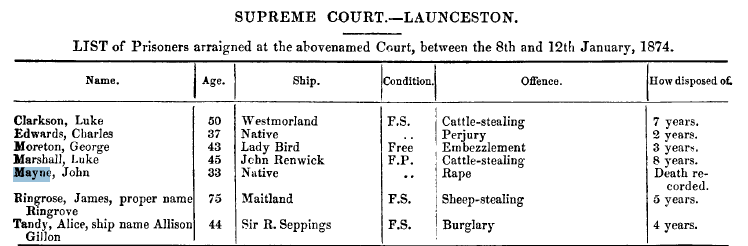
Miscarriage of justice: the case of John MAYNE 1874


Thirty-three year old John Mayne was a Member of the Table Cape Road Trust when he was wrongfully convicted for rape in January 1874. A sentence of death was recorded which was remitted to 15 years. He was released 10 months later, in December 1874 after protracted protests in the press and several juror capitulations, the same jurors who had initially returned a verdict of guilty after two hours' deliberation at the trial (13 January 1874), a case strongly defended by John Mayne's barrister R. Byron Miller. Thomas Nevin photographed John Mayne on arrival at the Hobart Gaol from the Supreme Court, Launceston, in January 1874 before Mayne was sent to the Port Arthur prison, from where he was discharged as "Free." The release was effected by barrister R. Byron Miller and Attorney-General W. R. Giblin, two key members of the legal fraternity along with John Woodcock Graves jnr, whose endorsement of Thomas J. Nevin as government contractor for the provision of prisoner identification photographs was effected in 1872 and extended through to the late 1880s. Thomas Nevin also provided portraits of these lawyers, including members of their respective families (Graves & Miller family album , KLW NFC Private Collection).


[Left]:John Mayne, wrongfully convicted and imprisoned
Photographer Thomas J. Nevin 1874
TMAG Ref: Q15599

[Centre]: Attorney-General W. R. Giblin (1840-1887)
Photographer Thomas J. Nevin 1874
TAHO Ref: NS1013/1971

[Right]: Barrister R. Byron Miller
Photographer George Cherry late 1860s
Photo © copyright KLW NFC Imprint & KLW NFC Private Collection


Wrongly convicted: Prisoner John MAYNE. "Native"
Photographed by Thomas Nevin, January 1874
The incorrect verso caption "Taken at Port Arthur 1874" was inscribed in 1915.
Originally held at the QVMAG in the Beattie Collection
Now held at the TMAG Ref: Q15599


Verso: Wrongly convicted: Prisoner John MAYNE. "Native"
Photographed by Thomas Nevin, January 1874
The incorrect verso caption "Taken at Port Arthur 1874" was inscribed in 1915.
Originally held at the QVMAG in the Beattie Collection
Now held at the TMAG Ref: Q15599

The Six Jurors
THE CASE OF JOHN MAYNE.
The following telegram was received late on Monday evening by the hon. R. Byron Miller, Esq, by whom it has been placed at our disposal :- Petition of six jurors received and laid before Governor, with all the examinations who has been pleased to remit the unexpired portion of Maynes sentence. -(Signed) W. R. GIBLIN, Hobart Town . The following is a copy of the letter of the jurors : To his Excellency Charles Du Cane, Esq., Governor of Tasmania.- -We, the undersigned being members of the jury upon the trlal of John Mayne for rape, having learned that an application has been made to your Excellency to grant a free pardon to John Mayne upon the ground of his innocence, beg respect fully to recommend such application to your Excellency's favorable consideration. The case was a difficult one, and our verdict was arrived at in consequence of our belief in the good character and truthfulness of Sophia Jane Shackle; Mrs Shackle, and Hickey, the three principal witnesses for the prosecution. We have now learned from an investigation instituted by your Excellency's orders, that these witnesses did not merit the credence which we gave them, and instead of being per- sons of good character were living in a state of disgraceful immorality; and we have only too much reason to fear that our verdict was a mis- taken one. (Signed) W. East, foreman ; B. P. Farrelly, J. Hollington, E. Gaunt, John Ellis, F. Hart.

Source: THE CASE OF JOHN MAYNE. (1874, November 26). Launceston Examiner (Tas. : 1842 - 1899), p. 2. Retrieved August 25, 2015, from https://nla.gov.au/nla.news-article52896337


TRANSCRIPT
RELEASE OF JOHN MAYNE
Now that John Mayne has been released from Port Arthur, our contemporaries, north and south, have become profoundly impressed with the enormity of the injustice that has been done him, and call aloud for vengeance upon his persecutors, the girl Shackles and the man Lawrence Hickey. The former they would like to see prosecuted for perjury; the latter for the offence upon the girl which was laid to Mayne's charge, and his hideous conspiracy against Mayne's life and liberty....It must be gratifying to the Mayne family to know that John Mayne will be restored to them without any direct intervention on their part, that neither they nor he have been suppliants for mercy, but that the Crown has been compelled to render him simple justice in the face of the revelations made. This fact goes a long way towards removing the terrible stigma cast upon his character by an unfortunate miscarriage of justice.
The following letter was forwarded to the Attorney-General on 24th inst.: -
REGINA V. MAYNE
St. John-streeet. Launceston
November 24th, 1874
Sir, — I have the honor to acknowledge tho receipt of your telegram informing me that "The petition of six jurors received had been laid before the Governor with all the examinations, and that His Excellency had been pleased to remit the unexpired portion of Mayne's sentence." This most gratifying intelligence has been communicated to the family of the prisoner, and I am now instructed on their behalf to tender their grateful thanks to His .Excellency and the members of the Executive Council, not for mercy extended towards a man whom they at least believe to be an innocent sufferer from a judicial mistake, but for justice rendered after a patient and exhaustive examination. His Excellency is about to leave the colony, and the Mayne family respectfully trust that amongst the pleasing memories of his official career in Tasmania will be the recollection that as the representative of Her Majesty, the fountain of justice and mercy, one of his latest acts was to restore to freedom the innocent victim of a foul conspiracy.
I have the honor to be
Sir-
Your obedient Servant,
R. BYRON MILLER.
The Hon. The Attorney-General,
Hobart Town.
Source: RELEASE OF JOHN MAYNE. (1874, December 5). The Tasmanian (Launceston, Tas. : 1871 - 1879), p. 8. Retrieved August 25, 2015, from https://nla.gov.au/nla.news-article198924565


Barrister R. Byron Miller
Photographer George Cherry late 1860s
Inscribed verso by Miller family member "My Father ... Judge in Chambers Essex St ..."
Photo © copyright KLW NFC Imprint KLW NFC Private Collection

POLICE RECORDS for JOHN MAYNE


John Mayne, 33 yrs old, was arraigned in the Supreme Court, Launceston on 8 January 1874, convicted of rape, death sentence commuted to 15 years, transferred to the Hobart Gaol where he was photographed by Thomas Nevin, then relocated to the Port Arthur prison, arriving there on 30th January 1874. His trade was listed as "Dealer". Mayne's record of earnings in the Port Arthur conduct book was inscribed -

Transferred to House of Correction for Males Hobart Town by order of the Hon.ble The Attorney General Telegram dated 24/11/74
Civil Commandant


TAHO Ref: CON94-1-2_00033
Description:Conduct register - Port Arthur
Start Date:01 Aug 1873
End Date:30 Sep 1876
CON94 TASMAN'S PENINSULA - CONDUCT REGISTERS, PORT ARTHUR.


John Mayne was transferred to the Hobart Gaol on 24th November, and discharged, 2nd December 1874: "Free."

Source: Tasmania Reports of Crime Information for Police J. Barnard Gov't printer

Featured Post

Captains, emigrants and convicts: the summer of 1842-1843 in Hobart, VDL

Captain Edward GOLDSMITH on the Janet Izzat Lt. Charles HEXT on the Cape Packet PRISONERS on the Emily and Moffatt George O'BRIEN, s...