John Nevin snr and family 1851-1854: shipping documents

John NEVIN: the ship Fairlie July 1852
Miss Mary NEVIN: the ship Columbus October 1854
Mr James and Mrs Mary NEVIN: the ship Kingston August 1854

1851-1852
Former soldier of the Royal Scots First Regiment, John Nevin snr (1808-1887), his wife Mary Ann Nevin nee Dickson (1810-1875), and their four children all under 12 years old (Thomas James, Mary Ann, Rebecca Jane and William John) boarded the convict transport Fairlie at Gravesend, England on the 22nd February 1852 bound for Hobart, Van Diemen's Land (Tasmania). John Nevin snr worked the family's passage as one of 30 out-pensioner guards of the 294 convicts on board.

Details of the family's movements in the decade between John Nevin's medical discharge in Canada from the Royal Scots in 1841 and the family's immigration to VDL in 1852 are sketchy. His return to the British Isles as a Chelsea pensioner on being invalided out in 1841 was followed by his marriage soon afterwards to Mary Ann Dickson (b. 1810 England) who had moved to Newtonards, Ireland with her brother, nurseryman Alexander Dickson. He pursued the vocation of gardener in his wife's brother's business, Alexander Dickson's nurseries at Newtonards, taught school, and contributed to journals with surveyor John [James?] Hurst, proprietor of the Freeman newspaper. The births of their four children from August 1842 when Thomas James was born, followed by the births of the two daughters Mary Ann in 1844 and Rebecca Jane in 1847, and just prior to departure, the birth of William John in County Down in 1851, were all registered in Ireland. If John Nevin's  poem "My Cottage in the Wilderness" published in 1868 at Hobart, contains factual autobiographical information, he spent an unprofitable and unhappy time at the Californian Goldfields before returning  to his "partner" and children in Tasmania no later than 1854. By the time of his death in his beloved garden at Kangaroo Valley, Hobart, in 1887,  his occupation was registered simply as "gardener". His old friends from the Royals, for their part however, who published his obituary in the Mercury, 11th October 1887, were keen to praise first and foremost his good nature, his military history, and his literary achievements.

Had John and Mary Nevin and their four children arrived in London before the 15th October 1851, or indeed been resident there in the previous months while preparing for the long voyage, they would have seen hundreds of items from Van Diemen's Land to excite their interest at the Great Exhibition of the Works of Industry of All Nations at the Crystal Palace, Hyde Park.


Detail from plate above, representing the Van Diemen's Land display. Exhibits visible here included framed pictures, animal skins and textiles.

THE CATALOGUE 1851: VDL Exhibits
Title Official descriptive and illustrated catalogue of the Great Exhibition of the Works of Industry of All Nations, 1851., v.2.
Author; Great Exhibition
Edition; New ed.
Published; London: Spicer Brothers,[1851]
Description v. :ill., plates (some col., some fold.)
Rights; Public Domain, Google-digitized.
Permanent URL; https://hdl.handle.net/2027/hvd.32044021206354 pages 992-999

EXTRACT from the Catalogue,

Page 992:
VAN DIEMEN'S LAND. South Area, S. 81. The general character of the productions of the Tasmanian colony resembles that of the others, and is principally remarkable for the number and interesting nature of the products contained in the first four classes of the Exhibition. The exceptions are, however, more numerous than in some other instances. Some interesting and attractive articles of furniture, turned out of richly-marked woods, are presented to notice, and may prove instrumental in directing the attention of decorative furniture makers to the capabilities of the materials for the construction of furniture in England.
Page 996:
DENISON, His Excellency Sir W. T. 188 Six tanned skins of the Ornithorhynchus paradoxus. The platypus of the colonists. The fine fur under the coat of long hairs upon its back is said to be equal to the fur of beaver for hat -making. [The Ornithorhynchus is peculiar to Australia and Tasmania, and combines with the hair and fur of a mammalian quadruped, the webbed feet and the beak of the duck, whilst the male has spurs on the hind legs like a cock. In its internal anatomy the Ornithorhynchus offers many marks of resemblance to both birds and reptiles, and forms the nearest link in the mammalian series to the oviparous classes.— R. O.]


Above: Dickinson Brothers - Dickinsons' comprehensive pictures of the Great Exhibition of 1851
The Crystal Palace from the northeast during the Great Exhibition of 1851.
Source: Dickinson's Comprehensive Pictures of the Great Exhibition of 1851, from the originals painted for ... Prince Albert, by Messrs. Nash, Haghe and Roberts Published: London Created: 1854 Format: Book / Illustration / Image Creator: Louis Haghe, Joseph Nash, David Roberts Usage terms: Public Domain Held by: British Library Shelfmark: Cup.652.c.33., volume 2 British Library https://www.bl.uk/collection-items/dickinsons-comprehensive-pictures-of-the-great-exhibition-of-1851

The ship "Fairlie" in brief
This barque was built by the yard of J. Gilmore, Calcutta for the account of John Biddulph. On the 5th June 1811 the ship was launched under the name FAIRLIE. It was a Class A two-decked vessel. The height between decks was 5.11ft., the tonnage was 698 86/94 tons (bm), and dimensions 106.0 x 35.3 x 17.1ft

On the 4th June 1812 the Fairlie was chartered by the East India Company for a round voyage to Bengal, under the command of Captain Peter d’Esterre. The charter terminated on 3rd June 1814. On the 22nd May 1815 she was chartered again by the British East India Company for a round voyage via Madeira to Bengal under the command of Captain Thomas E. Ward. The charter finished on the 5th November 1816. Her last voyage for the British East India Company under the same command was chartered on 1st April 1818 for a round voyage to Bengal and Bombay. The charter finished on 8th June 1819.

In 1824 the Fairlie was sold to David Gordon, and traded to India as a licensed ship. In 1833 she was under the command of Captain J. Cromartie. She sailed on 27th October 1833 from England with 376 convicts for Australia under the command of Captain Henry Ager. After a passage of 111 days she arrived at New South Wales on 15th February 1834. During the passage four (4) convicts died. After disembarking she sailed for England.

The Fairlie then sailed from London on 4th April 1840 with cargo and 266 passengers under the command of Edward Garrett, RN. And via the DOWNS on 6th April she set course for Australia, arriving at Port Adelaide on 7th July 1840. One of the passengers James Bowley kept a diary during that voyage. In 1843 she was sold to Joseph Soames at London.

On the 11th March 1852 she sailed from Plymouth with 294 convicts on board under the command of Captain Ed Pavey, arriving on 3rd July 1852 at Hobart. John Nevin and his family were on board. In 1865 the Fairlie was transferred to the Merchant Shipping Co. Ltd., London and in sold in 1866 for breaking up or use as a convict hulk.

Further reading and disambiguation of the ship's name Fairlie can be found here at Ships Stamps UK:
Link: http://www.shipstamps.co.uk/forum/viewtopic.php?f=2&t=8877

Embarcation: 22nd February 1852
The records below list the names of the convict guard, their wives and their children who embarked on the Fairlie at Gravesend on 18th - 22nd February 1852:


Tasmanian State Archives
Nominal Return of a convict guard on the ship Fairlie 18 Feb 1852
Accession No. 376/164


Above: Nominal Return of a Detachment who Embarked at Gravesend on board the Ship Fairlie being the remainder of the Convict Guard who Embarked at Woolwich. Gravesend 22nd February 1852. Rank and Name, No. Remarks
Private Jno Nevin


Above: Embarked at Gravesend, 22nd February 1852
Wives of the Convict Guard
Mary Nevin (wife of guard John Nevin)


Above and below:
Nominals Return of Children belonging to the men of the Convict Guards. Embarked on board the ship Fairlie Gravesend 22nd February 1852
Boys under 12 years; Thomas Nevin
Girls under 12 years: Mary A. Nevin, Rebecca Nevin
Under 1 year: Will J. Nevin


Boys under 12 years; Thomas Nevin
Girls under 12 years: Mary A. Nevin, Rebecca Nevin
Under 1 year: Will J. Nevin
Nominal return
ADRI: MB2/98/1/1
Source: Archives Office of Tasmania
Series: Nominal return of the convict guard on board the Fairlie. (MB2/98) 18 Feb 1852 18 Feb 1852
Electronic resources: MB2-98-1-1
Available here: https://drive.google.com/file/d/1XvaCnvLhBOGrwYFpYkZlvIw5khn7iSY9/view?usp=sharing

BRITISH PRESS REPORTS OF THE DEPARTURE
29th February 1852: The Fairlie arrived at Spithead from Woolwich to take on convicts for Van Diemen's Lands. (“Naval Intelligence” “Portsmouth, February 29 “ (1852, March 1). Morning Post, (London, England).

2nd March 1852: Convicts from the hulks York and Sterling Castle embarked at Portsmouth Harbour. Boy prisoners from Parkhurst were put on board at Cowes. Sailed that evening (“The Navy” “Portsmouth, March 3 “(1852, March 4). Morning Chronicle, (London, England).

4th March 1852: "...put into the Sound on Thursday, on her way down the channel."(“The Navy” “Plymouth, March 6 “(1852, March 9). Morning Chronicle, (London, England).

9th March 1852: embarked prisoners from hulks at the Spithead. (“Naval Intelligence” “Portsmouth, Sunday “(1852, March 9). Kerry Examiner and Munster General Observer, (Kerry, Republic of Ireland).

10th March 1852: In the Sound. More than a thousand emigrants left for the colonies from the Plymouth that week. (“Naval Intelligence”, “Emigration“ (1852, March 10). Western Courier, West of England Conservative, Plymouth and Devonport Advertiser, (Kerry, Republic of Ireland).

11th March 1852: Fifty-two convicts had embarked from Dartmoor, probably days before. Sailed from Plymouth for Van Diemen's Land (“The Navy” (1852, March 12). London Evening Standard, (London, England).

Source: HAA007 Convict Ancestors Story - Evelyn Mitchell
Intro: Why I chose Samuel Sheepwash! [a convict on board the Fairlie 1852]
Link: https://www.ourfamilypast.com/article/home/3086/haa007-intro-why-i-chose-samuel-sheepwash

1852: Nevins on the "Fairlie" sick lists
Thomas James Nevin's father, John Nevin snr, born in 1808 at Grey Abbey, County Down, Ireland, with service in the West Indies (1825-1838) and Canada (1839-42), was one of 30 out-pensioners and guards travelling with the 99th Regiment on board the Fairlie when it left Plymouth on March 11th, 1852, bound for Hobart with 294 convicts. Thomas' mother Mary Ann Nevin nee Dickson was one of 24 women on board, and Thomas himself, together with his three younger siblings, Mary Anne, Rebecca Jane and William John were numbered among the 47 children. Among the convicts were 32 boys from the Parkhurst prison who had embarked at the Isle of Wight on March 2, 1852.

While conditions on board must have been rudimentary for women and children accompanying a crew member, for a mother and baby it must have been a floating hell. The medical officer for the voyage which began on March 2-11, 1852 recorded that prior to departure, on February 28th, both John Nevin and his wife Mary suffered diarrhoea, and were discharged from the list on the day of departure. Mary (Anne) Nevin, aged 5 yrs, was put on the sick list on the 23rd April. Her mother Mary Nevin (aged 40 [sic]), joined her daughter on the sick list a day later, on the 24th April. Both were listed in the "QUALITY" column with their status: child of guard and wife of guard.


Mary Nevin, aged 5, child of guard; Mary Nevin, aged 40, wife of guard.


William Nevin, aged 6 months, child of guard

Reference: ADM 101/27/2
Medical journal of convict ship Fairlie .
Admiralty and predecessors: Office of the Director General of the Medical Department of the Navy and predecessors: Medical Journals Convict Ships etc. Date: 1852. Source: The Catalogue of The National Archives [UK]

On the 2nd June, the babe in arms, William Nevin, aged 6 months, was also put on the sick list, "QUALITY" also listed as child of guard. As the sick lists indicate, they were named in the company of other wives and children of guards, and of convicts of all ages.

Folio 2: John Nevin, aged 43, Private of pensioners; sick or hurt, diarrhoea; put on sick list 28 February 1852, discharged 2 March 1852 to duty. Folio 2: Mary Nevin, aged 40, Wife of pensioners;

Folio 2: Mary Nevin, aged 40, Wife of pensioners; sick or hurt, diarrhoea; put on sick list 14 March 1852, discharged 25 March 1852 to duty.

Folio 4: Mary Nevin, aged 5, Child of Guard; sick or hurt, diarrhoea; put on sick list 23 April 1852, discharged 30 April 1852 to duty. Folio 4: Mary Nevin, aged 40, Wife of Guard; sick or hurt, diarrhoea; put on sick list 24 April 1852, discharged 14 May 1852 to duty.

Folio 5: William Nevin, aged 6 months, Child of Guard; sick or hurt, convulsio; put on sick list 2 June 1852, discharged 9 June 1852 to duty.

See the complete sick list for this voyage of the Fairlie 1852 in this article - click here.

Absent from the sick lists were the two other children of John and Mary Nevin - Thomas James (b. 1842), and his sister Rebecca Jane (b.1847). Whatever ailments they endured on the voyage apparently left few permanent effects on Thomas and his father: Thomas James Nevin (photographer) lived to the age of 81 yrs (d. 1923). His father John also lived to the age of 80, and remarried at the age of 71 to a 46 year old widow, Martha Salter nee Genge, soon after the death of his wife and mother of his four children, Mary Nevin nee Dickson (1810-1875), who lived just 65 years. However, the two sisters did not survive to the 20th century: Rebecca Jane Nevin died in 1865, aged 18 years at Kangaroo Valley, Hobart; Mary Anne Nevin died in Victoria, aged 34 yrs shortly after her marriage in 1877 to John Carr and within a fortnight of giving birth to a daughter in 1878, and younger brother William John, known as Constable John Nevin and simply as Jack to the family, died of typhoid fever in 1891, aged 39 yrs. Jack joined the Prison administration at H. M. Hobart Gaol while still in his teens, and remained there until his untimely death, assisting his brother Thomas as the official photographer supplying convicts' identification cartes-de-visite mugshots for the Hobart Municipal Police Office and Prisons Department. Jack was variously enrolled as an elector with the name (Constable) John Nevin and William John Nevin, not to be confused with Thomas Nevin's son carrying the name into the next generation: William John Nevin, born in 1878, who died in 1927 in a horse and cart accident in Hobart.

Arrival at Hobart, VDL, July 3rd 1852
The Principal Medical Officer, Dr Edward Nollett (also spelt as Nolleth) reported no serious medical incidents had occurred during the voyage. Yet one child was still-born, vaccinations were attempted (unspecified types), and two prisoners were found to be nearly blind on disembarkation.


The barque Fairlie arrived in Hobart on July 3, 1852. On board were 292 male convicts, 30 pensioner guards with their families - 24 women and 47 children. In charge of the convict guard was Ensign Meagher for the 99th Regiment. Surgeon Edwarth Nolloth RN voyaged in the Cabin as did the religious instructor John B. Seaman and his wife. The Rev. Seaman reported:


TRANSCRIPT
July 13 [1852]
The arrangement and cleanliness of the Penitentiary, the courtesy of the officers, combined with the discipline exercised, will effect, it is hoped, the reformation of England's exiles.
(Signed) John B. SEAMAN, Queen's, Cambridge,
Religious Instructor of "Fairlie", C. S.
Religious instructor John B. Seaman, on visit to Male House of Correction, Hobart Town
Source: Parliamentary Papers, House of Commons and Command, Volume 54, page 19 

The Calcutta-built Fairlie, 775 tons and carrying two guns, had left Plymouth on March 11, 1852 with 45 crew. Cargo listed included 1 bag of despatches, 2 ropes, 8 leather bags, 1 ship bag and 1 small paper parcel. When the ship sailed into the River Derwent at Hobart and the pilot Mr Hurburgh boarded at 4pm, he reported the weather was fine, winds light, and the ship's draught was 18 feet.

The Port Officer's Form carried the REMARKS:
2 Deaths Convicts - 1 Birth - Female
And this note:
"The Pest Bomangee" was to leave [?] in about 3 weeks after this vessel sailed
"The Sylph". Sailed from Plymouth three days before.


Source: State Library of Tasmania
Series Number MB2/39
Title: REPORTS OF SHIPS' ARRIVALS WITH LISTS OF PASSENGERS
Start Date 24 Mar 1828
End Date 31 Dec 1970


CORRESPONDENCE re Mr NOLLETT [sic]


TRANSCRIPT
"Copy of a DESPATCH from Lieut.-Governor Sir W. Dension to the Duke of Newcastle
Government House , Van Diemen's Land, May 5, 1853 [etc etc]
...inspection made by the principal medical officer of the convict ship "Fairlie" on her arrival in this port, and I would beg to draw attention to that portion of it which states that two of the men are nearly blind, and who will consequently become a permanent charge up on the convict establishment.
I have & (Signed ) W. DENISON [&&&]"
Below: Enclosure in No 10 Encl in No 10
Principal Medical Officer's Office July 5 1852


TRANSCRIPT

SIR
I HAVE the honour to report my inspection of the "Fairlie" male prison ship, surgeon superintendent, Dr Edward Nollett. The ship left Plymouth on the 11th March with 294 prisoners, under a guard of 30 out- pensioners, with 24 women and 47 children. They were generally healthy, the more prevalent complaints being diarrhoea and pulmonic affections. Two prisoners died, one from disease of the heart the second from pleurisy There were also two births, one still born. I observed two prisoners who (I am informed) were embarked nearly blind They are fit cases for an invalid depot, and I have directed their removal to the General Hospital, together with four other men who are in delicate health and unfit at present for labour. Vaccination was attempted but without success. The berths, decks, and utensils were clean, and in good order. I have etc The Comptroller General (Signed) A. SHANKS &c & &c Deputy Inspector General PMO Report of August 11, 1853:
Source: Parliamentary Papers By Great Britain Parliament. House of Common papers Vol 54

1854: who were these two relatives?
On 11th, July 1854, John Nevin snr, schoolmaster at Kangaroo Valley, paid £5 at Hobart for two single tickets for the passage of "R" indicating relatives (and not "Servants") on a "Family Ticket". No details of the passenger, the name of the ship or the origin of the journey are shown on this register.
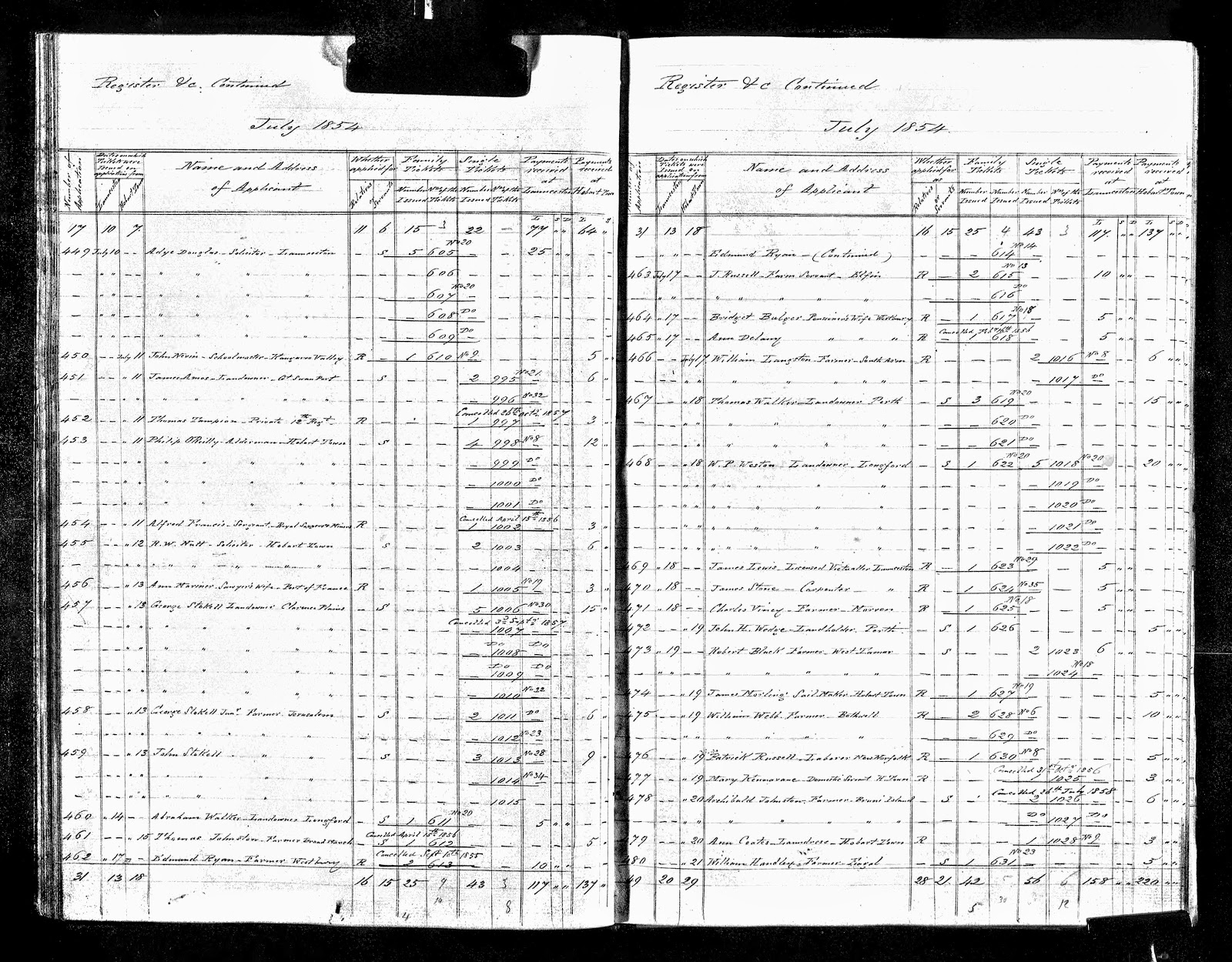


Second name, page on left:
Application No. 450: 11th July 1854
John Nevin schoolmaster Kangaroo Valley
Payment for Family Ticket "R" = relative
Number issued: 2 single tickets
Payment received at Hobart Town £5

Source: Archives Office Tasmania
Link: http://stors.tas.gov.au/CB7-30-1-1 Nevin John 1854 image 27
Source Citation: Register of applications for immigrants from Europe, of payments received and bounty tickets issues with some monthly and half yearly summaries; Film: SLTX/AO/MB/266; Series: CB7/30.


The fee of £5, according to the Immigration Department schedule of 1865 (Walch's Tasmanian Almanac 1865, page 86) was the amount to be paid for a single female, so who was the female immigrant who arrived in 1854? Or did John Nevin pay just an initial £5 for two single tickets, one in advance, one to be paid on arrival, or indeed were some of the costs pre-paid by the "R" - relative(s)?


Immigration Department extract from Walch's Tasmanian Almanac 1865: 86

TRANSCRIPT excerpt
The Commissioners of Immigration have issue the following Regulations for persons desirous of introducing servants or relatives from the United Kingdom, under the Bounty System adopted on the 21st December 1858: -
     An Immigrant resident in Tasmania who may wish to bring to the colony any relative from the United Kingdom, being a British subject, and being either a mechanic, domestic servant, or laborer, should apply to the Immigration Agent at Hobart Town or Launceston, in writing; and Bounty Tickets will be issued (subject to approval of the Commissioners) on the following rates of payment by the applicant: -
Family Ticket for man, wife (or either of them) with the children under 12 years at time of embarkation ------------------------ £15
Single Male Ticket --------------------- 10
Single Female Ticket -------------------- 5
The Tickets should be sent to the Agent appointed by the applicant in the United Kingdom, who will take the proper steps for procuring passages in vessels sailing direct to Hobart Town or Launceston, or to Melbourne, whence the emigrants will be forwarded to their destined port, and will in all cases be provided for at the expense of the ship owners until their friends may be enabled to receive them, provided that the period for such accommodation does not exceed fifteen working days from date of arrival.
The fee of £5, according to this schedule of 1865, was the fee to be paid for a single female. A single male ticket cost £10. Those fees were established with the Bounty System Regulations of 1858. Perhaps in 1854 they were cheaper when John Nevin paid £5 for two singles.

In this record (below) of the arrival at Hobart of the Columbus in October 1854, Miss Mary Nevin, 21 yrs old, a Roman Catholic from County Clare, unable to read or write (indicated by the word "none") was listed as a housemaid who could cook and wash linen. In several respects this was probably not the relative/family member whose ticket John Nevin funded in July 1854, firstly because she was from County Clare in the south west of Ireland, whereas John Nevin's family originated from Grey Abbey, County Down in the north, but more significantly, her religious affiliation was Roman Catholicism, whereas John Nevin's was Protestantism. He was a teacher at the Wesleyan Chapel, Kangaroo Valley (now Lenah Valley, Hobart) by 1854 where he built his cottage adjacent to the Lady Franklin Museum on land in trust to the Wesleyan Church.


Name: Nevin, Mary
Record Type: Arrivals
Title: Miss
Age: 21
Arrival date: 27 Oct 1854
Departure port: Plymouth
Ship: Columbus
Record ID:
NAME_INDEXES:1495074
Resource: CB7/12/1/2 Bk14 p90
Archives Office of Tasmania

This same single young woman, 21 year old Mary Nevin, housemaid, Roman Catholic, unable to read or write, from County Clare in southwest Ireland lodged two applications in her own name on behalf of two single men also from County Clare who arrived within weeks of each other in November 1855 as passengers on board the Emma to Hobart via Melbourne, viz:

 - David Maloney, single male, 24 years old, Roman Catholic, unable to read or write, a farm labourer, arrived on board the Emma, November 2, 1855 (primary document at http://stors.tas.gov.au/CB7-17-1-1 page 41), and

- Hugh Nevin, single male, 22 years old, Roman Catholic, able to read and write, a farm labourer, arrived on board the Emma, November 30th, 1855 (primary document at http://stors.tas.gov.au/CB7-17-1-1 page 45)

1854: James and Mary Nevin on the ship "Kingston"
Two other immigrants with the surname "Nevin" arrived at Hobart in 1854: James Nevin, 28 years old, and Mrs Mary Nevin, presumably his wife, 25 years old, arrived on 26th August 1854 from Southampton on board the Kingston.


Name: Nevin, Mary
Record Type: Arrivals
Title: Mrs
Age: 25
Arrival date: 26 Aug 1854
Departure port: Southampton
Ship: Kingston
Remarks: With husband James.
Record ID: NAME_INDEXES:1510960
Resource: CB712/1/2 Bk19 p290
Archives Office of Tasmania

In this record, James Nevin was listed as a 28 year old coachman and groom from County Derry, able to read and write. Mrs Mary Nevin was listed as a 25 year old housemaid from County Antrim, able to read. Both were registered as Presbyterians. In the remarks column of this record is written the comment "useful persons". These two were more likely to be the two "family ticket" holders for whom John Nevin paid an initial £5 on 11th July 1854, for these reasons: they originated from the north of Ireland, they were both literate, and their religious affiliation was Protestant rather than Roman Catholic. They were married three months before sailing, on 7th February, 1854 at County Coleraine, Ireland: James was the son of Samuel Nevin of Coleraine (1807-1879) and Mary was the daughter of Robert Hemphill. James Nevin may have been a nephew of John Nevin's - how they were "R" = related - is yet to be determined.


Source: familysearch.org. See image for citation.


Page on left: James and Mary Nevin sailed from Southampton, England on board the Kingston. 843 tons, 4 guns, master R. L. Weeks, departing 26th May, 1854. They were "Gov't Emmigrants" among 35 married couples, 23 single men, 145 single women and 54 children.

Port Officer's Log
Arrival of the ship Kingston at the Port of Hobart Town 25 August 1854
Archives Office Tasmania
Ref: MB2-39-1-18 Image 137


Bounty immigrants, James and Mary Nevin listed as "Married with families: Nevin 2"
Ship Kingston arrivals in Hobart
Mercury 30 August 1854

1855: Eliza Hurst and family on the "Flora McDonald"
The point here is to negate any speculation that the document above which shows John Nevin paid £5 for the passage of two relatives on a family ticket on 11th July 1854 is the document which proves he paid for three members of the Hurst family who arrived at Launceston, Tasmania, on 3rd February, 1855 on board the Flora McDonald viz. Eliza Hurst, widow, 40 years old, a needlewoman; her son John Hurst, designer, 16 years old; and her daughter Mary Jane Hurst, 14 years old, house servant, despite the evidence in a letter to John Nevin from his sisters in Grey Abbey dated May 1855 that Eliza Hurst (1814–1902) was his younger, widowed sister who had emigrated. These are two separate events, two different dates, and two separate groups of passengers. Even though the Hurst and Nevin families had associations in both Ireland and Tasmania before and after both families emigrated, the list clearly shows these three Hursts arrived in 1855, not 1854, at Hobart. So, if their sponsor was the same John Nevin (no address given on this document below) who had sponsored two emigrants on a family ticket the previous year, in 1854, the document cited above with his address at Kangaroo Valley (http://stors.tas.gov.au/CB7-30-1-1 Nevin John 1854 image 27) does not reference this document below dated 1855 which names the three Hursts:


Detail: of above: Hursts x 3 left hand page
Tasmanian Archives and Heritage Office, TA211 Immigration Agents Department, CB7/17/1/1 Alphabetical descriptive list of immigrants arriving under the indenture system – details of name, ship, marital state, age, religion, native place, trade & bounty paid, January 1854 to December 1856, Page 24, book no. 9, url=http://stors.tas.gov.au/CB7-17-1-1


Photograph of John Nevin (1808-1887) taken in 1873 by his son Thomas Nevin
Copyright © KLW NFC Imprint Private Collections 2003 ARR

RELATED POSTS main weblog

Prisoner John APPLEBY 1873

PRISONER JOHN APPLEBY Tasmanian mugshots 1870s
PETITIONS DECLINED
FAKE HISTORY EXHIBITIONS 1900s


Prisoner John Appleby, Hobart Gaol, Tasmania
Photographed by Thomas J. Nevin, September 1873
NB: The catalogue entry title was devised by the NLA from the verso inscription.
NB: The number "84" is missing from this catalogue entry.

National Library of Australia catalogue
"John Appleby, per Candahar, taken at Port Arthur, 1874"
Call Number PIC Album 935 #P1029/51
Created/Published 1874
Extent 1 photograph on carte-de-visite mount : albumen ; 9.4 x 5.6 cm., on mount 10.4 x 6.4 cm.

The verso (below) of this carte-de-visite of John Appleby held at the NLA is numbered "84" which was the number assigned to the copy made in the 1900s by John Watt Beattie from the glass negative of Thomas Nevin's original capture taken at the Hobart Gaol in 1873 where Appleby was transferred from the Port Arthur prison after his petition to the Governor was declined.

The inscription 'Taken at Port Arthur 1874" is Beattie's confabulation of facts in the name of tourism. Beattie prepared copies of these prisoner cdv's for display in his collection of Tasmanian convictaria at his "Port Arthur Museum" located at 51 Murray St. Hobart (and not at Port Arthur) to coincide with the first of two early 20th century film adaptations (1908-9, 22 minutes - see theatre poster below; the second was filmed at Port Arthur in 1927) of Marcus Clarke's popular fiction For The Term of His Natural Life which appeared as a serial in 1870 and in novel form in 1874. Hence the date "1874" and the place "Taken at Port Arthur" written on the verso of this cdv when the actual date and the actual place of photographic capture were respectively 1873 and the Hobart Gaol in Campbell Street. Beattie fabricated this fake history for several dozen original mugshots taken in the 1870s by government contractor T. J. Nevin because he was required under the terms of his own commission as government contractor (from ca. 1900) to market photographic imagery of Tasmania's penal heritage to the intercolonial tourist. The loose cdv's such as this one of prisoner John Appleby were prepared for sale and exhibition at Sydney's Royal Hotel in 1915 to be displayed as Port Arthur relics, alongside relics and documents associated with the fake convict hulk Success which visited Hobart, Melbourne, Sydney and Adelaide. The collection of "convict portraits" held at the National Library of Australia Canberra and at the State Library of NSW in the Mitchell Collection are the estrays from these exhibitions. The NLA photographs inscribed verso with "Taken at Port Arthur 1874" were NOT taken at Port Arthur, despite the title devised by the cataloguist at the NLA from the cdv's verso inscription, nor were they taken by the reviled commandant A. H. Boyd. These ahistoric furphies continue to be promulgated by "interpretationists" at the Port Arthur Historic Site theme park who would wish to inveigle their visitors in the same way that Beattie et al deceived visitors to his museum in the 1900s in the name of tourism.


Verso the cdv of John Appleby held at the NLA
Inscription includes the number "84" and the wording "Taken at port Arthur 1874"
Fake history prepared in the 1900s for exhibitions associated with the fake hulk Success
Photo copyright © KLW NFC 2016 ARR

TRANSPORTATION & POLICE RECORDS
John Appleby alias Young was transported to Tasmania on board the Candahar in 1842, sentenced to 15 years for burglary. This record details his age, appearance, marital status, conduct etc on arrival. His occupation was painter and glazier. He was given a conditional pardon in September 1850 (CP), but by 1871 he was incarcerated again, sentenced to six years at the Supreme Court Hobart.


John Appleby per Candahar 1842 record: TAHO REF: CON33-1-23_00004_L


Detail of above: John Appleby per Candahar 1842 record: TAHO REF: CON33-1-23_00004_L

John Appleby, free in service (FS), was tried in the Supreme Court Hobart on 4th July 1871 and sentenced to 6 years for receiving stolen plate. His petition lodged twelve months later, on the 11th June 1872 was declined by the Attorney-General, and on the 20th September 1873 he was transferred to the Hobart Gaol, Campbell St. from the Port Arthur prison where Thomas J. Nevin photographed him on being received. Two years later, on the 13th August 1875, the residue of Appleby's sentence was remitted- see detail of record above, column extreme right - viz:.
The Governor's inf has declined to interfere 11/6/72
Hobart Gaol 20/9/73
Gov. inf. 13/8/75
Residue remitted


From February 1872, when the Attorney-General the Hon. W. R. Giblin commissioned Thomas J. Nevin to undertake the systematic photographing of prisoners, those prisoners whose petitions to the Governor were declined were among the first to be photographed. With the assistance of Frederick Stops, clerk and "right-hand man" to the A-G, Thomas Nevin collaborated on collating information on prisoner records, both visual and written through the 1870s into the mid-1880s.


Source: Tasmania Reports of Crime Information for Police 1871-1875, James Barnard Gov't Printer

John Appleby was photographed again in the fortnight prior to discharge on March 4th, 1875, per regulations laid down in the Victoria and NSW Police Acts 1871-1872, adopted in Tasmania after the visit by Victoria's Solicitor-General in January 1872.


MacMahon and Carroll's ... For the term of his natural life
by Academy of Music (Launceston, Tas.) Date 1909]
Archives Office Tasmania. Link: https://stors.tas.gov.au/AUTAS001128189875j2k

RELATED POSTS at main weblog

Captain Edward Goldsmith and the conundrums of the Ethiopian Serenaders 1851

CAPTAIN EDWARD GOLDSMITH 1851
ROYAL VICTORIA THEATRE
BLACKFACE performance

Warning & Disclaimer:
The resources in this article contain offensive language and negative stereotypes. Such primary historical documents should be seen in the context of the period and as a reflection of attitudes, perspectives, and beliefs of different times.  The items are part of the historical record, and do not represent the views of this weblog. Please note that this example of a mid-19th century performance genre called "blackface" and the use of the "N" word here will offend 21st century readers.Proceeding is your responsibility.


Source: Library of Congress Front cover and sheet music of 'Music of the Ethiopian Serenaders', a touring blackface minstrel troupe, New York, USA, circa 1830-1860.

Please note that this example of a mid-19th century performance genre called "blackface" and the use of the "N" word here will offend 21st century readers; proceeding is your responsibility.

Captain Edward Goldsmith puts household goods at auction 1855

CAPTAIN EDWARD GOLDSMITH
19 DAVEY St HOBART TASMANIA 1855 and 1863
The INDIAN QUEEN Blackball Line 1856-59


Large mirror and clock at Runnymede, New Town with reflection of house guide Bob
Photo copyright © KLW NFC 2012 ARR

1855: Captain Goldsmith's Auction
Auctioneer Wm. Gore Elliston considered himself "favoured" with the opportunity to sell the contents of Captain Edward Goldsmith's residence at 19 Davey Street, Hobart, Tasmania at auction, scheduled for the 8th and 9th August, 1855. Captain Goldsmith himself would have attended. He remained in the colony until permanent departure in February 1856 on board the Indian Queen as a passenger, accompanied by his wife Elizabeth and son Edward jnr.

In addition to the sale of valuable household furniture and furnishings were food processing equipment from Captain Goldsmith's licensed wholesale store, and ship gear and timber from his shipyard and patent slip on the Queen's Domain. If sold, the many hundreds of items of furniture, dinner ware, engravings and antiquities on offer would have been purchased for the families of public officials in the colonial administration as much as by the wealthy merchant class, and those families eventually, as they do, would have donated superior pieces to the Tasmanian Museum and Art Galley (TMAG) and other local public collections. Purely by coincidence, the present address of the TMAG just happens to be 19 Davey Street, the same address as Captain Goldsmith's residence in the 1850s until the street numbers were changed (sometime early 20th century?). The view from Captain Goldsmith's house at 19 Davey St. overlooked St. David's Cemetery (now St David's Park, the street number is now No. 47 Davey St ), while the view from the TMAG now listed as 19 Davey St. three blocks further north, faces Constitution Dock and the wharves.


Auctioneer W. Gore Elliston
Title: Wm. Gore Elliston
In: In: Members of the Parliaments of Tasmania No. 13
Publisher: Hobart : J. W. Beattie, [19--]
ADRI: AUTAS001136190386
Source: Allport Library and Museum of Fine Arts


Source: Classified Advertising. (1855, August 9). The Courier (Hobart, Tas. : 1840 - 1859), p. 1.
https://nla.gov.au/nla.news-article2488334

TRANSCRIPT
WEDNESDAY and THURSDAY
8th and 9th August
Household Furniture and other Effects, including Plate, Linen, Glass, Wines, Quantity of Ship Gear, Timber &c &c.

MR ELLISTON
is favoured with instructions from Captain Goldsmith (prior to his departure for England) to submit to public competition, at his house, No. 19, Davey-streeet, the whole of his Valuable Household Furniture, comprising Plate, Linen,Glass, Wines , &c &c., on WEDNESDAY and THURSDAY, the 8th and 9th days of August, the sale commencing each day at 11 o'clock, and following the order as allotted in the Catalogue.
HORSEHAIR and other CHAIRS, rosewood and Spanish mahogany; card and loo tables; handsome chimney-glass, 4 feet by 3 feet; ladies' inlaid work-table, forming a chess-table with backgammon board and men complete; telescope dining-table for 12 persons; Spanish mahogany chairs; sideboard 7 feet long; horsehair sofa; handsome engravings; valuable book-case; dinner service, 175 pieces; rich cut decanters, glasses, &c; white and gold breakfast and tea services; dessert ditto; model of a frigate with case and stand.
PLATE
Solid silver cruet-stand with 7 bottles; table, dessert, teaspoons and forks; soup ladle; quantity of albata plate, including fish knife. forks, spoons, candlesticks , &c &c
BEDROOMS
Four-post mahogany and iron canopy and other bedsteads; handsome marble top washstand, with dressing table, glass, and cheval ditto to match; blue, white and gold toilette sets; wash stands; dressing tables , &c; book-case and chest of drawers; horsehair and cane chairs; chest of drawers, &c &c.
YARD and STORES, which will be sold on THURSDAY, the 9th.
Superior port and sherries, gin, Salmon's bottling apparatus, wine and beer corks, Norfolk Island dripstone, filter, 250 gallon water casks, quantity deals, metal bars, ship gear, spunyarn, rope, mast-hoops blocks, soap, pickles, potatoes, arrowroot, and an immense variety of sundries too numerous for the limits of an advertisement.
Catalogues are now in preparation, and may be obtained at the Auctioneer's on Friday. The Furniture will be on view on Tuesday, the 7th, from 11 to 4, and on the morning of sale.
Terms - Cash under £100; above that sum by an approved acceptance at 3 months, endorsed if required.
The auction over, and with the household contents sold,Captain Edward Goldsmith took rooms at Broadland House, on the corner of Elizabeth and Collins Streets, Hobart, per this advertisement in The Courier of 19th December 1855:
NOTICE
CAPTAIN GOLDSMITH, being about to leave the colony, particularly requests that all Claims against him be forthwith sent in for liquidation.
Broadland House, 17th Dec. 1855
Broadland House was still respectable enough to be considered by the Police as a lodging house not to be entered under their powers of the Legislative Council's Act passed for the "well ordering and regulation of Common Lodging-Houses", if the The Colonial Times, 3rd September 1855 is to be believed, although by the 1860s, the clientele was somewhat downmarket (Mercury 15 December 1862).


Broadland House, cnr Elizabeth and Collins St, Hobart Tas
A. Winter blind stamp impress, no date, ca. 1868
Source: University of Tasmania ePrints

TMAG colonial furniture
The Tasmanian Museum and art Gallery has an inventory of furniture which may have originated from the auction at Captain Edward Goldsmith's house at 19 Davey St. in 1855. In addition to the pieces shipped from London for personal use, he would have sourced locally-made sofas, chairs, chiffoniers, loo-tables, bedsteads, bookcases etc from the workshop of J. W. Woolley or the King's Yard at Old Wharf, worked by convict labour. Antiques dealer J. B. Hawkins' article titled The creation and furnishings of Government House, Hobart by Lt Governors Sorell, Arthur and Franklin between 1817-1843 (Part II) published in the periodical Australiana (May 2009) lists many examples of fine furniture both imported and locally-made by convict cabinet makers for Government House, some of which are now held at the TMAG. The article is available online - click here.


The Hamilton Inn sofa c. 1825
Maker unknown (Tasmania)
Wood (Australian red cedar, eucalypt, pearwood, mahogany); metal (steel and brass fittings); textile (woven horsehair, horsehair stuffing, cotton webbing, unprocessed wool stuffing, cotton)
TMAG Collection
Photo copyright © KLW NFC 2016 ARR


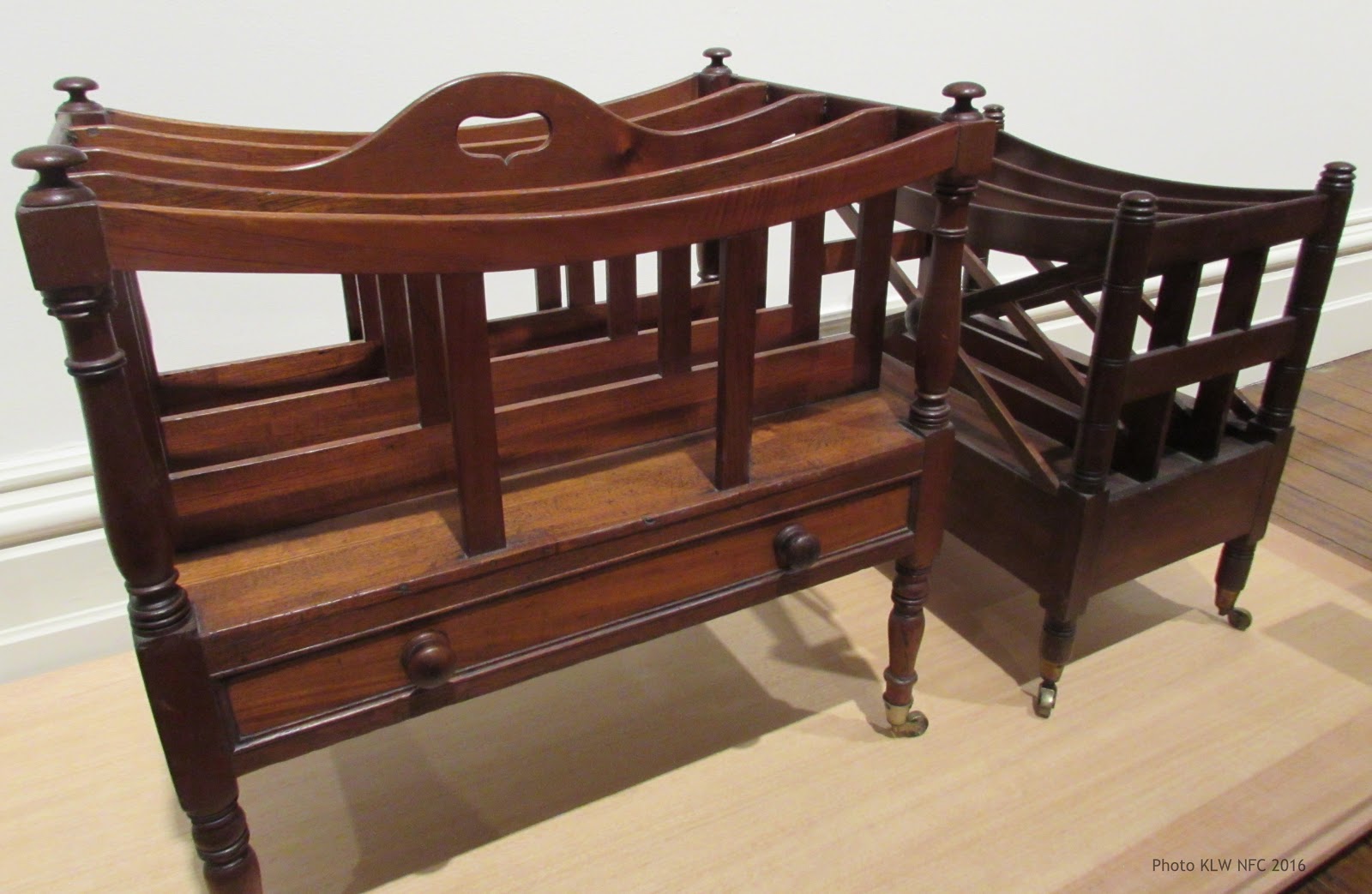
Canterbury, to hold books and sheet music, ca. 1820
TMAG Collection
Photo copyright © KLW NFC 2016 ARR


Chiffonier ca. 1850 Huon pine, imported steel and brass fittings
TMAG Collection
Photo copyright © KLW NFC 2016 ARR


James Shaw
Tasmanian myrtle, Huon Pine, non-native pine, brass and steel fittings
Exhibited at Government House 1850.
TMAG Collection
Photo copyright © KLW NFC 2016 ARR

Narryna Heritage Museum
This house, now open to the public as a museum, was built for Captain Andrew Haig in 1837-40 on land he purchased in 1824 while trading out of Calcutta en route to China with the British East India Company. On the 29th October, 1839, the Colonial Times (Hobart) announced the formation of a ship-building company with Edward Goldsmith, Andrew Haig and others :
SHIP BUILDING. - A Ship Building Company, composed of Messrs. Bilton, Goldsmith, Haig, Meaburn, and Williamson, are just about to commence, on the ground lately purchased from Mr. Mortimer, where an extensive and well sheltered building yard, and patent slip, are to be erected; an enterprise very much required, and deserving of encouragement. The parties are all gentlemen of practical knowledge, a qualification very much calculated to give general satisfaction, and to ensure success, for the attainment of which they have our best wishes.
The ship building company was disbanded in 1841, as the Courier reported in this notice:
NOTICE.- The Copartnership hitherto carried on by the undersigned, under the style or firm of "The Derwent Ship Building Company", has been dissolved as on this date.
George Bilton
   for John James Meaburn
Andrew Haig
E. Goldsmith
Wm. Williamson
Witness- Robert Pitcairn
Hobart Town, March 3. [1841]
Source: Classified Advertising. (1841, March 5). The Courier (Hobart, Tas. : 1840 - 1859), p. 3. Retrieved April 21, 2014, from https://nla.gov.au/nla.news-article2956876


Narryna Heritage Museum, Hampden Rd Battery Point
Photo copyright © KLW NFC 2016 ARR


Cedar bedside steps and commode
Narryna, Hampden Rd Battery Point
Photo copyright © KLW NFC 2014 ARR

Runnymede, New Town, Tasmania
The home of another family of mariners, whalers and merchants Captain James Bayley and his brother Charles Bayley, Runnymede was the name of their most famous whaling barque as well as this house, which was still the family home of their descendants well into the 1950s when the National Trust of Tasmania acquired it. Harriet McGregor nee Bayley, sister of James and Charles Bayley, married Alexander McGregor on 24th June 1847. The barque Harriet McGregor named after her was built in 1870 by John McGregor at the Domain slipyard at Hobart which Captain Edward Goldsmith established back in 1854 prior to his sale of the lease in 1855 to Alexander McGregor (1821–1896). The McGregor brothers may well have purchased several additional items listed as "ship gear, timber etc" on offer at Captain Goldsmith's auction in August 1855, having already acquired the government lease of his patent slipyard.


Runnymede, Bay Rd. New Town Tasmania
Photo copyright © KLW NFC 2015 ARR


Dining room and set table, Runnymede, New Town Tasmania
Photo copyright © KLW NFC 2012 ARR

Elizabeth Farm, NSW
On display in the laundry at Runnymede, New Town, Hobart is a dripstone, possibly from Norfolk Island. Made from a massive chunk of calcarenite, a locally occurring limestone deposit, dripstones were used to filter impurities from creek, rain or pond water which leached slowly through the stone, giving clear water dripping into a vessel beneath. A Norfolk Island dripstone was selected by Governor Sir William Denison for the Great Exhibition in London in 1851 as part of the manufactures of the colony of Van Diemen's Land. It was described as being 'in general use in the colony, and much approved', according to Sydney Living Museums. On 9th August 1855, Captain Edward Goldsmith's dripstone, filter and water casks were on offer from his stores:

YARD and STORES, which will be sold on THURSDAY, the 9th.
Superior port and sherries, gin, Salmon's bottling apparatus, wine and beer corks, Norfolk Island dripstone, filter, 250 gallon water casks, quantity deals, metal bars, ship gear, spunyarn, rope, mast-hoops blocks, soap, pickles, potatoes, arrowroot, and an immense variety of sundries too numerous for the limits of an advertisement.

This example of a Norfolk Island dripstone is held at Elizabeth Farm, Sydney, NSW. It may have been manufactured during the Island's second period of convict settlement (1825-53).


Source: Sydney Living Museums, Elizabeth Farm,
https://sydneylivingmuseums.com.au/stories/elizabeth-farm-dripstone

1856: Departure on the "Indian Queen"
On February 21, 1856 Captain Edward Goldsmith boarded one of the Black Ball Line clippers, the Indian Queen, in Hobart as a passenger, accompanied by his wife Elizabeth and son Edward Goldsmith jnr, bound for Liverpool, England, on his final voyage from the colony re-named Tasmania [formerly Van Diemen's Land] just months prior, in July 1855. The Indian Queen collided with an iceberg on April 1st, 1859 (see Illustrated London News and Basil Lubbock's account (below).


Source: National Library of Australia
Title: The Liverpool Black Ball Line of Australian packets being the only regularly established line of clippers sailing between Liverpool and Melbourne, forwarding passengers to Geelong, Sydney, Adelaide and Launceston, at ship's expense.
Published: [Liverpool : s.n., 1854?] Ref: NK Broadside NK4183

Also on board was passenger Captain H. Butler Stoney of the 99th Regiment, author of A residence in Tasmania: with a descriptive tour through the island, from Macquarie Harbour to Circular Head (London, Smith, Elder & co., Sept. 1856). During the three-month voyage he edited the ship's newspaper, completed his book on the colony of Victoria, and made headway with his book on Tasmania. He also directed a performance of Wm Barnes Rhodes' short opera, Bombastes Furioso presented by the 99th Regiment's Amateur Corps Dramatique. When he published his book on Tasmania in 1856, he mentioned Captain Goldsmith's difficulties with the Hobart Legislature in construction costs etc of the patent slip and Twin Steam ferry Kangaroo (pp 26-27). The passage below hints at the very real obstacles Captain Goldsmith experienced with the colonial government, which no doubt formed his decision to finally leave for good:


Above: Capt Butler Stoney on Captain Goldsmith, pp.26-27
A residence in Tasmania ... etc 1856

TRANSCRIPT
Joining the Cricket Ground, on the bank of the Derwent, is a piece of land leased to Mr. Goldsmith by the Colonial Government, for the erection of a patent Slip, which was brought to the Colony by him in the year 1848, but was not erected until 1856, in consequence of delay in getting a proper lease of the ground. It is now erected, and capable of taking up sailing vessels or steamers of 1,000 tons at high water, and one of 500 to 600 at low water, with every capability of repairing any description of vessel. The Slip is worked by steam power.
In 1848 the Twin Ferry Boat was laid down by Mr. Goldsmith, of 480 tons, capable of taking four loaded drays on her deck, besides her passengers ...
The Twin Ferry Boat was completed about twelve months since, but not delivered to the Government until January last; the reason of this the Government is fully aware of...
The "Indian Queen" 1859:


Caption to illustration: "Striking of the 'Indian Queen' on an iceberg in the South Pacific , on the morning of April 1 - see Supplement page 210". London Illustrated News, August 27, 1859, p. 211

This is Basil Lubbock's account (1921) of the Indian Queen's collision with an iceberg, 31 March 1859:

The “Indian Queen.”
The Indian Queen, 1041 tons, the most notable Black Baller launched in 1853, and advertised as Marco Polo’s sister ship, was a very fast vessel, her first voyage to Australia being made in 6 months 11 days, and in 1855 she came home from Hobart in 78 days. In 1859 she narrowly escaped the fate of Guiding Star. On 13th March, 1859, she sailed from Melbourne for Liverpool under Captain Brewer, with 40 passengers and the usual cargo of wool and gold dust. All went well until she was half way to the Horn, when on the 27th March the weather became thick with a strong N.W. wind and heavy westerly swell.

On the 31st March she was in 58° S., 151° W. by account; the day was wet, foggy and very cold and the ship logged a steady 12 knots with the wind strong at N.W. At 2 a.m. on the following morning those below were aroused by a violent shock, the crash of falling spars and a grinding sound along the port side, and the first of the frightened passengers to arrive on45 the poop found the ship lying broadside to broadside with an immense iceberg. All her spars and sails above the lower masts were hanging over the starboard side, the foremast was broken off close to the deck and was held at an angle by its rigging, the mainyard was in half, the bowsprit was washing about under the bows, and though the mizen topmast was still standing the topsail yard was in two, broken in the slings.

The night was dark and rainy and at first the watch below and passengers thought that all was lost. They found no one at the wheel, the port life-boat gone, and not a soul on the poop, but they were somewhat reassured by the appearance of the carpenter who had been sounding the pumps and pronounced the ship to be making no water. Then the second mate appeared aft and announced that the captain, mate and most of the crew had gone off in the port life-boat. Apparently there had been a disgraceful panic which involved even the captain, who actually left his own son, an apprentice, behind on the ship.

However those who had been so shamefully deserted began to buckle to with a will, headed by the second mate, Mr. Leyvret, and the cool-headed carpenter, a man named Thomas Howard. Passengers, cooks, stewards and those of the crew left on board were promptly divided into watches, the captain’s son was sent to the wheel, and whilst some set about clearing up the raffle of gear and getting things ship-shape as far as possible, others shovelled the ice, which lay in masses on the decks, overboard.

With some difficulty the crossjack was backed and the head of the spanker hauled in. At the same time the boat was perceived tossing in the swell on the port46 beam and apparently endeavouring to regain the ship, and faint cries for help could be heard against the wind. She seemed to be without oars and with sea after sea washing over, she was soon swept past the ship by the back wash off the ice and lost sight of in the fog never to be seen again. The ship, though, with the backed crossjack, began to drift along the side of the berg and presently dropped clear of it into smoother water to leeward.

Day now began to break and all hands set about cutting away the wreck, but the mainyard and the rest of the raffle hanging from the stump of the mainmast was hardly clear before the terrible cry of “Ice to leeward!” arose and a huge berg appeared looming out of the mist. The crossjack was at once braced up, the spanker set and the foresail trimmed in some fashion or other, then in a tense silence the survivors watched the ship slowly forge ahead and, dragging the wreck of masts and spars and torn sails along with her, weather the new danger by a bare 100 yards. And scarcely had she done so when the foremast fell crashing on to the long-boat, the other boats having been already stove in by falling spars. The next business was to get the wreck of the foremast over the side and clear of the ship. Here the carpenter displayed the greatest coolness and skill, being ably backed up by the second mate and the 4 seamen left on board. With the last of the wreck overside, time was found to muster the survivors, when it was discovered that the captain, chief mate and 15 men had been lost in the port life-boat, leaving behind the second mate, carpenter, bosun, 4 A.B.’s, 1 O.S. and 2 boys, besides the cooks, stewards, doctor, purser, and passengers who numbered 30 men, 3 women and 7 children.

47

A course was now steered for Valparaiso, some 3800 miles away. It was not until the 7th April that the ship got finally clear of the scattered ice, but on the 3rd the wind came out of the south and with a lower stunsail and main staysail set on the main, the ship began to make 3 or 4 knots through the water.

One iceberg of huge size and square like a mountainous box was only just cleared before it broke in two, the smaller portion bursting into the sea like an avalanche, and sweeping a huge wave in front of it, did not bring up until it was 2 to 3 miles away from the rest of the berg. The last ice was seen in 54° S., it being reckoned that the accident had happened in 60° S.

As soon as 49° S. was reached, a direct course was shaped for Valparaiso. Sheers were now rigged and a topmast secured to the stump of the foremast, then topsail yards were crossed on the jury foremast and mainmast, which improved the ship’s progress another knot. In this condition the Indian Queen slowly wandered north, weathering out gale after gale. On the 7th May a welcome sail was sighted. This proved to be the New Bedford whaler La Fayette, whose captain boarded them, offered them every assistance and corrected their longitude, which was 3° out. On the following day the French man-of-war Constantine appeared and promised to convoy them in. On the 9th May land was made some 20 miles south of Valparaiso, and on the morning of the 10th, as the crippled Indian Queen approached the Bay, the boats of H.M.S. Ganges, 84 guns, came out to her aid and towed her in to the Roads, where she anchored safely, just 40 days after her collision with the iceberg.

Source: The Project Gutenberg EBook of The Colonial Clippers, by Basil Lubbock, 2nd edition 1921
Link: https://www.gutenberg.org/files/52897/52897-h/52897-h.htm#Page_44

1862: Trustee of Reeves & Co.
Ship brokers and liquidators I. G. Reeves & Co. ran an exchange leather and grindery warehouse in Elizabeth St. Hobart among their other business concerns which included marine insurance and salvage. Captain Goldsmith was a director of the Hobart and Launceston Marine Insurance Company with Henry Hopkins, Askin Morrison, Thomas Giblin etc. until his departure from Tasmania in 1856. This notice of 1862 was to inform him through his proxy as one of the creditors in the Trust of I. G. Reeves & Co. that funds would be distributed from the residual credit of the Trust. Acting in Captain Goldsmith's interest was his attorney Mr. Wm. Knight.


Source: The Mercury (Hobart, Tas. : 1860 - 1954) Thu 7 Aug 1862 Page 1 Advertising

TRANSCRIPT
In the Trust Estate of I. G. Reeves & Co -
Notice to Creditors-The undersigned hereby request those creditors who have executed the trust deed in the above estate to attend a meeting to be holden at Messrs. Cleburne and Colvin's, New Wharf, at three o'clock on the afternoon of TUESDAY, the 12th day of August next, for the purpose of considering what mersures shall be adopted to procure the distribution of the funds now remaining to the credit of the Trust Estate.
Dated this 31st July, 1862.
ISAAC WRIGHT
E. GOLDSMITH, by his attorney W. KNIGHT
CLEBURNE & COLVIN
TONDEUR &, CO
BOYS & HALL
W. A. GUESDON
J. A. DUNN
W. CROSBY & CO.
One of Captain Goldsmith's imports was a diving bell and apparatus on the Earl of Chester from London, arriving on 5th January 1855. Although not stated specifically that the diving apparatus which arrived was from the London company, Siebe Gorman Co., it was new when Captain Goldsmith loaned it to his neighbour in Davey St. Hobart, ship owner, salvage operator and general merchant Frederick. A. Downing. Frederick Downing wanted to use the apparatus to salvage the wreckage of the Catherine Shearer which blew up at Port Esperance on June 6th. He paid the sum of £300 on 28th June 1855 for the wreckage and proceeded to convert the new apparatus and related items, and did not return them. Captain Goldsmith took his complaint to the Supreme Court for the value of the machinery etc. The court deposed in his favour:
SUPREME COURT.-MONDAY
CIVIL SITTINGS.
Before His Honor the Chief Justice, & the usual Juries of Twelve
ASSESSMENT.-GOLDSMITH V. DOWNING.
This was an action brought by Captain Goldsmith, against Mr. F. A. Downing for the conversion of a Diving Apparatus, lent to the defendant to enable him to recover property from the wreck of the Catherine Sharer, at Port Esperance, and which he had appropriated to his own use: the plaintiff claimed £212 10s 9d, as the value of the apparatus, and a sum for its use to the present time,
Captain Goldsmith deposed to the value of the machinery, and to the amount claimed for its use, namely £479 10s 9d : an agreement for hire was, also, proved, for £75 for two months.
The Jury assessed the amount claimed at £392 9s 10d.
Source: SUPREME COURT.—MONDAY. (1855, December 19). The Hobarton Mercury (Tas. : 1854 - 1857), p. 2. https://nla.gov.au/nla.news-article3337194


Anchor of the Catherine Shearer, Narryna Museum, Battery Point, Tasmania
Photos © KLW NFC 2014 ARR

1863: Auction of premises at Davey St.
Captain Edward Goldsmith and family retired to their residence, Gad's Hill House, in the village of Higham, Kent (UK) on arrival back in England in July 1856. With older brother John Goldsmith, he managed the gardens, orchards, and tenements at Chalk, Kent, bequeathed on the death of their father Richard Goldsmith snr in 1839. He acquired more freehold and leasehold properties around Chalk, Higham and Rochester, moved with his wife Elizabeth (nee Day) into Higham Lodge adjoining the family home Gad's Hill House which he then let to Andrew Chalmers Dods, made acquaintance with his prickly neighbour Charles Dickens at No. 6 Gad's Hill Place over water supply issues and the location of the mail box, both monopolised by Captain Goldsmith in Dickens' opinion, and drew his business interests in Tasmania to a close through the assistance of attorney W. Knight.

In 1863 Captain Goldsmith's former residence at 19 Davey St. Hobart, Tasmania was advertised for auction. The reason given for the sale was default on payment of the mortgage principal and part interest. "Now in parts beyond the seas", Captain Goldsmith's erstwhile co-partners in the mortgage on the house and adjoining brewery dated 1853 were John Leslie Stewart, John Robertson, and Henry Hopkins with whom he also shared the directorship of the Tasmanian Fire and Life Insurance Company. The sale of the Davey Street premises to shipowner Philip Leigh in September 1855 ensured payment of £1400.00 to Captain Goldsmith - see Historic Deed 04/1853 - but as Philip Leigh or subsequent owners had defaulted on payment, the original allotment was put at auction.


Source: The Mercury (Hobart, Tas. : 1860 - 1954) Mon 6 Jul 1863 Page 3 Advertising

TRANSCRIPT

PURSUANT TO THE PROVISO for that purpose contained in an Indenture of Release and Mortgage bearing date the twenty-ninth day of March and registered on the first day of April one thousand eight hundred and fifty three made between John Leslie Stewart of Hobart Town in Van Diemen's Land Gentleman of the first part John Robertson then late of Hobart Town aforesaid but then in parts beyond the seas Esquire (since deceased) of the second part Edward Goldsmith then of Hobart Town aforesaid Merchant (but now in parts beyond the seas) of the third part, Henry Hopkins of Hobart Town aforesaid Esquire John Beamont of the same place Esquire and Thomas Giblin of the same place Esquire (then three of the Directors for the time being of the company or co-partnership consisting of more than six persons established at Hobart Town aforesaid then and now carrying on business there under the style or firm of " The Tasmanian Fire and Life Insurance Company") of the fourth part Thomas Macdowell of Hobart Town aforesaid Esquire and Robert William Nutt then of the same place Solicitor (but now of Melbourne in Victoria) Trustees for the purposes therein mentioned of the fifth part
NOTICE IS HEREBY GIVEN that default having been made in payment of the principal and part of the interest monies secured by the said Indenture of Mortgage it is the intention of the said Thomas Macdowell and Robert William Nutt (at the request and by the direction of the said Henry Hopkins John Beamont and Thomas Giblin) for and on behalf of the said Company to sell by public auction the land messuage and hereditaments comprised in the said Indenture of Mortgage and that such sale will be effected by
MESSIEURS BRENT AND WESTBROOK
at their mart situate in Murray-street Hobart Town on Tuesday the eighteenth, day of August next at twelve o'clock at noon And the land messuage and hereditaments thus to be sold are described in the said Indenture as follows (that is to say) :
ALL THAT PIECE OR PARCEL OF LAND situate and being in Davey-street Hobart Town aforesaid and bounded-On the south-east side or in front by fifty feet and four inches or thereabout along Davey street On the south-west side by land lately belonging to Andrew Crombie and now to Douglas Thomas Kilburn On the north-west side by part of a grant to John Burnett And on the north-east side by a grant to William Pedder of an allotment of land formerly occupied by William Faitlough to Davey-street aforesaid Together with the capital messuage or tenement and outbuildings thereon erected.
Dated this fourth day of July 1863.
JOHN DOBSON,
Of No. 69 Macquarie-street, Hobart Town,
Solicitor to the above-named Company.
Referred to as Captain Goldsmith's "house" or "residence" in newspapers of the period, the building pre-dated the Congregational Church, erected in 1857, and the Royal Tennis Court, erected in 1875. Photographs taken of Davey Street in the 1870s show all of these buildings in a row, facing St David's Park, and many are still standing today, but by 1854, only six or so landmarks existed:

- the Waterloo Inn - favoured by sea captains visiting the town - on the corner of Murray and Davey Streets, now the offices of the legal firm, Butler, McIntyre & Butler;

- a weather board cottage sold to Mr Lee of Victoria in 1854, which sat between Captain Goldsmith's house and Stewart's Brewery;

- photographer Douglas Kilburn's house, now known as Kilburn House

- and the Odd Fellows' Hall, also photographed by Thomas Nevin in July 1871 which was labelled the "Tasmanian Hall" on early maps, located at the corner of Davey and Harrington Streets. The present building was founded by Monsieur Camille Del Sarte as a concert and music hall, designed by Mr. F. Thomas, and opened officially in May 1860.


Courtesy University of Tasmania Library Special and Rare Materials Collection.
"Photograph of Davey Street, Hobart, looking east, in about 1876.
The photograph is taken from the intersection with Harrington Street and Oddfellows Hall is in the foreground"


The Waterloo Inn on the corner Davey and Murray Sts - "a favourite with the sea captains visiting the town", now the offices of the legal firm, Butler, McIntyre & Butler. Photo courtesy ePrints UTAS.

Three master mariners - Captain Goldsmith, Captain Bentley and Captain Clinch were residents in Davey Street, Hobart, listed in the Hobart Gazette of 1855, p. 471. Two photographers also resided in Davey St. - William Paul Dowling, an Irish chartist, who moved his portrait studio from Macquarie St Hobart, located opposite the Hutchins School, to Number 24 Davey Street, "nearly opposite the Hampden-road" on the Harrington street side of photographer Douglas Kilburn's house at Number 22 Davey St. A little further down in the direction of Murray St and opposite St David's Cemetery was Stewart's Brewery, separated by a small house from Captain Edward Goldsmith's house at Number 19 Davey St. With the change to the numbering of residences in Davey St since the early 1900s, Kilburn House is presently numbered No. 51 Davey St.


Hobart Town Gazette 27 March 1855
Page 470-471: Davey St residents (far right column)
Click on for large view

The foundation stone of the Congregational Church, highlighted in this detail of Cooke's balloon's eye view of Hobart 1879 and visible in the photo below, was not laid until in 1857, and the Real Tennis Court (Royal Tennis) was built next to it much later, in 1875.


Detail of - Title: [Hobart Town] / A.C. Cooke, delt
Creator: Cooke, A. C. (Albert Charles), 1836-1902
Publisher: [Melbourne : Wilson and Mackinnon], 1879
Description: 1 print : woodcut ; sheet 33 x 53 cm
Format: Print
ADRI: AUTAS001128189651
Source: Allport Library and Museum of Fine Arts
Balloon's eye view
Published in the Australasian sketcher with pen and pencil, 10 May 1879 - printed and published at the Argus Office for Wilson and Mackinnon, 1879


This photo was taken of Davey Street Hobart in the 1870s looking west: on the left where three men are standing, is St. Mary's Hospital; on the right, Captain Goldsmith's two-storey house - bearing the Collegiate School name by the 1870s - facing St. David's Cemetery (Burial Ground). Image courtesy ePrints, University of Tasmania

On the opposite side of (lower) Davey Street, adjoining the Burial Ground, was St Mary's Hospital, erected in 1847.When elder son Richard Sydney Goldsmith fell gravely ill with fever in 1854, he was attended by Dr Edward Samuel Pickard Bedford (1809-1876) at the hospital. Edward Bedford was the medical officer for the City in 1852, on whose committee Captain Goldsmith served when Bedford campaigned for election in February 1855. But on 15 August 1854, at his father's house, Richard Sydney Goldsmith died, aged just 24 yrs old. He was born to Elizabeth Goldsmith only days after her arrival at Fremantle, W.A. in May 1830, on board the ill-fated brig the James alongside her very young husband Captain Edward Goldsmith on his first command. Richard Sydney was baptised on 11 Nov 1830 at St. Philips Sydney, NSW. At the time of his death, he was a cashier of the Union Bank of Van Diemen's Land, located in Macquarie Street, Hobart. He was buried in St David's cemetery opposite the family home. This family tragedy was possibly the tipping point in the decision to quit the colony.


Title: Map and select directory of Hobart Town, 1858
Creator: Proeschel, F. (Frederick), 1809-1870
Map data: 7 cm. = 20 chains
7 cm. equals 20 chains
Publisher: Melbourne : Hamel & Co., [1858?]
Description: 1 map : b&w ; 48 x 43 cm. on sheet 62 x 78 cm
Format: Map
ADRI: AUTAS001131821639

RELATED POSTS main weblog

Featured Post

Captains, emigrants and convicts: the summer of 1842-1843 in Hobart, VDL

Captain Edward GOLDSMITH on the Janet Izzat Lt. Charles HEXT on the Cape Packet PRISONERS on the Emily and Moffatt George O'BRIEN, s...