State Library of Tasmania
Title: Sir Richard Dry
Creator(s):Beattie, J. W. 1859-1930
Date: 19--Description: 1 photograph : sepia toning ; 14 x 10 cm.
Notes: Exact measurements 140 x 98 mm, Title inscribed in pencil beneath image in unknown hand., In: Members of the Parliaments of Tasmania - no. 101 / photographed by J.W. Beattie.
Other titles:Members of the Parliaments of Tasmania
Format: photograph
Location: Allport Library and Museum of Fine Arts
ADRI: AUTAS001125647933
The first Tasmanian-born Premier was Sir Richard Dry (1815-1869), and so a significant figure in the State's political history. This photographic portrait is one of more than 260 held at the State Library of Tasmania of the State's Parliamentarians. In the same year that J. W. Beattie was engaged in taking a series of portraits of Louisa Anne Meredith - 1895 - he was also preparing these reprints from the work of earlier photographers to complement his composite photograph called "Historical Parliamentary Picture".
The accreditation as photographer is to John Watt Beattie (1859-1930) despite the fact that the majority of these men of history were dead by the time Beattie had prepared their reprints; Sir Richard Dry died in 1869, as just one example from the series. John Watt Beattie did not arrive in Tasmania until 1878, and was not assigned the commission of government photographer until 1896.


The original image ca 1867 bearing Chas A. Woolley's commercial stamp
Source: ePrints, University of Tasmania
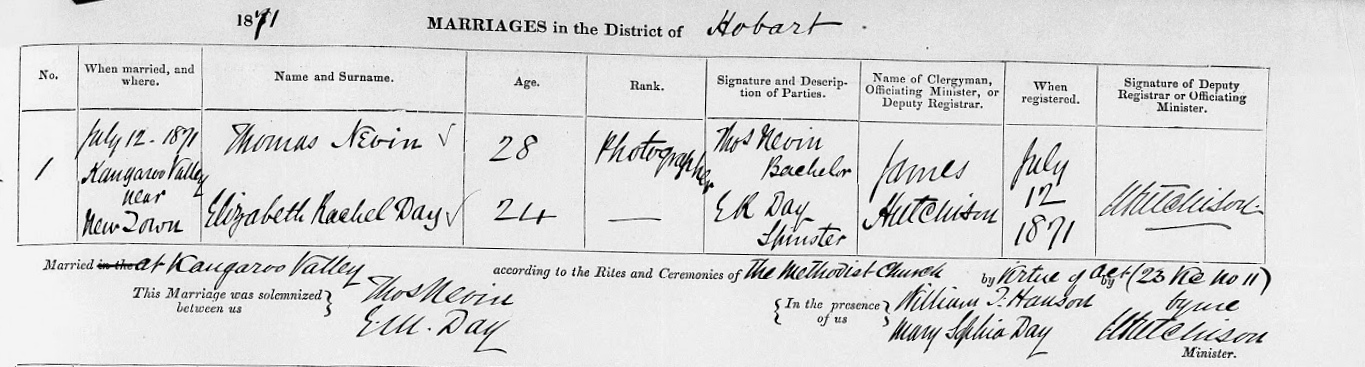
The problem with Beattie's reprinting for later generations is his lack of accreditation to the photographers whose earlier work provided him with such a lucrative business. This has been the fate of many of the Tasmanian prisoners photographs or "convict portraits" taken by Thomas Nevin in the 1870-1880s. Beattie reprinted them as tourist tokens of Tasmania's convict "stain" in the 1900s-1920s for sale and display at his convictaria museum, Hobart, assuming that all had been taken at Port Arthur in 1874, a date which appears on the verso of several extant prisoner cartes, when many in fact were taken over a period of several years at the Supreme Court and Hobart Gaol by Thomas and his brother Constable John Nevin. Beattie sourced Nevin's duplicates from the old photographer's room at the Hobart Gaol, others from the criminal records held at the Gaol's Sheriff's Office, and still more from the Habitual Criminals Register at the Town Hall Police Office. As police records - "booking shots", "mugshots" or simply criminal identification photographs - their "author" , a literary term some prefer (Reeder 1995) instead of the obvious term "police photographer" - was considered unimportant,then as it is now, irrelevant in fact, that is, until the photographs become an archive in a museum or library collection curated by art-trained photo historians, and then the essentialist notion of "authorship" becomes an issue of aesthetics, and the mugshots become "portraits" e.g. the term is used at the National Library of Australia for their 84 prisoner photographs. Beattie's commercialism was surely driven by similar interests in aesthetics and historicism in his convictaria venture, and to cinch their sale value, he needed to suppress accreditation to others to better reflect his own talents.


Thomas Nevin's portrait of W.R. Giblin ca. 1876
Archives Office of Tasmania Ref: NS 1013/1971
This portrait by Thomas Nevin of W.R. Giblin, who was the Attorney-General at the time of the sitting, escaped Beattie's reprinting because it was amongst Giblin's documents held at the Treasury until his death (1887, noted in a letter to The Mercury) when it was returned to the Allport law firm. From the Allport firm it was collected by an associate, retained in the Pretyman Collection and eventually donated to the Archives Office of Tasmania. It bears one of Nevin's most common commercial studio stamps on the verso, but was catalogued until recently as "Unidentified man" with the reference no: NS 1013/1971. AOT accreditation now includes the subject's name: W.R. Giblin.

Thomas Nevin's portrait of W.R. Giblin ca. 1876
Hon William Robert Giblin MHA,
Premier of Tasmania between 5 March 1878 - 20 December 1878.
Archives Office of Tasmania Ref: NS 1013/1971

Webshot: Archives Office of Tasmania
T. Nevin's portrait of W.R. Giblin ca 1876