Constable John (W. J. aka Jack) NEVIN 1860s-1800s
Prisoners' barracks, Hobart Gaol, Campbell St.
Stereographs, colour and frame, 1860s
 Map of the old Hobart Gaol
Copyright © KLW NFC Imprint Private Collection 2009
Three early stereographs of the Hobart Gaol
Map of the old Hobart Gaol
Copyright © KLW NFC Imprint Private Collection 2009
Three early stereographs of the Hobart Gaol
These three stereographs (below) of the H. M. Gaol, known as the Campbell Street Gaol, Hobart Town, taken in the mid 1860s are held in the State Library of Tasmania. Colour auto-adjustment of the first one in particular - depicting Jack Nevin as a boy and a top-hatted man, possibly the Superintendent J.P. Ball in the courtyard of the gaol - has revealed the yellow mount and arch framing used by Tasmanian photographer Alfred Bock, and his junior partner Thomas J. Nevin in his
stereograph series from the 1860s located at the Tasmanian Museum and Art Gallery.
Prolific stereographer Samuel Clifford (1827-1890),
Thomas J. Nevin’s long time friend and partner, used the same paper and framing for an exhibition of 100 stereoscopic views at Melbourne’s 1866 Intercolonial Exhibition. Clifford’s association with the Gaol was long-standing: between 1851 and 1856 he was the storekeeper at the Hobart Town Prisoners’ Barracks (Kerr, 1992:164), the subject of these three views below. Clifford reprinted many of Thomas J. Nevin's commercial negatives for his former private clientele after 1876 on Nevin joining the civil service as full-time Keeper of the Hobart Town Hall.
An unusual monogram appears on the verso of the last in this series - “J. P. Ball” . This monogram appears on the verso of another stereo at the State Library of Trinity Church with this note in the catalogue:
“Monogram in ink on left side of verso, with [J.P. Ball] in pencil, probably printed by G.T. Stilwell”
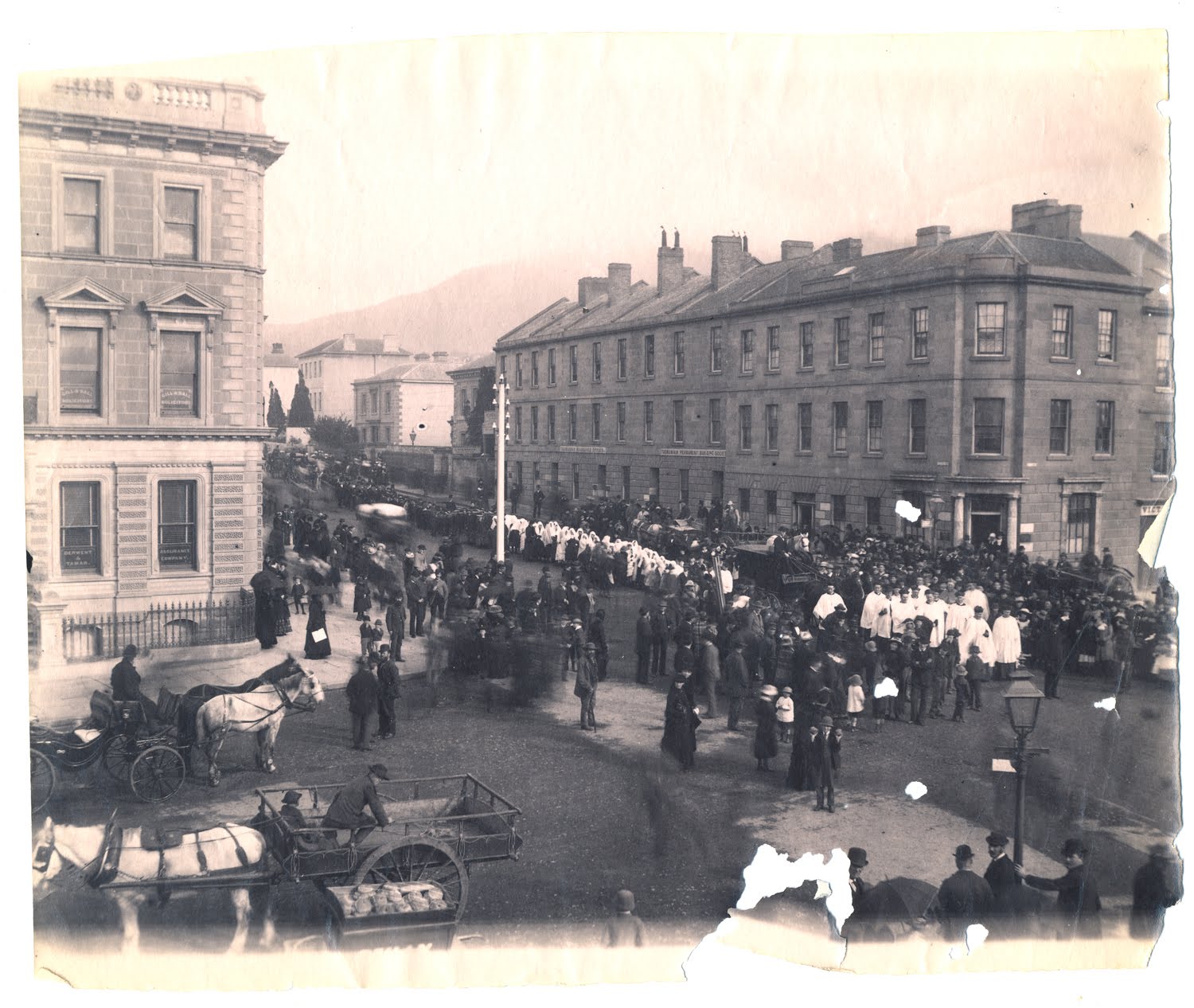
The late G. T. Stilwell was the curator of the ALMFA and Special Collections Librarian but who was J.P. Ball? He may have been one of more than twenty people named Ball living in Hobart at the time. There was an established firm of solicitors called
Gill & Ball in the 1870s, whose company name can be seen on the office windows - building on left - in the photograph below (not dated):
 Source: University of Tasmania ePrints
Lilac fixer was used extensively to cater to contemporary taste in the printing of photographs during the 1860s. These two versions of each of the three early stereographs taken at the Hobart Gaol, also known as the Prisoners' Barracks, Campbell St., show the print (a) scanned for digital display by the State Library of Tasmania, and (b) auto colour-corrected to reveal the colour of the mount.
 Above: scan at AOT
Below: colour auto-adjusted
Above: scan at AOT
Below: colour auto-adjusted
 Title: View of the prisoners' barracks, Campbell Street
Creator(s):Unknown
Date: ca. 1860
Description: 1 stereoscopic pair of photographs : sepia toned ; 9 x 18 cm. (mount)
Notes: Descriptive inscription in ink on verso., Image size 71 x 69 mm. each.
Subjects: Prisoners' Barracks (Hobart, Tas.) - History - 1851-1901
Location: W.L. Crowther Library
https://libraries.tas.gov.au/Digital/AUTAS001125299420/AUTAS001125299420
 Above: scan at AOT
Below: colour auto-adjusted
Above: scan at AOT
Below: colour auto-adjusted
 Title: Prisoners Barracks i.e. Gaol, Hobart Town
Creator(s):Unknown
Date: ca. 1865
Description: 1 stereoscopic pair of photographs : sepia toned ; 7 x 7 cm. each, on mount 9 x 18 cm.
Notes: Title inscribed in ink in centre of verso, in Sir William Crowther's hand., Date and accession number in pencil upper right corner of verso., Exact size 69 x 66 mm. each, on mount 86 x 171 mm.
Location: W.L. Crowther Library
https://libraries.tas.gov.au/Digital/AUTAS001124851619/AUTAS001124851619
 Above: scan at AOT
Below: colour auto-adjusted
Above: scan at AOT
Below: colour auto-adjusted
 Title: Interior, Hobart Gaol
Creator(s):Unknown
Date: ca. 1865
Description: 1 stereoscopic pair of photographs : sepia toned ; 8 x 7 cm. each, on mount 9 x 18 cm.
Notes: On verso: title inscribed in ink in upper left, in Sir William Crowther's hand ; the no. 63, circled, in pencil in centre in unknown hand ; monogram in ink on right side, consistent with one identified as J.P. Ball in stereoscope 8/14., Date and accession number in pencil upper right corner of verso., Exact size 72 x 68 mm. each, on mount 86 x 171 mm.
Format: photograph
Location: W.L. Crowther Library
https://libraries.tas.gov.au/Digital/AUTAS001124851627/AUTAS001124851627
Jack Nevin at the Prisoners' Barracks
The boy in this stereograph (figure on viewer's left) is Jack Nevin, the younger brother of commercial and police photographer Thomas J. Nevin. He was photographed standing in conversation with an older man in top hat, perhaps prison official Mr J. P. Ball, Superintendent of the Prisoners Barracks, Campbell Street, Hobart, Tasmania.
 Source: "View of the prisoners' barracks, Campbell Street", 1860s
W.L. Crowther Library State Library of Tasmania
Link: https://libraries.tas.gov.au/Digital/AUTAS001125299420/AUTAS001125299420
Source: "View of the prisoners' barracks, Campbell Street", 1860s
W.L. Crowther Library State Library of Tasmania
Link: https://libraries.tas.gov.au/Digital/AUTAS001125299420/AUTAS001125299420
 Detail of stereo right image above: A very young Jack Nevin ca. 1865, later Constable W. John Nevin in his favourite pose - left hand on hip - at the Hobart Gaol.
William John Nevin
Detail of stereo right image above: A very young Jack Nevin ca. 1865, later Constable W. John Nevin in his favourite pose - left hand on hip - at the Hobart Gaol.
William John Nevin (1851-1891), known as
Jack to the family, and as
Constable John Nevin on joining the civil service at age 18 yrs in 1870, was stationed at the Asylum, Cascades Prison for Males, Hobart until 1876. His service continued at the Hobart Gaol, Campbell Street, as "Gaol Messenger", a rank which covered his duties as photographer, and as a hospital "Wardsman" until his untimely death in the typhoid epidemic of 1891 while still in service, aged 39 yrs old. The registrar of his death gave his age as 43 yrs old; however, his burial records at Cornelian Bay Cemetery on 19th June 1891 listed his death at 39 yrs, i.e. born 1851, and this date is consistent with the sick lists of the
Fairlie shipping records stating that he was a babe in arms, less than 9 months old, when he arrived in Hobart on 3rd July 1852 with his settler parents, his father John Nevin snr, his mother Mary Anne (Dickson) Nevin, and his three older siblings: Thomas James Nevin, Rebecca Jane Nevin, and Mary Ann Nevin. The
Fairlie sick list recorded:
Folio 5: William Nevin, aged 6 months, Child of Guard; sick or hurt, convulsio; put on sick list 2 June 1852, discharged 9 June 1852 to duty.
Their father John Nevin snr, former soldier of the Royal Scots First Regiment with service in the West Indies and Canada, worked the family's passage on the
Fairlie as guard of the 292 adult male convicts and warden of 32 boys exiled from Parkhurst prison.
A full-length portrait of William John Nevin, 16 years old, taken by his brother Thomas J. Nevin in early 1868 during the visit to Hobart Tasmania of Alfred Ernest Albert, the Duke of Edinburgh, second son of Queen Victoria on board the Royal yacht
HMS Galatea, shows even more clearly the typical pose and dress of young William John aka Jack Nevin, choices made whenever he was photographed while still a youth, left arm bent, hand on hip, clean shaven (until his twenties when he favoured a moustache), a three piece suit with fob chain, and jacket with velvet revers (lapels).
 Subject: William John Nevin (1852-1891), known as Jack to the family;
also known as Constable John Nevin from 1870-1891
Photographers: Thomas J. Nevin (older brother) and Robert Smith, as the firm NEVIN & SMITH
Location and Date: 140 Elizabeth St. Hobart, Tasmania, January 1868.
Details: verso stamped with Prince of Wales blazon of three feathers, coronet and Ich Dien;
"From Nevin & Smith late Bock's, 140 Elizabeth St. Hobart Town"
Source: Private Collection, Sydney Rare Books Auction, June 2019
Jack Nevin's signature pose in this photograph - left hand on hip - also appears in a family group photograph taken in 1871:
 Detail of group photo: Nevin Group Portrait taken at the wedding of Thomas J. Nevin and Elizabeth Rachel Day, July 1871:
Jack Nevin, top right, Thomas James Nevin snr and Elizabeth Rachel (Day) Nevin seated
Copyright © KLW NFC Imprint Private Collection 2003
Detail of group photo: Nevin Group Portrait taken at the wedding of Thomas J. Nevin and Elizabeth Rachel Day, July 1871:
Jack Nevin, top right, Thomas James Nevin snr and Elizabeth Rachel (Day) Nevin seated
Copyright © KLW NFC Imprint Private Collection 2003
This detail of a group photo taken (by whom?) at the time of Thomas James Nevin and Elizabeth Rachel Day's marriage, 12 July 1871 at the Wesleyan Chapel, Kangaroo Valley, together with wedding guests, shows the bridal couple Thomas and Elizabeth Nevin seated and younger brother Jack Nevin standing with hands on hips, on viewer's extreme right.
 A younger Jack Nevin standing on viewer's extreme right
Nevin Group Portrait taken at the wedding of Thomas J. Nevin and Elizabeth Rachel Day, July 1871
Jack Nevin, top right, Thomas James Nevin snr and Elizabeth Rachel (Day) Nevin seated
Copyright © KLW NFC Imprint Private Collection 2003
A younger Jack Nevin standing on viewer's extreme right
Nevin Group Portrait taken at the wedding of Thomas J. Nevin and Elizabeth Rachel Day, July 1871
Jack Nevin, top right, Thomas James Nevin snr and Elizabeth Rachel (Day) Nevin seated
Copyright © KLW NFC Imprint Private Collection 2003
 Constable John (William John aka Jack) Nevin ca 1874-6
Photographed by his brother Thomas J. Nevin
City Photograph Establishment, 140 Elizabeth St. Hobart, Tasmania
Copyright © KLW NFC Imprint & Private Collection of Denis Shelverton 2006
Constable John (William John aka Jack) Nevin ca 1874-6
Photographed by his brother Thomas J. Nevin
City Photograph Establishment, 140 Elizabeth St. Hobart, Tasmania
Copyright © KLW NFC Imprint & Private Collection of Denis Shelverton 2006
This image was scanned from a photograph taken ca. 1874-6 which had been printed on thin paper and left unmounted. It was pasted into the scrapbook of George Nevin (1880-1957), the fourth son of Thomas and Elizabeth Nevin, born at the Hobart Town Hall during Nevin's incumbency as Hall Keeper.
The original photograph by Thomas J. Nevin was taken at his studio the City Photographic Establishment, 140 Elizabeth Street, Hobart Town. Even such a poor image gives details of the studio decor which featured a diamond-patterned carpet, and a table with griffin-shaped legs. Thomas J. Nevin captured his younger brother Jack in a relaxed standing pose leaning on a book (one of those key Victorian signifiers of literacy), wearing a shirt, tie, fob watch, and three piece suit with velvet collars.
In this later photograph (below) taken ca. 1880, Jack Nevin looks very relaxed and very savvy about the process of being photographed. His gaze is direct and very keen, his clothes suitable for everyday work in a foul place such as a prison. His salaried positions were primarily in administration, with a career path and ranking similar to the Gaol Keeper's until his untimely death during the typhoid epidemic of 1891. Older brother Thomas Nevin had been a Keeper too of a public institution, at the Hobart Town Hall between 1876-1880; a special constable during the Chiniquy Riots of 1879, and assistant bailiff in the courts during the 1880s.
 Constable John Nevin (William John aka Jack Nevin), ca. 1880
Photographed by his brother Thomas J. Nevin.
Copyright © KLW NFC Imprint Private Collection 2009
RELATED POSTS
Constable John Nevin (William John aka Jack Nevin), ca. 1880
Photographed by his brother Thomas J. Nevin.
Copyright © KLW NFC Imprint Private Collection 2009
RELATED POSTS main weblog