The Vernon and Sobraon
.jpg)

Vernon (est. 1867) and Sobraon (est. 1892) in Sydney Harbour
Captain Hector Axup and the Boys' Home
Hector Charles James Horation Axup (1843-1927) was one of three master mariners in the family of photographer Thomas J. Nevin. Both men had married daughters of Rachel (Pocock) Day (ca. 1812-1857) and master mariner Captain James Day (1806-1882) , namely, Elizabeth Rachel Day to Thomas J. Nevin in 1871, and Mary Sophia Day to Hector C. Axup in 1878. Their father Captain James Day passed away at the Battery Point home of his son-in-law Hector C. Axup in 1882. Their uncle Captain Edward Goldsmith (1804-1869) was master and commander of the James, Waterloo, Wave, Janet Izat, Parrock Hall and notably the Rattler, great merchant ships bringing cargo and well-heeled passengers to Hobart, returning with wool, whale oil and gold from the 1830s to the 1850s.
In the same issue of the Hobart Mercury, October 10, 1887, in which the "old boys" of the Royal Scots had placed an affectionate obituary to Thomas J. Nevin's father John Nevin (1808-1887), Hector C. Axup was mentioned in the following article. His donation to the Boys' Home was enclosed in a letter expressing his regret that a training ship was not available. No doubt his wish was informed by knowledge of the Vernon, established in 1867 on Sydney Harbour as a reformatory industrial school for vagrant, destitute or juvenile offenders, which provided boys with moral training, nautical and industrial training and instruction, and elementary schooling.

Hector Axup's donation, Hobart Mercury 11 October 1887
Link: https://nla.gov.au/nla.news-article9138680
TRANSCRIPT
Boys' Home.-The monthly meeting of the governors of this institution was hold yesterday afternoon at the Stone Buildings, Macquarie-street. Mr. J. Macfarlane presided, the others present being :-Messrs. Alfred Dobson, B. Shaw, F. W. Mitchell, and F. Belstead. The minutes of the previous meeting were read and confirmed. A Ietter was received from Mr. H. Axup enclosing a subscription towards the Home, and expressing his gratification at the healthy, happy, appearance presented by the boys at the recent annual meeting. He also favoured strongly bringing up the boys for a seafaring life, and regretted that they had not a training ship for the purpose. On the motion of Mr. Dobson it was decided that a letter of grateful acknowledgment should be sent to Mr. Axup for his donation and the kindly feelings he had expressed.
The "Vernon" 1867-1892

Powerhouse Museum collection
Photograph of Garden Island and reformatory ship 'Vernon', Sydney, c.1870
This photograph, produced around 1870, shows Sydney's Garden Island and the nautical school ship 'Vernon'. Garden Island is its original colonial form when it was used as a garden for members of the Royal Navy on station in the period. Several boats and waterfront buildings can be seen, but nothing specifically naval.
The 'Vernon', which had been used as a passenger and cargo vessel, was retired and under the direction of Henry Parkes was installed as a training vessel for orphan boys and unruly young lads. It was known as a reformatory ship. The ship actually spent very little time in the position shown here. From 1871 until it was replaced in 1892 it was usually moored on the northern side of Cockatoo Island, in Sydney Harbour. Here the complement of boys, as many as 500, carried out naval style drills under the charge of retired naval men. The boys tended a garden on Cockatoo Island from which much of their intake of green vegetables was provided. 'Vernon' was replaced by the much larger 'Sobroan' in 1892.
Source:POWERHOUSE COLLECTION
Link: https://collection.powerhouse.com.au/object/324533
The Press 1883: "young street Arabs"
THE necessity for juvenile reformation was urged upon the Government of this colony long before Parliament provided the requisite funds at the suggestion of the Ministry of the day. Strong representations had been repeatedly made respecting young street Arabs being allowed to become recruits for the criminal class; and many times had magistrates felt a repugnance in sending to prison larcenously-inclined juveniles who might be saved from evil courses, but there was no alternative for a time. At length public opinion became so marked that steps were taken to purchase the ship Vernon, formerly one of Green's line of Indiamen, a" vessel admirably adapted for the purpose it was to be designed for ; and, after sundry alterations, became the home of a number of. boys sent on board by magisterial orders. At first it was proposed to devote the Vernon to pre-paring these lads for a seafaring life, and to provide a Government farm where others could be educated to farming pursuits ; yet the training ship is still the only portion of the scheme carried into1 effect. That it has been a blessing to many is testified to by letters received now and again from former pupils - some of them officers of ships, others in good situations, and a few land-owners in the interior. Some difficulties were encountered at first, but these have been overcome long since, so that the Vernon and its occupants will now compare favourably with any kindred institution. The boys may be divided into three classes-namely, those who have committed some petty crime, those who were homeless, and those sent there by parents who could not control them, and who subscribe a weekly sum towards their maintenance and tuition. Once in charge of the ship's officers they are out of parental control and under that of the Colonial Secretary's Department, which arranges for their future, and knows the lads only by their conduct : their previous history is ignored, except so far as it indicates to their teachers the tendency of character of their charges. Their clothing, food, hours of school, of recreation, and of rest, are the same, with this distinction only, that when a good conduct stripe is awarded it is worn in a similar manner to à man-of-war's man's. As might be expected from the designation of their . new home, the chief duties of the lads are of a nautical character, and of these, perhaps, the first is to learn to sleep in a hammock, and how to make it in the morning when the bell, announces the first of the dog-watches. During the day they are taught the three " R's," gun and cutlass exercises, how to go aloft and make sail, how to reef, &c., and other items of the naval curriculum common to apprentices' life before the mast. All who are able to hold an oar are exercised in the ship's boats, and that many of them take pleasure in this portion of their duties, has been shown at our regattas, where the "Schnappers," "Yellow Tails," &c, have competed. Some of the boys also bid fair to become good musicians, thanks to the generosity of a few philanthropists, who subscribed money for the instruments necessary to form a full band, and the readiness with which the Government assented to providing a band-master for the ship.The youngsters are occasionally favored with magic lantern entertainments, as well as other amusements tending to enlarge their minds. On the occasion of our artist's visit they were being treated to an interesting lecture on a trip from Australia to Paris, illustrated by magic lantern views of scenes in the Red Sea, Egypt, Italy, Germany and France ; that which appeared to attract most attention being the Ave de Triomphe, Paris. Captain Neichenstein, the present commander of the Vernon, bears the reputation of being well adapted for his position, having the happy faculty of commanding the respect of his charges by firmness of character, and of securing their gratitude by a kindly interest in all that will conduce to their comfort and happiness. The hope of being able some day to take a berth on board the war steamer Wolverine, where some of their shipmates have already preceded them, will doubtless prove an incentive to many a Vernon boy to cultivate respect for his superiors, strict attention to discipline, and the acquirement of all that can be learned during the period of probation.Illustrated Sydney News (NSW : 1881 - 1894), Saturday 1 September 1883, page 14
Link: https://nla.gov.au/nla.news-article64034785
The Vernon
NSW State Records
Agency number: 411
Title: Nautical School-ship "Vernon" ( 1867-1892) / Nautical School-ship "Sobraon" (1892-1911)
Start date: 06 May 1867
End date: ? 31 Jul 1911
Category: Juvenile Justice Centre
Creation: Industrial Schools Act of 1866 [30 Victoria, Act No. 2, 1866]
"An Act for the relief of Destitute Children" [30 Victoria, Act No, 2, 1866] - the Industrial Schools Act of 1866- received assent on 12 September, 1866 and came into force on 1 January, 1867.(1) This Act authorised the Governor to proclaim "any ship or vessel or any building or place together with any yards, enclosures grounds or lands attached thereto to be a 'Public Industrial School' ". Any vagrant or destitute child under the age of sixteen could be directed by two Justices of the Peace to attend an Industrial School and to remain the responsibility of the Superintendent until the age of eighteen, unless apprenticed out or discharged. A child could be apprenticed out from twelve years of age but if twelve or over when admitted, was required to attend the School for a year before becoming apprenticed. Each child was to receive instruction in the religion of his family. The Superintendent was authorised to discipline any child who absconded from the School. Males and females were to attend different Institutions. Parents could be required to pay for the upkeep of their child while attending the Industrial School. (2)
On 25 January, 1867 the Colonial Secretary purchased the wooden sailing ship the "Vernon" and at a cost of more than eight and a half thousand pounds it was fitted up as an Industrial School. (3) The ship, moored in Sydney Harbour between the Government Domain and Garden Island was declared a Public Industrial School on 6 May, 1867. (4)
On 10 May, 1867 James Seton Veitch Mein was appointed Commander and Naval Instructor of the "Vernon" (5) and on 17 May, 1867 he was made Superintendent of the "Vernon". (6)
Admissions to the "Vernon" commenced on 20 May, 1867 (7) and by July, 1868 113 boys had been admitted, 14 of whom had been apprenticed out.(8) Boys as young as three were admitted to the Ship. "An Act to amend the Industrial Schools Act of 1866" [34 Victoria, Act No. 4, 1870] was assented to on 17 October, 1870. This Industrial Schools Act Amendment made provision for boys who were younger than seven when sent to an Industrial School to be placed in a Female Industrial School until the age of seven. (9) Subsequently, young boys admitted to the "Vernon" were cared for by the Biloela Public Industrial School for Girls on Cockatoo Island. On 28 February, 1878 there were nine boys at Biloela. (10)
On board the "Vernon", boys received a combination of moral training, nautical and industrial training and instruction, and elementary schooling. The curriculum was well-defined. (11)
From 1 April, 1878 Frederick William Neitenstein was appointed Superintendent of the Vernon, (12) establishing a system which rewarded good behaviour with privileges rather than by administering corporal punishment. (13) In 1878 trades teaching was abolished. (14) In 1880 the teaching of vocal music was introduced and a brass band was established. By 1881 the "Vernon" boys received an education in the same subjects as children received at any other Public School as prescribed by the Department of Public Instruction. (15) The School had its own gymnasium, a spacious recreation ground, an entertainment hall and a recreation hall on land. (16)
From its commencement, the "Vernon" served as both an Industrial School and a Reformatory. [Although legislation was passed in 1866 to authorise the establishment of reformatories no reformatory for boys was established until 1895]
After the passage of the State Children Relief Act, 1881 [44 Victoria, Act No. 24, 1881] the majority of destitute boys were boarded-out rather than being sent to industrial schools and those committed to the "Vernon" were increasingly boys with criminal charges. (17) By 1892 many had been transferred from charitable organisations (18)
Not until 1904 did the school have a sea-going tender, the HMS "Dart"- a steam and sailing schooner. (19) On 5 June 1906 the HMS "Dart" was proclaimed an Industrial School in accordance with provisions of the Neglected Children And Juvenile Offenders Act of 1905. (20)
On 8 November, 1892 the "Vernon" was replaced by the "Sobraon", which was treble the size of its predecessor. During 1893 it had an average number of 263 boys. (21)
The Neglected Children and Juvenile Offenders Act of 1905 [Act No. 16, 1905] came into force on 1 October, 1905. As the probationary system it established was introduced, the number of children committed to industrial schools and reformatories declined. (22)
The numbers of children sent to the "Sobraon" quickly decreased. The enrolment for 1910 was 231, a 5% decrease on the enrolment for the previous year. These boys were discharged to their parents or guardians or apprenticed out and by the end of July, 1911 the remaining of the boys were set to the Mittagong Farm Home for Boys and the Brush Farm Home for Boys. The "Sobraon" was abandoned.(23)
FOOTNOTES
(1) New South Wales Government Gazette, Sydney, Government Printer, 1867 v. 1, p. 1
(2) Industrial Schools Act of 1866, [30 Victoria, Act No. 2, 1866]
(3) Ramsland, J. "Children of the Backlanes", New South Wales University Press, Sydney, 1986, pp. 116-118
(4) New South Wales Government Gazette, op. cit., 1867, v. 1, p. 1165
(5) Ibid, p.1165
(6) Ibid, p. 1207
(7) New South Wales Votes and Proceedings of the Legislative Assembly, 1881 v. 4, p. 995, NSS Vernon , Report for the year ended 30 June 1881
(8) NSW V & PLA 1868-1869, v. 3, p. 845, Report respecting the Nautical School-Ship "Vernon"
(9) Industrial Schools Act Amendment, of 1870 [34 Victoria, Act No. 4, 1870]
(10) NSW V & PLA 1877-1878, v. 2, p. 663 Report of Superintendent of Industrial School for Girls, Biloela for 1877
(11) Ramsland, J op. cit., p. 140
(12) NSW Government Gazette, 1878, v. 2, p. 1733
(13) NSW V& PLA 1881 v. 4, p.995 NSS Vernon, Report for the year ended 30 June 1881
(14) Ibid, 1878-1879 v. 3 p. 951 Report of Inspector of Public Charities, 1879
(15) Ibid, 1881 v. 4, p. 995 NSS Vernon, Report for the year ended 30 June 1881
(16) Ibid, 1883-1884 v. 6, p.747 NSS Vernon Report for the year ended 30 June 1883
(17) Ibid, 1883-1884 v. 6, p. 747 NSS Vernon Report for the year ended 30 June 1883
(18) Ibid , 1892-1893 v. 3, p. 1395 NSS Vernon Report for the year ended 30 April 1892
(19) New South Wales Parliamentary Papers 2nd session 1904 v. 2, p. 984 NSS Sobraon, Report for the year ended 30 April 1904
(20) New South Wales Government Gazette, 1906, v. 2, p. 3289
(21) NSW PP 1893 v. 3, p. 707 NSS Vernon Report for the year ended 30 April 1893.
(22) Official Yearbook of New South Wales 1913 p. 554
(23) NSW PP 1910 v. 1, pp. 44-45 Report of the Minister of Public Instruction for 1910

11. Deck scene
Photographs - N.S.S. "Vernon", ca. 1890
https://collection.sl.nsw.gov.au/record/n88EBkvn
The "Sobraon" 1892-1911
The "Sobraon"
NSW State Records Office
Ref: 4481 a 026 000001


Leichhardt Library Service
Summary
The nautical school ship, the Sobraon. The ships Vernon (est. 1867) and Sobraon (est. 1892) were Industrial Schools for Boys. Boys received a combination of moral training, nautical and industrial training and instruction, and elementary schooling. The ships were made use of this way as there were no separate boys' reformatory schools until 1895. The Vernon was docked at Cockatoo Island. The Sobraon, which replaced the Vernon in 1892, was used until 1911, when the remaining boys were set to the Mittagong Farm Home for Boys and the Brush Farm Home for Boys. The Industrial Schools Act of 1866 authorised the Governor to proclaim "any ship or vessel or any building or place together with any yards, enclosures grounds or lands attached thereto to be a 'Public Industrial School' ". Any vagrant or destitute child under the age of sixteen could be directed by two Justices of the Peace to attend an Industrial School and to remain the responsibility of the Superintendent until the age of eighteen, unless apprenticed out or discharged.
The "Vernon" 1839
National Maritime Museum Greenwich UK
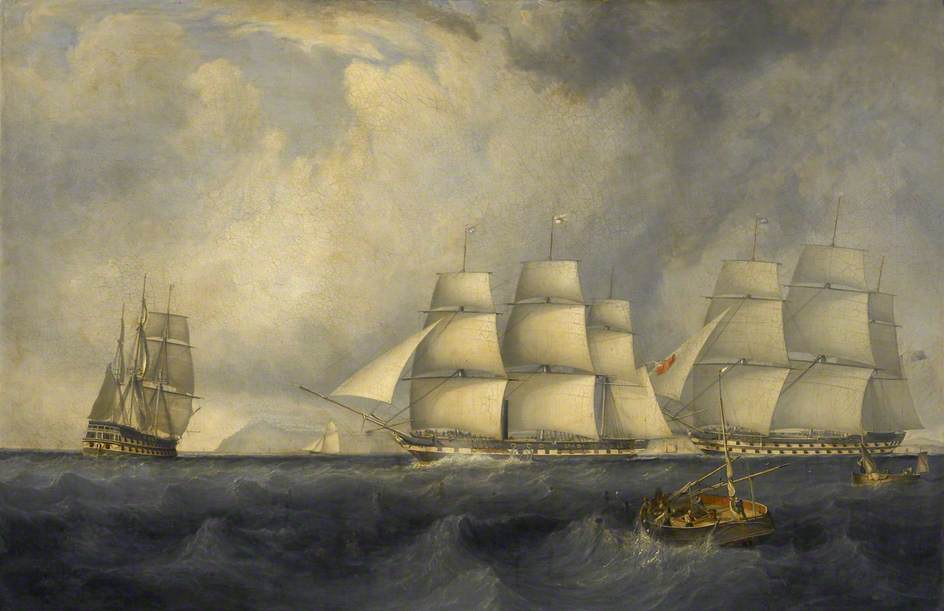
The 'Vernon' and Other Vessels (HM Ships 'Edinburgh' and 'Blenheim')
by John Lynn
Date painted: 1839
Oil on canvas, 99 x 137.1 cm
Collection: National Maritime Museum
A painting showing the steam auxiliary 'Blackwall frigate' East Indiaman 'Vernon', 996 tons, broadside in the centre. She is shown on her maiden voyage under sail and steam, passing HM ships 'Edinburgh' and 'Blenheim' as they beat down Channel off Bembridge, Isle of Wight, on 21 September 1839.
The painting was subsequently reproduced as an aquatint with the bow only of a further ship on the extreme right. All the three named ships are flying the Blue Peter, as outward bound, and the 'Vernon' flies the Wigram & Green pre-1843 house flag at the main. There are fishing boats tending buoyed lines in the foreground and a cutter in the distance with Bembridge cliff on the horizon. The 'Vernon' was built by Richard Green in London in 1838 to 1839 and according to the aquatint inscription her steam paddle engine was of 30 hp. Her sisters were the 'Earl of Hardwick', which also began life with auxiliary paddles, and the 'Owen Glendower', which was designed with them but converted back to sail only before her first voyage. The paddles of both other ships were unsuccessful and also soon removed. Registered for the London to Madras run, 'Vernon' was sold in 1863 to 1864 and ended her days as a reformatory ship at Sydney. John Lynn was a London artist who specialised in ship portraits, seascapes, coastal views and landscapes. He often combined ship portraits with exotic coastline and ethnographic detailing. Another portrait in the Green Collection showing the Indiaman 'Prince of Wales' (BHC3560) is also probably by him. The present painting is signed and dated 1839.
National Maritime Museum Greenwich UK
Object ID BHC3686
Mutiny on the Vernon 1863
NB: This is not Thomas J. Nevin's uncle-in-law, Captain Edward Goldsmith; it is Captain Lionel Campbell Goldsmid, now irrevocably associated with the Vernon Mutiny of 1863.
TRANSCRIPT
THE VERNON.
The Blackwall ship, Vernon, Captain [Lionel] Goldsmid, embarked 373 Government immigrants at Southampton, for Brisbane, on the 4th December, 1863, and on the 8th of the same month, she put to sea, but anchored at the Mother Bank off Ryde, in the Isle of Wight, owing to contrary winds. She lay there till the 13th of December, during which interval one of the seamen was lost overboard. She resumed her passage on that date, and had light variable winds and fine weather to the Line, which caused that portion of the run to occupy a longer time than usual. On the 2nd February, 1863, at 2 a.m., it was reported that some of the sailors were in the fore-hold broaching cargo, and making free with the spirits. Captain Goldsmid and Mr. Aldridge, the chief officer, went below and ordered them forward, and except that some of the men were very violent and threatening in their language, this attempt at mutiny passed off, and the men returned to their duty. At 10 o'clock on the same morning another attempt was made on the part of the crew to get into the hold, which was resisted by Captain Goldsmid and Mr. Aldridge, and some of the single passengers, who came to the assistance of the officers of the ship. As the sailors were all more or less excited by drink, they became very violent, and threatened to take the life of the chief officer, and some of them drew their sheath knives. Mr. Aldridge at this juncture went aft, and armed himself with a cutlass, with which he wounded two of the ringleaders, causing the mutineers to return to the forecastle. They still continued violent in their conduct, and threatened to fire the ship. From the time of this outbreak on the part of the crew, a guard of the single passengers, armed with cutlasses and pistols, was continually on duty on the poops and in the cabin, and the crew was not allowed on any pretence to go aft of the mainmast. The sailors said that they had been shown where to get the spirits by the second mate, and the present commander of the ship, Captain Aldridge informs us that from the subsequent conduct of that officer there is reason to believe they spoke the truth. The mutiny among the crew, and the incapacity of Captain Goldsmid, induced the surgeon-superintendent, Dr. James Sheridan Hughes, to direct that the vessel should put into Rio Janeiro, at which port she arrived on the 9th February. Here the mutineers, fifteen in number, were brought before a naval court held on board H.M.S. Egmont, and were sentenced to imprisonment in terms varying from three days to nine months. It may be mentioned, however, that although some of the men were sentenced to only three days confinement, yet, under the Brazilian law, they were not liberated until the ninth day, and those condemned to longer terms were in gaol a much longer time than the nominal sentence would seem to infer. The two wounded men and another who had interfered with some of the more violent mutineers on behalf of Mr. Aldridge, were sentenced to three days each, and the others to longer terms, according to their behaviour on board the Vernon.
As Captain Goldsmid had proved himself wholly unfit to hold the responsible position of master on board an immigrant ship, while on the passage from England to Rio Janeiro, the British Consul at the latter place removed him, and appointed Mr. Aldridge, the then chief officer to the command. The appointment seems to have been a very judicious one, and considering the very trying circumstances in which he was placed at the time, Captain Aldridge appears to have gained great credit for himself, by his conduct. While the Vernon was lying at Rio one of the sailors fell overboard and was drowned; this being the second loss from the crew by an accident of that kind. She sailed from Rio Janeiro on the 25th of February, and had a fair run of about thirty-two days to the meridian of the Cape of Good Hope. There she encountered a very heavy gale, during which she carried away the main topsail yard, an accident which protracted the passage very considerably, as it prevented the ship carrying as much sail as she would otherwise have done. From the Cape until after passing the southern portion of Tasmania, she experienced variable winds, and afterwards light north-westerly winds to Moreton Bay. She was off Cape Moreton on Tuesday the 10th May, but owing to light winds and calms she was carried away to the south by the coast current, and it was not until Thursday the 12th that she arrived in the bay. At 10.45 a.m. on that day, she was boarded by the pilot, and she anchored about three miles from the usual anchorage at sundown on the same night. Next morning she again got under weigh, and at one p.m. she brought up in her berth in the Brisbane Roads. On the following morning she was visited by Dr. Hobbs, who has courteously supplied us with the following information re- specting the passengers :
The Vernon was chartered by Her Majesty's Emigration Commissioners, and brings 373 government immigrants, comprising 152 single men, and 80 single women ; the remainder being married couples and their families. Notwithstanding the very lengthy passage through the detention at Rio Janeiro and other causes, there has been very little illness among the passengers, and the diseases which have been prevalent have been peculiar to children. There were eight deaths and five births.
Appended is a list of the births, giving the names of the mother and date of birth :-December 25th, Mary Barton, of a boy ; February 16th, Nancy Hall, of a girl ; 18th, Jane Cook, of a girl ; March 21th, Jessie Fisher, of a girl ; and 26th, Mary Rooney, of a girl. A list of the deaths is subjoined, giving the name, age, and date of death, and also the cause :-Sarah E. Hare, 1 year, of convulsions, on December 10 ; Robert House, 22, of disease of the heart, on December 23 ; Thomas Ryan; 40, of phthisis, on February 25 ;Ellen McMinimin, 8, of fever, on February 1 ; Harriet Rice, 1, of tabes mesenterica, on February l8 ; Alice M. Sibley, 1, of tabes mesenterica, on February 25 : Agnes Fisher, 8, of convulsions, on April 13 ; and James Quail, infant, of dentition, on May 4.
From The Brisbane Courier (Qld.), Monday 16 May 1864
Link: https://nla.gov.au/nla.news-article1258511
Captain Lionel Goldsmid biographical notes [source mislaid, apologies]
The Mercantile Navy List and Annual Appendage to the Commercial Code of Signals for all nations Ed J H Brown 2000 records Lionel Campbell Goldsmid Class examined OC; Date of Certificate 1854 and Examining Board Bristol. A List of New Patents Feb 5 1847 records Lionel Campbell Goldsmid of Rue Magador Paris - improvements in applying rudders to ships and other vessels. Lionel was a captain in the mercantile marine born Crickhowell South Wales abt 1820. He died July qtr 1913 Paddington London and was first married Oct qtr 1849 Marylebone 1 182. His first wife had already been married- she was Elizabeth Mackenzie who had married a Daniel. The 1851 Census ( Crown copyright, TNA) H0107 1491 589 66 shows Elizabeth at 55 St John's Wood Terrace Marylebone. Elizabeth GOLDSMID Married 29 authoress-fiction b Oxfordshire; Donald Daniel son 8 scholar b Jersey; Ellen daughter 6 b Jersey
The 1871 Census ( Crown copyright, TNA) RG10 2687 22 16 Ashfield-Holly Mill Villa Ross
Herefordshire records: Campbell Goldsmid M 49 Captain in the Merchant Marine b Crickhowell S Wales; Elizabeth Goldsmid wife 49 authoress: fiction b Oxfordshire, Coombe; Ellen step daughter U 26 Independent b Jersey, St Saviours.
The family had also appeared in the 1861 Census at 3 Sussex Place G Church Lane Hammersmith .
Lionel appeared in the Queensland, Australia Passenger Lists 1848-1912 age 41 b abt 1822 Wales Port of Departure Southampton arrival Brisbane 12 July 1863 on the Ship ' Vernon'.
By 1880 Lionel had re- married following the death of Elizabeth ( Jan qtr 1878 Wandsworth London 1d 495 age 55) to Kate Crawcour nee Hart.
RELATED ARTICLES main weblog