Prisoner poses: women, children and ticket-of-leave men

Early prisoner and forensic photography, Tasmania and elsewhere.

CHILD PRISONERS – U.K.


Source: National Archives, Kew, United Kingdom
"This photo comes from an album showing prisoners in Oxford Gaol. The inclusion of photos in prison records at this early date is very rare.
The child is Julia Ann Crumpling, aged seven. She was sentenced to seven days’ hard labour on 28th June 1870 for stealing a baby carriage.
This type of punishment for a child convict was not all that unusual. Even though many people thought that sending a child to gaol did more harm than good, there were still over 1500 children in adult prisons in 1871. This was to change later in the century. After 1899, children had to be sent to separate places of correction, such as Reformatory Schools.”


Elizabeth Roberts, aged 15 on discharge.


George Page, aged 12 on discharge.

WOMEN PRISONERS – U.K.


Prisoner B. Calder 1873


Prisoner Caroline Rose 1876

Source of all above: National Archives, Kew, U.K.

WOMEN PRISONERS – TASMANIA
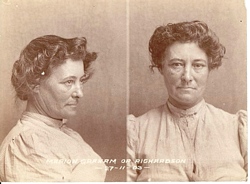


The Mercury, Saturday, April 1, 2006
UNIQUE photographs detailing Tasmania’s penal history will feature in an exhibition opening in Hobart this weekend. The display, part of the Tasmanian Heritage Festival, is the culmination of more than 20 years work by curator Martin Cashew, a historical researcher and curator at the Penitentiary Chapel in Hobart .... A recently discovered collection of negatives from 1961 has been reprinted for the display ....
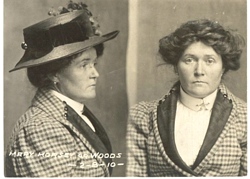


The photographs of these two women were taken in Tasmania in the 1900s according to the conventions of the Bertillon Method – one in profile, one full frontal. Alphonse Bertillon’s system of criminal anthrophotometry (example below, 1888) included taking measurements of the individual which were recorded on a card accompanying the photograph:

Bertillon 1888

Self-portrait: Alphonse Bertillon’s measurement card, done according to his own system for criminal anthrophotometry
Date: 1888
Source: University College London, GP, 137/13

THE FIRST ROGUES’ GALLERIES in TASMANIA
The earlier examples of prisoner identification photographs taken by Thomas J. Nevin from 1872 onwards show a consistent pattern of the subject seated, with sightlines to either the left or right side of the frame. The final image pasted to the prisoner's criminal record - his rap sheet - was mounted in an oval frame, a practice that continued in Tasmania from the 1870s when Thomas Nevin first produced these mugshots right up to the late 1890s. This convention of portraiture is also evident in Nevin’s upper-body portraits of his own family members (sister, wife, sister-in-law, including himself in a self-portrait) and of his private clientele where the subject’s sightlines are diverted to lower left or right of frame. The pose was commercially conventional; it was a technique applied by Nevin to his commission for the 1870s convicts’ identification photographs as well.

The pose was not the result of the social status, class and power differentials between photographer and convict, as Helen Ennis suggests (Exposures, Photography and Australia , 2007, pages 21-22), a suggestion which ignores this pattern in Nevin’s technique; which assumes that Nevin was not familiar, nor even friendly, with these convicts, some of whom had travelled as Parkhurst boys with Thomas Nevin, aged 10, and his family to Tasmania in 1852 on board the Fairlie, eg. Michael Murphy; and which presupposes that at the point of capture the convict was cowering under the gaze of a punitive individual such as the Commandant of the Port Arthur prison, A.H. Boyd, a furphy [erroneous story] created by Boyd's descendants and Chris Long which has resulted in a misattribution, and has misled Ennis into publishing this comment which is coloured by her misconception:
Within the field of portraiture Australia was no exception in addressing the needs of the state. In 1874 the last remaining convicts and paupers at the Port Arthur penal settlement in Tasmania were photographed according to a set formula; each man was placed in front of a neutral background and photographed in three-quarter view. In contrast to the standard commercial portrait in which eye contact was a key component, the convict did not face the camera. His averted gaze reinforced the unequal power dynamics in the relationships between the subject and the photographer and also between the subject and the relevant authorities. These are photographs in which those photographed are assumed to have no personal or emotional investment; presumably the convicts never saw the final prints over which they had no claim.
[Helen Ennis, 2007:21-22]

There are too many presumptions, not enough facts and no substance or proof supported by original documentation behind Helen Ennis’ statements. The majority of T. J. Nevin’s photographers of prisoners - or "convict portraits" as they called at the NLA - were taken at the Hobart Gaol and the adjoining Supreme Court, and not at Port Arthur. It was not until the mid to late 1880s that the Bertillon method became standard prison photographic practice in Tasmania.


Prison record of convict Allan Williamson with mounted photograph by T.J. Nevin
PCHS and State Library of Tasmania, eHeritage collection.


Prisoner Michael Murphy per Fairlie 1852
Tasmanian [Port Arthur] convicts photographs by Thomas J. Nevin
Archives Office of Tasmania Ref: PH30/1/3217.

For more extensive discussion of T. J Nevin’s 1870s mugshots of Tasmanian prisoners, visit :

All these prisoners were re-offenders, discharged with ticket-of-leave and other conditions, which required police to keep their photographic record in a central register - the Gaol Photo Books - and at their local police station. This practice originated with Scotland Yard in 1862:

From Good Words 1869, By Norman Macleod, Donald Macleod,
The public may not be aware that there is a photographic album at Scotland Yard, in which may be seen the carte of every ticket-of-leave man in the country … One carte de visite is kept in the police album at Scotland Yard, another at the station-house of the division of the metropolis in which he may select to reside, and a third is forwarded to any country district he may wish to remove to ....
Thomas J. Nevin was the only commercial photographer in Tasmania to produce prisoner identification photographs on colonial warrant in the 1870s. This Rogues’ Gallery from the National Library of Australia’s collection online (82 images as at 2008), was sourced originally from the 1870s police registers for reproduction, exhibition and sale in the 1900s by John Watt Beattie. The NLA Collection represents a small number of estrays from the more than a thousand original and duplicate photographs taken by Thomas Nevin and his brother Constable John Nevin at the Hobart Gaol, Campbell Street. In the 20th century, these prisoner cdv's have been re-contextualised within two types of discourse: commercial interests promoting penal heritage for the tourist industry (eg. Beattie’s Studios 1913, the Port Arthur Historic Site, 1983, 2007); and modern and post-modern art historian aesthetics (eg. Long, Crombie, Ellis 2007). A significant number of prisoner cdvs by Nevin are also held at the Tasmanian Museum and Art Gallery, the State Library of NSW, and the Queen Victoria Museum and Art Gallery. Some are also held in private collections.

POLICE AND FORENSIC PHOTOGRAPHY
Source: The Oxford Companion to the Photograph OUP 2005
Police and forensic photography serves the purposes, respectively, of identifying and documenting individuals suspected or convicted of committing crimes, and of detecting and presenting evidence needed to solve crimes and obtain convictions. The former has involved the compilation of rogues’ galleries and albums; the latter, scene-of-crime photography and a range of scientific imaging techniques.

During the 19th and 20th centuries two developments were particularly important in relation to police and forensic photography. First, as state administrations became increasingly professionalized, more and more data about citizens were collected. Secondly, the organizational and technical modernization of criminal-justice systems brought science to bear on both police and judicial procedures. As far as identification and investigative photography were concerned, criminological, physiognomical, and anthropological theories were significant, but played little part in everyday practice. The main reason for eventual police and judicial adoption of photography, apart from the medium’s increasing ubiquity, was the widespread belief in the unequivocal verisimilitude of the photographic portrait.

Police photography to 1890

Although photography was accepted from the beginning as the most precise method of depicting people and objects, its acceptance as a forensic instrument and means of identification took some time. The earliest evidence for the photographic recording of prison inmates comes from Belgium (1843-4) and Denmark (1851). Although in the 1850s the photography of detainees began in Switzerland (Prosecutor-General Jakob Amiet, 1854), the USA (San Francisco, 1854), and England (Bristol, 1852), and in the 1860s in many other states, including Germany, Spain, and Italy, it was on a purely experimental basis. It was not yet governed by any basic technical or legal principles, and there was no special training for photographers, policemen, or prison officials. Nor were there any sizeable portrait collections that could have facilitated systematic searches for suspects or escapees. The pictures were taken either by amateurs, such as prison governor Gardener in Bristol from 1852, or by commercial photographers like Carl Durheim in Bern, Switzerland (1852), or Emil Rye in Odense, Denmark (1867-78). Efforts to make prisoner portraits in the 1850s were not only scattered, but sometimes failed to win approval from above. Although in 1850s France the journal La Lumière several times discussed suggestions for prison photographs, there was no response until after 1871. (However, the Paris police took an early interest in photographic as their Dossier BB3 demonstrates.)

In the 1870s, when the authorities in many countries increasingly had delinquents photographed, it was by professional photographers who produced conventionally posed portraits. Although poses were gradually adapted to police requirements, this practice remained widespread until the end of the 19th century; until 1900, for example, the Berlin police presidency used the firm of Zielsdorf & Adler. This period also saw the emergence of the still widely accepted convention that—subject to police discretion—only individuals convicted of fairly serious offences should have their pictures taken and archived.

In practice, police and, particularly, forensic photography remained for a long time limited to big cities. Only there did the scale of police organization and the existence of a scientific infrastructure make it feasible to use photographic methods to record clues at crime scenes and evaluate them in the laboratory. But urban criminal investigation departments had to keep track of ever-increasing numbers of suspects. With the ‘rogues’ gallery’, a means was found to classify criminals and sort their portraits in albums or card indexes according to types of offence. The earliest precursors of such collections have been identified in Birmingham, England (1850s-1860s), Danzig (1864), Odense (1867), and Moscow (1867). But systematic picture archives were first assembled in London (1870), Paris (1874), and Berlin (1876), the responsibility for them shifting from prison services to the police. The first attempts were also made to standardize the pictures. But although the anthropological practice of using profile and full-face shots was suggested, it took nearly two decades to be universally accepted. Another challenge was the sorting and classification of the collections, which in a few years swelled to many thousands of images and therefore became practically unusable.

The problem was solved by Alphonse Bertillon while he was employed in the Paris prefecture of police at the end of the 1870s. The Paris portrait collection was arranged according to sets of anthropometric data designed to guarantee reliable identification even when the name of an individual was unknown. In fact, the system was meant to replace the mug shot as a means of identification, but this did not happen, since photography was by this time too firmly established in police practice. Bertillon therefore worked out rules for a scientifically exact form of identification photography, which were published in Paris under the title La Photographie judiciaire (1890). For police purposes, an individual would be photographed full face and in profile, with the face well lit and, in the profile image, the ear clearly visible. Bertillon insisted that the conventions of commercial portraiture should be completely excluded from judicial photography. His physical measurement system and photographic rules gained acceptance and by the turn of the century had been introduced in nearly all states. While body measurements were replaced soon after 1900 by fingerprinting, the standardized method of making photographs endured, but was supplemented from the 1920s by the inclusion of a three-quarter portrait.

Since the early 20th century, identification data have been exchanged internationally, a practice that increased after the founding of Interpol in 1923. Whenever possible, lists of internationally wanted criminals have been accompanied by photographs.

Not only criminal investigation departments but special branch (political) sections made and used photographic portraits for identification and search purposes. As early as 1855, Berlin police president Karl Ludwig von Hinckeldey circulated photographs of ‘revolutionaries’ among his colleagues in other German states. In 1858 the Württemberg political police used photographs in hunting for the Italian republican nationalist Giuseppe Mazzini. Collections of political portraits also grew rapidly. The National Library of Ireland holds an album of 204 pictures of Fenian (Irish Republican) conspirators compiled by Samuel Lee Anderson, a government intelligence officer, between 1865 and 1871; many more Fenian portraits exist in the Irish National Archives. At international level, from 1898 to 1899, a secret album of hundreds of portraits of wanted anarchists assembled by the Berlin political police was regularly updated by pictures of new suspects. The survival of this ‘anarchist album’ in numerous European archives indicates how far reaching such cooperation was.

Research on ‘criminal physiognomy’

Scientific examination of picture collections from an anthropological or physiognomical perspective was not actually done by the police themselves. Significantly, the two best-known users of criminal portraits, the Italian Cesare Lombroso (1836-1909) and the Englishman Francis, began their work before Bertillon’s reform of police photography. Lombroso, a doctor and eventually professor of forensic medicine and hygiene in Turin, attempted in his book L’uomo delinquente(1876) to prove both that criminal tendencies were hereditary and that they could be identified from particular physical characteristics. To this end he had visited prisons, made body measurements of prisoners, and collected pictures of criminals. After the appearance of his book he continued to work on the subject, and by the turn of the century had a large collection of criminal portraits obtained from governments in Europe and overseas. Although his theory was heavily criticized, and was never accepted by experts, it became popular. So too with Galton, who began his research a few years after Lombroso. He too believed in the heritability of mental traits, grappled with the phenomenon of criminality, and used official pictures. His method was to make composite copies of portraits of different people in order to arrive at an ‘average’ deviant physiognomy. His major work, Inquiries into Human Faculty, containing papers written since 1869, appeared in 1883. But his theories also failed to convince his peers, and there were no further attempts to examine criminals or criminality on the basis of police portraits. Undeniably, however, a certain image of ‘the’ delinquent did emerge in the popular imagination, and persists as a visual code identifying certain characters as criminals in literature, comics, films, and tabloid newspapers.

Forensic photography

Alongside photography’s role as a means of documenting individuals, it is an important tool in solving crimes. Narrowly defined, forensic photography serves to identify and document clues. Crime-scene photographs were made in Lausanne as early as 1867. Photographic exposure of forgery, and revelation of handwriting invisible to the eye, also took place before the end of the 1860s. But it took decades before such evidence became widely acceptable in court. Eventually in Germany, however, the forensic chemist Paul Jeserich from Olmütz and the Berlin court official Friedrich Paul formulated convincing procedures for photographic clue gathering; Paul’s 1900 handbook, complete with gruesome images of murders and accidents, also provided a fascinating history of the whole subject and a review of current practices. Rodolphe Reiss, professor of judicial photography at Lausanne University from 1906, played an equally important role in Switzerland. After the turn of the century the celebrated Austrian criminologist Hans Gross (1847-1915) also lent his authority to the cause of forensic photography. In this more favourable climate an increasing number of police forces created their own studios or modernized existing ones, among them those in Vienna (1899), Berlin (1900), and London, where in 1901 Scotland Yard could finally give up using commercial photographers.

Such developments, reflecting the increasing professionalization and scientific sophistication of police work, have continued up to the present. Promising technical advances have been rapidly adopted by police specialists, while tasks unsuitable for police laboratories have been handled by outside institutes. At the beginning of the 21st century, conventional and photography continues to play an important role in police work, ranging from long-established, technically straightforward activities such as surveillance and traffic monitoring to the use of sophisticated equipment to show minute objects and invisible substances.

— Jens Jaeger

Bibliography
  • Paul, F., Handbuch der criminalistischen Photographie für Beamte der Gerichte, Staatsanwaltschaften und der Sicherheitsbehörden (1900).
  • Phéline, C., L’Image accusatrice (1985).
  • Regener, S., Fotografische Erfassung: Zur Geschichte medialer Konstruktionen des Kriminellen (1999).
  • Hamilton, P., and Hargreaves, R., The Beautiful and the Damned: The Creation of Identity in Nineteenth-Century Photography (2001).
  • Jaeger, J., ‘Photography: A Means of Surveillance? Judicial Photography 1850 to 1900’, in Crime, History and Society (2001)

Source: “Police and forensic photography.”
The Oxford Companion to the Photograph.
Oxford University Press, 2005.
[end of OUP extract]

THE BERTILLON METHOD


"Bertillonage" and Identification by Body Measurements
Youtube: https://www.youtube.com/watch?v=lB6UqplGTIU

The PARKHURST prisoners & anthropometry

Dr Charles GORING, the Lombrosian Theory, and Bertillonage,
BEATTIE's Studio reprints of T. J. NEVIN's convict portraits of the Parkhurst boys ca 1916.
"There is no criminal type. " Dr Charles Goring, 1913


On the left, Havelock Ellis' sketches of the criminal stereotype, and on the right, the thirty outlines based on photographs by Dr. Goring from stock held at the Parkhurst Prison, Isle of Wight.

"THERE IS NO CRIMINAL TYPE," SAYS PRISON EXPERT
THE NEW YORK TIMES
November 2, 1913, Sunday
Section: Magazine Section, Page SM13, 4250 words
THE 'criminal type' is an anthropological monster. There is no such thing as a 'criminal type.'" In other words, the criminal is a normal person, not markedly different from the rest of humanity who have managed to keep out of prison. In other words, there are in ministers and Cambridge undergraduates and college professors the making of pickpockets and thieves, as well as murderers and forgers...
Tourists to Tasmania in the early 1900s were encouraged to disagree with this sort of thinking put forward in newspapers by Dr Goring. With the intense promotion of Tasmania's penal heritage in the early 1900s, due largely to the release of the first of the two films based on Marcus Clarke's 1874 novel, For The Term of His Natural Life (1908, 22 minutes), many Tasmanian prisoner dientification photographs taken by Thomas J. Nevin on government contract to police and prison authorities in the 1870s were reprised by John Watt Beattie and Edward Searle for sale as tourist tokens in Beattie's convictaria museum in the 1900s, called The Port Arthur Museum, although it was located in Hobart and not at Port Arthur.

Some of Searle and Beattie's reprints were displayed in albums as "Types of Convicts - Official Prison Photographs from Port Arthur", such as this one of convict William Lee. The paper reprint is from a reproduction of Thomas Nevin's original glass negative, taken of William Lee per the ship Neptune 1 on the prisoner's discharge from the Hobart House of Corrections for Males (Hobart Gaol), October 1873. William Lee was regularly discharged thereafter as a pauper from the Brickfields Depot in 1874 and 1875.

The album leaf is cunningly labelled with “Port Arthur” to attract the tourist. Presumably Searle or Beattie wrote the caption - "Official Prison photographs from Port Arthur" - to hype the commercial value they saw in promoting the penal heritage of both their museum objects and the State’s history. Just as they hyped Beattie's “Port Arthur Museum" with the “Port Arthur” label, despite its city location in Hobart and not at Port Arthur, this photo of prisoner William Lee was forcibly associated with the label “Port Arthur”. It had become a brand name by the early 1900s, much as it is in today's aggressive promotion of the Port Arthur Historic Site as Tasmania's premier tourist destination. The very ordinary facts of William Lee’s life as a prisoner and pauper in a city depot would not have sold his photo without the caption, the brand name. The unspoken appeal to the tourist imagination, through their revulsion and fascination, was to suggest that despite such humble beginnings, a transported felon could do well in the colonies, but a pauper's end-of-life story, if revealed, offered nothing.


National Library of Australia Catalogue
Part of the collection of photographs compiled by Australian photographer E. W. Searle while working for J. W. Beattie in Hobart during 1911-1915.
On the photograph held, the image including the name of the subject appears in reverse. "Official Prison Photographs from Port Arthur" and "Types of Convicts"--Inscription on page of album, below photograph.
Subject Lee, William

POLICE RECORDS for William Lee


William Lee per Neptune 1, aged 78 years, last tried August 1872 for being idle and disorderly, was discharged on 1st October 1873 from the Hobart Gaol. William Lee, pauper, was discharged again from Brickfields Depot, Hobart 12 September 1874 and discharged again on 29 January 1875. Thomas Nevin photographed several more of these prisoners who were discharged in the same week, and whose mugshots are extant in public collections, viz. Thomas Owens, James Wood, James Smith, Thos Molyneux and William Baker aka Whittaker.

In 1977, The Queen Victoria Museum and Gallery, Launceston, Tasmania, held an exhibition of T. J. Nevin's convicts photographs sourced from John Watt Beattie's collection which had been deposited there from Beattie's estate in 1930. Newspaper reports of the 1977 exhibition noted that some of the prisoners had been transported to Tasmania as Parkhurst boys.

Clearly for commercial reasons, Beattie and Searle's promotion of T. J. Nevin's 1870s police mugshots was meant to curry and to cater to the popular belief in the existence of a criminal type, a theory proposed by Lombroso, demonstrated for the Paris police by Bertillon, expanded by Havelock Ellis and refuted by Dr Goring, Medical Officer, H.M. Prison, London, who collated data from the stock of prisoner photographs held at Parkhurst prison to support his views. Beattie and Searle may well have been aware of the debates and reports of Goring's experiments.

John Nevin and family on board the "Fairlie" with Parkhurst boys
The Nevin family connected to the Parkhurst Prison in two key aspects. Thomas J. Nevin's father, John Nevin snr (1808-1887) of the Royal Scots First Regiment with service in the West Indies and the Canada rebellion (1825-1842) worked as a warden of the adult convicts and Parkhurst boys on board the convict transport the Fairlie to assist the passage of his family, English-born wife Mary Ann nee Dickson and their four Irish-born children: Thomas James, aged 10, (born 1842), Mary Ann (born 1844), Rebecca Jane (born 1847) and Jack, babe in arms (William John born 1851), arriving in Hobart on July 3rd, 1852. When the Nevin family settled on property in trust to the Wesleyan Church, at Kangaroo Valley, Hobart, John Nevin snr became both a trustee of the Wesleyan Chapel and the local schoolmaster.

The Fairlie left the Isle of Wight on March 2, 1852 and sailed from Plymouth on March 11, 1852, with a total of 292 male prisoners and 32 Parkhurst boys on board. All of the boys were said to have disembarked in Tasmania. Thomas J. Nevin was still a child in 1852 but he would have been able to recognise and recount the identifiable features of these adult prisoners and Parkhurst boys from their common experience as passengers on board the Fairlie. This was a distinct advantage when he began working with police in the early 1870s.

From 1872 until the mid 1880s, Thomas Nevin was the only commercial photographer working in Hobart for the colonial government on contract to provide prisoner identification photographs for police and prison authorities. Some of these Parkhurst boys who had re-offended and were imprisoned for a second or third time between 1870 and 1880 were among his subjects. For example, George White, alias Nutt, was a former Parkhurst boy who was transported as George Nutt, shoemaker. He was a 13 year old boy sentenced to seven (7) years in May 1848 at the Central Criminal Court London for larceny. When he arrived in Hobart with the Nevin family aboard the Fairlie on July 3, 1852 he was about 17 years old. His various felonies landed him in the Separate Model Prison at Port Arthur in 1871. He escaped from Port Arthur in August 1875, was sought by police with a warrant and offer of reward to his captor. He was arrested and imprisoned at the Hobart Gaol on 15th September 1875, where he was photographed by T. J. Nevin. His photograph or copy held at the AOT was numbered "1" on the mount, presumably by Beattie when it was displayed in his "Port Arthur" museum in the 1900s.


Archives Office of Tasmania
PH30/1/3222
Caption: George White alias Nutt convict transported per Fairlie 1852
Photo taken at Port Arthur by Thomas Nevin 1874

POLICE RECORDS for George Nutt

reward for George White aka Nutt

George Nutt was undergoing a sentence of ten years for robbery from a person when he absconded from Port Arthur, per this police gazette notice published on 27th August, 1875. Some details were amended when the warrant for arrest was issued in the following week's description for police information:


TRANSCRIPT
HOBART TOWN. - On the 3rd instant, by William Tarleton, Esquire, J. P., for the arrest of George Nutt, alias White, charged with having, on the 24th ultimo at Port Arthur, escaped from lawful custody and control while a prisoner under sentence for felony. For description see Crime Report of the 27th ultimo, page 134; but for height 5 feet 3, read 5 feet 1 inch, full prominent features, walks with a remarkable swagger in his gait.

The notice appeared again on the eve of Nutt's capture, with the offer of a reward of ten pounds and the notice of his arrest appeared in the same issue.

Nutt arrested 3 Sept 1875

Sources: Tasmania Reports on Crime for Police Information 1875. Govt printer.

Addenda

1. EXTRACTS from THE NEW YORK TIMES November 2, 1913, Sunday


2. "What the statistics show": more from the article above "There is no criminal type"...


Source: New York Times November 2, 1913

3. FURTHER READINGS:


Mugshots by Raynal Pellicer 2008
Photos © KLW NFC 2009 ARR


Suspect Identities by Simon Cole 2001, p. 19 below.


RELATED POSTS main weblog

Melville Street from the Hobart Gaol 185 years ago

NEVIN brothers at the Hobart Gaol, Campbell St. 1860s
Thomas J. NEVIN, commercial photographer, government contractor (1842-1923)
Constable John (William John, aka Jack) NEVIN (1852-1891)


Panorama of Hobart from the Domain, showing the Hobart Gaol, Penitentiary Chapel and Melville Street on viewer's left.
Archives Office Tasmanian Ref: NS052420


Hobart Gaol and Penitentiary Chapel, Hobart
Archives Office Tasmania
Link: https://stors.tas.gov.au/LPIC147-3-190

The tower of the Penitentiary Chapel, which is now a National Trust property, is the key landmark (building E on the map). Melville St is further to the left of the Chapel, on the other side of the site, and ended abruptly at the Governor's Quarters (building G).


Photo taken of map pasted to a window at the Penitentiary Chapel Historic Site, Campbell St. Hobart.
Copyright © KLW NFC Imprint 2008 ARR.

The photograph (below) was taken by Thomas J. Nevin in July 1868 on a day of heavy snowfall.


'Melville St West Hobart under snow'
TMAG Collection Ref: Q9134

The verso of this photograph carries Thomas J. Nevin's most common commercial studio stamp and the wording "This by W. J. T. Stops Esq."which suggests that the photograph was presented to Frederick Stops by Nevin in 1868, perhaps as a gift to Emily Stops on the birth of their daughter, and was then passed down to his son W. J. T. Stops, who subsequently donated it to the Tasmanian Museum and Art Gallery from the Stops estate or even  from the University archives (Royal Society Collection) where more of Nevin’s photographs are held. It was then inscribed by an archivist on accession with the note - "This by W.J.T. Stops Esq". Frederick Stops and photographer Thomas Nevin were well acquainted for several reasons, the first being the dissolution of Thomas Nevin's partnership with Robert Smith operating as the firm "Nevin & Smith" in February 1868 which was underwritten by Frederick Stops' employer and Nevin's mentor, the Hon. W R. Giblin, Attorney-General.

Thomas Nevin exhibited this photograph at the Wellington Park Exhibition, Hobart, in July 1868. It was reproduced in the publication Tasmanian Photographers 1840-1940: A Directory (Tasmanian Museum and Art Gallery, 1995:82).


Entry on two photographs by Thomas J. Nevin (TMAG collections)
TMAG publication Tasmanian Photographers 1840-1940: A Directory (1995)

Thomas Nevin's chosen position to take the photograph was from the second storey of the Governor's Quarters. His camera captured the right side of Melville Street, and a wider vista of Mount Wellington to the north west. This photograph is yet another which suggests Nevin's association with the Hobart Gaol administration in 1868 when his solicitor W.R. Giblin, later Attorney-General, acted on his behalf to dissolve his partnership with Robert Smith, of the firm Nevin & Smith.

A few years earlier, ca. 1865, Thomas Nevin's younger brother Jack Nevin (Constable John Nevin) posed for a photograph in the courtyard of the Hobart Gaol, seen in this stereograph, left hand on hip, in the company of a prison official, possibly the Superintendent T.P. Ball.


Location: W.L. Crowther Library
ADRI: AUTAS001124851627 (auto color-corrected)

For further discussion of this stereograph, see this article here.

This stereograph, and others taken at the same time and place of the Prisoners Barracks (see below) are held at the State Library of Tasmania, and although unattributed, they were most likely taken by Thomas Nevin  working with Alfred Bock between 1863-1866 at their studio, 140 Elizabeth St. Hobart. The Nevin brothers' association with the Hon. W. R. Giblin and the Hobart Gaol continued throughout the 1870s and 1880s while Nevin was contracted to the Municipal Police Office as prisons photographer, both as a commercial photographer on government contract, and as a full-time civil servant in 1876. His principal studio and business, The City Photographic Establishment, was located one block away, close to the corner of Melville and Elizabeth Streets directly to the west. During his contracted years he used the studio to display photographs of absconders and others under warrant. His younger brother Constable John Nevin was a salaried employee and resident in training as keeper of the Hobart Gaol (H. M. Prisons) from the early 1870s until his death during the typhoid epidemic of 1891. He acted as his brother's photographic assistant at the Hobart Gaol during the 1880s.

Hobart Gaol governors house facing Melville St

Source: eHeritage images, State Library of Tasmania
Title: The Gaol Governor's House which blocked Melville Street.
Photographer: J. Hutchinson
Date: 1961
Notes: Monochrome photograph laminated over a white cardboard mount. The prison walls of the Hobart Penitentiary flank either side of this two storied house. The road surface in front of the house is uneven and unsealed. The house was in use in from the 1850s until November 1960. It was demolished in 1963.
Ref: PCH_00005


It was from this building, which by 1900 was called the Superintendent's house, that Nevin took the Melville St. photograph. The public entrance to this building was from Melville St, which terminated at its front gate (photo above), rather than the Gaol's entrance in Campbell St (photo below).


Frontal side view of the Superintendent's House at the Hobart Gaol in Campbell Street [PH30-1-3691]
Locality: Campbell Street, Campbell Street, Hobart
Date: 1900
Archives Office of Tasmania
Link: https://libraries.tas.gov.au/Record/Archives/PH30-1-3691

These identification photographs of convicts were taken by the Nevin brothers at the Hobart Gaol and at the Town Hall Municipal Police Office between 1872 and 1886.


Photo © KLW NFC Imprint 2008 ARR.

This poster of Thomas Nevin's identification photos of convicts, 1870s, was printed in 1991 from the QVMAG's collection of prisoner cartes.

PAHSMA accreditation printed on lower left border reads:
Produced by Port Arthur Historic Site Management Authority, with photographs (circa 1870) from the Queen Victoria Museum and Art Gallery Beattie Collection.


These in the series of stereographs dated ca. 1865 of the Prisoner Barracks and yards of the Hobart Gaol and the one above are color adjusted here to show the yellow salt paper on which they were printed:


Courtesy State Library of Tasmania
Location: W.L. Crowther Library
ADRI: AUTAS001124851619
Location: W.L. Crowther Library
ADRI: AUTAS001125299420


Left panel of panorama
State Library of NSW
"Part of Hobart"
Ref:a8816031h

Updated 2026

Prisoner Bewley TUCK can speak for himself

NEVIN'S GLASS NEGATIVES 1870s
PRISONER BEWLEY TUCK or JOHN TUCK?


Black and white print from Thomas Nevin's glass negative taken of prisoner Bewley Tuck, No. 68 at the Hobart Gaol 1875
From the Tasmanian Museum and Art Gallery Collection (online until 2006)

Dark Tourism and Heritage Fictions
Carolyn Strange in this article points to the fictionalisation of the past as the dominant modality of museological practice at the Port Arthur Historic Site. Convict Bewley Tuck's fictive "voice-over" tale stands in for a new "interpretative" identity between museum and tourist. Thomas Nevin's photograph of Tuck (ca. 1870), however, is not a construct but an artefact of the convict's reality as both convict and photographer experienced it. A documentary original photograph is not the same thing at all as a contemporary "interpretation" of it. As one visitor remarked to Strange on leaving the display, "I prefer the real thing."

Article by Carolyn Strange [pdf]

"Proceeding off from the workers’ display area is a room set aside for a slide show that combines 1860s photographic images of real convicts with voice-over fictional recollections of real-life convict Bewley Tuck. Inspired by the experiences of this man, who served sentences at Port Arthur between the 1830s and 1870s, the script is a salty tale about the penal regime and the changes at the site (particularly the introduction of the separate silent prison) in the post 1840s era. Visitors can learn more about the post-convict period (the 1880s to the present) if they move beyond this bare chamber to a story board area that explains how Port Arthur was transformed from a somewhat shameful curiosity into a carefully preserved historical site vying for world heritage status."

From ‘Place of Misery’ to ‘Lottery of Life’: Interpreting Port Arthur’s Past by Carolyn Strange © Open Museum Journal Volume 2: Unsavoury histories, August 2000

Thomas J. Nevin and prints from his glass negatives
Of the three hundred and fifty (350) or so extant photographs taken by government contractor Thomas J. Nevin of Tasmanian prisoners in the 1870s which were printed unmounted and/or in an oval mount for prison records, this unmounted print of Bewley Tuck (above) is held at the Tasmanian Museum and Art Gallery (TMAG), Hobart.

At least forty more unmounted photographs of prisoners taken by T. J. Nevin in the 1870s which were collated by John Watt Beattie in three panels ca. 1915 are held in the Queen Victoria Museum and Art Gallery, Launceston, together with seventy or so cdvs in oval mounts, the remainder of part of more than three hundred in oval mounts which were originally acquired from the estate of convictaria collector and government photographer John Watt Beattie to the QVMAG in the 1930s. When several dozen mounted and unmounted cdvs were removed from Beattie’s original collection at the QVMAG and taken down to the Port Arthur prison heritage site for an exhibition as part of the Port Arthur Conservation Project in 1983, they were not returned to the QVMAG. They were deposited instead at the TMAG .

Given the scratches, crossed out inscriptions and general damage, the glass negative from which this print was made would have been used extensively to reprint the prisoner's photograph for prison records as each offense and charge was recorded. The print, unmounted such as this one, would have been pasted to his rap sheet, and more would have been reprinted from the original glass plate several times over the prisoner's long criminal career. Examples of both types of prisoner mugshots - mounted and unmounted - attached to prisoners' rap sheets are held at the Archives Office of Tasmania in the Hobart Gaol photo books.

The QVMAG holds the mounted carte-de-visite of this prisoner Bewley Tuck, printed from the one and only sitting with police photographer Thomas J. Nevin, in 1875 at the Hobart Gaol. The QVMAG list (acquired here in 2005) showed a total of 199 mugshots, but only 72 were physically held there when the list was devised. A total of 127 mugshots were missing by 2005. Two mugshots in this sequence – numbers 198 and 200 of prisoners James Mullens and William Smith, each bearing verso Nevin’s government contractor Royal insignia studio stamp – were deposited at the State Library of NSW, Mitchell collection (SLNSW PBX 6274) ca. 1907, among a dozen more which do not bear the numbering on recto.


The Port Arthur Conservation Project 1983, Elspeth Wishart
Notes from the QVMAG catalogue Q1985: P: 0068
Cdv and uncut print of prisoner Bewley Tuck.

Elspeth Wishart (an employee perpetuating the A. H. Boyd misattribution, formerly at the QVMAG and now at the TMAG), contrived the absurd and groundless photographer attribution to the commandant A. H. Boyd during this 1983 exhibition at Port Arthur as a result of a socially aspirational comment by a descendant of Boyd. It was hearsay, and remains nothing more than vexatious misinformation.
See these articles:

One man, two names, one image


In addition to a paper copy of T. J. Nevin's photograph of Bewley Tuck (seen in this webshot, 2005), the Archives Office of Tasmania holds two relevant convict records.

71580
Tuck John
04 Aug 1831
Argyle 18 Mar 1831
Plymouth

71572
Tuck Bewley
16 May 1833
Lotus 13 Dec 1832
Portsmouth

Two versions exist of the one photograph taken of a convict who was labelled JOHN TUCK on the print from Nevin's original glass plate, and BEWLEY TUCK on the carte-de-visite mounted in an oval frame. Were they one and the same person, or two different men? The Archives Office of Tasmania holds a record for each name, with different transportation dates and physical descriptions, so there must have been two different men, so why is there just one image of the same man, identified as John Tuck on a glass negative, and Bewley Tuck on the carte printed from the negative?

The image of the man himself on the glass negative print with the name John Tuck scratched on it is the original photograph taken by Thomas Nevin at the Hobart Gaol of Bewley Tuck, photographed in the week ending 5th May, 1875, the date of Bewley Tuck's discharge. He had served 15 years for the "attempt to commit unnatural offence" and was 65 years old when he was discharged.


Bewley Tuck's discharge, page 72 of the police gazette, May 1-5, 1875

Although the item held now in a public collection is catalogued as the 1870s original, it may in fact be a later reproduction of Nevin's 1875 glass negative, printed by John Watt Beattie in the 1900s for display at his "Port Arthur Museum" located at 51 Murray St. Hobart, and for inclusion in travelling exhibitions associated with the fake convict hulk Success. Images of Tasmanian convicts were also used in lectures on physiognomy delivered by phrenologists such as Mr Sheridan. The Mercury reported his lecture on 30 March 1892 had focused on the criminal type, classifications within the type, and the use of composite photography in phrenology.
There were two great types of criminals - the normal criminal, as already mentioned, and the epileptic.


Mr Sheridan on the criminal type portrayed by phrenology
Hobart Mercury 30 March 1892

John Watt Beattie made forty (40) prints from the negatives of Thomas J. Nevin's 1870s originals which he collated into three panels and offered for sale in his 1916 catalogue at his shop. This is one of the panels:

Beattie reprints of mugshots 1916

Forty prints of 1870s Tasmania prisoners in three panels
Original glass plate negatives by T. J. Nevin 1870s
Reprints by J. W. Beattie ca. 1915
QVMAG Collection: Ref : 1983_p_0163-0176

His reprisal of these negatives for commercial purposes during the boom in tourism of Tasmania's penal heritage at the turn of the 20th century may account for the name "John Tuck" appearing on one side of the frame, and another name scratched out appearing on the other side. It is likely therefore to be an error by Beattie and his assisant Edward Searle who reproduced these convict images on each panel as "Types of Convicts - Official Prison Photographs from Port Arthur" - an incorrect claim since these prisoners were photographed by Nevin at the Hobart Gaol. A few more of these later reproductions from the original glass negative of prisoners Rosetta, Meaghers, and Lee, attributed to Beattie & Searle ca. 1916, are held at the NLA. The QVMAG holds the three panels totalling forty (40) unmounted prints devised by Beattie and Searle, together with individual cdvs in oval mounts, mostly of the same prisoner, which they also inscribed on versos with the claim "Taken at Port Arthur 1874" to encourage sales.

Thomas J. Nevin photographed men who were absconders, men who were arrested on suspicion and charged, men arraigned in the Supreme Court and discharged from the Mayor's Court on a regular basis at the Hobart Gaol. When he photographed this man in May 1875, Tuck was known to his gaolers only as Bewley Tuck. His name appeared only once in the weekly police gazettes, called Tasmania - Reports of Crime for Police Information, between 1871 and 1875, and that one occasion was his discharge.

Nevin photographed Bewley Tuck once, and once only, providing the prison and police authorities with at least four duplicates from his negative for future police reference, including this print in a cdv mount, pasted onto the prisoner's rap sheet. The image mounted or unmounted, was a standard police record mugshot, small enough to fit onto the paper record with room for written details.

It's up to the reader to decide which physical description of the two men fits the image, keeping in mind that these records are convict transportation records of arrival and muster, written no later than 1853, and the photograph by T. J. Nevin was taken in 1875. That is a difference of over 40 years, and both written records indicate that John Tuck and Bewley Tuck were 18 years old when transported. The discharge details for Bewley Tuck in 1875 gave his age at 65 yrs, and an anchor tattoo on back of left hand.

The "punctum" - the detail that grabs the eye - and informs a viewer's interpretation, may be in the image itself, or in the written description, for example, the "long scar below left cheek bone" in John Tuck's record. In the negative image, it's below the right cheek bone, or is it?


Above: the print from the 1870s glass negative with "John Tuck" written down the right side.


What has been scratched out on the left?


The cdv on the left bears the number "3". Its mirror version on the right shows the image as it appeared on the original negative. The mirror version, straightened, shows that there was just one image of this man, captured first on glass, then printed as both an unmounted paper print, and then mounted in an oval frame as a cdv.


Verso and recto of same image in cdv format in the QVMAG database. Notice that it is number 3 in the series copied at the QVMAG ca. 1985 for distribution to other public institutions (AOT, NLA, TMAG): the first,  number 1 being of prisoner Nutt aka White, and number 2 being Wm Yeomans (also at NLA as a mounted cdv). None of these first three cdv's copied from the QVMAG Beattie collections, from which Nevin's 1870s original negatives and vignetted duplicates were drawn, has the inscriptions on verso "Taken at Port Arthur 1874". See this article here: Aliases, Copies and Misattribution.


Records for Bewley Tuck


Tuck, Bewley
Convict No: 71572
Voyage Ship: Lotus
Voyage No: 104
Arrival Date: 16 May 1833
Departure Date: 13 Dec 1832
Departure Port: Portsmouth
Conduct Record: CON94/1/ p202, CON31/1/43, CON37/1/9 p5285
Muster Roll:
Appropriation List: CON27/1/6, CSO1/1/652 14642, MM33/6
Other Records:
Indent: MM33/2
Description List: CON18/1/13 p107


Archives Office of Tasmania – digitised record
Item: CON18-1-13 Image 57
Link: https://search.archives.tas.gov.au/ImageViewer/image_viewer.htm?CON18-1-13,233,57,C,40


Archives Office of Tasmania – digitised record
Item: CON31-1-43 image 98
https://search.archives.tas.gov.au/ImageViewer/image_viewer.htm?CON31-1-43,176,98,F,80


Records for John Tuck


AOT: Archives Office of Tasmania – digitised record
Item: CON18-1-3
Digital image no. 50

Link: https://search.archives.tas.gov.au/ImageViewer/image_viewer.htm?CON18-1-3,242,50,C,40


Convict Details
Tuck, John
Convict No: 71580
Voyage Ship: Argyle
Voyage No: 87
Arrival Date: 04 Aug 1831
Departure Date: 18 Mar 1831
Departure Port: Plymouth
Conduct Record: CON31/1/43
Muster Roll:
Appropriation List: CON27/1/5, MM33/6
Other Records:
Indent: CON14/1/2
Description List: CON18/1/3 p90


RELATED POSTS main weblog

Featured Post

Captains, emigrants and convicts: the summer of 1842-1843 in Hobart, VDL

Captain Edward GOLDSMITH on the Janet Izzat Lt. Charles HEXT on the Cape Packet PRISONERS on the Emily and Moffatt George O'BRIEN, s...