Thomas J. Nevin at the New Town studio to 1888


Title: New Town from "The Tower" [i.e. Church Tower, Congregational Church New Town Road]
In: Allport album IV No. 22
Publisher: Hobart : s.n., [Between 1880 and 1889]
ADRI: AUTAS001126184191
Source: Allport Library and Museum of Fine Arts

Photographer Thomas J. Nevin was dismissed from the civil service and his residential position as Hall and Office Keeper at the Hobart Town Hall by the Hobart City Corporationin December 1880 amidst false allegations by a vengeful Constable Blakeney (see this article). From his appointment to the civil service in 1876, Thomas Nevin had produced the photographic registers of prisoners for the Hobart Municipal Police Office (HMPO) at the Town Hall in addition to the duties of events management and maintenance of the building and grounds. Prior to this appointment, he had provided the HMPO with prisoner identification photographs taken at the Port Arthur prison, the Supreme Court and Hobart Gaol in Campbell St. since 1872 on commission and as an adjunct to his commercial business.

Mindful of his growing family after his dismissal in 1880, the Hobart City Corporation retained Nevin's services as police photographer and bailiff with the Municipal and Territorial Police Forces on the recommendation of Superintendent F. Pedder, Sub-Inspector J. Connor and the Nevin family solicitor, Attorney-General W. R. Giblin. Younger brother Constable John Nevin (Wm John or Jack), the Hobart Gaol messenger in Campbell St, was his assistant when Nevin was required at Oyer sessions at the adjoining Supreme Court sittings. Together they continued to produce prisoner mugshots typical of commercial studio portraiture until 1888 (see this article).

But by January 1881, on dismissal from the Town Hall residency, Thomas Nevin relocated his family to the house his father John Nevin had built at Kangaroo Valley (now Lenah Valley, Tasmania). He resumed commercial photography nearby from his New Town studio. When Elizabeth Rachel and Thomas Nevin's second daughter and fifth child was born - Minnie (Mary Ann) Nevin - in November 1884 at New Town, her father declared his profession simply as "photographer" on her birth registration form.


Siblings Minnie and George Nevin 1884-1886
Photographed by their father Thomas Nevin, New Town studio, Hobart
Source: TAHO. Ref: NS434/1/245 and Ref: NS434/1/230.
Copyright © KLW NFC Imprint Private Collection 2005-2014 ARR.

In 1886, Thomas Nevin was still working with detectives as bailiff and photographer in the courts, but by 1888 with the birth of his last child, Albert Edward, he declared his profession as "carpenter", address at Argyle St. Hobart. His commercial studio stock, including Samuel Clifford's negatives, was acquired by the Anson brothers who produced prints from Nevin's negatives taken decades earlier, which they published one year later as an album titled "Port Arthur Past and Present", reported in The Mercury of 20 June 1889. For the next thirty years until his death in 1923, Thomas Nevin worked as photographer, lithographer, stonemason, carpenter, horse trainer, mechanic, orchardist, carrier and labourer. His wife Elizabeth Rachel Nevin nee Day predeceased him in 1914. Six of their seven children survived to adulthood, the last - Minnie - dying in 1974, nearly a century after the last time her father registered his profession as "photographer" on his children's birth registrations. There was one child, however, whose birth registration he did not sign - that of his second child, Thomas James jnr. in 1874.

1874
When Thomas and Elizabeth Nevin's second child - Thomas James Nevin jnr- was born at his father's studio, the City Photographic Establishment, 140 Elizabeth St. Hobart Town, on the 16th April, 1874  and given the exact same name as his father, it was master mariner Captain James Day, Elizabeth's father, who was the informant at the registration of the birth one month later on the 26th May 1874, and not the child's father.


Detail: Father-in-law Captain James Day signed the birth and registration form of Thomas James Nevin jnr, born 19th April and reg. 26th May 1874.


Source: Tasmanian Archives and Heritage Office (TAHO)
Document ID: NAME_INDEXES:976011
Resource RGD33/1/11/ no 415

Thomas Nevin senior was 60 kms away at the Port Arthur penitentiary on the Tasman Peninsula, arriving there more than a fortnight earlier, on the 8th May, 1874, in the company of a prisoner whom he had photographed with the alias William Campbell but who was executed at the Hobart Gaol in 1875 with the name Job Smith. Under the auspices of the Port Arthur Surgeon-Commandant Dr Coverdale, Thomas Nevin was in the process of photographing the prison inmates and updating police records against aliases, physical descriptions, and convict shipping records when the birth of his son was registered by his father-in-law who - as a widower - resided at the Elizabeth Street photographic studio with his daughter Elizabeth Rachel and son-in-law Thomas in the 1870s when not at sea. Once the Nevins took up residence at the Hobart Town Hall on Thomas' appointment as Keeper, Captain James Day joined his other daughter Mary Sophia (registered at birth in 1853 as Sophia Mary) and her husband Captain Hector Axup in Sloane St. Battery Point where he died in 1882.


Way bill: Prisoner William Campbell aka Job Smith accompanied by photographer Thomas Nevin to Port Arthur
Passengers aboard the government schooner Harriett, May 8th, 1874.
Source: Tasmanian Papers Ref: 320, Mitchell Library SLNSW. Photo © KLW NFC 2009 ARR


Thomas Nevin's hand coloured portrait of Wm Campbell aka Job Smith held at the Tasmanian Museum and Art Gallery.

ON THE ROAD with SAMUEL CLIFFORD
Thomas Nevin returned from Port Arthur to his Hobart studio in early August 1874 to rejoin his 2yr old daughter, Mary Florence, (known as May), his new-born son Thomas jnr, (known as Sonny), and his wife Elizabeth Rachel, on board the Star with his father-in-law Captain Day, but by September, he was travelling again on police business with his close friend and colleague, photographer Samuel Clifford, heading north to Launceston . In the final week of September 1874, they were passing through Bothwell, 45 miles north of Hobart, when they were enjoined to photograph the procession of Templars attending a large meeting. The Mercury reported their arrival in the town in a long account of the meeting, published on 26 September, 1874.


Samuel Clifford and Thomas Nevin in Bothwell
The Mercury 26 Sept 1874

TRANSCRIPT
The members of the Order, according to their respective lodges then formed in procession outside the building, where a capital photograph was taken by Messrs Clifford and Nevin, photographers of Hobart Town, who were located in the township on a travelling tour. The township was then paraded, the band striking up some lively airs, but a smart shower coming down, the procession was speedily dispersed in every directions in quest of shelter.


Scans courtesy © The Private Collection of John & Robyn McCullagh 2006. ARR.

Several carte-de-visite portraits survive in public and private collections with this inscription of the photographers' names on verso. A comparison with Thomas Nevin's signatures on his children's birth registrations would suggest that this is not Nevin's handwriting but rather Samuel Clifford's whose signature appears on the birth certificate of his son Samuel Charles George Clifford, born to Annie Margaret Clifford and Samuel Clifford, registered 30th January 1867. Both child and mother died in childbirth.


Detail, photographer Samuel Clifford's signature on the birth registration of his son.


Tasmanian Names Indexes TAHO
Registration year: 1867
Document ID: NAME_INDEXES:970518
Resource RGD33/1/9/ no 9004

The notice inserted in the Mercury, 17th January, 1876 by Thomas Nevin and Samuel Clifford announcing Nevin's retirement from commercial photography was to inform Nevin's clients that further reproductions could be obtained from Clifford. However, Samuel Clifford himself retired from photography in 1878, selling his entire stock to the Anson brothers, whose stock and studio in Hobart were acquired in turn by John Watt Beattie in 1892 on the Ansons' insolvency. Thomas Nevin resumed commercial photography in 1881 at New Town, and also sold on his stock to the Ansons and John Watt Beattie on cessation in 1888 (see this article).


TRANSCRIPT
PHOTOGRAPHY:-
T.J. NEVIN, in retiring from the above, begs to thank his patrons for the support he has so long received from them, and also to state that his interest in all the Negatives he has taken has been transferred to Mr S. CLIFFORD, of Liverpool-street, to whom future applications may be made.
In reference to the above, Mr T.J. Nevin's friends may depend that I will endeavour to satisfy them with any prints they may require from his negatives.
S. CLIFFORD
The Mercury, 17th January, 1876

This advertisement underscored Nevin's status as a full-time civil servant which was announced later in January 1876. As a civil servant, he was not entitled to further remuneration - "interest" as it is termed here - from his commercial photography. However, he continued with photographic work for the Municipal Police Office, located at the Town Hall, with duties as well at the Hobart Gaol. His earlier government contract from 1872 for the new Colonial Government was to photograph prisoners on transfer to the Hobart Gaol, re-conviction, and discharge from the prison system with various conditions. And by 1880, he was producing commercial work once more with photographer and lithographer Henry Hall Baily, another close friend while still a civil servant at the Town Hall, a fact noted by the Mercury, December 4th, 1880. After dismissal from his position as Office and Hall Keeper, Nevin resumed commercial photography and continued working for the New Town Territorial Police and Hobart Municipal Police Office until 1888 when the several Police Forces were centralised at the Town Hall (see this article).

The New Town Studio
Thomas Nevin's first commercial business was acquired from photographer Alfred Bock at 140 Elizabeth Street, Hobart on Bock's departure to Victoria in 1867. Nevin continued to operate from those premises, which included a residence and glasshouse as well as a studio and shop, until his appointment to the Hobart Town Hall in January 1876. The address of the New Town studio is yet to be determined. If it was located on the New Town Road, it would have been close to Pedder Street, since several of his photographs bear the name "Pedder" on verso, and one of his close police associates was Superintendent Frederick Pedder. Or it may have been located close to the Maypole Hotel, or the Methodist Church, given the Nevin family's close association with the Wesleyan Ministry. It may have been close to St John's Church, the cemetery, and the Queen's Orphan School, photographed several times over two decades by Clifford and Nevin. If it was located on the Augusta Road leading to Kangaroo Valley (renamed Lenah Valley in 1922), it may have been located close to the Harvest Home hotel, where Nevin photographed its famously large proprietor Thomas Dewhurst [Josh?] Jennings.


Above: Stereograph by Thomas J. Nevin of the Maypole Inn and Congregational Church behind, ca, 1870. The verso is unstamped. Sourced from eBay March 2016. Below is the same image reprinted by Nevin at his new Town studio in the 1880s.


Title: Maypole Corner of Newtown Road and Risdon Road looking north
In: Allport album III No. 59
Publisher: Hobart : s.n., [ca. 1888] [s.n.= no name]
ADRI: AUTAS001126183722
Source: Allport Library and Museum of Fine Arts


Title: [Thomas Dewhurst] Jennings - 32 stone
In: Allport album IV No. 45
Publisher: Hobart : s.n., [Between 1880 and 1889]
ADRI: AUTAS001126184324
Source: Allport Library and Museum of Fine Arts


Title:Photograph - Exterior view of the Harvest Home Hotel, at Newtown, with the proprietor JENNINGS, Thomas D., standing outside
ADRI: PH30-1-2613
Source:Archives Office of Tasmania

The NEW TOWN STUDIO STAMP
The Tasmanian Museum and Art Gallery holds a sizeable collection of Thomas Nevin's stereographs dating from ca. 1868. Thomas Nevin exhibited at the Wellington Park Exhibition in 1868, and at the Hobart Town Hall Bazaar in 1872. This stereograph titled Hobart from Lime Kiln Hill looking down Harrington Street carries his New Town studio stamp on verso, taken in the mid to late 1860s. St Mary's Cathedral is more clearly visible in the image on left. The verso of this stereograph also carries the inscription "A. Pedder", commissioned for Superintendent Pedder and family.


Hobart from Lime Kiln Hill looking down Harrington Street
Stereograph by Thomas Nevin ca. late 1860s-1870
New Town studio stamp on verso
TMAG Ref: Q1994.56.30


Verso:
Tasmanian Museum and Art Gallery Database Ref: Q1994.56.30
Description : Photograph, sepia salt paper stereoscope:
MAKER: Thomas Nevin [photographer];
TITLE: '[Hobart from Lime Kiln Hill looking down Harrington Street; St Mary's, Warwick Street, West Hobart]'
ITEM DATE: 1870s
IMAGE CONTENT: view townscape; .
Size : Mount buff coloured 85 x 173mm Images (2) 73 x 70mm [images rounded at top]
Inscriptions and marks : On back handwritten in pencil:  A. Pedder and stamped Thos Nevin/ Newtown

This studio stamp is only one of seven different impresses and stamps used by Nevin between the years 1865-1888. The Tasmanian Museum and Art Gallery holds dozens of portraits by Nevin, some 50 or so of prisoners, including a duplicate of his photograph of Wm Campbell aka Job Smith, and fifty or more stereoscopic views, several stamped verso with the New Town studio address, as well as a number taken around New Town (see this article). For example (from the TMAG online databases, 2006, copied verbatim):

Q16826.11 ITEM NAME: photograph: MEDIUM: albumen silver print sepia toned stereoscope, MAKER: Thomas Nevin [Photographer]; TITLE: 'A Mining Operation' DATE: 1870c DESCRIPTION : Appears to be a mining operation. The presence of crushed rock/ore. A trolley on tracks. Horse and pulley. Location uncertain, but there is a mountain or something like one shrouded in mist in the background. Perhaps Mt.Wellington. There are three men in the scene. One is partially hidden beside the shed on the right. INSCRIPTIONS & MARKS: Thomas Nevin New Town  
Q1994.56.28 ITEM NAME: Photograph: MEDIUM: sepia salt paper stereoscope, MAKER: Thos Nevin [Artist]; DATE: 1870s DESCRIPTION : New Town ? looking to the Domain INSCRIPTIONS & MARKS: Stamped on back: Thos Nevin/ Newtown 
Q1994.56.17 ITEM NAME: Photograph: MEDIUM: sepia salt paper stereoscope , MAKER: T Nevin [Artist]; DATE: 1870c DESCRIPTION : D Chisholm, standing at gate Bathurst ? Brisbane ? Street, Hobart Town, D Chisholm , school master, New Town School, 1872 [refer Q1987.388] INSCRIPTIONS & MARKS: None
The State Library of Tasmania holds many more stereoscopes by Thomas Nevin, many of which are accredited to Samuel Clifford or reprinted in albums bearing Clifford's name (see this article). Many more bear no studio identification, such as this one of William Graves standing on Nevin's carpet at the New Town studio ca. 1884. Although the Archives Office calls this man Payne, he is not the same man identified as "Brother Payne" in their collection of Brother Payne images. He is likely to be a pauper, arrested as William Graves by P. C. Badcock of the New Town Territorial Police, with assistance from Thomas Nevin, in May 1875. The police gazette gave these details:

19th March 1875: Description of Wm Graves
"About 60 years of age, about 5 feet 5 inches high, lame of right leg, walks with a crutch. Well known in Glenorchy district."

21st May 1875
"William Graves was arrested by the New Town Territorial Police with assistance from Thomas Nevin on 21st May 1875"

As police did not usually request paupers on short term convictions to be photographed, Nevin most likely was not required to supply police with a mugshot of Graves, whose detention was for one month.  BDM records show that William Graves was born in 1810 and died in 1893, aged 83, at the New Town Charitable Institution. This full length photograph of Graves was taken at Nevin's New Town studio later than the arrest in 1875, and dates somewhere between 1881 and 1886, supplied gratis too, given the man's condition.


TAHO Reference: PH30/1/221
Date: ca. 1880 (Misidentified as Brother Payne)

Thomas Nevin's signatures 1872-1888
"Defendant said that he was the father of a large number of children, and did not know which one was referred to. (Laughter.)"
The  Hobart Mercury of the 11th August 1886 reported this comment and laughter, and that the defendant, i.e. Thomas Nevin, was working as assistant bailiff  to Inspector Dorsett when he was required to appear in the Magistrate's Court for not sending one of his children to school during a whooping cough epidemic.

Here is a synopsis of the children born to photographer Thomas James Nevin (Belfast 1842- Hobart 1923) and Elizabeth Rachel Nevin nee Day (Rotherhithe, London 1847- Hobart 1914) with birth registrations: see this article for more photographs.


Above: 1872 - a confident artistic flourish which included the "Jas" in Thomas James Nevin's signature on the birth registration of their first child, Mary Florence Nevin (1872-1955 , known to the family as May.


Above: 1874 - Captain James Day, father-in-law, signed the registration form for the birth of Thomas James Nevin jnr. (1874-1948) while Thomas snr was away on business at Port Arthur.


Above: 1876 - now the Keeper at the Hobart Town Hall, signature on the birth registration of Sydney John Nevin (1876-77) who died of convulsions at 3 months.


Above: 1878 - now Hall and Office Keeper at the Hobart Town Hall, signature on the birth registration of William John Nevin (1878-1927), named after Thomas' brother Jack. Wm John died prematurely in a horse and cart accident.


Above: 1880 - still the Keeper at the Hobart Town Hall, signature on the birth registration of George Ernest Nevin (1880-1957).


Above: 1884 - dismissed from the Town Hall position three years earlier, Thomas Nevin was working from his studio in New Town when he wrote his profession, address and signature as "photographer, New Town, 18 December 1884" on the birth registration of Mary Ann Nevin (1884-1974), known as Minnie to the family and named after Thomas' sister Mary Ann Nevin who died in 1878. Thomas' mother's name was also Mary Nevin.


Above: 1888 - birth of their last child, Albert Edward Nevin (1888-1955), who would inherit his father's love of horses, a tradition passed down to his grandsons who train pacers to this day. Thomas Nevin listed his profession as "carpenter" on Albert's birth registration and his address as Argyle St, Hobart, but he continued to take photographs of family and friends well into the 1900s. This is a detail of a photograph he took of his wife Elizabeth Rachel Nevin ca. 1890-1900; the original may have been hand-painted.


Elizabeth Rachel Nevin nee Day, photograph by her husband Thomas J. Nevin ca. 1890-1900
Copyright © KLW NFC Imprint Private Collection 2005-2014 ARR.


Albert Edward Nevin, youngest son and last born child of Elizabeth and Thomas Nevin ca. 1917
Copyright © KLW NFC Imprint Private Collection 2005-2014 ARR.

Marcus Clarke and Thomas Nevin at the Old Bell Hotel, Elizabeth St. Hobart Town , 1870s

MARCUS CLARKE in Hobart, Tasmania 1874
THE OLD BELL HOTEL Elizabeth St. Hobart
THOMAS NEVIN's STUDIO 140 Elizabeth St. Hobart

Marcus Clarke 1866

State Library of Victoria
Title: Portrait photograph of Marcus Clarke in riding gear [picture].
Date(s): ca. 1866 [unattributed] alt. title, "Marcus Clarke aged 20, 1866"
Description: 1 photographic print on carte de visite mount : albumen silver ; 10.3 x 6.3 cm.
Source: https://handle.slv.vic.gov.au/10381/49163

Marcus Clarke & Frederick Haddon in Hobart, 1870
According to Michael Wilding (2021, pp 106-36), Marcus Clarke's health was affected by the failure of two commercial publications in which he had heavily invested - the Colonial Monthly in 1868 and Humbug – A Weekly Illustrated Journal of Satire in January 1870. His doctors ordered "a change of air to the more salubrious climate of Tasmania" where his stated intention to his financial backers was "to write up the criminal records". Financing Clarke's exploration of convictism was editor of The Argus, Frederick William Haddon. On a previous visit to Tasmania in January 1869 Haddon may have posed for this fetching photograph taken by Henry Hall Baily at his studio, 94 Liverpool Street, Hobart Town. He would again visit Tasmania, this time accompanying  Marcus Clarke, arriving at Launceston on 21 January 1870 and at the Port Arthur prison on 26 January 1870.


This subject of this photograph - F. W. Haddon - was mistakenly identified as Marcus Clarke when sent to auction in 2019 (Sydney Rare Books Auctions, passed in) and again currently at Leski's Auctions (May 2026).

Source online at Leski's Auctions, Melbourne May 2026
Catalogue notes:
Lot 1116:
[TASMANIAN INTEREST] A circa 1870 carte-de-visite featuring Marcus Clarke (1846-1881), Australian novelist best known for his 1874 novel "For the Term of His Natural Life", produced by H.H. Baily (Hobart). Taken during a brief visit to Tasmania in January 1870 at the behest of the Argus, Clarke is seen here striking a pose befitting a young bohemian of the time, lying on a chaise longue, gazing directly at the camera.

BRIEF BIOGRAPHY Frederick William HADDON (1839–1906)[extract]
Source: https://adb.anu.edu.au/biography/haddon-frederick-william-3686

... Haddon worked first as a contributor to the Argus and then as sub-editor. He became co-editor of the new weekly Australasian in 1864 and sole editor in 1865. He was promoted editor of the Argus on 1 January 1867. Under his guidance it became, according to Richard Twopeny, 'the best daily paper published out of England'. Meanwhile Saturday night gatherings at his lodgings in 1867-68 and quarters which he briefly shared with Marcus Clarke attracted talented literary friends who in 1868 formed the Yorick Club. Haddon, one of the first trustees, withdrew as the club lost its Bohemianism but retained ties with Marcus Clarke and in 1870 went with him to Tasmania...


Marcus Clarke, F. W. Haddon and Aubrey Bowen
Author / Creator Johnstone, O'Shannessy & Co.
Date: [ca. 1846-ca. 1881] 1870
Source: State Library of Victoria
https://handle.slv.vic.gov.au/10381/208344

Michael Wilding on Marcus Clarke at Port Arthur
This extract is from Michael Wilding's article on Marcus Clarke's Port Arthur experience (footnotes excluded):

TRANSCRIPT
The trip is described in a series of articles Clarke wrote three years later, when the closure of Port Arthur was announced and, no doubt hoping to generate some book sales, a month after Old Tales of a Young Country had been published. The three articles were published in The Argus, 3, 12 and 26 July 1873, and the last two reprinted in The Australasian, 26 July and 2 August.19 Clarke’s reference to the 1830 Tasmanian ‘war of extermination, known as the Black War’ provoked angry correspondence, with the result that The Australasian did not reprint the first article, and Mackinnon excluded it from the Austral Edition.
‘You will find it difficult to get down to Port Arthur unless you’ve got friends there!’ said the genial but imperative landlady of the Ark Hotel. ‘Of course, I mean friends in the Government,’ she added, seeing that I looked askance.
We had friends in the Government, for Hacker, my companion, was a man of mark at the office of the Peacock and had hinted vaguely of columns of lead minion to be supplied by my eminent hand.20
Clarke’s account of his visit captures the horror of the place.
To me, brooding over stories of misery and crime, sitting beside the ironed convicts, and shivering at the chill breeze which whitened the angry waters of the bay, there was no beauty in those desolate cliffs, no cheering picturesqueness in that frowning shore. I saw Port Arthur for the first time beneath a leaden and sullen sky; and as we sailed inwards past the ruins of Point Puer, and beheld barring our passage to the prison the low grey hummocks of the Island of the Dead, I felt that there was a grim propriety in the melancholy of nature.
He continues:
I know that I thought to myself that I should go mad were I condemned to such a life, and that I caught one of the men looking at me with a broad grin as I thought it. I know that there seemed to me to hang over the whole place a sort of horrible gloom, as though the sunlight had been withdrawn from it, and that I should have been ashamed to have suddenly met some high-minded friend, inasmuch as it seemed that in coming down to stare at these chained and degraded beings, we had all been guilty of an unmanly curiosity.
There were still some 574 inmates — convicts, invalids and insane at Port Arthur. Looking through the records Clarke asked to see one of them, transported for poaching when he was thirteen:
The warder drew aside a peep-hole in the barred door, and I saw a grizzled, gaunt and half-naked old man coiled in a corner. The peculiar wild-beast smell which belongs to some forms of furious madness exhaled from the cell. The gibbering animal within turned, and his malignant eyes met mine. ‘Take care,’ said the gaoler; ‘he has a habit of sticking his finger through the peep-hole to try and poke someone’s eye out!’ I drew back, and a nail-bitten hairy finger, like the toe of an ape, was thrust with rapid and simian neatness through the aperture. ‘That is how he amuses himself,’ said the good warder, forcing-to the iron slot; ‘he’d best be dead, I’m thinking.’21
The experience was a horrifying one; the library researches Clarke made through the published records were no less so. He concludes the third and final ‘Port Arthur’ piece:
In out-of-the-way corners, in shepherds’ huts or roadside taverns, one meets ‘old hands’ who relate terrible and true histories. In the folio reports of the House of Commons can be read statements which make one turn sick with disgust, and flush hot with indignation. Officialdom, with its crew of parasites and lickspittles, may try to palliate the enormities committed in the years gone by; may revile, with such powers of abuse as are given to it the writers who record the facts which it blushes for; but the sad grim truth remains. For half a century the law allowed the vagabonds and criminals of England to be subjected to a lingering torment, to a hideous debasement, to a monstrous system of punishment futile for good and horribly powerful for evil; and it is with feelings of the most profound delight that we record the abolition of the last memorial of an error fraught with so much misery.22
The first part of Clarke’s series of articles on the convict records, ‘Old Stories Retold’, later to be collected as Old Tales of a Young Country, appeared in The Australasian on 19 February, 1870. The forthcoming serial His Natural Life had been advertised in the Australian Journal in January and the first instalment appeared in the March issue. The publisher A. H. Massina recalled:
Now Clarke was going to write that story in twelve monthly sections. At first he wrote enough for two months, then enough for one month, and got down to very little. In fact we had once to put it in pica type, instead of brevier to swell out the size of that month’s contribution. But on one occasion he had nothing ready and we had to go to press with an apology to our readers. Finally we had to lock him in a room to get his matter written.23
And so His Natural Life came into being, ultimately running for twenty-seven episodes instead of the twelve originally agreed upon. The ‘Old Stories Retold’ series appeared simultaneously, all but two of them appearing in The Australasian between February and October 1870, some in multiple parts over two or three weeks, and the last, ‘An Australian Crusoe’ in three parts in June 1871. His Natural Life concluded a year later in June 1872.
From Marcus Clarke: Novelist, Journalist and Bohemian, by Michael Wilding, Australian Scholarly Publishing, Melbourne, 2021, pp 106-36.
Incorporating 'Marcus Clarke's Old Tales of a Young Country', Southerly, vol. 33 (1973) 394-408. Source: https://www.academia.edu/94741487/Michael_Wilding_Marcus_Clarke_Novelist_Journalist_and_Bohemian

Marcus Clarke at the Old Bell Hotel
In January 1920, the Old Bell Hotel in Elizabeth St. Hobart closed its doors for the last time. This notice repeated the story that Marcus Clarke had written parts of his famous novel For The Term of His Natural Life (1874) while imbibing in the parlour.


TRANSCRIPT
HOBART HOTELS CLOSED
HAUNT OF MARCUS CLARKE
Eight hotels delicensed recently by the Hobart Licensing Court closed their doors last night. One is the Old Bell, where Marcus Clarke is supposed to have written a portion of his famous novel, "For the Term of His Natural Life."
Source: HOBART HOTELS CLOSED. (1920, January 2). Daily Herald (Adelaide, SA : 1910 - 1924), p. 4. Retrieved September 21, 2014, from http://nla.gov.au/nla.news-article106495811.

By November 1921, plans were in place to demolish the hotel and in its place erect a two storey building renamed Old Bell Chambers housing a suite of shops and offices and a motor garage at rear, according to this report:

TRANSCRIPT
THE "OLD BELL" INN.
The demolition of another of the oldest public-houses in Hobart, known as the Old Bell Inn from the very early days of Hobart Town (as the city used to be called until comparatively recent years) is in progress, to make wav for new business premises, which will be styled "Old Bell Chambers". The most historic, and probably most interesting, reminiscence associated with the old building is the fact that Marcus Clarke is believed to have written his famous story, "For the Term of His Natural Life," in the main parlour of the inn. Though doubt is often cast on the possibility of this being actually true, owing to the author's reputedly short sojourn in Australia, it is more than probable that the original notes on which his narrative was framed at leisure were penned in the inn parlour on his return from a visit to the penal settlement at Eaglehawk Neck and Port Arthur. The site has a frontage on Elizabeth Street of 50 feet, widening to 70 feet at a depth of about 150 feet. The ground floor of the front portion will be occupied by shops, with suites of offices on the first floor, approached  by a stair-way leading direct from Elizabeth-street, and isolated from the shops by means of a reinforced concrete wall. The rear portion of the site will be occupied by a spacious motor garage, accessible by a right-of-way from Elizabeth-street The tender of Mr. A P McElwee has been accepted for the erection of the building, which will be carried out from the design prepared by the architect, Mr R W Koch, who will supervise the construction.
Source: THE "OLD BELL" INN. (1921, November 4). The Mercury (Hobart, Tas. : 1860 - 1954), p. 4. Retrieved October 23, 2014, from http://nla.gov.au/nla.news-article23473314

As it seems that photographer Thomas Nevin was partial to a drink, inebriation being the chief reason he was dismissed by the Police Committee from his position of Town Hall keeper in December 1880, the Old Bell Hotel would have been one of his preferred watering holes in the 1860s-1870s. The closest, however, was the Royal Standard Hotel located right next door to his studio, situated at 142 Elizabeth St on the corner of Patrick St, owned and operated by James Spence from 1862 to 1874.

Thomas J. Nevin was still alive in 1920 (d. 1923) when the hotel, known as the Old Bell, was delicensed, so he may have contributed to this story that Marcus Clarke drank there while writing his famous novel, published in instalments from 1870 after a visit to the derelict prison at Port Arthur on the Tasman Peninsula. Marcus Clarke was a heavy drinker, a sufferer of dyspepsia and a disordered liver, dying at just 35 years old (1846-1881), whereas Thomas Nevin (1842-1923) was a Wesleyan who not only proved immune to the illnesses which beset his other family members on the voyage out on the Fairlie (1852), he lived to the distinguished age of 81 yrs, his beard still red and his eyes still clear. according to his grand children Eva and Hilda - children of his youngest son Albert and wife Emily Nevin - who were five and three yr olds, born 1917 and 1919 respectively, and who were still alive when this weblog went online in 2003.

Views of the Old Bell Hotel
The Old Bell Hotel (or Inn) was located at 132 Elizabeth Street, in one photograph, a streetscape ca. 1890, and at 148 Elizabeth St. in another photograph of the facade. In either case, it was just three doors from Thomas Nevin's studio, The City Photographic Establishment, his glass house and residence at 138-140 Elizabeth Street, Hobart, and on the same side of the street. Thomas Nevin acquired the business and premises from Alfred Bock in 1865, operating with the business name Nevin & Smith until 1868 with Robert Smith's departure for NSW and continued as a commercial photographer at the same premises until late 1875 when he was appointed to the civil service at the Hobart Town Hall with residency.

T. Nevin's studio at 140 Elizabeth St.
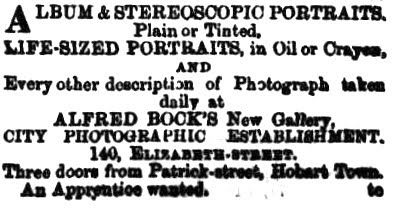
When Thomas Nevin took these two stereographs of his studio and shop front at 140 Elizabeth St. Hobart, shown at extreme right of the frame, the Old Bell Hotel would have been located at 132 Elizabeth St, just at the crest as the street dipped towards the River Derwent and visible at the distant perspectival centre in each frame. According to Alfred Bock's advertisement for an apprentice in 1863, the address of the City Photographic Establishment, 140 Elizabeth St. was "Three doors from Patrick-street, Hobart Town ..." .


Source: The Mercury, 7 July 1863.
The City Photographic Establishment at 140 Elizabeth St "Three doors from Patrick-street"
Alfred Bock’s new gallery was actually a glass house.


A view of Thomas Nevin's studio and shop, extreme right of frame, 140 Elizabeth St. Hobart
Stereograph by T. J. Nevin ca. 1867-70 of the City Photographic Establishment
The dark building next door at 138 Elizabeth St, Nevin's residence, was leased from A. E. Biggs
T. Nevin impress on lower centre of mount.
The Tasmanian Museum and Art Gallery Collection TMAG Ref: Q1994.56.12


Another view of Thomas Nevin's studio and shop, extreme right of frame, at 140 Elizabeth St. Hobart
The dark building next door at 138 Elizabeth St, Nevin's residence, was leased from A. E. Biggs
Stereograph by T. J. Nevin ca. 1867-1870 of the City Photographic Establishment, three doors from Patrick St.
TMAG Ref: Q1994-56-33 Verso blank

If the story about the Old Bell is factual, propinquity alone would have brought Thomas J. Nevin and Marcus Clarke together, and to their mutual satisfaction, given the journalistic background of John Nevin snr, Thomas' father, and Thomas Nevin's involvement with photographing the prisoner and ex-prisoner population. Another ready source of information would have been Thomas' younger brother Constable John Nevin stationed at the Cascades Prison for Males and at the Hobart Gaol, one street away from the Old Bell Hotel.

The Old Bell Hotel in Elizabeth St.
This photograph (below) dating from the 1890s distinctly shows The Old Bell Hotel on the right hand side of Elizabeth Street if looking towards the wharves, with the address as No.132 Elizabeth St.


Title: Photograph - Elizabeth Street looking south (Brisbane Street) - Bridges Bros and The Bell Hotel at number 132
Description: 1 photographic print
Format: Photograph
ADRI: NS1013-1-820
Source: Archives Office of Tasmania

But this photograph shows the Old Bell at 148 Elizabeth St, Hobart:


Source: TAHO Ref:PH40-1-93c


Title: Photograph - "Old Bell Hotel", Hobart - interior of bar [n.d.]
Description: 1 photographic print
Format: Photograph
ADRI: PH40-1-94
Source: Archives Office of Tasmania

When the photograph (below, top left) was taken of three boys standing outside the Old Bell Hotel, the authors of this article published in the Mercury Supplement series Cheers! on Hobart's hotels in 2005 stated that the hotel's address by then was 146 to 150 Elizabeth St. Hobart.


The Old Bell Hotel at what is now 146-150 Elizabeth t. Hobart
J. V. Peck licensee; the property at Nos 136-140 in his wife's name Catherine Peck by 1886
Source: Mercury Supplement Cheers, Friday August 26, 2005
Photo copyright © KLW NFC 2019 Private Collection

The Serial and Novel
A press report by Marcus Clarke 2 August 1873:


TRANSCRIPT

When at Hobart Town I had asked an official of position to allow me to see the records, and – in consideration of the Peacock – he was obliging enough to do so. There I found set down, in various handwritings, the history of some strange lives… and glancing down the list, spotted with red ink for floggings, like a well printed prayer-book …

Source: Marcus Clarke, THE SKETCHER. (1873, August 2). The Australasian (Melbourne, Vic. : 1864 – 1946), p. 5. Retrieved September 21, 2014, from https://nla.gov.au/nla.news-article137581230


THE LAST HOPE. Book III, Chapter XIII (page 290)
Image taken from Marcus Clarke, For the Term of his Natural Life
WL Crowther Library,
State Library of Tasmania
Source: Colonialism and its Aftermath

Marcus Clarke's Preface to His Natural Life
First Published: 1870.
Source: University of Sydney Australian Digital Collections
PREFACE
The convict of fiction has been hitherto shown only at the beginning or at the end of his career. Either his exile has been the mysterious end to his misdeeds, or he has appeared upon the scene to claim interest by reason of an equally unintelligible love of crime acquired during his experience in a penal settlement.
Charles Reade has drawn the interior of a house of correction in England, and Victor Hugo has shown how a French convict fares after the fulfilment of his sentence. But no writer — so far as I am aware — has attempted to depict the dismal condition of a felon during his term of transportation.
I have endeavoured in “His Natural Life” to set forth the working and results of an English system of transportation carefully considered and carried out under official supervision; and to illustrate in the manner best calculated, as I think, to attract general attention, the inexpediency of again allowing offenders against the law to be herded together in places remote from the wholesome influence of public opinion, and to be submitted to a discipline which must necessarily depend for its just administration upon the personal character and temper of their gaolers.
Some of the events narrated are doubtless tragic and terrible; but I hold it needful to my purpose to record them, for they are events which have actually occurred, and which, if the blunders which produce them be repeated, must infallibly occur again. It is true that the British Government have ceased to deport the criminals of England, but the method of punishment, of which that deportation was a part, is still in existence. Port Blair is a Port Arthur filled with Indian-men instead of Englishmen; and, within the last year, France has established, at New Caledonia, a penal settlement which will, in the natural course of things, repeat in its annals the history of Macquarie Harbour and of Norfolk Island.
M.C.
MELBOURNE, AUSTRALIA

Watch The Movie (1929)
Watch the full version here at YouTube -