Thos J. NEVIN's cdv's of the Citizen's Arch 1868
Photograph ALBUMS of scenes and children gifted to the Prince 1868
Captain GOLDSMITH's vehicular ferry "Kangaroo" on fire 1868
F. J. PATERSON (attr) reprints as stereo of Thos J. Nevin's cdv the Citizen's Arch 1890
1868: a busy year for Thomas J. Nevin

Above: cropped detail of carte-de-visite below:
The Citizens' Arch, Hobart, Tasmania
Erected for the visit of HRH Prince Alfred, Duke of Edinburgh
Photographer: Thomas J. Nevin, 8 January 1868
Private collection (ex DSFB) October 2023)

Subject: The Citizens' Arch, design and decorations by Charles E. Walch, paid for by citizens' subscriptions to honour the visit to Tasmania by HRH Prince Alfred, Duke of Edinburgh. Inscription on arch - "The Citizens Greet You."
Photographer: Thomas J. Nevin (1842-1923)
Location and date: Liverpool Street, Hobart, Tasmania, 8 January 1868
Format: albumen print photograph, carte de visite landscape format, 63 x 103 mm (mount)
Verso: bears the signature of "Thos J Nevin" in sepia ink, written in his usual orthographic style and contemporaneous with the date of photographic capture and print, January 1868.
Details: this is one of two consecutive images of the same scene taken by Nevin within a minute of each other, the second printed here as a cdv, and both intended to be printed together as a stereograph (Nevin's original stereograph may have been misattributed to F. J. Paterson - see below).
Condition: crisp, clean, ash burn at top edge, no foxing.
Provenance: acquired for sale by Douglas Stewart Fine Books, Melbourne, Victoria from the estate of photographer Joyce Evans (1929-2019).
Copyright: Sold by DSFB, October 2023 to private collector. Permission to reproduce here.

Thomas J. Nevin's signature: "Thos J Nevin"
Thomas James Nevin printed and signed the verso of this photograph in the same sepia ink used to develop it, and probably within hours of returning to his studio from capturing the scene in Liverpool Street on the morning of the Prince's procession through the Citizen's Arch, Tuesday, 8 January 1868. To meet an anticipated high demand for souvenirs by the thousands of people attending the event, he had left little time on that day to imprint the verso with one of his studio stamps or labels. His signature remained largely unchanged from this example in 1868 to his signatures on the birth registrations of six of his seven children, 1872-1888. The one birth registration he did not sign was that of his first-born son to wife Elizabeth Rachael Day, whom they named the same as his father - Thomas James Nevin jnr in May 1874 - signed by her father Captain James Day while Nevin was away on business at the Port Arthur prison.

Above: Photographer Thomas J. Nevin's signature on the birth registration of their first child, daughter Mary (May) Florence Elizabeth Nevin, 29 June 1872. His first name "Thomas" was abbreviated to "Thos" and second name "James" to "Jas", both presumably written first, followed by an artistic calligraphic flourish on the "N" for Nevin which appears to start from the front at "Thos" and flies over the frst two names to finish as "Nevin". Note the 18th century copperplate script for "P" on "Photographer" in the Rank or Profession of Father column.

Above: Nevin, Mary Florence Elizabeth
Record Type: Births
Gender: Female
Father: Nevin, Thomas James
Mother: Day, Elizabeth Rachel
Date of birth:19 May 1872
Registered: Hobart
Registration year:1872
Record ID:NAME_INDEXES:974599
Resource:RGD33/1/10/ no 2599
Source: Tasmanian Names Indexes TAHO
Link: https://stors.tas.gov.au/RGD33-1-10-p373j2k
See more examples of photographer Thomas James Nevin's signature here: https://tasmanianphotographer.blogspot.com/2014/10/thomas-j-nevin-at-new-town-studio-to.html
Nevin & Smith partnership
In late 1865 Thomas J. Nevin moved his practice from Kangaroo Valley (Hobart) where he was selling stereographs out of the New Town Post Office, to the studio leased by Alfred Bock at 140 Elizabeth St. Hobart Town. On Bock's insolvency and imminent departure to Victoria in 1866, Nevin acquired the lease on the studio, including the glass house, furnishings, stock in trade and business name, "The City Photographic Establishment". A joint lease with the Biggs family included a residence and shop next to the studio at 138 Elizabeth Street. In 1867 Nevin formed a partnership with photographer Robert Smith, operating from the studio as the firm Nevin & Smith. Their studio marks, stamps and labels included a rare, distinctive stamp featuring the Prince of Wales' blazon of three feathers and a coronet, banded with the German "ICH DIEN" (I Serve).
This delicately coloured carte-de-visite in a buff oval mount of an unidentified bearded man in semi-profile wearing a summer check-pattern jacket was taken in January 1868 during the visit of HRH Prince Alfred, Duke of Edinburgh. On the verso is the stamp featuring the Prince's blazon used by Thomas Nevin and Robert Smith in partnership during the Royal visit.


Carte-de-visite of bearded young man in check jacket, hand tinted, 1868
Photographers: Nevin & Smith. Late Bock's, 140 Elizabeth St. Hobart Town
Verso bears the Prince of Wales' blazon of three feathers and coronet, p
Printed during the visit of Prince Alfred, January 1868
Courtesy of ©The Liam Peters Collection 2010.
In anticipation of robust sales during the visit of Prince Alfred in January 1868, Thomas J. Nevin advertised extensively in the Tasmanian Times. He submitted photographs of streetscapes and portraits of children at the request of the Prince Alfred Preparation Committee along with a dozen other photographers, a selection of which was printed in souvenir albums to be presented to the Duke on his departure (see newspaper articles below). Thomas Nevin's partnership with Robert Smith was dissolved in late February 1868, a month after the Duke's visit by his solicitor, W. R. Giblin (later Attorney-General and Premier), on Smith's decision to leave Hobart and set up his own photographic studio in Goulburn NSW.
Tuesday, 8th January 1868
The atmosphere ... was rather sultry during the early part of the day, but towards noon a refreshing sea breeze sprang up, which soon crested the river with foam, and although it rendered the scene rather difficult for the photographers by reason of the waving of the banners and the movement of the various decorations, it was extremely refreshing, and contributed greatly to the pleasure of all concerned in the reception. Speaking of the photographers, we may mention that the gentlemen engaged by the reception commissioners have succeeded in producing very creditable views of the procession, both on large plates and in stereoscopic style. [Mercury, 8 January 1868]
By 9 o'clock on the morning of Tuesday 8th January 1868, Thomas J. Nevin had set up his cameras in Liverpool Street, Hobart, facing the Citizen's Arch as the crowds began forming in anticipation of the Duke of Edinburgh passing through on his way to Government House in Macquarie Street at midday. He may have been working on commission for the Citizens' Arch designer and decorator, Charles E. Walch, partner in the family firm Walch & Sons Co., publishers of the annual Walch's Almanac and regular importers of photographic supplies.
Well before the Duke's arrival, Thomas Nevin took two photographs (extant) of the street and the Citizen's Arch, each a minute or so apart from the same spot. Both photographs have survived. He would print a single image as a carte-de-visite of one of the captures as well as pasting the two slightly different captures of the scene side by side on a double mount to be viewed as a true stereograph with a stereoscopic viewer. His first photograph captured a man near the (viewer's) left side of the arch (see stereograph below with Paterson attribution). The second photograph taken a minute or so later captured the same man having walked from the left side of the arch to the centre of the road, presumably to greet oncoming traffic.
This second photograph of the street and a man now closer to the centre of the road beneath the arch carries Thomas Nevin's signature on verso in sepia. It survived in modern times as a single image carte-de-visite in the estate of the late Joyce Evans (1929-2019), photographer and friend of Professor Joan Kerr whose farewell lecture at Sydney University on retirement in 1994 included an affectionate appraisal of the work of Thomas J. Nevin as the photographer of Tasmania's "convicts" in the 1870s.
The Citizens' Arch, Hobart, Tasmania: man near centre of the arch
Erected for the visit of HRH Prince Alfred, Duke of Edinburgh
Photographer: Thomas J. Nevin, 8 January 1868 (private collection - see above)
The first photograph which Thomas Nevin took a minute or so before the second of the same scene in Liverpool Street shows a man standing under the left side of the Citizens' Arch. This first image has survived on a stereographic mount in the collection of the Cox family (held at the Archives Office of Tasmania), printed as a stereograph and attributed to F. J. Paterson. But it is not a true stereograph (see below). The same image was printed twice from Nevin's single first negative he took of the man standing under the left side of the arch before the man moved towards the centre of the road. Those same two prints from this first negative were then pasted to a square format stereograph mount to make the whole appear to be a true stereograph. Each image on left and right in this so-called stereograph are from the same capture and negative, whereas for a stereograph to give a true 3D experience, two distinct photographs are printed from two separate negatives (if a single lens camera is used) and then pasted side by side, with more detail of the scene, usually in the right image showing at the right side margin where the camera was moved to the right.
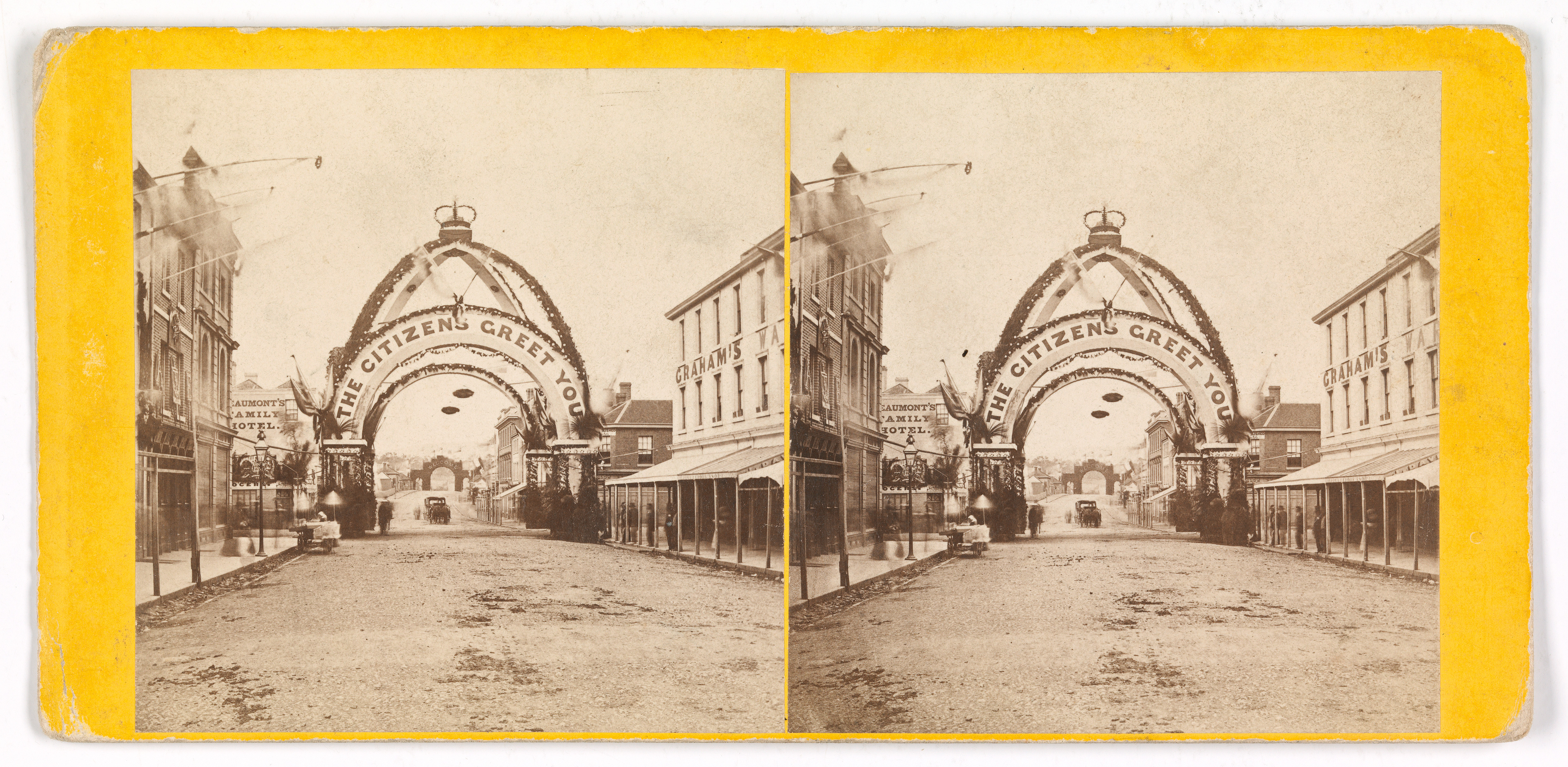
Photograph - stereogram - Duke of Edinburgh's visit, Welcome arch, "The Citizen's Greet You", shows side of Beaumont's Family Hotel, Liverpool Street and "Graham's",
Photographer F.J Paterson
Item Number: NS6904/1/34
Start Date: 01 Jan 1868
End Date: 31 Dec 1868
Source: Tasmanian Archives
Creating Agency: Cox, Weymouth and Miller Family (NG1640)
Series: Photographs collected by the Cox Family (NS6904)
View online: https://stors.tas.gov.au/NS6904-1-34

Detail: The Citizen's Arch, Liverpool Street, Hobart Tasmania
Single image from right side of stereograph
Photographer: F.J Paterson (attributed)
Item Number: NS6904/1/34
Start Date: 01 Jan 1868
End Date: 31 Dec 1868
Source: Tasmanian Archives
Differences
The two photographs - the cdv carrying Thomas Jas. Nevin's signature verso taken after the image in the so-called stereograph which is attributed to F. J. Paterson of the same scene - are slightly different. In Paterson's there is a woman with a cart shielded by an umbrella on the pavement to the left, whereas in the Nevin print there are several carts and men in the same spot. In the Paterson print, the man standing under the arch is closer to left column of the arch, whereas in the Nevin photograph the man appears to have walked closer to the centre of the road in order to greet the approaching van. The van in the distance is further away in the stereo image (attr. Paterson's) than in the cdv image (Nevin's). The sky and foreground in Nevin's cdv appears to have been cropped for printing, whereas the stereograph print shows more of both. These differences raise questions of both printing techniques from different cameras and lenses, as well as attribution: was there just one photographer present who took two separate captures just minutes apart? Or were both Nevin and Paterson present together in the exact same spot from where each took almost identical photographs, one within minutes of the other? One valued opinion (at DSFB) very much doubts that, opting for Nevin's as the sole attribution for both images.
The stereograph bears no photographer's mark, imprint or studio stamp. It was donated to the Archives of Tasmania as part of the Cox family collections and given an attribution to F. J. Paterson, who operated a studio at 53 Argyle St. Hobart between 1864-1869 (Davies & Stanbury The Mechanical Eye in Australia, Oxford University Press 1986.) but was much better known later in the 1890s as a marine photographer and assistant secretary to the Photographic and Arts Association. F. J. Paterson may have acquired the first negative Nevin took of the Citizen's Arch from Nevin's own collection of commercial negatives which he passed on to Samuel Clifford when ceasing commercial photography temporarily on joining the civil service as resident Hobart Town Hall keeper with family, 1876-1880. In turn, on Clifford's retirement in 1878, his own negatives and collections, including those of Nevin's, were acquired by the Anson Bros and subsequently by John Watt Beattie who reprinted the work of these earlier photographers without attribution. The first negative Nevin created of the scene which has survived as a stereograph, and possibly misattributed to F. J. Paterson, may have survived therefore from Beattie's collections, perhaps even been reprinted as a stereograph in 1899-1900 in anticipation of the Duke and Duchess of York's Royal Visit in 1901. A proposal by its original decorator C. J. Walch to re-erect the Citizen's Arch for the occasion would have included printing historical as well as contemporary photographic souvenirs ahead of the visit.
As was Thomas Nevin's practice, he used different formats when producing photographs for important public occasions. For the VIP visitors' trip to Adventure Bay in 1872, for example, he printed the first of two consecutive captures taken on the spot of the visitor group as a landscape carte-de-visite, and with the second image produced a stereograph with both slightly different images pasted side by side on two types of mount: arched above both images for one item, circular or binocular for another. He would also take and print two photographs of the same sitter in his studio, leaving one without a studio mark, and signing or printing his commercial stamp on the verso of the other, chosen according to his clients' preferences (examples are held in the TMAG collection). Given two images were taken of the same street scene of a man under the Citizen's within a minute of each other, the print bearing Thomas J. Nevin's signature verso was either the one he intended to keep, or the one he intended to include with the second capture to print as a stereograph, perhaps with the Nevin & Smith stamp featuring the Prince's blazon, but failed to proceed with using his studio's mark because Robert Smith would be departing the partnership in a matter of weeks.
Put together, the views in sequence as Thomas Nevin would have photographed them:

There is a narrative here: the first image shows a man waiting on the left side of the arch, and on seeing a van and horses approaching in the second image he walks toward the centre of the road to greet them.
Some time later, as the entire procession with the Prince and his official entourage comes into view, large crowds now gathered on both sides of Liverpool Street watch and wave and cheer. The moment the procession passes under the arch, an unnamed photographer skilfully captures every aspect of the excited scene: the barking and running of the dogs, the skittishness of the horses, the billowing of women's dresses, the flapping of flags, and the flurry of flowers and dust. The air is filled with tumultuous cheers and applause as everyone surges towards the Prince. Except one man. There he is, the same watchful man photographed by Thomas Nevin a few hours earlier. He's back at his post, squeezed up against the left side of the arch's column by the crowds. Perhaps he was a Special Constable in plain clothes enlisted for the occasion, just as Thomas Nevin was made Special Constable in 1879 during the visit of the Canadian renegade Catholic priest, Charles Chiniquy.
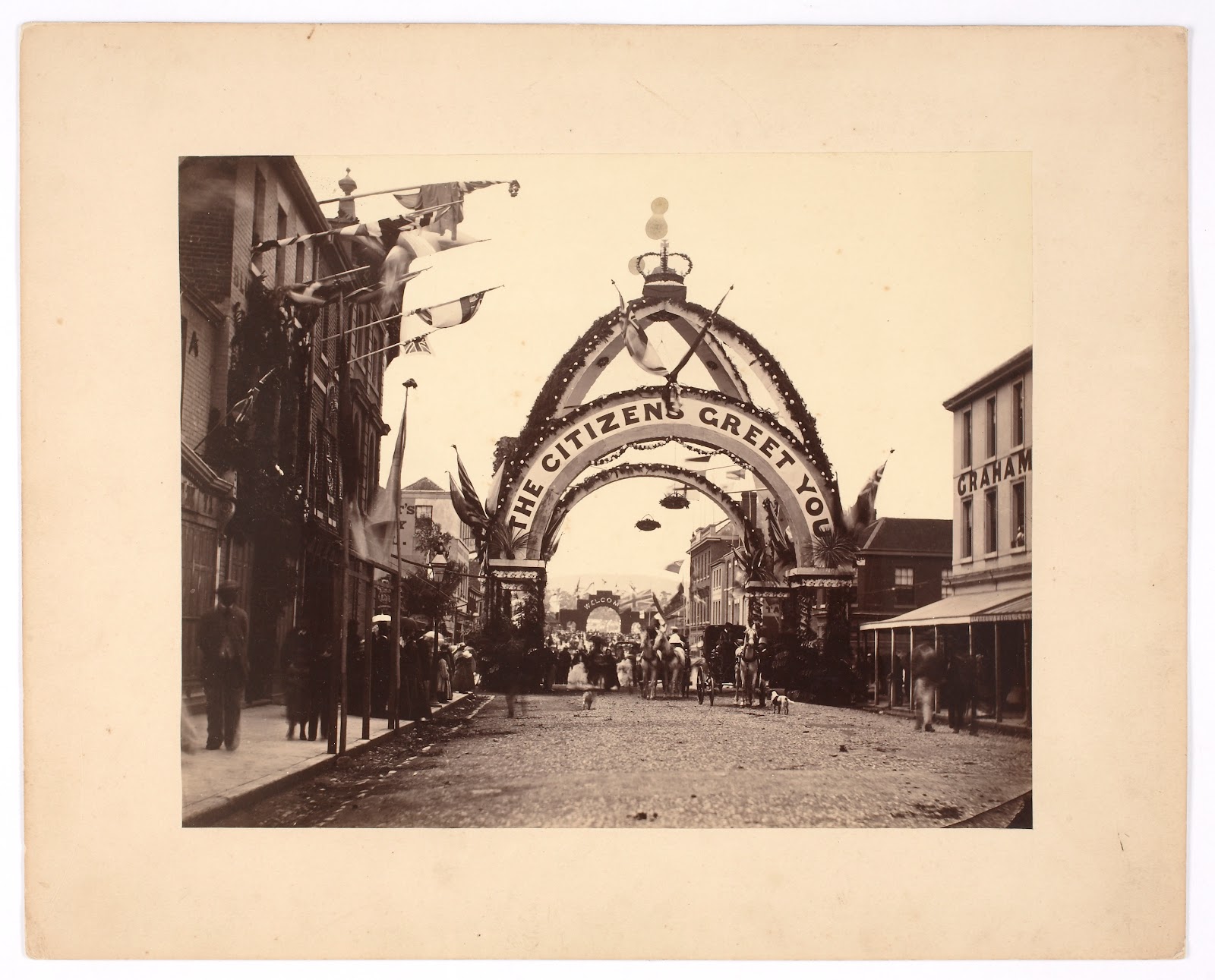
Description: Photograph - Street view of decorations for the visit of Duke of Edinburgh in January
Item Number: PH30/1/3320
Start Date: 01 Jan 1868
Format: photograph [unattributed]
Creating Agency: Unidentified Creating Agency (XX1)
Archives Office of Tasmania
View online: https://stors.tas.gov.au/PH30-1-3320
Not only did Charles E. Walch publish again in the Mercury of 2 April, 1901 the exact same paragraph about the Citizen's Arch that he published in the Mercury on 24 December 1867, he would have displayed at the family's business premises a collection of the original photographs and memorabilia of his beautiful floral designs for the 1868 arch in anticipation of another success when the Citizens' Arch was again to be erected in honour of the Duke and Duchess of York's visit, 2-6 July 1901, this time in Macquarie Street.

'Citizens Arch,' Macquarie Street, 2-6 July 1901
Item Number: NS5742/1/38
Creating Agency: Edward Swarbreck Hall and Family (NG308)
View online:https://libraries.tas.gov.au/Record/Archives/NS5742-1-38
Timeline: the Citizens' Arch, 1867-1901
Newspaper Reports
4 December 1867: LETTER from Charles Walch
THE CITIZENS' ARCH.
TO THE EDITOR OF THE MERCURY,
SIR-In reading over the report of the proceedings of the Municipal Council published in this morning's Mercury there are two inaccuracies which I shall be glad if you will allow me to correct. In the first place the letter read at the Council Board, from the secretary of the Citizens' Arch Committee, is stated to be from Mr. Creswell. This is not correct ; Mr. Creswell is the indefatigable secretary of the Citizens' Reception Committee, but Mr. Charles E. Walch has the honour of being the secretary of the Citizens' Arch Committee. In the second place it is stated that my application to the Mayor and Aldermen was for a grant towards erecting the arch. This is the second error, for my application was for a grant towards decorating the arch, the Prince Alfred Preparation Committee having decided to erect the arch for which a model has been accepted leaving its decoration entirely in the hands of the citizens, and for which a small committee, in the name of the citizens generally, have made themselves responsible.
I am very glad to say that the design for this arch (the model is now on view at Wellington Bridge has been approved by all who have seen it), and that the few citizens who have been asked to contribute towards the cost of the decorations have done so most liberally. I am sorry that the Mayor and Aldermen, in their corporate capacity, could not see their way clear to give a grant either in money or in labour' towards the decoration of the citizens' arch ; however, it is gratifying to see that they are prepared to do the next best thing, and that is to subscribe liberally themselves. I have urged the erection of this citizens' arch on the Corporation, because nowhere on the route of the Prince's public entry into and passage through the city, will there be the slightest visible result of our having a Corporation at all excepting of course the pleasure that he will have in seeing the Mayor and Aldermen themselves.
The whole matter stands thus. There has been collected and promised up to the present time about sixty pounds ; but to decorate the arch worthily will cost at least one hundred pounds, leaving forty pounds yet to be collected. To get together this little sum of forty pounds, I now I confidently look to His Worship the Mayor, the Aldermen, and those citizens who have not yet been asked to contribute ; so that if in the vastness of their assembled crowds, and the gorgeousness of their general display, her sister colonies ease Tasmania completely into the shade, who in her turn will be able to boast of a triumph of artistic and decorative art in her " citizens' arch'."
I am, dear sir,
Faithfully yours,
CHARLES E. WALCH.
December 3rd, 1867
Source: THE CITIZENS ARCH. (1867, December 4). The Mercury p. 2.
Link: https://nla.gov.au/nla.news-article8849312
7 December 1867: FUNDING the Citizens' Arch
At a meeting of the Citizens' Reception Committee at Hobart Town on Wednesday, subscription lists were submitted representing £200. Another £100 is expected. It seems that the arch termed the Citizens' Arch is to be erected at the expense of the Government, and the only part to be played by the citizens is the decorating of it with flowers, designs, &., which it is expected will cost no less than £100. We are informed that in Melbourne the artificial flowers alone of one of the arches cost upwards of £200. The Citizens' Committee have appointed three subcommittees to carry out the details of the objects contemplated by the Citizens' Committee, viz., a Citizens' Ball, the erection of an emblematic arch, and a banquet to the crew of the Galatea. The model of the citizens arch, at Hobart Town, represents a four faced structure with the principal face towards Liverpool-street as seen from Murray-street. It will start from the four corners and will present a pretty effect. It will be in the shape of a dome highly ornamented with appropriate drapery, flowers, lamps, &, and have on its principal face an appropriate motto. The top will be surmounted with a huge crown composed of flowers.Source: RECEPTION OF PRINCE ALFRED. (1867, December 7). Launceston Examiner p. 5.
Link: https://nla.gov.au/nla.news-article36647697
28 December 1867: HUMOUR by Punch
This article's attempt to disparage the elaborate preparations for the Duke's visit may have passed for humour of the day. The journalist writing this for the Hobart Town Punch spared the Citizen's Arch of criticism but not the Emblematic Arch. He ridiculed in particular the Ode of Welcome written by Mrs Louisa Anne Meredith intended to be sung by five thousand children.


TRANSCRIPT
The Arches.Source: The Arches, Hobart Town Punch Saturday 28 December 1867, page 8
SOME skeletons of what are intended to be ornamental structures blockup the thoroughfares, and look sadly miserable, as the wind whistles through their bare ribs. We don't know how these skeletons will look when" clothed with evergreens and flowers, but at present "triumphal" is about the last adjective proper to characterise them. The Emblematic Arch on the Wharf is an idea of a good kind, and appropriately founded on oil-butts, signifying that Tasmania is the butt of the colonies and of the empire, an Ultima Thule indeed. We believe that beside the wool bales on top, there are to be other objects characteristic of Tasmanian commerce, amongst others, a Truss of Hay cut open to exhibit a large stone which takes up a good part of its interior, some bags of sour Chilian flour mixed with plaster of Paris and branded "Best Tasmanian Flour," some tins of boiled carrots sweetened with sugar, labelled "Fine Tasmanian Jam" from a well-known Hebrew firm, a stranger from Victoria as he appeared when taken in and done for by Hobart Town lodging house keepers and Cabmen. These will form a striking emblem of some lucrative branches of Tasmanian Commerce. Then a few models of the manufactories and mines of Tasmania, the Pyrolignite Works, the Seymour Coal Mines, Fingal Companies, and others, showing in a striking manner the energy and perseverance of the people. On the top three enormous barrels of beer from the breweries of the Mayors of Hobart Town and Launceston and our ex-Mayor, this being the only really flourishing trade in Tasmania. On these barrels will be a group of native youth in various lounging attitudes, smoking — with some City Arabs and one or two country skullbankers. This group will typify the strongest characteristics of a large part of our energetic population. His H. H. the Prince will then get a bird's eye view of Tasmania. The citizens' Arch, called so because the Government have erected it, is a great credit to the town and a feather in the cap of the energetic individuals to whom we owe it. A brilliant illumination of arches would quite cut out all other displays, even the magnificent star of Messrs Salier & Co.
The Ode of Welcome. WE have said so much about this, that we have little more to add. It will be enough to say that the way it is sung does more than justice to the words of Mrs. Meredith and the music of Packer, for the less that is heard of either the better. The verses have not even the merit which so many other nonsense verses have, that of decent rhythm. On the whole we prefer the National Anthem, and we think the Prince will be of the same opinion, if he hears either from the assembled children. The conductor has snubbed every one who has attempted to help him with the children; he wanted all the glory, and we think no one will care to share with him what he will get when the production is 'performed' before the Prince. His H.H. R. will call him and the performers a Pack of ninnies.
The Platforms !!! ARE by no means the least brilliant part of the display intended to do honor to the Sailor Prince. They are, for the most part, constructed of colonial hardwood, which being in the rough, gives them a pleasingly rustic appearance, and is likely to conduce in no small measure to the comfort of their occupants. That slight spice of danger too, which is generally so much appreciated by the public, is not wholly absent, and lends a zest to the enjoyment of those adventurous spirits who feel a pleasure in paying their shilling or half-crown for the privilege of balancing themselves for a couple of hours or so on a couple of inches of batten, at a distance of from ten to thirty feet from the ground. Messrs. Bromby and Cox would like it to be as generally known as possible, that in their advertisement, which appeared in our last number, it was omitted to be stated that their platforms are all arranged as locomotives, being mounted on wheels, and travelling upon rails. By this ingenious arrangement they can be run back after the Prince has passed, and will be available for the ceremony of Laying the Foundation Stone of the New Cathedral. It is suggested that people of an economical turn of mind should take seats, for the procession, on these platforms, as by laying in a stock of sandwiches. &c., there would be no necessity for them to move until after the day of the Laying the Foundation Stone, and they would be thus enabled to view both ceremonials for the same money. N.B.—Bed-gowns similar to those to be worn by the choir on the latter occasion may be had at reasonable rates on application to Messrs. Bromby, Cox, or Hunter.
Link: https://nla.gov.au/nla.news-article232935336
8 January 1868: STATE RECEPTION and CITIZENS' ARCH

TRANSCRIPT - excerpt
THE DUKE OF EDINBURGH IN TASMANIA.Source: THE DUKE OF EDINBURGH IN TASMANIA. (1868, January 8). The Mercury p. 2.
THE STATE RECEPTION.
Yesterday will be marked as a red-letter day in the history of Tasmania, being that upon which the first scion of English royalty ever set foot upon her shores. The importance attached by a loyal populace to the event was most unmistakable, and if the demonstration of affectionate greeting which was made on the occasion was in any degree loss imposing than that shown in richer colonies, it is on account of the smaller proportions of our city, and from no want of genuine liberality and loyal feeling on the part of our citizens. In introducing a detailed report of the state ceremony of the day, it would be difficult to convey any adequate idea of the genuine enthusiasm which pervaded all the arrangements, suffice it to say that from the moment of His Royal Highness's landing until his arrival at Government House, the welcome which greeted him was spontaneous, heartfelt, and sincere. Those of our readers who know the city will be aware that at sundown on Monday evening the arrangements for the reception were far from complete, and men were employed in some cases throughout the night in perfecting them. At day dawn gangs of men were at work on the various arches, in hoisting flags on the wharves, and otherwise completing the arrangements, and it was quite 12 o'clock before all was ready. By nine o'clock in the morning the streets were crowded with people who had turned out to view the general decorations, and to make sure of their positions for obtaining a good sight of the procession. The centre of attraction seemed to be the public buildings, and from thence to the wharf ; and many thousands of persons had assembled in those localities at an early hour. The stands erected in various parts of the city were scarcely so well patronised as might have been expected. Those erected by the government, by Messrs. Walch, and by private persons on the wharves, were well filled, but the others were far from crowded. It was about eleven o'clock when the populace really began to muster in force, and then the wharf stands were fairly rushed, the piles of timber also became superior points of view, and every available point from which the landing and progress of the procession in its earlier stages could be witnessed were eagerly seized upon. From the river and wharves, wherever a clear view of the town could be obtained, the sight was most imposing ; and seen from the top of the hill behind Franklin Square, the marshalling of the procession was a most magnificent sight. The dense mass of heads moving about in the plateau below, the waving of the flags' and banners borne by the friendly societies, the red shirts of the fire-men, and the emblematic arch with its two whaleboats manned by crews of native youths in red shirts and sailor hats ; and beyond all the long clear space, with the dais for the accommodation of the Mayor and Corporation standing out in bold relief, dotted here and there by groups of officials in uniform, and the clergy in their robes of office, besides little knots of private citizens ; the whole scene enlivened by the regular lines of scarlet coats, white belts, and glittering bayonets, distinguishing the guard of honor, combined to form a scene of surpassing brilliancy. Nor have we half described the appearance of the crowd from this point of view. The natural beauties of the harbour added much to the grandeur of its effect. The wharves flanked by lines of vessels dressed in all their colors, and all crowded with eager spectators, and the glittering river with the noble ship riding at anchor, and resplendent with bunting, formed a glorious contrast, and combined to complete a scene scarcely equalled in the pages of fairy romance. The weather during the morning was everything that could be desired, although dark threatening clouds hung over the mountain, fore-boding rain. The atmosphere, too, was rather sultry during the early part of the day, but towards noon a refreshing sea breeze sprang up, which soon crested the river with foam, and although it rendered the scene rather difficult for the photographers by reason of the waving of the banners and the movement of the various decorations, it was extremely refreshing, and contributed greatly to the pleasure of all concerned in the reception. Speaking of the photographers, we may mention that the gentlemen engaged by the reception commissioners have succeeded in producing very creditable views of the procession, both on large plates and in stereoscopic style. What we have said of the landing place, the wharves, and the public buildings, will apply equally to other divisions of the city; but if any particular points are deserving of special mention above others, it is the Citizens' canopy of arches, and the Sunday school children's platform in the domain. After the more immediate excitement of the royal progress was over the latter point became the centre of general attraction. On the procession crossing Park-street a somewhat lengthy stoppage occurred to enable the photographic artist stationed there to perform his duty. During this interval the city seemed to empty itself into the noble park, and the fences of the cricket ground, the rising ground behind the platform, and every available point of view were rushed by eager spectators. At a rough computation wo should say that from at least 10,000 to 15,000 persons were here assembled, and the scene was a brilliant and imposing one. The children's platform extended in the form of an amphitheatre for a distance of about 150 yards, and the seats ranged five deep, while hundreds of children who were unable to obtain accommodation lined the rear. The children were for the most part dressed uniformly, the girls wearing white dresses and blue sashes, and the boys sailor hats and blue favors. A vast number of small Union Jacks were distributed among the schools, and the waving of those added materially to the general effect. The various scenes in connection with the reception will, however, be described in detail below......
......
In the above order the procession moved away under the emblematic arch, amid the cheers of the populace. This arch was a most appropriate and imposing structure. The piers were composed wholly of oil barrels, and, illustrative of our whaling trade, had a fine effect, and the top, piled up in the form of a high pyramid, with samples of our porter, ale, beer, jams, leather, wheat, barley, oats, &c., &c, and surmounted by the huge jaws of a whale, the merchant ensign of Britain floating over all, formed a most characteristic trompe l'oeil. Beneath this, on the river side of the arch, was the inscription, "Welcome Sailor Prince," and on the other side, " Welcome to Tasmania." The feature which would, we imagine, most please His Royal Highness in connection with this structure, would be the two fine whale boats which surmounted the side arches, and which were manned by crews of six native youths attired in red shirts and sailor hats. These lads peaked their oars and cheered as the Prince's carriage passed under the archway. All the stands along the route of the procession at this point were densely crowded, and the enthusiasm of the spectators knew no bounds. The principal stands were at Belbin and Dowdell's at the Old Market, and at the lower end of Murray-street, and the occupants of each cheered, waved their handkerchiefs, or threw bouquets as the pro-cession passed. Gradually it wended its way up Murray-street towards the first of the Government arches, where the word "Welcome," in roses again, greeted the Prince, and his carriage passed under the arch....
Presently the swell of voices which prelude the march of an approaching crowd grew more and more audible, and in about a quarter of-an hour from the moment of His Royal Highness putting his foot on the landing stage, the head of the procession showed beneath the archway abutting on the government offices. Tim array passed on in the order in which it had been marshalled, as already described, on the wharf until the carriage of His Royal Highness had arrived opposite the parliamentary platform, when a halt was called in order to allow of the National Anthem being sung, as arranged in the programme, by the ladies assembled in front of the government buildings, aided by the occupants of the platform on the opposite side of the street. The anthem was sung with commendable precision, but the volume of sound was not sufficient to render it as effective as could have been desired. At this point a photographic picture was taken by Mr. Stewart, who was stationed for the purpose in one of the windows of the tower of St. David's Cathedral. The stay was of brief duration, but during its continuance there was some good humored crowding around the Prince's carriage, induced by a loyal curiosity to see His Royal Highness in as immediate proximity as possible; but the pressure arising from this cause rapidly subsided on the procession resuming its march. The progress along Murray and Liverpool streets was not marked by any event worthy of special mention, and the flag decorations, though profuse, were of necessity to such an extent repetitions of those previously described, as to render it needless to attempt describing them in detail..
.
THE CITIZENS' ARCH.
This is a structure worthy of the citizens,-a noble arch,-an elegant arch,-built by the Government as far as the woodwork is concerned, but the decorations were supplied by the citizens at a cost of from £120 to £130. And they are worthy of the occasion. A quadruple arch, rising to a height of 57 feet, and surmounted by a floral crown, 10 foot in height, with a cross of 2 feet, completes a structure worthy of the advent of an emperor. But in addition to this, the arch is profusely decorated with evergreens and flowers. On the front facing Liverpool-street, in the west, is the inscription, "The Citizens greet you," surmounted by two Union Jacks, partly folded, and from the centres of the four arches were suspended baskets of flowers. The arches rest on four pilasters, forming a pediment, and entwined with native shrubs and creepers, the base being formed by fern fronds from the Huon track, and kept fresh and fragrant by constant jets of fresh water. The arch was designed by Mr. C. Walch, and for the information of our country friends, we may describe it briefly as a quadruple arch, the four corners springing from Mr. Graham's to Messrs. Russells', and from Messrs. Walch's to Messrs. Saliers.' We may add here that a contretemps occurred during the progress of the procession at this part by a woman falling down, and being trampled on, but, fortunately, no serious injury was sustained. In fact, the police, aided by the special constables, maintained the most complete order and regularity. At the corner of Elizabeth and Liverpool-streets the scene was particularly gay and striking. Flags and banners were flaunting from many houses, and at Messrs. Walch's a rather novel but pleasing effect was produced by the display of flags at the windows, the staffs of which were entwined with wreaths of roses. At Messrs. Salier's wreaths of overgreens were carried in front of the house, which had a very pretty appearance. At Messrs' R.D. and W. Russell's the building was covered with flowers and evergreens, and Messrs. Harcourt, Holmes, G. Johnson, and Hinsby displayed similar floral decorations. Proceeding towards the domain the same decorations of flags and evergreens met the eye in every direction, until it rested on the arch erected by the hospital, when it received rather an unpleasant check, as the arch in question was more like the entrance to a cemetery, than an object of welcome and gratulation to a Royal Prince Passing this by, however, the procession moved onwards, and on arriving in view of the domain a scene of surpassing bounty and interest met the view. There, ranged in seats provided for them, were seen some hundreds, nay, thousands of children, belonging to the various Sunday-schools, and who were waiting to greet our royal visitor with an "Ode of Welcome," A more gratifying spectacle than this we never beheld, although in olden times wo have witnessed the annual gatherings of the charity children in St. Paul's, London. When the carriage with His Royal Highness and the Governor came in view of the domain a stoppage took place, and we observed that His Royal Highness, as he looked towards the children, seemed very highly pleased with so novel and so interesting a spectacle. No doubt, indeed, but that our sailor Prince was much delighted, for he could have witnessed nothing of the kind,-so largely carried out, at least,-in any of the neighboring colonies. We may add that the windows of the houses en route were filled with spectators, and several stands on the line of the procession were fairly occupied....
Link: https://nla.gov.au/nla.news-article8849902
The Tasmanian Times Special Edition ran a lengthy report on each stage of the Duke's tour around Hobart. Thomas Nevin's colleague Samuel Clifford produced a fine series of stereoscopic and album prints of the day, which he advertised for sale on the 26th February 1868.

TRANSCRIPT
PHOTOGRAPHS CONNECTED WITH H.R.H. THE.DUKE OF EDINBURGH'S VISIT TO TASMANIA.Advertising (1868, February 26). The Mercury (Hobart, Tas. : 1860 - 1954), p. 1.
Landing in State, "instantaneous," stereoscopic and album.
The Landing, 10 x 8.
The Galatea, 10 x 8, stereoscopic and album.
Emblematic Arch, 10 x 8, stereoscopic and album.
State Carriage, with Outriders und Orderlies, cabinet!
The Duke's Saddle Horse, album.
H. R. H. His Excellency, and Company at Government House', 10 x 8.
S. CLIFFORD, Liverpool-street, Prize Medallist [sic] at Melbourne, and highest Award at New Zealand.
Link: http://nla.gov.au/nla.news-article8850754

Emblematic Arch, 10 x 8, stereoscopic and album.
Photographer Samuel Clifford 1868
Archives Office of Tasmania Ref: PH30-1-31

TRANSCRIPT
THE EMBLEMATIC ARCH.THE STATE LANDING. (1868, February 1). The Tasmanian Times (Hobart Town, Tas. : 1867 - 1870), p. 3.
In this order the procession moved away under the Emblematic Arch, erected by the Citizens' Reception Committee. This was declared on all sides to be a novel and striking feature in the various symbols of welcome offered to the Prince, and very successfully carried out. The piers were built up of tun butts, used in our whaling trade. The arch itself being composed of a main and two smaller arches, surmounted by bales of wool, pockets of hops, cases of preserves, bundles of shingles, leather, and bark used in tanning, sheaves of wheat, and a variety of the other products of the colony. Above the whole the jaw bones of a sperm whale. The side openings were crowned by two whale boats manned by the proper number of hands dressed in whaling costume. The whole of the arch was embellished with our beautiful ferns and flowers. On the side to meet the Prince's view was the legend " Welcome to Tasmania," and on the other side was "Welcome Sailor Prince." The top of it was decorated with flags. The whole line of the procession from the landing stage was also decorated with flags. Every halting place or stoppage was taken advantage of to loudly cheer our Royal visitor, who courteously responded to the same by bowing. Along the wharf and up Murray-street were several commodious stands tastefully decorated, and filled with well dressed people who all cheered lustily as the Prince passed. The procession moved slowly upwards from the wharf amidst continuous cheering, between two lines of Military who kept the route clear from the landing stage to the arch in Murray street.
Link: http://nla.gov.au/nla.news-article232857843
8 January 1868: FIRE on the "KANGAROO"
The Twins steamer ferry Kangaroo built by Elizabeth Rachel (Day) Nevin's uncle Captain Edward Goldsmith in 1854-55, was sold to Askin Morrison in 1857, then to James Staines Taylor in 1864 who operated it for the next 40 years. Under his command on this day of celebrations with a full complement of passengers greeting the Prince's yacht Galatea, fireworks exploded over the deck, catching ladies' dresses on fire and causing them to faint.

TRANSCRIPT
THE TWINS STEAMER.Source: THE DUKE OF EDINBURGH IN TASMANIA. 1868, January 8. The Mercury p. 3.
The ladies and gentlemen who were to take part in the torchlight aquatic procession began to assemble about half-past 7 o'clock, accompanied by their friends and a large number of ladies and gentlemen invited by the committee. The evening was beautifully fine. The sea breeze which had been blowing briskly all day, died away, aud gave place to a westerly wind. The moon shone beautifully, and rode through an almost cloudless sky. The temperature was sufficiently cool to render shawls and wrappers a comfortable addition to the ordinary dress. There were on board altogether about six hundred ladies and gentlemen, including many of the leading inhabitants of the city. The entire management of the procession was under the direction of J. Davies, Esq.,M.H. A., who was assisted by H.S. Barrett, Esq., M.H. A., and the arrangements to give effect to the demonstration were as perfect as they possibly could be. The whole of the living freight being on board, the band, under the leadership of Mr. Thomas, struck up a quickstep march, the red fire was lighted, and a signal rocket fired. The steamer got slowly under way, and proceeded towards the Galatea, amid cheers from the shore. A little delay was caused in arranging the flotilla, during which the rockets and red and green fires were occasionally burnt, and the band played some of its most inspiring strains. The steamer went slowly round the Galatea, the company singing Rule Britannia with great precision and effect. The scene at this time was brilliant and beautiful in the extreme. The long line of boats, with lighted torches undulating with the waves, and slowly advancing was one of the prettiest sights ever witnessed on the banks of the Derwent. Three hearty cheers were given as the steamer passed the Galatea, which were returned by the men on board the frigate, the band at the same time striking up a lively air. Green fires were now burnt and several rockets thrown up, the band playing a march, and then the company sang " O'er the calm and sparkling waters," which sounded very beautifully, the voices blending well. As soon as this ended the Galatea exhibited a blue fire at each port hole, and one from the jibboom end. The effect was magnificent, and there was but one feeling of delight at this brilliant exhibition. The flotilla now steamed gently towards Government House, firing rockets and burning alternatively red and green fires, the company singing "Lo, the gladsome day is breaking," and with increasing effort and precision, as the amateurs seemed to gain confidence. Everything was proceeding as " merry as a marriage bell," and all on board were enjoying themselves thoroughly, and were in the greatest state of enthusiasm and delight, when one of those accidents which seem to mock all human prudence and foresight occurred. A large case of rockets had been placed at the opposite end of the steamer to where the orchestra was situated, and it was believed quite sufficiently secured from accident. The man in charge went to fire a serpent, and the sparks fell in among the rockets, and set them on fire. In an instant a scene of great confusion occurred. Several of the rockets flew about the deck and exploded, and the greatest danger was for a few minutes apprehended. A rush was made to the other end of the steamer, and several ladies fainted, and the clothes of one or two caught fire, but were quickly extinguished by the bystanders. Several gentlemen at a great risk made a rush to the burning box of fireworks, and after getting in one or two instances burnt on the hands, the box was thrown overboard and all danger ceased. The deck of the steamer was burnt in several places, and the bulwarks were on fire, but a few buckets of water promptly extinguished all remnants of fire. The alarm among the ladies was very great, and it was some time before many of them could get over the fright which had been given them. Mr Davies and others were indefatigable in reassuring them, but every time afterwards that a rocket went off, or the green or red fires were burnt, their alarm was renewed. By the time order was restored the flotilla had reached its appointed place of Government House. The anchor was dropped, rockets fired, and the orchestra began in accordance with the arrangements to go through the programme again. " Rule Britannia" and the other pieces were gone through with great precision and effect, and the spirit stirring strains had a most invigorating effect on those whom the recent accident had rendered timid and nervous. The " Welcome to Prince Alfred" was especially well rendered, and called forth many encomiums. The "National Anthem" closed the musical portion of the serenade, and the steamer weighed anchor and returned to town. On passing the Galatea "Rule Britannia" was again played by the band, and the large freight was landed safe, in spite of an accident which threatened once to be serious. Had it not been for the unfortunate explosion the serenade would, as it still must be considered, have been the most beautiful and successful spectacle ever witnessed in the colonies. On landing at the wharf three hearty cheers were given for Mr. Davies, for the energetic and successful way in which all the arrangements had been carried out.
Link: https://nla.gov.au/nla.news-article8849902

Title Aquatic torchlight procession, Hobart Town. [picture]
Contributor(s) Gill, S. T., 1818-1880 artist.
Publisher Melbourne : Robert Stewart
Date February 29, 1868.
Description print : wood engraving.
Notes Wood engraving published in The illustrated Melbourne Post.
State Library of Victoria
Link: https://handle.slv.vic.gov.au/10381/47696
10 January 1868: FORTY POUNDS in debt
On January 10, Charles E. Walch wrote a letter addressed to both the editor of the Tasmanian Times and the Hobart Mercury, requesting their readers to meet a shortfall of forty pounds - £40 - in subscription funds to complete the decorations on the Citizens' Arch.
THE CITIZENS ARCH.Source: THE CITIZENS ARCH. (1868, January 10). The Tasmanian Times p. 3.
To the Editor of the Tasmanian Times
SIR,—The Committee of The Citizens' Arch, desire to avail themselves of' your columns, that it may be generally known that a sum of about Fifty Pounds is still required to pay for the decorations in addition to the seventy pounds subscribed by the Committee and others. The Citizens of Hobart Town may well feel proud of their Arch, for it far surpasses any yet erected by their wealthier neighbour, but that their boasting may be justified, they must clear off the debt of forty pounds, and in order to accomplish this, Mr. Jas. E. Salier, Mr. W. Weaver, and myself are prepared to receive any donations. no matter how small, and I need not add, how large.
I am, Sir,
Yours obediently,
CHAS. E. WALCH,
Secretary and Treasurer.
Link: https://nla.gov.au/nla.news-article232857259
THE CITIZENS' ARCH.Source: THE CITIZEN' ARCH. (1868, January 10). The Mercury , p. 2.
To the Editor of the Mercury .
Dear Sir - Having practically shown your own interest in the Citizens' Arch, I trust that you will still further aid the committee by inserting this letter in the columns of your paper, its purport simply to inform the citizens of Hobart Town other friends that a sum of about forty pounds is still required to defray the expenses of decoration their arch. The cost of the decorations will amount to about £110; of this sum the committees have subscribed among themselves 12s in cash, (I won't say one word about the value of the personal services of some of their number), and have received other subscriptions bringing the total up to £70. In undertaking the responsibility of decorating this arch which I am fully justified in styling the finest, both in design and decoration, yet erected in the Australian colonies - the committee felt confident that their fellow-citizens would stand by them, and now that the arch speaks for itself and funds are required, the committee would not cast such a slur on them as to make any appeal, but would simply state that three members of the committee, Messrs. Weaver, James E. Salier, and Charles E. Walch, are prepared to receive any donation, however small, towards meeting the deficit of forty pounds.
I am, dear Sir,
Yours faithfully
CHAS. E. WALCH,
Secretary and Treasurer.
Link: https://nla.gov.au/nla.news-article8849936
Photograph Albums presented to the Prince
Thomas J. Nevin was one of a dozen or so local photographers invited by the Reception Commissioners to submit prints for inclusion in two albums to be presented to Prince Alfred on his departure from Hobart. His contributions to the album of Tasmanian scenery would have included his photographs of the Citizens' Arch in Liverpool Street, his studio and residence in Elizabeth Street seen from corner of Patrick Street, the Orphan School at New Town, and several houses at Kangaroo Valley including the house his father built there. His contributions to the album of children's portraits, some lightly hand-coloured, would have included his portrait of younger brother Jack (William John) Nevin (see below).

Source: Tasmanian Times (Hobart Town, Tas. : 1867 - 1870), Monday 20 January 1868, page 2
TRANSCRIPT
PHOTOGRAPHIC ALBUM PRESENTED TO HIS ROYAL HIGHNESS.Source: PHOTOGRAPHIC ALBUM PRESENTED. TO HIS ROYAL HIGHNESS.
On Saturday the album of photographs of Tasmanian scenery which has been prepared by the Prince Alfred preparation committee "for H.R.H, the Duke of Edinburgh from the colonists as memorial of his visit to Tasmania in H.SCS. Galatea," was presented on board that vessel to Hie Royal Highness by the chairman of the committee, the Hon. James Milne Wilson, mayor of the city, accompanied by Mr. Hugh M. Hull, Secretary to the committee. There were present also the Hon. Sir R. Dry, the Hon. T. D. Chapman, the Hon. W. L. Dobson, and Capt. Tarleton. Mr. Wilson accompanied the presentation with few remarks, and H.R.H. expressed the pleasure he felt in receiving so beautiful a present, saying that there many parts of the colony he would have wished very much to see, and that he hoped to enjoy a leisure hour in looking over the album. The gentlemen named had then the honor of lunching in the Prince's dining cabin. Besides H.R.H.'s staff and Lord Newry, His Excellency the Governor, and Mrs. and Miss Gore Browne were present. The album which was admitted to be the most costly book ever prepared in the colony, and valuable as illustrating our lovely scenery, and our beautiful children, (of whom 8,000 welcomed H.R.H. in the two towns alone) is of imperial size, bound in crimson morocco, gilt and ornamented in an elaborate and tasteful manner. It contains 83 photographs of Ferntree vallies, river scenery, public buildings, schools, hospitals, orphan asylums, country towns, such as Richmond, Deloraine, New Norfolk, Pontville, Circular Head, Swansea, - views of several private residences, such as Mona Yale, Sunnyside, Cascades, Dr. Officer's and Mr. Sharland's, and of Government House, and the R.S. Gardens. There are also 48 coloured portraits of our most beautiful children, selected from the studies of the photographic artists who go in for that line. The committee also succeeded in placing in the album the following plates in immediate connexion with the Prince's visit to the colony:-
1. The Galatea as she lay in harbour.
2. The Landing in State.
3. The Emblematic Arch.
4. The Public Buildings' Arch.
5. The Savings Bank decorated, and the Ladies' Platform.
6. The Citizens' Arch.
7. The Children in the Domain.
8. The Laying of the Cathedral Stone.
9. The O'Briens' Bridge Arch.
The title page was drawn by Mr. Alfred Randall in letters of gold, surrounded by wreaths of Macquarie Harbour pine trailed on twigs, and in each corner of the page was an inimitable sketch in pen and ink by Mr. W. C. Piguenit, the subjects being Risdon, Prince of Wales' Bay, Benlomond, and the. rocks at New Norfolk respectively. The Pictures were accompanied by an elaborate index in gold letters by Mr. Randall.
His Royal Highness was pleased to request Mr. Hull to procure for him duplicate copies of all the pictures in the album, for the purpose of aiding in illustrating a work which His Royal Highness is preparing in connection with his visit to the Australian Colonies.
Tasmanian Times (Hobart Town, Tas. : 1867 - 1870), Monday 20 January 1868, page 2
https://nla.gov.au/nla.news-article232857474
Thomas Nevin and partner Robert Smith, operating as the firm Nevin & Smith, were indeed "photographers who go in for that line" of photographing children and colouring their portraits as contributions to the promised album for the Prince. Toddlers to teens sat for them, including young Jack Nevin (William John, later Constable John Nevin), Thomas Nevin's younger brother who posed for this full-length portrait during the Prince's visit in 1868. The typical pose and dress of young Jack Nevin, choices made whenever he was photographed while still a youth, were with left arm bent, hand on hip, clean shaven (until his twenties when he favoured a moustache), a three piece suit with fob chain, and jacket with velvet revers (lapels). The little bowler was brand new, placed next to two decorative pot plants. The decor in the studio at this time - January 1868 - featured the heavy plinth with plaster panels inset with a wreath which Thomas Nevin acquired from Alfred Bock's auction and which appears in one of his photos of the Bayles sisters. The large lozenge patterned carpet softened with white edges and floral centre appears in several of these Nevin & Smith portraits.


Subject: William John Nevin (1852-1891), known as Jack to the family;
also known as Constable John Nevin from 1870-1891
Photographers: Thomas J. Nevin (older brother) and Robert Smith, as the firm NEVIN & SMITH
Location and Date: 140 Elizabeth St. Hobart, Tasmania, January 1868.
Details: verso stamped with Prince of Wales blazon of three feathers, coronet and Ich Dien;
"From Nevin & Smith late Bock's, 140 Elizabeth St. Hobart Town"
Source: Private Collection, Sydney Rare Books Auction, June 2019
1901: Resurrect the Citizen's Arch?
22 January 1891: F. J. PATERSON
The stereograph of the Citizens' Arch attributed to F. J. Paterson bears no studio mark or inscription to warrant accreditation, even if it was produced in 1868 as an original, possibly taken by him at the exact same spot where Thomas J. Nevin stood to take the first one, though that would seem an unlikely occurrence. F. J. Paterson was certainly active as a photographer in the 1890s, according to the report of an exhibition held in 1891, whereas photographs by him taken in the 1860s are rare, if extant at all, and only known as part of the Cox family collections.
This article mentions F. J. Paterson's work in some detail. Note the patronising tone towards the photographic work of the women who contributed to an exhibition held at Temperance Hall, 21 January 1891:
PHOTOGRAPHIC AND ART ASSOCIATION
There were those who, when the Tasmanian Photographic and Art Association was founded some four years ago, did not hesitate to characterise the movements an amateur's fad, and a mushroom growth that would, they prophesied, die as rapidly as it had sprung into existence. Time, however, has proved that the photographic art, apart from that particular portion of it which has to do with those who gain their living by its practice, has not only come amongst us, but has come to stay. The ranks of our amateur photographers are daily swelling, and as each successive exhibition of their handiwork has come around there has been placed on evidence that they are not more spoilers of plates and paper, but workers imbued with the enthusiasm of art and the determination to excel. Indeed, they trim their professional brothers very close, and in some instances the eye of the expert is requisite to detect and define a tints of comparison. The exhibition opened yesterday in the Temperance Hall, is the largest collection of photographs yet shown. These have been grouped around the room together with paintings and collections of material and instruments used in photography. Of the exhibits made by amateurs, those of Mr. Aikenhead, of West Devonport, stand head and shoulders above the rest. They mc nil silver prints, but the artist has shown excellent taste in choice of subjects (all landscape and the lighting is most perfect. Mr. Aikenhead is the holder of the senior prize for the current year. Mr Gruncell is a new man, but has succeeded in turning out some very creditable work, and Mr. F. J. Paterson maintains the reputation he has gained for his excellence in relation to instantaneous work, his pictures of steamers and yachts being perfect specimens of this class of work. Sir. N. Oldham has not had time at his disposal to furnish other than an ordinary exhibit, but his choice of subjects has been good. Mr. Shepherd's animal portraiture furnishes so me most amusing pictures, Miss Frean's views are well selected, although, of course, the the ladies are always handicapped in this work. Mr. R. Downing has effectively copied some old engravings, and Mr A. Butler, whose specialty appears to be instantaneous, water pictures, is to be complimented on, his id suits. Miss Dickson has secured good negatives, but the work of vignetting has been but poorly done. The exhibits by professionals comprise portraits by both Messrs. Watson and Co., and Messrs. Wherrett Bros., and that of the former show considerable recent improvement. Mr. J. Anson contributes a fine group of landscapes. Captain Forrest heads the list of exhibitors of oil paintings with a fine picture of the gully at the back of the Cascades. The lighting is effective, and the warmth of tone noticeable in this artist's paintings of Tasmanian scenery is well preserved. A second contribution (unfinished) is a derelict barque, an excellent piece of sea painting. Mr. E. Mace, jnr , has been on the West Coast, and his pictures of the Pieman River Mount Zeehan, are interesting. "In the Lake Country" is not so satisfactory a piece of work. Miss Hope's picture of Tasmanian berries is on exhibition although not a new painting by this lady Mrs. Reichenburg has conveyed considerable force into her picture "In the Engadine Valley," although, occasional weekly classes in foliage work are perceptible. Miss Dickson's little piece of mountain scenery is charming. Other contributors were Misses Carraway, M. Williams, and Elliott. A collection of Fijian curios is loaned. by Mrs. Lang, of Risdon, A collection of fine bromide, enlargement is also worthy of special mention. In a separate room the president (Mr. Curzon Allport) exhibited a collection of pictures, many of which are known as works of art. Proceedings opened at 11 o'clock, following the arrival of His Excellency the Governor, who is patron of the Association, take along a good attendance, In the evening there was a good attendance and the progressive provided for the entertainment of patrons give general satisfaction. It embraced a short address by the President of The Association and its work, which proved interesting alike to members and those not, within the past, A short experimental lecture by Mr. Paterson on "The production of the photographic picture " also formed an interesting loin, but chiefly successful was the splendid lime-light, exhibition with some of the features of which the Hobart public are already convey any, but which loses none of its attractive-ness by repetition. The entire arrangements reflected great credit on the Executive Copies notice, the secretary (Mr. Nat Oldham), and assistant secretary (Mr. F. J. Patterson). The exhibition will be open this evening, when, in addition to the lime-light pictures already spoken of, other attractions will be presented in the form of the lime-light exhibition with the Mining lanterns and oxy-hydrogen microscope, thrill particulars, I can be cleaned from the announcement published elsewhere.
Source: PHOTOGRAPHIC AND ART ASSOCIATION. (1891, January 22). The Mercury p. 3.
Link: https://nla.gov.au/nla.news-article12711860
2 April 1901: PROPOSAL to erect the Citizen's Arch again for another Royal visit
Designer and decorator of the Citizen's Arch for the 1868 Royal visit, Charles E. Walch requested that the Mercury reprint a paragraph about the arch first published on January 8, 1868, by way of suggesting the arch could be resurrected for the forthcoming Royal Visit of the Duke and Duchess of York in 1901:
TRANSCRIPTS
THE VISIT OF THE DUKE AND DUCHESS OF YORK.
Sir,-As it appears that the Government, as far as I know, has not decided on the exact form the public welcome to the Duke and Duchess of York is to take, permit me to suggest that what was done in one instance a generation since, on the occasion of the visit of the Duke of Edinburgh, might well form part of our welcome on this new occasion. I allude to the Citizens' Arch, which was erected at the junction of Elizabeth and Liverpool streets. I enclose an extract from "The Mercury" of January 8, 1868, giving a descriptive account of the arch, which, I think, will be read with interest -
Yours, etc.,
CHAS. E. WALCH.
THE CITIZENS' ARCH.Source: Mercury (Hobart, Tas. : 1860 - 1954), Tuesday 2 April 1901, page 3
This is a structure worthy of the citizen and a noble arch and elegant arch built by the Government as far as the woodwork is concerned, but the decorations were supplied by the citizens at a cost of from £120 to £200, and they are worthy of the occasion. A quadruple arch, rising to a height of 57ft., and surmounted by a floral crown, 10ft. in height, with a cross of 2ft., completes a structure worthy of the advent of an Emperor. But in addition to this, the arch is profusely decorated with evergreens and flowers. On the front facing Liverpool-street, on the west, is the inscription, "The Citizens Greet You," surmounted by two Union Jacks, partly folded, and from the centre of the four arches are suspended baskets of flowers. The arches rest on four pilasters forming a pediment, and entwined with native shrubs and creepers, the base being formed with fern fronds from the Huon track, and kept fresh and fragrant by constant jets of fresh water. The arch was designed by Mr. C. Walch, and for the information of our country friends, we may describe it briefly as a quadruple arch, the four corners springing from Mr. Graham's to Messrs. Russell's, and from Messrs. Walch's to Messrs. Salier's.
Reprinted from THE DUKE OF EDINBURGH. (1867, December 24). The Mercury p. 3.
Link: https://nla.gov.au/nla.news-article8849641

Photograph - 'Citizens Arch,' Macquarie Street, to celebrate the visit of Their Royal Highnesses The Duke and Duchess of Cornwall and York
Item Number: NS5742/1/38
Start Date: 02 Jul 1901
End Date: 06 Jul 1901
Format: photograph
Creating Agency: Edward Swarbreck Hall and Family (NG308)
Series: Photographs (NS5742) 01 Jan 1870 31 Mar 1933
View online:https://libraries.tas.gov.au/Record/Archives/NS5742-1-38
Addenda:
1.TRANSPARENCY of the Prince, Lands Dept

Source: THE CARNIVAL WEEK. (1868, January 24). The Mercury p. 2.
Link: https://nla.gov.au/nla.news-article8850166
TRANSCRIPT
THE LATE ILLUMINATION-.-The following should have been added to the Davey-street list of transparencies noticed on the night of the illumination ¡-- Captain Bateman, angle of Davey street and Molle-streets-Crown and anchor transparencies with the words, " Alfred may your voyage through life be prosperous." In the second window a crown and star, with the words " Welcome England's Sailor Prince ;" the fan-light being also adorned with a colored transparency. Mrs. Garrett's house in Davey-street was tastefully adorned with transparencies in the whole of the front windows. In the upper centre window was an anchor with the letter "A" also ; in the windows right and left, the whole being surmounted by stars. The lower windows were decorated with transparencies of the Union Jack, and the flag red, white, and blue, and in the fanlight was placed an illuminated transparency of Prince Alfred. Mr. Fielding Browne's house was illuminated throughout, with colored transparencies in each window ; and the front and end windows of Mr. A. Gellie's residence, also in Davey-street, were brightly illuminated with candles.
TRANSCRIPT
0:19 Hi. I'm Elspeth Wishart, I'm the senior curator of cultural heritage at the
0:23 Tasmanian Museum and Art Gallery and I'd like to talk to you about this
0:27 fascinating object. A large banner which has been a mystery to us
0:36 and I think that's really what excites me about it. It was brought into the
0:41 museum 30 years ago from a government department, the Lands Department, and we
0:48 didn't really know much about it except that it had been connected with a royal
0:53 visit in the eighteen hundreds. So we wrapped it up, catalogued it and put
0:59 it away and then we did this exhibition, The Changing Landscapes Creating
1:04 Tasmania, and we were looking for objects that was helping Tasmanians to find
1:13 their identity in the 1800s, so I remembered that we had this object so we
1:18 got it out and because we didn't have much information about it we took a
1:23 couple of avenues. We started doing research on it and then we also looked
1:30 at it physically to see what clues it could give us and that was really where
1:34 we started to get excited because we thought it was a large painting that was
1:38 perhaps framed and hung in some important place but when you look at the
1:42 close details it's very naive, it's got very light
1:48 paint on it and it's got paint on both sides but then we looked at the edges
1:54 and we found that it had been put on a stretcher but it had never been framed
2:00 so we started to think, what what was this object? It was maybe a prop for a
2:06 play or some sort of just temporary ephemeral thing – it doesn't have an
2:13 artist signature or anything on it. And then it was suggested by one of our
2:19 curators that maybe it was a transparency. Now in the 1800s
2:24 transparencies were used for festivals, they were usually lit from behind which
2:30 would make sense with the light paint and they were used for
2:35 special occasions, so we started to read up about this and looking at the royal
2:40 visits and we found that in 1868 the first ever royal visit came to Australia
2:47 and that was of Prince Alfred who was the Duke of Edinburgh, he was the second
2:52 son of Queen Victoria, and we were able to identify that this is actually an
2:59 image of Prince Alfred. And the details show him surrounded with the Union
3:07 Jacks and ash trees and acorns and oak trees and he's leaning on a maritime
3:20 object and he's got anchors and then of course there's this ribbon saying
3:25 "Welcome to Tasmania". So it all sort of began to fall into place and then we
3:30 found a newspaper account of his visits around the world and everywhere he went
3:36 there were massive illuminations where people had light displays and
3:43 transparencies such as this in their windows, you know, from small little paned
3:49 windows to large windows and when we were reading the account in the Mercury
3:54 in January in 1868 there was a description of this exact transparency
4:04 being displayed in the Lands Department, which is where this came from, or the
4:10 Survey Department, which is now, which is still in Davey Street, the old St Mary's
4:15 Hospital, and it was painted by one of the draftsman from the Survey
4:20 Department – Stan Dunnett [sic - Frank Dunnett 1822-1891]. So all that information was already there and we
4:25 were able to piece it together so suddenly this sort of rather faded, worn
4:32 banner became a really significant piece of Tasmania's history and to this date
4:39 we think it's the only one in the world remaining from
4:43 the whole of his, the prince's, global tour to many many countries. So we're very
4:51 excited to have this and would like to put it out there if anyone knows of any
4:55 other ones we'd be really interested to hear about it.
English (auto-generated)
Source: Tasmanian Museum and Art Gallery YouTube Channel
Link: https://youtu.be/KR4E0vvnJP8?feature=shared
2. BIOGRAPHY of Charles Edward WALCH (1830–1915)
ADB: https://adb.anu.edu.au/biography/walch-charles-edward-4783

Walch's Corner, Elizabeth Street and Liverpool Street [unattributed]
Publication Information: [Tasmania : s.n., between 1860 and 1870].
Physical description: 1 photographic print : b&w ; 150 x 201 mm.
Citation: Digitised item from: Allport Library and Museum of Fine Arts, State Library of Tasmania.
Link: https://libraries.tas.gov.au/Record/Library/SD_ILS-684701
RELATED POSTS main weblog
- NEVIN & SMITH, 1868: the client with white fingernails
- Gifts for Prince Alfred's visit to Hobart, Tasmania, 1868
- Thomas J. Nevin at the New Town studio to 1888
- The sweetest young brother: thirteen year old Jack Nevin 1865
- Thomas Nevin and Alfred Barrett Biggs 1872-1876
- Nevin & Smith studio Elizabeth St. 1867-1868
- Thomas Nevin's VIP commission 1872