The Trial of Joshua ANSON 1877

Joshua ANSON, criminal offence 1877
Photographers H. H. BAILY, T. J. NEVIN, ANSON Bros. 1870s-1880s
James CRONIN, prisoner ex Aboukir 1851


Detail of Joshua Anson's Hobart Gaol record with photos taken 1877 (Nevin) & 1897 (unknown)
Source: Archives Office State Library of Tasmania
Mugshots 1891 GD67-1-10, 1895 GD128-1-2, 1901 GD128-1-1


The Anson brothers photographers, and there were only two - Joshua, who called himself John once paroled from prison on January 12, 1879, and his brother Henry who died in 1890 (the third brother Richard, b. 1851 died in infancy) - bought Samuel Clifford's studio and stock in 1878. Included in that purchase were photographs, negatives, cartes and stereographs by Clifford & Nevin taken and printed during their partnership which began in the 1860s and lasted beyond 1876 when Nevin transferred the "interest" in his commercial negatives to Clifford (Mercury, January 17th, 1876). John Watt Beattie joined the Anson brothers in 1890, buying them out in 1892, and reprinting many of the stock of Clifford and Nevin he had acquired through the purchase and without due attribution.

Joshua Anson 1877 and 1897
Joshua Anson was indicted for feloniously stealing a quantity of photographic goods from his employer, H. H. Baily, photographer, of Hobart Town on May 31st, 1877. The charge was larceny as a servant. The prisoner pleaded not guilty. Despite the depositions of good character from photographer Samuel Clifford, Charles Walch the stationer, and W.R. Giblin, lawyer and Attorney-General, Joshua Anson (b. 1854, Hobart), was found guilty of stealing goods valued at £88, though the real value of the goods, which included camera equipment, negatives, paper, mounts, chemicals, tripods etc exceeded £140. He was sentenced to two years’ imprisonment, with parole. On July 12, 1877, the Mercury reported that Joshua Anson’s appeal was ” to seek to retrieve his character by an honest career in another colony; and asked that during his incarceration he might be kept from the company of other prisoners as much as possible, though not, he said, on account of feeling himself above them, as the verdict of the jury removed that possibility.” The seriousness of the crime warranted a 14 year sentence, but the jury strongly recommended him to mercy “on account of his youth“.

Henry Hall Baily, the victim of Joshua Anson's theft in 1877, was a colleague and close friend of Thomas Nevin. Their respective studios in the 1860s were located opposite each other in Elizabeth St. Hobart Town. Baily and his wife were in Nevin's company that fateful night in December 1880 when Nevin was detained by Detective Connor on suspicion of acting in concert with the "ghost". The Chief Justice in Joshua Anson's case was Sir Francis Villeneuve Smith, who was photographed about this same time holding a carte-de-visite. The photograph was later reprinted by Beattie, and although the original is unattributed, it can safely be assumed from the Justice's acerbic comments on Anson's character in the course of hearing the case on July 11, 1877, that Joshua Anson was certainly NOT the photographer.

Joshua Anson's trial stirred interest. The Mercury, July 11th, 1877 reported:
Second Court
Before His Honor the Chief Justice
LARCENY AS A SERVANT
Joshua Anson was indicted for feloniously stealing a quantity of photographic goods from his employer, H. H. Baily, photographer, of Hobart Town on May 31st, 1877. The prisoner pleaded not guilty.
The ATTORNEY-GENERAL prosecuted, and Mr. J. S. DODDS defended the prisoner."
Despite the depositions of good character from photographer Samuel Clifford, Charles Walch the stationer, and W.R. Giblin, lawyer and Attorney-General, Joshua Anson (b. 1854, Hobart), was found guilty of stealing goods valued at 88 pounds, and sentenced to two years' imprisonment, with parole. This was no small misdemeanour. Joshua Anson had also racked up a large bill at Walch's Stationers with promissories for goods which included expensive imported equipment.

The Mercury, July 11, 1877 further reported:
"H.H. Baily's evidence was in substance the same as that given at the preliminary examination in the Police Court. He believed all the articles produced in Court, embracing views, portraits, mounts, albums etc were his property, and specially identified some particular albums and other goods as his.
By Mr. DODDS: Two albums produced are not mine, but they contain views that have been taken from negatives that belong to me. The mounts produced I claim, as I have similar mounts in my shop. Other photographers in the town have not got mounts of the same quality. I cannot possibly say that the cards are mine. The albumenized paper I cannot swear as to my property. The glass produced I cannot identify as my property, but I have missed some glass of a similar description, marked with a diamond in the corner. I cannot swear to the brushes produced ..... The stereoscopic views (produced) were printed by the prisoner from negatives belonging to me .... I have treated the prisoner as my brother.... About 12 months ago, I increased his salary from 2 to 3 pounds a week, but I did not then offer to give him an interest in the business .... I have assisted him in printing from negatives belonging to him in order to see the effect of the printing. Some of these negatives were upon glass belonging to me. I did not then suspect him of taking my property. I had lent the prisoner a camera and lens, a tripod stand, and a glass but nothing else. I gave the prisoner on one occasion permission to take two bottles of chemicals home, so as to take quantities out for his own use ....." " .... W.R. Giblin said he had known the prisoner for about seven years, and his reputation for honesty was good. Witness had personally a very high opinion of the prisoner and had offered to find him 50 to 100 pounds to set him up in business but the prisoner declined the offer....."


Attorney-General W.R. Giblin by Thomas J. Nevin ca. 1874
Archives Office of Tasmania Ref: NS 1013/1971

"The Jury, after a retirement of about 20 minutes, found the prisoner guilty, and strongly recommended him to mercy on account of his youth...."

The charges warranted a sentence of 14 years, but was shown mercy on account of his youth.


Source: Criminal: re Anson, June 29, 77 (1.189)

On July 12, 1877, The Mercury reported that Joshua Anson's appeal was -
" to seek to retrieve his character by an honest career in another colony; and asked that during his incarceration he might be kept from the company of other prisoners as much as possible, though not, he said, on account of feeling himself above them, as the verdict of the jury removed that possibility."


Joshua Anson, 22 years old, arraigned at the Supreme Court, Hobart on 10th July 1877 for the offence of larceny as a servant, was sentenced to two years.
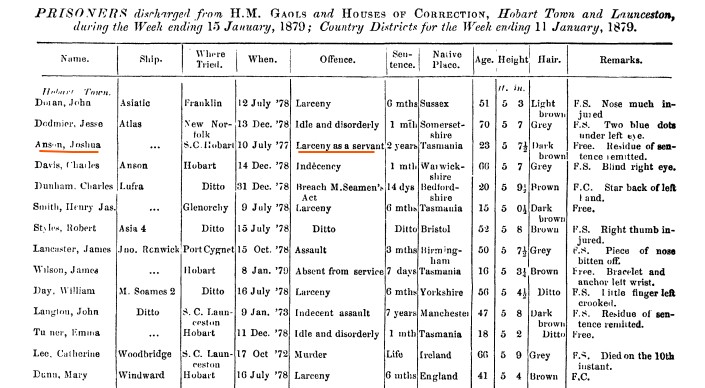


Source: Tasmania Reports of Crime Information for Police, Gov's printer J. Barnard

Joshua Anson was discharged from H. M. Gaol on 15 January 1879, the residue of sentence remitted.


Joshua Anson's Hobart Gaol record
Source: Archives Office State Library of Tasmania
Mugshots 1891 GD67-1-10, 1895 GD128-1-2, 1901 GD128-1-1

Joshua Anson did not take the two photographs of himself that were pasted to his criminal sheet, the first (on left) in 1877 when he was 23 yrs old, and the second (on right) in 1897 when he was 43 yrs old, nor did he photograph any of the other prisoners for gaol records while serving time at the Hobart Gaol. His abhorrence of the company of convicts was extreme, as his statement testifies. His 1877 prisoner mugshot was taken by Constable John Nevin in situ, and unmounted. Thomas Nevin may have printed another for the Municipal Police Office Registry at the Town Hall, Macquarie St. Hobart where he was the Hall and Office Keeper, but it is yet to be identified among the Tasmanian prisoner cdvs held in public collections. Joshua Anson was certainly the beneficiary of Thomas Nevin’s stock and commercial negatives when Samuel Clifford acquired them in 1876 and then sold them on to Joshua Anson and his brother Henry Anson in 1878. The Anson brothers reprinted Clifford & Nevin’s Port Arthur stereoscopes for their highly commercial album, published in 1890 as Port Arthur Past and Present without due acknowledgement to either Nevin or Clifford.

The Launceston Examiner reported another theft by Joshua Anson on 30 May, 1896.


TRANSCRIPT
HOBART, Friday
At the City Court to-day Joshua Anson, photographer, was charged with having robbed Charles Perkins of £32 12s5d. Accused, who was not represented by counsel, stated he had had two epileptic fits since he was arrested, and his head was not now clear. He asked for a remand. After the evidence of the prosecution had been taken, the accused was remanded till Tuesday.
Beautiful spring-like weather is prevailing.
Both of the Anson brothers were incarcerated at different times at the Hobart Gaol. In July 1889, Henry Anson, aged 39, was sentenced to one month for being drunk. Soon after Joshua Anson's parole, the two Anson Brothers set up business at various addresses:

132 Liverpool St. Hobart 1878-80
129 Collins St. Hobart 1880-87
36 Elizabeth St. Hobart 1880-87
52 Elizabeth St. Hobart 1887-91


Ansons' studio, 36 Elizabeth St 1880 (TAHO)

The photograph of ex-convict James Cronin


Studio portrait of ex-convict James Cronin ca. 1880
Anson Brothers 1880s, TMAG Collection

This is the only extant image of former convict James Cronin (1824-1885). It was taken by the Anson brothers, commercial photographers, as an Album portrait in their Hobart studio in the 1880s, i.e. it was therefore a privately commissioned portrait, and this is evident from both the street clothes and the pose of the sitter. It is not a police photograph, ie. a mugshot pasted to a criminal record sheet, unlike those taken by Thomas J. Nevin for the express use of police authorities, because James Cronin was not an habitual offender, at least, he was never convicted and sentenced under his own name in the decades 1860s-1880s or up to his death in 1885 at the Cascades Hospital for the Insane, Hobart. The Tasmanian Police Gazettes of those decades registered no offence for James Cronin, nor even an inquest when he died of pulmonary apoplexy on July 16, 1885.

Criminal and Transportation History: James Cronin (1824-1885)
James Cronin may have offended at Limerick for theft prior to his major felony of shooting at Jas. Hogan with intent to kill in 1847. He was transported to Bermuda on HMS Medway in the same year to serve eight years.  It was at Bermuda that he attempted to murder Mrs Elleanor Howes, wife of James Howes, mate in charge of the prison hulk, the Coromandel. Despatches from Charles Elliot, governor of Bermuda (CO 37/135) requested James Cronin be returned to England on HMS Wellesley to be convicted and transported to Tasmania (VDL) in correspondence dated January and April 1851. James Cronin arrived at Norfolk Island on board the Aboukir in March 1852, and thence to the Port Arthur prison Tasmania in December where he was "detained" until 1857 and assigned on probation to Major Lloyd at New Norfolk, Hobart on 27th November.


The National Archives UK has two entries for James Cronin detailing his attempt to murder Mrs Howes in Bermuda:
1. Reference: CO 37/135/4 Description:
Reports that a convict named James Cronin had attempted to murder Mrs Elleanor Howes, the wife of James Howes, mate in charge of the Coromandel hulk. Considers the existing laws inadequate to punish such cases. Recommends that a law should be passed to bring such cases to Courts Martial. Adds that in Cronin's case a convict named Edwin Smith intervened and saved Mrs Howes. Recommends Smith for a free pardon. Encloses a memorandum and correspondence concerning the matter.

Convict Establishment No. 4, folios 15-38
Date: 1851 Jan 18 Held by: The National Archives, Kew

2. Reference: CO 37/135/35 Description:
Reports that the convict James Cronin would be returned to England in HMS Wellesley. Encloses the requisite documents.

Convict Establishment No. 29, folios 224-230
Date: 1851 Apr 17 Held by: The National Archives, Kew


Source: Tasmanian Archives
Cronin, James
Convict No: 16007
Extra Identifier:
Voyage Ship: Aboukir
Voyage No: 347
Arrival Date: 20 Mar 1852
Departure Date: 07 Dec 1851
Departure Port: London
Conduct Record: CON33/1/106
Muster Roll:
Appropriation List:
Other Records:
Indent: CON14/1/31
Description List: CON18/1/56


Indent: CON14/1/31 

Title: James Cronin, one of 280 convicts transported on the Aboukir, 24 December 1851.
Details: Sentence details: Convicted at Ireland, Limerick for a term of life on 08 March 1847.
Vessel: Aboukir.
Date of Departure: 24 December 1851.
Place of Arrival: Van Diemen's Land and Norfolk Island. [These convicts appear to have all landed in Van Diemen's Land].

The death of James Cronin, labourer, was registered at the Cascades Hospital for the Insane on 16 July 1885. His cause of death was pulmonary apoplexy, unlike several other deaths of asylum inmates which were registered in the same month, e.g. "brain softening".


Death of James Cronin, male, 63 yrs old, 16 July 1885, Hobart, Tasmania
Record ID: NAME_INDEXES:1232085
Resource: RGD35/1/10 no 2506
https://stors.tas.gov.au/RGD35-1-10p314j2k
Archives Office Tasmania

The Anson Bros photo of ex-convict James CRONIN

The photograph of ex-convict James Cronin


Studio portrait of ex-convict James Cronin ca. 1880
Anson Brothers 1880s, TMAG Collection

This is the only extant image of former convict James Cronin (1824-1885). It was taken by the Anson brothers, commercial photographers, as an Album portrait in their Hobart studio in the 1880s, i.e. it was therefore a privately commissioned portrait, and this is evident from both the street clothes and the pose of the sitter. It is not a police photograph, ie. a mugshot pasted to a criminal record sheet, unlike those taken by Thomas J. Nevin for the express use of police authorities, because James Cronin was not an habitual offender, at least, he was never convicted and sentenced under his own name in the decades 1860s-1880s or up to his death in 1885 at the Cascades Hospital for the Insane, Hobart. The Tasmanian Police Gazettes of those decades registered no offence for James Cronin, nor even an inquest when he died of pulmonary apoplexy on July 16, 1885.

Criminal and Transportation History: James Cronin (1824-1885)
James Cronin may have offended at Limerick for theft prior to his major felony of shooting at Jas. Hogan with intent to kill in 1847. He was transported to Bermuda on HMS Medway in the same year to serve eight years.  It was at Bermuda that he attempted to murder Mrs Elleanor Howes, wife of James Howes, mate in charge of the prison hulk, the Coromandel. Despatches from Charles Elliot, governor of Bermuda (CO 37/135) requested James Cronin be returned to England on HMS Wellesley to be convicted and transported to Tasmania (VDL) in correspondence dated January and April 1851. James Cronin arrived at Norfolk Island on board the Aboukir in March 1852, and thence to the Port Arthur prison Tasmania in December where he was "detained" until 1857 and assigned on probation to Major Lloyd at New Norfolk, Hobart on 27th November.


The National Archives UK has two entries for James Cronin detailing his attempt to murder Mrs Howes in Bermuda:
1. Reference:CO 37/135/4 Description:
Reports that a convict named James Cronin had attempted to murder Mrs Elleanor Howes, the wife of James Howes, mate in charge of the Coromandel hulk. Considers the existing laws inadequate to punish such cases. Recommends that a law should be passed to bring such cases to Courts Martial. Adds that in Cronin's case a convict named Edwin Smith intervened and saved Mrs Howes. Recommends Smith for a free pardon. Encloses a memorandum and correspondence concerning the matter.

Convict Establishment No. 4, folios 15-38
Date: 1851 Jan 18 Held by: The National Archives, Kew

2. Reference:CO 37/135/35 Description:
Reports that the convict James Cronin would be returned to England in HMS Wellesley. Encloses the requisite documents.

Convict Establishment No. 29, folios 224-230
Date: 1851 Apr 17 Held by: The National Archives, Kew


Source: Tasmanian Archives
Cronin, James
Convict No: 16007
Extra Identifier:
Voyage Ship: Aboukir
Voyage No: 347
Arrival Date: 20 Mar 1852
Departure Date: 07 Dec 1851
Departure Port: London
Conduct Record: CON33/1/106
Muster Roll:
Appropriation List:
Other Records:
Indent: CON14/1/31
Description List: CON18/1/56


Indent: CON14/1/31 

Title: James Cronin, one of 280 convicts transported on the Aboukir, 24 December 1851.
Details: Sentence details: Convicted at Ireland, Limerick for a term of life on 08 March 1847.
Vessel: Aboukir.
Date of Departure: 24 December 1851.
Place of Arrival: Van Diemen's Land and Norfolk Island. [These convicts appear to have all landed in Van Diemen's Land].

The death of James Cronin, labourer, was registered at the Cascades Hospital for the Insane on 16 July 1885. His cause of death was pulmonary apoplexy, unlike several other deaths of asylum inmates which were registered in the same month, e.g. "brain softening".


Death of James Cronin, male, 63 yrs old, 16 July 1885, Hobart, Tasmania
Record ID: NAME_INDEXES:1232085
Resource: RGD35/1/10 no 2506
https://stors.tas.gov.au/RGD35-1-10p314j2k
Archives Office Tasmania

The albumen process: examples by Thomas J. Nevin ca. 1874


Eggbeater, Narryna Museum, Battery Point Tasmania
Photo Copyright © KLW NFC 2014 ARR

Tasmanian photographer Thomas J. Nevin began his professional career in the 1860s within a cohort of amateur and commercial photographers who produced enduring images using the latest contemporary equipment, papers, and printing processes. Their sources of information were journals such as The Photographic News 1863 imported from British and intercolonial photographers' societies. The albumen process was commonly used by T. J. Nevin in vignetted and upper torso studio portraiture in the 1870s for both his private clientele, and for his government commission to supply prisoner identification photographs (mugshots) to the Municipal Police Office, Hobart Town Hall.

Preparation with egg whites
ON OBTAINING PURE WHITES ON ALBUMINIZED PAPER.
MR. TUNNY has, in answer to an enquiry in Photographic Notes, given one of the best accounts of the preparation of albuminized paper that we have seen. He says, "I always prepare my albuminized paper with the pure white of eggs, which I believe to be preferable to all the cheaper compounds that have been substituted for it. Take any quantity of albumen with double the quantity of water, adding eight grains of chloride of ammonium to each ounce of the mixture. Whip up with a bunch of quills into a froth. The albumen will subside in an hour or two, then filter through a piece of fine linen cloth that has been previously slightly singed over a spirit lamp. Pour the albumen into a flat dish and float the paper for about three or four minutes, having previously folded back one of the corners of the sheet in order to keep it from coming into contact with the albumen. If the paper is pinned up by this unalbuminized corner, it will dry without the least streak or imperfection, but if the albumen conies into contact with the pin. a drip will begin which will end in innumerable streaks. By this precaution much paper may be saved.
"The albumen containing the above amount of chloride requires about sixty-five or seventy grains of silver to render it sensitive. I print in the usual way, a little deeper than the finished print.
"The print when taken from the printing frame is thoroughly washed from all free nitrate of silver. Make certain of this, to make the fixing process as economical as possible,, which should not be expensive if carefully done: The washed print is put into a chloride of gold bath, two grains to five ounces of water. In this bath the picture will readily change colour and slightly lower in tone. After it is reduced to the required tone it is passed through water, then placed into a new hypo-bath--four ounces to ten ounces of water. The print will be perfectly fixed in fifteen minutes. Taken from this bath it is repeatedly washed with cold water, then thoroughly with boiling water. The French and German papers get from fifteen to twenty waters, the English papers part more readily with the size, and consequently fewer washings are necessary to fix the prints on it.
"In order to secure perfect whiteness it is essential not to use the hypo bath when above a day old. The whole secret of retaining the clearness of the whites, being in always using a new strong pure hypo bath. By the above process I never fail in obtaining the whites pure.
"I may mention a curious circumstance of hyposulphite of soda. In some I got lately every picture that I fixed possessed that yellow old cheese-like appearance that has been so often complained of, while another sample of hypo gave me prints of absolute whiteness. In testing the solvent powers of these two I found that the first possessed only the half of the solvent power of the latter, viz.; it took double the quantity to dissolve twenty grains of chloride of silver in a given quantity of water. Whether the soda possessed other impurities I have been unable to detect."
Source: THE LIVERPOOL AND MANCHESTER PHOTOGRAPHIC JOURNAL. Vol. 1, 1857, p.213:

Video: albumen photo process
This beautifully animated silent exposition of the albumen photo process (s.XIX) is from the Museu del Cinema (Spain) with subtitles.


Albumen is one of the earliest photographic processes that allowed to make prints from a negative, usually, on glass. This type of photography comes from the discoveries of Abel Niépce de Saint Victor and Louis Désiré Blanquart-Evrard and was used throughout the second half of the nineteenth century. This albumen method is the photographic procedure on paper most characteristic of the nineteenth century.

Albumen portraits by Thomas J. Nevin 1870s


Carte-de-visite of Elizabeth Rachel Nevin nee Day, ca. 1870-71.
Married July 12, 1871 to photographer Thomas J. Nevin.
Copyright © KLW NFC 2010 Private Collection ARR


Laura McVilly (left) and Dick McVilly (centre), and unidentified toddler on right
Children of William Thomas McVilly, albumen, cdvs by T. J. Nevin ca. 18 December 1874.
Courtesy of the National Library of New Zealand

Nevin, Thomas J, 1842-1923. Nevin, T J (Hobart) fl 1867-1875
Portrait of Laura Blanche McVilly. McVilly, Richard William, 1862?-1949 :
Photograph albums and a group portrait.
Ref: PA2-1198. Alexander Turnbull Library, Wellington, New Zealand.
Link: https://beta.natlib.govt.nz/records/22801544

Read more in this article: T.J. Nevin's portraits of the McVilly children 1874


These albumen photographs of Tasmanian prisoners, taken and printed by Thomas J. Nevin on cdv mounts, 9.1 x 5.7 cm. are held in the National Library of Australia collection

Right: John F. Morris was originally transported to Tasmania before 1853 on the ship the P. Bomanjee 3. He was convicted at the Supreme Court , Hobart, on the 9th April 1861 for murder and sentenced to life imprisonment. He was photographed by T. J. Nevin on discharge from the Hobart Gaol, 28th April, 1875, residue of sentence remitted.

Left: George Fisher was photographed by T. J. Nevin on discharge, 15th April 1874 at the Municipal Police, Hobart Town Hall, when Fisher was "enlarged" with a ticket-of-leave. On 2nd December 1874, he was arraigned and sentenced to 12 years for forgery and uttering at the Supreme Court, Hobart

Read more about these two photographs in this article: "In a New Light": NLA Exhibition with Boyd misattribution


Flat-irons, Narryna Museum, Battery Point Tasmania
Photo copyright © KLW NFC Private Collection 2014 ARR

Flat-irons were used in several printing processes, from simple flattening of paper to radiating heat onto prints for faster drying. Flat-irons were also used to deepen the tones on albumen and salt paper prints and to render a high bright varnish quality to dry plates prints finished with tannin or gelatine.

RELATED POSTS main weblog

Updated 19 April 2024

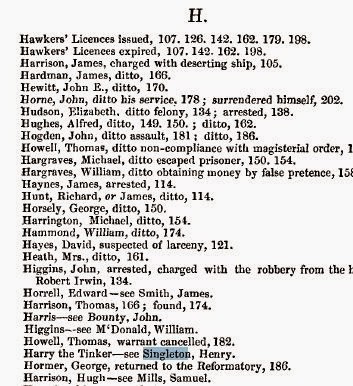
Prisoner Henry SINGLETON aka Harry the Tinker who pinches books

Who was Henry Singleton aka Richard Pinches aka Harry the Tinker aka Henry Salterton, really? And who was his companion Elizabeth Wilder aka Mrs Poole or Singleton aka Elizabeth Singleton - his mistress, his wife or his daughter? And how old was he when government contractor Thomas J. Nevin photographed him twice in the 1870s?

The Photographs
According to the Tasmanian police gazette of 23 March, 1871, Henry Singleton absconded from the prison at Port Arthur, 23 March 1871, with two transport ships to his two names - as Henry Singleton per Lord Wm Bentinck, and as his alias Richard Pinches, per Lady Kennaway 2, also known with the moniker Harry the Tinker.

Commercial photographer and government contractor Thomas J. Nevin photographed this prisoner at least twice, in 1873 and again in 1875 producing a different image for each separate sitting. The questions posed by these two photographs centre on this man's age and name at the time of transportation, his name and age when photographed in the 1870s, and his and his female companion's literary tastes which warranted lengthy documentation when the police arrested him in a cave in May 1873 at Oatlands, Tasmania.

Tasmanian prisoner Henry Singleton photo by T. j. Nevin

Above, a copy or duplicate from Nevin's negative and cdv of a prisoner, held at the National Library of Australia, called Henry Singleton, alias Richard Pincers, per Ld. [Lord] Wm. [William] Bentinck, with verso transcriptions almost identical to the information on the verso of the different photograph on the right of the same man held at the QVMAG.

NLA Catalogue notes (incorrect information)
nla.pic-vn4270249 PIC P1029/42 LOC Album 935 Henry Singleton, alias Richard Pincers, per Ld. [Lord] Wm. [William] Bentinck, taken at Port Arthur, 1874 [picture] 1874.
1 photograph on carte-de-visite mount : albumen ; 9.4 x 5.6 cm., on mount 10.4 x 6.4 cm. Gunson Collection file 203/7/54.
Title from inscription on reverse.
Inscription: "319"--On reverse
Link:https://nla.gov.au/nla.obj-142918617


Above, another photograph of Henry Singleton, one of several of this prisoner held at the Queen Victoria Museum and Art Gallery, Launceston, with the same information about the same ship and the same name, which might be a phonetic spelling of the name "Pinches" , i.e. "Pincers" with the added date of "1838" and notes about additional photographs. This archivist recorded three copies extant at the time of the transcription: No's: 318, 319, & 320". Photograph No. 319 was the NLA photograph, so the QVMAG photograph must be the last photograph, No. 320. Where is "318" and were there more photographs of this prisoner taken over the course of Singleton's long criminal career?

More important still is the question about the source of the information written on the versos of these photographs, since no transported convict by the name of Henry Singleton or Pincers appears on the arrival lists of the ship Lord William Bentinck, 1832 or 1838, the only two possible dates. If indeed this prisoner of the 1870s called Henry Singleton arrived in 1838, and the police in 1869 recorded his age as 35 yrs old, he would have been born in 1834, and only 4 yrs old when he arrived in VDL, not as a convict but as the child of a guard perhaps. The fact that the National Library's copy bears the same information as the copy at the QVMAG suggests strongly that the QVMAG was the source of the NLA's copy of this photograph (and many others), and that the written transcription on the versos was added from just the one 1871 police gazette notice by an archivist at the QVMAG back in the years of their accession of these records from Beattie ca. 1916 and Beattie's collection in 1930. .


Verso of No. 155
No's: 318, 319, & 320".
QVMAG Ref: QM: 1985: P: 77.

The Archives Office of Tasmania holds a copy of the QVMAG photograph but recorded Singleton with the alias of "Pinches" and the ship on which he arrived as the Lady Kennaway 2, not the Ld. [Lord] Wm. [William] Bentinck.


Caption: "Henry Singleton (alias Richard Pinches) convict, transported per Lady Kennaway. Photograph taken at Port Arthur by Thomas Nevin."
Archives Office of Tasmania (TAHO):
Ref: PH30/1/3248.

There are no transportation records for a convict called Henry Singleton transported later than 1842. Who was copying what from where? The NLA and the QVMAG both document Singleton aka Pincers arriving on the Lord Wm Bentinck (1838), and the source of that inscription is probably from the police gazette of 1871 (see below), but the AOT and the police gazettes both document Singleton aka Richard Pinches arriving on the Lady Kennaway 2 (1851).That too is unlikely, since the man described as Richard Pinches on the Lady Kennaway 2 transportation records does not describe the younger man in these two photographs.

It is likely that the prisoner in these two photographs was neither Henry Singleton per Lady Kennaway 2 nor his alias Richard Pinches per Lord William Bentinck. The prisoner in these photographs may be Robert Bew, per Mayda , 1846, off Norfolk Island, or indeed the only recorded Henry Singleton to arrive as a transported convict - Henry Singleton, per Surry 4, aged 18, arrived 1842. Robert Bew was photographed by Nevin on 19 July 1873 when discharged with a ticket-of-leave but no extant photograph carries his name and he was arrested and convicted with the Henry Singleton documented with the Richard Pinches alias in March 1870 (see police record below).The original convict transportation records for the name Pinches compound the confusion today (see more below); the police at the time were doubly confused by Henry Singleton's youthful appearance.

Henry Singleton's Police Records 1869-1883


Henry Singleton aka Harry the Tinker, Index, police gazette called Tasmania Reports of Crime Information for Police 1869. The following records are all sourced from these police gazettes which were published weekly.

1869: warrant


Warrant for Henry Singleton 19 November 1869 with alias of Harry the Tinker, for stealing flour. The following description accompanied the warrant.


Description of Henry Singleton, 19 November 1869 -" 35 years old, appears younger", 5 feet 6 inches, a tin-plate worker, hence the moniker "Tinker". If 35 yrs old in 1869, his DOB would be ca. 1834 (1869-35=1834).


Henry Singleton was arrested three weeks later at Oatlands, 3 December 1869. Beneath this notice, a transgendered person was arrested the same week- William McCafferty, alias Annie Lowrie Scotty.


Tradesmen by inclination and intent, Henry Singleton and an accomplice called Robert Bew (or Berr) were committed for trial on 24 December 1869 for theft of carpenter's tools.

1870: breaking and entering


Robert Bew per Mayda and Henry Singleton alias Richard Pinches per Ly Kennaway 2 were convicted in the Supreme Court Hobart on 4 March 1870, sentenced to four and five years respectively for the offence of breaking and entering within curtilage, i.e. within the boundary of a private property. They were sent to the Port Arthur prison where one year later, Henry Singleton absconded and headed towards Oatlands. This is the first mention in the police records of the ship and the alias, Richard Pinches per Lady Kennaway 2

1871: absconded


Henry Singleton absconded from Port Arthur, 23 March 1871, with two transport ships to his two names - as Henry Singleton per Lord Wm Bentinck, and as alias Richard Pinches, per Lady Kennaway 2, known with the moniker Harry the Tinker.

1873: the library in the cave


Henry Singleton was arrested 30 May 1873. The police discovered quite a cache in his hideout, a cave in Oatlands,including -


TRANSCRIPT
The following is a list of articles found in a cave in the Municipality of Oatlands, recently occupied by Henry Singleton, alias Harry the Tinker (vide Crime Report, 1871, page 41), and a woman named Elizabeth Wilder, recently arrested by the Oatlands Municipal Police: - 7 vols Sir Walter Scott's novels, paper covers; 1 vol. East Lynne; 1 small vice and other small tools (carpenter's), since identified by Mr John Page, of Lemon Springs; 1 book on Electricity; 1 ditto Philosophy of Common Things; 1 vol. Popular Educator; 1 Church Lesson Book, bound in green velvet, brass edges, "Ohio Brown" written in the cover; 1 single-barreled gun, a crack in the stock where screw fastens lock; 1 small telescope, red barrel; 1 tomahawk; 3 small hammers; several files; 1 rasp; 2 dark lanterns; 8 dies; 2 tin billies; a quantity of note paper and envelopes; a revolver case; 1 bullet mould; 1 nipple-screw; a quantity of bullets; 1 blow-pipe; a quantity of flour; 23 door and drawer keys on steel ring; 14 small keys on a string; 15 ditto; 30 skeleton keys and door keys, some of them broken; 1 frying-pan; 1 pack of cards; 1 black wide-a-wake hat; 1 new Scotch twill shirt; 1 old dark moleskin trousers; 1 pair woman's stays, new; sugar, tea, caraway seeds &. The above articles with the exception of those claimed by Mr Page, are at Police Office, Oatlands, awaiting identification.
Henry Singleton's impressive stash of loot was discovered in a cave at Oatlands after his arrest, reported on 6 June 1873. He was held at the Oatlands Gaol in the Men -on-Routes room until taken on Page's coach to the Hobart Gaol. He was photographed soon after arrival by Thomas J. Nevin, the photograph (above, left) now held at the National Library of Australia. He may have been sent to the Port Arthur prison again but his name IS NOT on the lists of those 109 men who were sent there from the Hobart Gaol, and then relocated back to the Hobart Gaol by July 1873 at the request of the Parliament.


Title: [Oatlands Gaol]
Publisher: [Tasmania : s.n., 18--?]
Description: 1 photographic print on card : sepia toned ; 197 x 340 mm
Format: Photograph
ADRI: AUTAS001131821738
Source: Allport Library and Museum of Fine Arts


Men -on-Routes room
Title: Plan - Oatlands - Plan and elevation of intended alterations in the 'Men-on-Routes' room at the Oatlands New Gaol
Description: 1 photographic print
Format: Photograph
ADRI: CSO1-1-937
Source: Archives Office of Tasmania


1875: Ticket of Leave


Henry Singleton was discharged with a ticket of leave from Hobart on 21 July 1875. The police continue to document his ship as the Ly Kennaway 2.


Henry Singleton's discharge was reported again on 23 July 1875. When he was discharged with a Ticket of Leave from Hobart per this notice of 23 Juy 1875, his name was listed twice: the Port Arthur information listed his sentence as 10 years, i.e. dating from his Supreme Court conviction of 1 March 1870, but omits any physical description; the second entry lists his sentence as 5yrs, giving a physical description, and his age - 60 yrs old. If he was 35 yrs old in in November 1869, by July 1875, he would have been about 41 yrs old, not 60 yrs old. The second photograph of Singleton, held at the QVMAG, was taken by Nevin at the Hobart Municipal Police Office in July 1875 on the TOL discharge.

1883: discharge and warrant


Henry Singleton was discharged 23 May 1883, sentenced to three months in February 1883 for larceny. Here his age is listed 68 yrs old in 1883, but if he was 35 yrs old in 1869, he would have been 49 yrs old, not 68 yrs old. Was he Singleton or was he Pinches? The age discrepancy points not to aliases, but two entirely different men. Little wonder the police commented that he looked young for his age!


Warrant for the arrest of Henry Singleton 5 September 1883


Warrant for Henry Singleton on suspicion of stealing 20 yards of Crimean shirting etc, 28 September 1883


Henry Singleton and a woman called Mrs Singleton or Poole, accused of stealing a green skirt etc, was also arrested on 26 October 1883.


Henry Singleton, alias Richard Pinches, still documented with the ship the Lady Kennaway 2, now aged 71 years - and now with a new alias - "Henry Salterton" - was arraigned in the Supreme Court Launceston on 7 November 1883 with a 14 year sentence, along with Elizabeth Singleton, aged 27, a native or local, who was arrested on a count of burglary and disposed of with a Proclamation. But if he was 35 yrs old in 1869, and looked even younger to police in that year (!), by November 1883, he would have been 49 yrs old, not 71 yrs old. Or, if he was the prisoner transported to Norfolk Island in 1851 as Pinches on the Lady Kellaway 2, aged 32 yrs, by 1883 he would be 64 yrs old, not 71 yrs old, (1851-32 = born ca.1819; 1883-1819=64). And if indeed he was transported at all, and in 1869 he was 35 yrs old, in 1851 he would have been born in 1834, transported as a child if transported at all. None of these recorded ages are consistent with the names associated, and none concord with the looks of the prisoner in Nevin's mugshots taken in the 1870s.

And so on ...
More offences appear in the police gazettes for both names - Singleton and Pinches - throughout this decade.


On left, the NLA image (1873), flipped and color-corrected to compare with the QVMAG image (1875) on right. The prisoner on right looks a little older by 1875, but he does not look like a man who was supposedly born in 1819 and transported in 1851 to Norfolk Island, aged 32 yrs. He was described by the police gazettes as "35 years old, appears younger" in 1869, so in 1873, per police records, he would have been 39 yrs old, and by 1875, he would have been 41 yrs old. These look like correct ages for the man photographed, so why was he associated with the following transportation records?

Transportation records
Too old: a man named Richard Pinches from Birmingham (UK), a glazier and plumber, was tried at the Oxford Q.S. in 1844. He was 32 years old when he arrived on Norfolk Island on 4th July 1851, so by 1873 this man would have been 54 yrs old. He was then sent to Hobart (Port Arthur) as a convict on board the Lady Kennaway 2,on 29 September 1852 per these records:

Richard Pinches per Lady Kennaway 2, 1851


TAHO Ref: CON14-1-42_00322_L; CON14-1-42_00322_L


TAHO Ref: CON33-1-102_00185_L
Convict Details - Pinches, Richard
Convict No: 56424
Voyage Ship: Lady Kennaway (2)
Voyage No: 337
Arrival Date: 28 May 1851
Departure Date: 05 Feb 1851
Departure Port: Portsmouth
Conduct Record: CON33/1/102, CON37/1/ p5138
Indent: CON14/1/42
Description List: CON18/1/52
Remarks: Reconvicted as Henry Singleton

Robert Bew per Mayda, 1842


TAHO Ref: CON33-1-79_00018_L

Robert Bew per Mayda and Henry Singleton alias Richard Pinches per Ly Kennaway 2 were convicted in the Supreme Court Hobart on 4 March 1870, sentenced to four and five years respectively for the offence of breaking and entering within curtilage, i.e. within the boundary of a private property.

Henry Singleton per Surrey 4, 1842


TAHO Ref: CON33-1-27_00216_L

This prisoner called Henry Singleton was 18yrs old, literate and 5 ft 6 ins tall when he arrrived at Hobart, VDL in 1842 on board the Surrey 4, but was this prisoner a different man with the same name, or the same man whose alias was Richard Pinches? This man would have been 50 yrs old in 1874,

Henry Pinches per Candahar, 1842


MISSING FRIENDS
Information is requested respecting Henry Pinches, per ship Candahar, whether living or dead; if the latter, the date and place of death. Communicate with this Office.
Illiterate, too short and too old: someone was looking for a man by the name of Henry Pinches, per this missing friends notice published in the police gazette of 19 September 1879. Henry Pinches, aged 25 years old, was illiterate and under five feet tall when he was transported on the Candahar in 1842, per this record which shows he was discharged from the Police Office Hobart Town Hall in August 1874 where he would have been photographed on discharge by Thomas Nevin, so where is his photograph? If he was born ca. 1817 (1842-1825=1817) he would have been 57 yrs old by 1874.


TAHO Ref: CON33-1-23_00168_L

Why the Infamy?
The Tasmanian tourist destination, the Port Arthur Historic Site(PAHS) (accessed April 2014) on the Tasman Peninsula, makes a great deal of this prisoner for visitors, casting him as a bad character -
... constantly in trouble for refusing to work, being dirty and disobedient, talking and having money improperly in his possession, insubordination and using threatening language. He received many short sentences of hard labour or solitary confinement. Sent to Port Arthur in 1853, he continued to refuse to work, and to be disobedient and insolent, and received more spells in solitary for his pains.


Webshot on Singleton file

The PAHS insisted (up to April 2014) he be called Richard Pinches and not Henry Singleton, despite all the police records over decades stating clearly that the name Richard Pinches, per Ly Kennaway 2, was an alias, and despite these transportation records for Richard Pinches showing no correlation to the youngish prisoner called Henry Singleton whom Nevin photographed in the 1870s.

This is the information greeting visitors to their website up to April 2014 until their update and after viewing our post here with a thousand clicks:

PAHS publication: People of Port Arthur

Richard Pinches a.k.a Henry Singleton was a 27 year old plumber and glazier when he was transported. He was a single Roman Catholic from Birmingham who could read and write.
Pinches had made a habit out of minor crime; he had four previous convictions for stealing and housebreaking and had served short sentences. Finally the court decided that it had seen enough of him, and he was transported for 14 years for stealing linen. He arrived in mid 1851.
He was first sent to Norfolk Island and in a year he served nine and a half months hard labour in chains for being disobedient, dirty, disorderly and having money improperly in his possession.
Transferred to Port Arthur in early 1853, Pinches continued his campaign of disobedience, earning himself more time in solitary and hard labour in chains. In May 1854 he gained a pass but it seemed that he still had not developed a taste for work; three months later he absconded from his master. He was caught after some weeks and returned to Port Arthur for 18 months hard labour. This was not to his liking and two months later he bolted; he was recaptured and after serving 12 months he was again assigned to a master.
This time Pinches completed his sentence without incident. His next appearance was in Oatlands Goal under a new name, Henry Singleton, but he was still up to his old tricks. He was sentenced to four years at Port Arthur for stealing five pigs. There he got another three months hard labour for being drunk. In early 1864 Richard gained his freedom but only seven months later he was back in goal in Hobart, charged with bigamy. Marriage records cannot even verify that he was married once.
He was acquitted, so the charge against him may have been fabricated.
RICHARD PINCHES 10 15
He kept out of trouble until 1870, when he was returned to Port Arthur for five years for breaking and entering an outbuilding and stealing. He must have misbehaved at Port Arthur because four years later he was in the Separate Prison, although his offence was not recorded. Then he received another three years with hard labour, including a year in the Separate Prison, for attempting to escape.
In July 1875 and again in 1879 he was in the Prisoners’ Barracks, but we do not know why. 1883 was a bad year for Richard. He was arrested twice, once in February when he was sentenced to three months hard labour for larceny and then in November he received 14 years for burglary. We have no further records for Richard.
He was then 65 years old and had spent almost half his life in the convict system.
Note the vernacular phrasing and attitudinal markers, the intimate use of the prisoner's first name "Richard", and the closing down of the topic by affirming there are no further records for the prisoner because "we" don't have any. The information used by the Port Arthur site was most likely sourced from Thomas Keneally's book, Australians from Eureka to the Diggers (2011, Allen & Unwin), page 2, (or vice versa) though no sources are cited.


This is the PAHS update (accessed 6 October 2014) which denies ever having insisted on the name Pinches instead of Singleton:


But the PAHS still insists on captioning the QVMAG copy of Nevin's photograph of Singleton with the A. H. Boyd misattribution on their fact sheet. Attributed by whom? Again, no source, no concession to the simple fact that not one photograph of a prisoner or landscape or anything else purported to be taken by the Commandant A. H. Boyd has ever existed except in the febrile minds of vested interests at the Port Arthur historic Site:


[sic] "Henry Singleton circa 1873-4, photograph attributed to Boyd
Reproduced courtesy of Queen Victoria Museum and Art Gallery"

Relatively speaking, compared with the murderers, child rapists, and the thousands of blood-thirsty felons who populated the prisons of Tasmania in Singleton's time, he was neither especially dangerous to people's physical safety, nor ignorant or malicious. The loot found in his cave hideout at Oatlands in 1873 gives a very clear idea of what aspirations he held, despite his circumstances. He was a tradesmen who stole tools in the hope of building himself and his female companion Elizabeth a house; he was literate with educated tastes who stole novels to read for their amusement, and religious volumes for their enlightenment, and above all, he cared and shared all this with a young woman called Elizabeth, probably his daughter, whom police disposed of with a Proclamation in 1883 rather than imprison. Why the infamy?


One of the books found in Henry Singleton's possession ...

Mrs. Henry Wood, 1814-1887
East Lynne, or, The Earl's Daughter.
Richmond: West & Johnston, 1864.


Print by Alfred Winter
Title: Photograph - View of the township of Oatlands, shown in picture are the sails on Callington Mill
Description: 1 photographic print
Format: Photograph
ADRI: PH30-1-2969
Source: Archives Office of Tasmania

Featured Post

Captains, emigrants and convicts: the summer of 1842-1843 in Hobart, VDL

Captain Edward GOLDSMITH on the Janet Izzat Lt. Charles HEXT on the Cape Packet PRISONERS on the Emily and Moffatt George O'BRIEN, s...