Captain Edward Goldsmith and the "Waterloo" (1832)

CAPTAIN EDWARD GOLDSMITH master mariner
JAMES DAY first mate
WATERLOO brig 1832


Captain Edward Goldsmith (1804-1869) ca. 1849
Uncle of Elizabeth Rachel Nevin nee Day, wife of photographer Thomas J. Nevin
Daguerreotype by Douglas T. Kilburn, Sydney 
Copyright © Private Collection KLW NFC Imprint 2014

The "Waterloo" 1832
Following the trials and calamities which beset one of his first commands as a young master on the James which was wrecked days after arrival at the Swan River, Western Australia, in May 1830, Captain Edward Goldsmith, his wife Elizabeth and new-born son Richard Sydney continued their journey to Hobart, VDL, as passengers aboard the Bombay, together with crew-member James Day, Elizabeth Goldsmith's brother. They sailed in the Elizabeth from Hobart to Sydney where Captain Goldsmith took command of the Norval, departing Sydney for London on 26th April 1831. He returned in 1832 to the port of Hobart in command of the Waterloo (not to be confused with the convict transport the Waterloo which was shipwrecked at Cape Town in 1842). First Mate on board the Waterloo (1832) was  his brother-in-law, James Day (1806-1882), younger brother of his wife Elizabeth Day (b. Yorkshire 1803- d. Kent 1875) arriving 5th August at Hobart and 22nd August at Sydney.

The 266 tons brig Waterloo built at Hull carried no guns, and was manned by 13 crew when they left Liverpool on 28th March. They arrived at the port of Hobart on August 5th carrying a general cargo, 28 adults, including pensioners, some bound for NSW, and 8 children. One man died during the voyage.


Hobart Port Officer's Report of the arrival of the Waterloo, 5 August 1832
Source: TAHO Arrivals MB2/39/1/1 P276
Goldsmith Ship's Master Waterloo 5 Aug 1832 MB2/39/1/1 P276


Source: The Waterloo, master Edward Goldsmith, arrived Sydney 20 August 1832
New South Wales Australia Unassisted Immigrant Passenger Lists 1826-1922

After a short stay of ten days in Hobart, Captain Goldsmith and brother-in-law, First Mate James Day, set sail for Port Jackson (Sydney) on 16th August, 1832, arriving on 20th August. They reported no instances of cholera or other infectious diseases, and no Surgeon aboard. Exactly one year later, Captain Goldsmith arrived again in Hobart as master of the Wave, a ship he commanded on several more voyages between 1833 and the 1840s . He attended the wedding of his wife's brother, master mariner Captain James Day to Rachael Pocock - future parents of photographer Thomas Nevin's wife Elizabeth Rachel Day (b. 1847, Rotherhithe) - at St David's in 1841, and returned every year thereafter to Hobart in command of various brigs and barques, including his finest, the Rattler, which he advertised in superlatives, but he never again commanded the Waterloo. His last command of the Rattler was on the return voyage to London in 1851. His final farewell to Hobart was in February 1856 when he returned home to Gadshill, Higham, Kent as a passenger on board the Indian Queen, accompanied by his wife Elizabeth and son Edward Goldsmith jnr..


Signature of Edward Goldsmith, witness, on marriage certificate at -
St David's Hobarton
6th January 1841
James Day, 34yrs, Master Mariner
Rachel Pocock, 29 years, Spinster

First Mate James Day
Voyages 1829-1832

1829
Day J Carpenter
Georgiana 22 Aug 1829
Hobart Bombay
CUS33/1/1 p135

1830
After the wreck of the James at Swan River, James Day sailed to Hobart on board the Bombay with Captain Edward Goldsmith, wife Elizabeth Goldsmith nee Day, sister of James Day, and the Goldsmith's new-born son, Richard Sydney Goldsmith as passengers

Day James Seaman
Bombay 22 Aug 1830
Hobart Sydney
CUS33/1/1 p253

Day James Mr Chief Mate
Orelia 6 Oct 1830
Hobart Western Australia
CUS33/1/1 p266

1831
Day James Mr Chief Officer
Lion 24 Apr 1831
Hobart London
CUS33/1/1 p334

1832
On this voyage of the brig Waterloo, Captain Edward Goldsmith was in command, his brother-in-law James Day was first mate.

James Day J 1st Mate
Waterloo 15 Aug 1832
Hobart Sydney
CUS33/1/1 p474


Full List of Crew & Passengers
Archives Office Tasmania
Waterloo, 1832; Edward Goldsmith master, James Day 1st mate 
Arrivals Passengers 1833-35
https://stors.tas.gov.au/CUS30-1-1P075

SUMMARY of Captain Edward GOLDSMITH's voyages to and from Hobart 1830-1849: -
This is an incomplete list and does not include voyages which started or terminated at Port Jackson, Sydney.

1830
Departed Goldsmith Child Passenger on the Elizabeth 15 Aug 1830 Hobart to Port Jackson
Ship to colony Bombay Child of Captain and Mrs CUS33/1/1 p258
Departed Goldsmith Mrs Passenger on the Elizabeth 15 Aug 1830 Hobart to Port Jackson
Ship to colony Bombay CUS33/1/1 p258
Departed Goldsmith Captain Passenger on the Bombay 22 Aug 1830 Hobart to Sydney CUS33/1/1 p253

1832
Arrived in Hobart Goldsmith Ship's Master on the Waterloo 5 Aug 1832 MB2/39/1/1 P276
Departed Hobart Goldsmith E Master Waterloo 15 Aug 1832 Hobart to Sydney CUS33/1/1 p474

1833
Arrived in Hobart Goldsmith Ship's Master on the Wave 14 Nov 1833 MB2/39/1/1 P443

1835
Arrived in Hobart Goldsmith Ship's Master on the Wave 9 Mar 1835 MB2/39/1/2 P245

1836
Arrived in Hobart Goldsmith Ship's Master Wave 6 Dec 1836 MB2/39/1/3 P73


Captain Goldsmith reported breakers at Bonavista, Cape Verde Islands (Atlantic, west from Senegal, Africa) on the voyage from London to Sydney in command of the Wave, September, 1836. The reef was the site of the wreck of the Madeline 1835.
Source: John Purdy 1838: page 45, The Brasilian navigator; or, Sailing directory for all the coasts of Brasil, to accompany Laurie's new general chart, Volume 1. Oxford University.

1838
Arrived in Hobart from Portsmouth on the barque The Wave 17 July 1838
Goldsmith Ship's Master Wave 17 July 1838 MB2/39/1/4 P100

1839
Arrived in Hobart Goldsmith Ship's Master on the Wave 25 Sep 1839 MB2/39/1/4 P351

1842
Arrived in Hobart from London, Goldsmith Ship's Master on the Janet Izzatt 26 Oct 1842 MB2/39/1/6 P355

1843
Arrived in Hobart Goldsmith Ship's Master on the Janet Izzatt 16 Dec 1843 MB2/39/1/7 P313

1844
Arrived Goldsmith Capt on the Louisa 13 Dec 1844 CSO92/1/13 P110

1845
Arrived in Sydney from Hobart Town on the Louisa, 1st January 1845
Arrived in Sydney from London and Cape of Good Hope, Goldsmith Cpt master of the Angelina, 12 December 1845


1846
Arrived in Hobart Goldsmith Mr Rattler 11 Nov 1846 CSO92/1/16 P96
Goldsmith Ship's Master Rattler 12 Nov 1846 MB2/39/1/9 P45

1847
Arrived in Hobart Goldsmith Ship's Master on the Rattler 11 Nov 1847 MB2/39/1/9 P374

1848
Arrived in Hobart Goldsmith Ship's Master on the Rattler 5 Dec 1848 MB2/39/1/10 P374

1849
Arrived in Hobart from London on the Rattler, 27 November 1849 Goldsmith Ship's Master
Rattler 27 Nov 1849 MB2/39/1/11 P381
Arrived Goldsmith Mrs on the Rattler from London 27 Nov 1849 MB2/39/1/11 P381

VOYAGES on the RATTLER, Captain Edward Goldsmith, Master:
1846: arrived Hobart from London, 14th November 1846, departed 21st January 1847.
1847: arrived Hobart from London, 11th November 1847, departed 29th January 1848.
1848: arrived Hobart from London, 4th December 1848, departed 25th February 1849.
1849: arrived Hobart from London, 27th November 1849, departed 26th February 1850.
1850: arrived Hobart from London, 13th December 1850, departed 19th March 1851.

The "Waterloo" 1842
Although this convict transport bears the same name as the Waterloo which arrived safely at Hobart Town in 1832 under the command of Captain Edward Goldsmith, it appears NOT to be the same vessel. This vessel was shipwrecked off Cape Town in 1842, it weighed 414 tons, not 266 tons, and was built at Bristol, not Hull, in 1815, though it too was built for the timber trade, and in a state of “fragility and rottenness” -

" ... no longer fit to carry logs, she is patched up like other whited sepulchres, stuffed with a living cargo by a contractor, and dispatched to the ends of the earth – a voyage of more than twenty thousand miles ..." (see the editorial below)


Source: State library Tasmania
Wreck of the Waterloo
Charles Hutchins, lithographer, from a sketch by Captn. Hext, 4th The King's Own regiment

The South African Commercial Advertiser for 31 August 1842 and for 3, 7 and 10 September 1842 carried reports of the wreck of the convict ship Waterloo in a scathing critique of those responsible. . Sue MacKay has posted this transcript online together with names of those who died and those who survived.

Editorial 31 August 1842
Cape Town, August 31 1842
On the forenoon of Sunday last two large vessels, the Abercrombie Robinson and the Waterloo went on shore on the South Eastern beach at the bottom of Table Bay.
Both vessels were engaged as Transports by the British Government. The Abercrombie Robinson had on board, besides her crew and several passengers, 501 soldiers with their officers. She was a large Ship of nearly 1500 tons burden. After grounding near the shore she stood upright, and no lives have been lost. She will probably, or rather certainly, be a total wreck.
The Waterloo, a Ship of 414 tons, bound to Van Diemen’s Land, had on board, besides her crew, two hundred and nineteen male convicts, Dr. HELSELL in charge, Lt. HEXT, Ensign LEIGH, thirty men of HM 99th Regiment, five women and thirteen children. She took the ground between eleven and twelve o’clock in the forenoon and in fifteen or twenty minutes became a mass of rubbish, And now ensued a most piteous massacre. In about two hours and a half, amidst the crumbling heaps of their perfidious prison – of men, women and children, one hundred and ninety four were crushed, disabled and drowned.
There was no preparation for saving life made on board or on shore. No life buoys, no coils of ropes lashed to casks, nor any apparatus for establishing a communication with the shore from the Ship.
On the shore there was no Life Boat, no apparatus for throwing ropes over stranded vessels, nor any thing, in short, to show that the Government or people here had ever before heard of such a thing as a shipwreck. We stood amongst thousands on the beach within a hundred and fifty yards of the dissolving fabric, looking on the agonised faces of our fellow creatures, as they sunk in dozens, battered and bruised and suffocated – useless as children, or idiots, or wild Caffers. As corpse after corpse floated to our feet, and was raised from the brine, there seemed a curse in every dead man’s eye on the improvidence, the imbecility, the brutish indifference to human suffering and human life, to which, combined with fiendish avarice, so many miserable souls had been sacrificed.
For this ship, it appears, was built twenty seven years ago at Bristol, of light materials for the timber trade. No longer fit to carry logs, she is patched up like other whited sepulchres, stuffed with a living cargo by a contractor, and dispatched to the ends of the earth – a voyage of more than twenty thousand miles.
No doubt a “survey of professional men” will “find” that there was no fault anywhere; that the Waterloo was a sound ship, thoroughly repaired, and perfectly seaworthy; that she had on board all the equipments requisite for such a voyage and such a consignment; that the officers of the ship did all that human strength, directed by skill and animated by humanity, could do; and that the accident must be ascribed entirely to a hurricane, a mountainous sea, and a remarkably hard beach.
Now as to the hurricane and the mountainous sea, it is enough to observe that there were twenty other vessels at anchor in the Bay, besides the Waterloo and the Abercrombie Robinson, and none of them parted from their anchors, or dragged them to any perceptible extent. The wind was blowing a gale, but by no means a violent one, and it was partly off shore. The sea was not running unusually high. Without ropes in their hands or any precaution, men walked into the water up to their shoulders to drag out the bodies of the dead and dying, without the slightest risk. This could not have been done had the surf been such as a gale causes on an open beach. These are facts to which thousands can bear witness.
With respect to the bottom or ground where the ship struck, some say it is rock, others that it is sand, like the rest of the beach. As soon as the weather is fine it will be examined, and the most convenient spaces marked for this method of disembarking Her Majesty’s troops or convicts.
For some years back such “accidents” have been ascribed to the insufficiency of Lighthouses at the entrance of the Bay. That fault has just been fully remedied. The old Lighthouse is now properly attended, and the new one is so well placed, and so brilliant, that no man dare pretend to miss it, or to mistake it for anything else. These and some further improvements in this department, still in progress, were forced on the Government by the remonstrances of the Public, and particularly of the mercantile body.
When the Helen was lost at the entrance of the Bay, four or five months ago, the Commercial Committee very properly inquired into the cause, and found on the testimony of numerous witnesses that the Lights on that particular night were defective, and had thus misled the master of the vessel. This they represented to Government, and a remedy was instantly found.
We recommend the same course in the present case. The committee cannot compel witnesses to attend or give evidence, but they can invite them; and if interested parties disregard such invitations, that fact will not be without meaning.
These two wrecks will be much talked of at home. We think we can insure their being mentioned in Parliament. Let us show that we here are neither indifferent to human life nor to the character of our bay, which the villainy and the incapacity of strangers have too often brought into undeserved disrepute.
In the midst of this unhesitating condemnation on some points, and charges of guilt on others, we have to mention that two unofficial spectators, Mr. MOLTENE and Mr. STILL, procured the assistance of a common boat belonging to a Malay, which reached the Waterloo after she was falling to pieces, and brought off two men, and on a second trip fastened a rope to the wreck. After this a larger boat, belonging to Messrs. SINCLAIR was brought from the Abercrombie Robinson, and moving backwards and forwards along the rope, saved a good many lives. This shows what might have been done by a Life Boat used in time.
We purposely avoid going further into details at present, satisfied with thus openly charging all the parties concerned, before the world, with the offence of culpable negligence, or criminal intention. The world, let them be well assured, expects an answer, and will treat them according to the case they may make out in defence.
It is not strange, by the way, that we should hear such lamentations from what is called the Shipping Interest, as if no employment could be had for their new-built, fine-moulded, copper-fastened A.I. Vessels, while for the most important of all services, the transport namely of troops, and of persons under Judicial Sentences, such vessels as the Waterloo find ready acceptance in the twenty seventh year of their fragility and rottenness? We shall endeavour to force our way through this moral confusion, convinced that either the Shipping Interest are a pack of liars or the Contractors a pack of knaves. The official gentry who grant the contracts and their cousins the Surveyors will naturally fall into their proper places in the course of the Inquiry.


Records of the convicts aboard the Waterloo who drowned.
Source: TAHO
Item CON33/1/30 Cape Packet ex Waterloo (2) 01 Nov 1842 24 Nov 1842
Item CON14/1/18 Cape Packet ex Waterloo 24 Nov 1842 24 Nov 1842 24 Nov 1842


Copy, dated 24 November 1842, of alphabetical list of convicts saved from the wreck of the Waterloo, convict ship; forwarded to the Lieut. Gov. of Van Diemen's Land from the Government of the Cape of Good Hope.


Painting of the troop carrier "Abercrombie Robinson" and the convict ship "Waterloo", aground in Table Bay in August 1842. Unattributed, sourced at Wikipedia.

RELATED POSTS main weblog

Photographers A. Bock, S. Clifford and T. Nevin at Port Arthur

Tasmanian photographers Alfred BOCK, Samuel CLIFFORD and Thomas J. NEVIN
VIP visitors to the Port Arthur prison 1860s-1870s
Convict clothing Tasmania 1870s


Title: Officers at Port Arthur Cricket Team
Creator(s):Bock, Alfred, 1835-1920
Date: Between 1858 and 1867
Description: 1 photograph mounted on board : sepia toned ; 7 x 10 cm.
Notes: Exact measurements of image: 58 x 95 mm., Title derived from note inscribed in pencil on verso by unknown hand., Alfred Bock's trademark for his studio at 140 Elizabeth St. Hobart on verso.
Location: Allport Library and Museum of Fine Arts
ADRI: AUTAS001126187517

Alfred BOCK at Port Arthur 1866
In late April, 1866, photographer Alfred Bock was at the Port Arthur prison site on the Tasman Peninsula, 60 kms south of Hobart at the request of its Commandant, James Boyd. Alfred Bock's studio - The City Photographic Establishment - at 140 Elizabeth Street, Hobart, was manned by his junior partner Thomas Nevin and his apprentice, younger brother William Bock, in his absence. Bock's mission at Port Arthur was to provide a series of landscapes and portraits of officials. However, it was photographer Samuel Clifford, Nevin's friend and mentor, of Liverpool Street, Hobart, who was the source and supplier of photographic materials to the Port Arthur prison administration, in this instance for Alfred Bock in April 1866, and again in August 1873, when Clifford himself visited the prison site.

Alfred Bock sent Samuel Clifford an urgent telegram from Port Arthur on 27th April 1866 requesting 24 dry plates - panoramic. The details of the telegram were recorded as -

March -May 1866 Account of Private Telegrams
Date 27th April, No. 269, Alfred Bock to Mr Clifford Liverpool St. H. Town,
"Send down 24 dry Plates Panoramic. by the Shannon, at once. - Reply."


Source: Tasmanian Papers 316 (microfilm)
Records of Telegrams sent and received between Hobart and Port Arthur 1863-1871
Mitchell Library, State Library NSW
Photos © KLW NFC Imprint 2013


Signal stations Port Arthur and Mt Nelson (courtesy of TAHO). The electric telegraph was introduced to Tasmania in 1857. The Electric Telegraph Office was situated in Macquarie Street Hobart opposite Franklin Square, also known as the old guard house (since demolished). This photograph taken ca. 1869 shows its arches:


The Electric Telegraph Office ca. 1869 (small building on corner).
Image courtesy Mitchell Library SLNSW

Alfred Bock's portraits of Commandant James Boyd were reported in the Hobart Mercury on 10th October 1866:


From Bock's telegram, it is very clear that dry plate photography was practiced by both Alfred Bock and his assistants, and by Samuel Clifford, as early as 1866. At left is an example of Alfred Bock's solar-enlarged photography which he may have devised from technical instructions published in The Photographic News, 1863. Both photographs are held at the State Library of Tasmania:

Notes for painted photograph of James Boyd on left:
Title: Mr. James Boyd
Creator(s): Bock, Alfred, 1835-1920
Date: 1866
Description: 1 photograph : sepia ; 15 x 10 cm.
Notes: Exact measurements : 144 x 100 mm, Title inscribed in ink on card mount centred below image., "Mercury 10/8/66, Portrait by Mr. Alfred Bock, presented to Jas. Boyd, 2/8/66" inscribed in pencil on verso., Original created by Alfred Bock., Photograph of an oil painting, painted over solar-enlarged photograph, head and shoulders inclined to left.
Subjects: Boyd, James - fl. 1866
Location: Allport Library and Museum of Fine Arts
ADRI: AUTAS001125882142

Notes for photograph of James Boyd and his horse:
Title: James Boyd, Commandant P. Arthur
Creator(s): Bock, Alfred, 1835-1920
Date: 186-?
Description: 1 photograph : sepia ; 10 x 6 cm.
Notes: Exact measurements : 93 x 58 mm, Title inscribed in pencil on verso in unknown hand., Full length photograph of James Boyd standing beside his horse.
Location: Allport Library and Museum of Fine Arts
ADRI: AUTAS001125882134


Title: Port Arthur, Guards c.1866
Publisher: Hobart : Alfred Bock, ca. 1866
Description: 1 photographic print on card : sepia toning ; 62 X 100 mm
Source: Allport Library and Museum of Fine Arts
Notes: Title inscribed in pencil on verso

See also these articles (main weblog):


James Boyd, Port Arthur Commandant ca. 1860s.
Source: Australia: Image of a Nation 1850-1950 by David Moore and Rodney Hall (Collins 1983).

Samuel CLIFFORD at Port Arthur 1873
The way bill for the government schooner Harriet of July 24th, 1873, recorded that a cargo of 2 gross (288) photographic glass plates were intended for Port Arthur. Photographer Samuel Clifford had supplied the plates in anticipation of photographing the Colonial Governor Du Cane and his party of vice-regal visitors from South Australia. Because of a major dispute between the incumbent Port Arthur commandant A. H. Boyd with the Lands and Survey Department's photographer and painter William Piguenit, who subsequently resigned in protest at Boyd's bullying, the commission to photograph the ruinous state of the Port Arthur prison site at the request of opponents within the Colonial government was assigned to Samuel Clifford and Thomas Nevin. Opponents to the continuation of extravagant expenditure urged Parliament in July 1873 to close down the prison, transfer the prisoners to the gaol in Hobart, and dismiss the much despised Port Arthur commandant, Adolarious Humphrey Boyd, on grounds of corruption. As a result, from July 1873, those sixty or so prisoners still at Port Arthur were relocated to the gaol in Hobart (Campbell St) where they were photographed by Thomas Nevin on arrival, and A. H. Boyd was effectively removed from Port Arthur to a position in charge of paupers at the Cascades Prison for Males in Hobart by February 1874, per this notice in the Mercury, 19 January 1874:


TRANSCRIPT
PORT ARTHUR.-The breaking up of Port Arthur is proceeding more rapidly than the public have any idea of. The transference of prisoners to Hobart Town has been completed so far as is considered advisable till further accommodation can be provided in Hobart Town, and sufficiently far to allow of Mr. Boyd's early transference from Port Arthur. Dr. Coverdale proceeds to Port Arthur at once, and takes medical charge, vice Dr. McCarthy resigned. He will be initiated into the duties of Superintendent by Mr. Boyd till 31st March, when he will assume duties as the head of the establishment, and when Mr. Boyd will be transferred to the Cascades, which, we learn, can be fitted up at a very moderate expense to be a place of safe-keeping for criminals. (Mercury, 19 January 1874).
Boyd was neither a photographer, nor an engineer, and the row ensuing over Piguenit resonated throughout the dying days of his tenure at Port Arthur, both within Government and in the press.


Way bill for the Harriet, 20 July 1873:
288 photographic glasses as cargo to Port Arthur
Source: Tasmanian Papers 320 (microfilm)
Mitchell Library, State Library NSW
Photos © KLW NFC Imprint 2013


Samuel Clifford arrived at Port Arthur on board the Harriet on August 12th, 1873, together with a case of photographic materials. He fulfilled the commission, and departed Port Arthur on board the Harriet on 28 August 1873.


Way bill
Samuel Clifford (passenger list, top of second page) arrives at Port Arthur with photographic materials on August 12, 1873.


Way bill
Samuel Clifford (passenger list) departs Port Arthur on 22 August 1873.
Source: Tasmanian Papers 320 (microfilm)
Mitchell Library, State Library NSW
Photos © KLW NFC Imprint 2013

Several photos taken by Samuel Clifford at Port Arthur were forwarded to the monthly magazine The Australasian Sketcher, which were published as engravings in August 1873, and mentioned again in the October 1873 issue:


"The photographs from which our views are engraved, as also those of Port Arthur, given in our last issue, were taken by Mr Clifford of Hobart Town. "The Australasian Sketcher 4 October 1873.


The Australasian Sketcher with Pen and Pencil was a monthly magazine published by the proprietors of The Argus between 1873 and 1889 and contained many illustrations, engravings, and articles which captured "the picturesque phases of our public and social life of notable objects and events in Australia and New Zealand". It provides an important pictorial account of life in the colonies before the wide spread use of photography.(Notes from NLA Trove).


State Library of Tasmania
Stereo by Samuel Clifford and T. Nevin
Ref:AUTAS001124851726


State Library of Tasmania
Stereo print of Port Arthur by Thomas Nevin
Ref: 17AUTAS001124851759 (color corrected for display here)


Samuel Clifford's series 1873
The Government Cottage, Port Arthur,
Photo dated 1873
State Library of Tasmania


Samuel Clifford, Port Arthur panoramic No, 2
State Library Tasmania
Ref:17AUTAS001124075847

See also these articles:

Thomas NEVIN at Port Arthur 1872-1874
Between January 31st and 2nd February 1872, Thomas J. Nevin was commissioned to photograph parties of VIPS visiting Hobart on trips to Adventure Bay and Port Arthur. The trip to Adventure Bay resulted in a series of group portraits which included the Hon. Mr. James Wilson (Premier of Tasmania), Alfred Kennerley, (Mayor of Hobart and Police Magistrate), the manager of the Van Diemen’s Land Bank (?), the Hon. John O’Shanassy (former Premier of Victoria), Mr John Miller (Cape of Good Hope), Father Sheehy, Mr. Tobin (Victoria), John Woodcock Graves jnr (barrister Tasmania), Captain Clinch (commander of the City of Hobart), the Hon. James Erskine Calder (Surveyor-General), and Robert Byron Miller (barrister Tasmania).

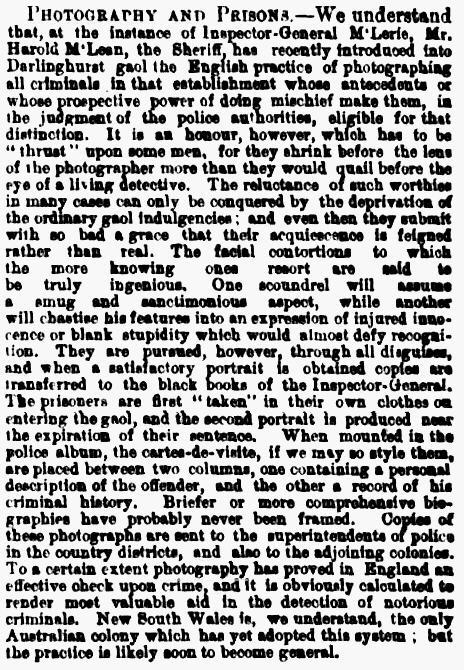
The trip to Port Arthur included British author Anthony Trollope, Premier J. M. Wilson, lawyers Howard Spensley, Solicitor-General of Victoria, and the Tasmanian Attorney-General W.R. Giblin, Nevin’s family solicitor since 1868, who had requested Nevin join them to organise facilities on site and procedures for photographing prisoners in accordance with recent legislative provisions in Victoria and NSW. The colony of New South Wales had already introduced the practice of photographing prisoners twice, firstly on entry to prison and secondly near the end of their term of incarceration by January 1872 when this report was published in the Sydney Morning Herald. The purpose of the visit to the Port Arthur prison by the former Premier and Solicitor-general from the colony of Victoria with photographer, Thomas Nevin and the Tasmanian Attorney-General the Hon. W. R. Giblin on 1st February 1872 in the company of visiting British author Anthony Trollope, was to establish a similar system for processing prisoners through the central Municipal Police Office, Hobart Town Hall on their relocation from the dilapidated and dysfunctional Port Arthur prison to the Hobart Gaol in Campbell St. The few remaining prisoners at Port Arthur were returned to Hobart from mid-1873 to early 1874. Some were photographed by Nevin at Port Arthur, but the majority were photographed by Nevin on arrival in Hobart.


Photography and Prisons, Sydney Morning Herald 10 January 1872

TRANSCRIPT
PHOTOGRAPHY AND PRISONS.-We understand that, at the instance of Inspector-General McLerie, Mr. Harold McLean, the Sheriff, has recently introduced into Darlinghurst gaol the English practice of photographing all criminals in that establishment whose antecedents or whose prospective power of doing mischief make them, in the judgment of the police authorities, eligible for that distinction. It is an honour, however, which has to be " thrust " upon some men, for they shrink before the lens of the photographer more than they would quail before the eye of a living detective. The reluctance of such worthies in many cases can only be conquered by the deprivation of the ordinary gaol indulgencies; and even then they submit with so bad a grace that their acquiescence is feigned rather than real. The facial contortions to which the more knowing ones resort are said to be truly ingenious. One scoundrel will assume a smug and sanctimonious aspect, while another will chastise his features into an expression of injured innocence or blank stupidity which would almost defy recognition. They are pursued, however, through all disguises, and when a satisfactory portrait is obtained copies are transferred to the black books of the Inspector-General. The prisoners are first " taken" in their own clothes on entering the gaol, and the second portrait is produced near the expiration of their sentence. When mounted in the police album, the cartes-de-visite, if we may so style them, are placed between two columns, one containing a personal description of the offender, and the other a record of his criminal history. Briefer or more comprehensive biographies have probably never been framed. Copies of these photographs are sent to the superintendents of police in the country districts, and also to the adjoining colonies. To a certain extent photography has proved in England an effective check upon crime, and it is obviously calculated to render most valuable aid in the detection of notorious criminals. New South Wales is, we understand, the only Australian colony which has yet adopted this system ; but the practice is likely soon to become general.
Source: The Sydney Morning Herald. (1872, January 10). The Sydney Morning Herald (NSW : 1842 - 1954), p. 4. Retrieved from https://nla.gov.au/nla.news-article13250452


[Left]: Tasmanian Attorney-General W. R. Giblin
Photographer: Thomas J. Nevin 1873 studio stamp verso
TAHO Ref: NS1013-1-1971
[Right]: Trollope’s Port Arthur interviewee prisoner Denis Dogherty
Photo by T. Nevin, stamp and verso inscription “Calder”.
Private collection KLW NFC Imprint.

The visitors to Port Arthur stayed a few days while Trollope gathered information from interviewing prisoners, including Denis Dogherty, whom Thomas Nevin photographed among other recent absconders. He took photographs as well of the derelict state of the buildings, of costly but unfinished engineering works, and general vistas across the site. The men in the foreground of this series taken on the trip in January 1872 were the lawyers and the legislators who were Nevin’s patrons and employers throughout his engagement as photographer in Hobart’s prisons and courts from 1872 into the 1880s.


The Colonists' Trip to Adventure Bay
VIPs on board The City of Hobart, 31st January 1872
Stereograph in buff arched mount by Thomas J. Nevin
Private Collection KLW NFC Group copyright © KLW NFC Imprint 2015

Thomas Nevin had worked closely with Alfred Bock and Samuel Clifford from the mid 1860s to the late 1870s. From Bock he learnt portraiture until Bock's departure from Tasmania in 1867, and from Clifford he learnt stereography. Although some of Nevin's townscapes survive in public collections (TMAG, TAHO, QVMAG), it is his portraiture of both private clients and prisoners which is his enduring legacy. Of the hundreds of extant prisoner mugshots in public collections taken by Nevin, two photographs of prisoners, taken in 1875 rate a mention here because the prisoners are wearing prison hats made at Port Arthur. The way bill for the government schooner Harriet for the 4th July 1873 listed a cargo of 2000 leather caps sent to Hobart.


Way bill for the Harriet 4th July 1873 from Port Arthur to Hobart
2000 leather caps, 1800 woollen ditto.

Source:Tasmanian Papers 320 (microfilm)
Mitchell Library, State Library NSW
Photos © KLW NFC Imprint 2013


These photographs are the only two in public collections of Tasmanian convicts wearing the leather caps in the mid 1870s. Nevin's photographs give an accurate idea of the styling of the leather caps, what were made of, when they were worn, who wore them, and how they were worn. A falsified and misleading description by Julia Clark of these two photographs by Nevin, which we originally photographed at the Mitchell Library for this weblog in 2009, has appeared in an article titled More than Magpies: Tasmanian Convict Clothing in Public Collections, Linda Clark, Julia Clark, Elspeth Wishart, Kim Simpson and Ian Terry, Historic Environment Volume 24 Number 3 2012, without acknowledgement to either Nevin or the source of their information, namely these weblogs. They falsify the dates - 1880s instead of 1875 - and in the footnote give a date of 1800 (!) for the photographs, minus the attribution to Nevin. These museum workers are reprehensible propogandists for Kim Simpson's ancestor, A. H. Boyd, who wishes Boyd might have taken the NLA's collection of photos of Tasmanian prisoners or "Port Arthur convicts 1874", though Julia Clark et al have known all along only too well that it never happened, and never could have possibly happened. In addition to the plagiarisation of our material about these caps, the same authors have used information only found on these Nevin weblogs about the painted scarf on Bramall's mugshot by Nevin, revealed only through our photographs taken at the NLA (see below).


The two photographs of prisoners, James Mullins on left and William Smith on right, were taken in 1875 at the Hobart Gaol. Both wearing leather caps. Each verso bears Thomas J. Nevin's colonial warrant contractor stamp with the Hobart Supreme Court Royal Arms insignia.

Photos © KLW NFC Imprint 2013
Mitchell Library SLNSW (PXB 274)

Neither carte bears a date, but the photographs can be dated from the same week of 9th July 1875 when both men were booked and sentenced at the Hobart Supreme Court . Mullins' carte (on left) is numbered recto "198" and Smith's (on right) is numbered recto "200". Nevin took an earlier and different photograph of an unshaven Smith, which is numbered "199" and stamped verso as well. It is held at the Queen Victoria Museum and Art Gallery. See this article here on this site. A journalist visiting the Hobart Gaol in 1882 noted this uniform with the cap in his report to the The Mercury on 8th July 1882:
In their dark-grey uniform and black leathern caps, with their criminal visages, shaven of the covering Nature had given to aid them in the concealment of their vicious propensities and villainous characters, they were, in truth, a forbidding, repulsive lot. Yet very far from unintelligent, at least, in some marked instances. A villainous shrewdness and a perverse cleverness writ in many a cunning, gleamy eye and heavy brow ; and a dogged determination to be read in the set of the jaw, and the style of the gait, were as the translated speech of artfully calculated, daring crime.


William Smith per Gilmore 3.
Photo by Thomas Nevin, July 1875; copyright KLW NFC 2009 ARR
Stamped verso with Nevin's government stamp
Mitchell Library NSW PXB 274 No.1

On May 8th, 1874, Thomas Nevin journeyed to Port Arthur on board the Harriet, in the company of a prisoner whom he had earlier photographed as William Campbell, but who was subsequently hanged as Job Smith. The new Surgeon-Commandant of the prison site, Dr Coverdale, by that date was implementing a speedy evacuation of all prisoners to the Hobart Gaol. Nevin photographed some of these serious offenders in situ at Port Arthur, but the majority he photographed when they were received in Hobart.


Mr Nevin arrives at Port Arthur aboard the Harriet, May 8th, 1874
accompanying the prisoner whom he had photographed as William Campbell
but who was hanged as Job Smith at the Hobart Gaol, May 1875.
Source: Mitchell Library SLNSW, Tasmanian Papers Ref: 320.


William Campbell returned to the Hobart Gaol four days later in the company of Constable Mooney on board the Harriet , 12 May 1874. He carried no luggage. Nevin remained at Port Arthur for another week, returning to Hobart with his father-in-law, master mariner Captain James Day, on board the Star.


Detail of the tinted photograph (below on right) of prisoner Walter Johnstone aka Henry Bramall
NLA Catalogue nla.pic-vn4270027.
Photo copyright © KLW NFC 2015 ARR. Watermarked


Johnstone aka Bramall or Taylor absconded, reported February 6, 1874
Source: Tasmania Reports on Crime for Police Information


Walter Johnstone aka Henry Bramall aka Taylor
NLA Collection nla.pic-vn4270027
Vignette on left, not tinted but mounted, and hand-tinted mounted cdv
Original prisoner mugshots by T. J. Nevin 1874
Photos recto and verso taken at the National Library of Australia, 7th Feb 2015
Photos copyright © KLW NFC 2015 ARR. Watermarked.


William Campbell, hanged as Job Smith 1875
NLA Collection nla.pic-vn4270353
Hand-tinted vignetted and mounted prisoner portrait by T.J. Nevin 1874
Photos taken at the National Library of Australia, 7th Feb 2015
Photos copyright © KLW NFC 2015 ARR. Watermarked.

The original cdvs of Job Smith and Bramall online at the National Library of Australia barely show the hand-tinting, and in one cdv of Bramall, none at all, yet Clark et al have referenced both cdvs with comments about the colouring without acknowledgement of their source, namely our weblogs or Nevin as the photographer. We took this photograph of Bramall (above) to reveal that the prison scarf was painted at the neck of this prisoner, detailed in this weblog post of December 2009.

In the carte of Walter Johnson aka Bramall aka Taylor (sic, below), however, there IS no neckerchief. He is not wearing one at all underneath his collar, so the blueish colouring we can see is actually just paint patterned in squares to look like the standard issue neckerchief. This is a telling detail, and would have been added by Nevin to the print he made of an earlier photograph he took of Bramall to underscore the fact that the man was in effect a prisoner who had absconded in prison clothing. The eyes of this man have intense blue colouring as well. The reason for the colour was not to render a pretty picture; it was to aid the public's recognition of him. The carte would have been displayed at the Town Hall Police Office, and most likely exhibited in Nevin's studio window at 140 Elizabeth St, Hobart Town. It would have been available to the public, on sale, since Johnstone alias Bramall alias Taylor absconded from the Cascades area of Hobart on June 6th, 1874, and appears to have succeeded in remaining at large, as his recapture was not recorded during 1875.


MICROFILM IMAGES SLNSW


Sources:
Tasmanian Papers 316, 317, 320 (microfilm)
Mitchell Library, State Library NSW
ALL photos © KLW NFC Imprint 2013

RELATED POSTS main weblog