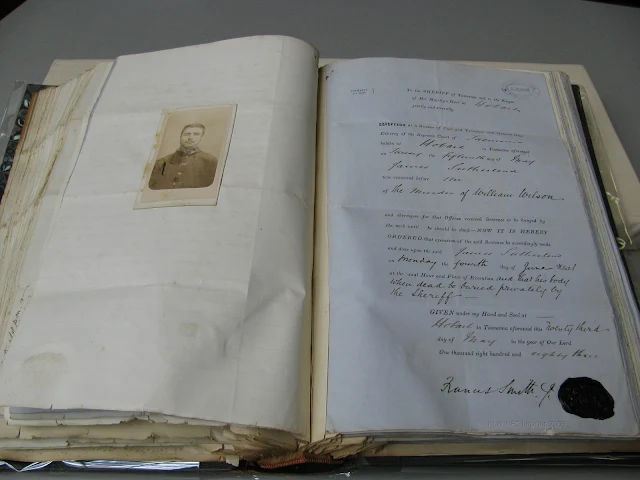
HER MAJESTY'S GAOL HOBART
INQUEST for Constable Frank GREEN May 1882
The Nevin Brothers, photographer Thomas James Nevin (1842-1923) and Constable John (William John aka Jack, 1852-1891) served the Police and Prisons Departments of the Tasmanian government from the late 1860s to the late 1880s. Thomas was contracted as prisons and police photographer by the family solicitor, Attorney-General and later Premier, W. R. Giblin, from 1868, serving the New Town Territorial Police, the Hobart Municipal Police (1870s-1880s), and the Hobart City Council as special constable (1879) during the Chiniquy riots at the Hobart Town Hall where he was Keeper. He was also assistant bailiff in the City Police Court and Supreme Court (1880s).

Map of the old Hobart Gaol
Photo copyright © KLW NFC Imprint 2008 ARR
William John Nevin's civil service
This photograph of Jack Nevin was taken by his brother Thomas J. Nevin ca. 1880. Gazing directly at the camera, he appeared relaxed and very savvy about the process of being photographed. The clothes he wore were suitable for everyday work in a foul place such as a prison. His salaried positions were primarily in administration, with a career path and ranking similar to the Gaol Keeper's until his untimely death during the typhoid epidemic of 1891.

Constable John Nevin (William John aka Jack Nevin), ca. 1880
Photographed by his brother Thomas J. Nevin.
Copyright © KLW NFC Imprint Private Collection 2009
Constable John (William John) Nevin (1852-1891), known to the family as Jack, was the younger brother of Tasmanian photographer Thomas J. Nevin. He was also his brother's assistant at the Hobart Gaol, Campbell Street during his brother’s commission as police photographer in prisons during the 1870s. They jointly maintained Thomas' old studio in New Town until the mid late 1880s when Thomas apparently ceased professional photography, although family BDM records show his occupation as "photographer" in 1907 (on the marriage certificate of daughter Minnie), in 1917 (on the marriage certificate of son Albert) and on his cemetery burial record of 1923.
The earliest date on record of Constable John Nevin's service with the police is 1870 when he joined the civil service, aged 18 yrs, and was stationed at the Asylum, Cascades Prison for Males, Hobart. His service continued at the Hobart Gaol, Campbell Street, as "Gaol Messenger", a rank which covered his duties as photographer, and as a hospital "Wardsman" until his untimely death while still in service, aged 39 yrs old. The registrar of his death gave his age as 43 yrs old; however, his burial records at Cornelian Bay Cemetery on 19th June 1891 listed his death at 39 yrs, i.e. born 1851, and this date is consistent with the sick lists of the Fairlie shipping records stating that he was a babe in arms, less than 9 months old, when he arrived in Hobart on 3rd July 1852 with his settler parents, John and Mary Anne Nevin nee Dickson, and his three older siblings Thomas James, Rebecca Jane, and Mary Ann. The Fairlie sick list recorded:
Folio 5: William Nevin, aged 6 months, Child of Guard; sick or hurt, convulsio; put on sick list 2 June 1852, discharged 9 June 1852 to duty.Constable John Nevin was a resident on salary to H. M. Government at the Hobart Gaol by 1884 when he registered on the Electoral Roll for the district of North Hobart. The Electoral Roll of the Electoral District of North Hobart, year commencing 11th April, 1884, showed this entry:
NEVIN, William John
Place of Abode: H.M. Gaol
Nature of qualification: Salary
Particulars of Qualification: H.M. Government

Nevin, William John: Electoral Roll for North Hobart 1884.
Source: Archives Office Tasmania
Applications to the constabulary 1870s-1880s
This record of Jack Nevin's application to the Constabulary Tasmania, signed by the Sheriff on 28th February 1877, not only gives details of Jack's former employment at the Cascades Goal for Males between August 1875 and April 1876, it details his physical characteristics: aged 25, single, height nearly 5ft 6", educated but not too well, a labourer by trade, a Wesleyan by religion and Belfast born, arriving free on the Fairlie (1852). He was of course no more than a babe in arms in 1852, noted on the ship's sick lists, but this record shows no physical deformity or disease as an adult.
These records are crudely categorical, as we know that Jack Nevin was highly literate, the son of a journalist and poet, brother of spelling-bee whizz, his sister Mary Ann, and brother too of Thomas, a police photographer with powerful political mentors. Because he was an amateur rather than professional photographer, his trade is listed as "labourer", i.e. no specialist apprenticeship or profession.

W. J. Nevin Applications to join the Constabulary Tasmania 1877 and 1881
Records courtesy State Library of Tasmania
While a constable at the Cascade Gaol for Males, Constable Nevin was involved in an incident which was reported in the Mercury, 27 October, 1875:

Constable Nevin, Mercury, 27 October 1875.
TRANSCRIPT
CITY POLICE COURT
Tuesday 26th October, 1875
Before Mr. Tarleton, Police Magistrate
PEACE DISTURBERS. - Robert Evans and William Inman were charged by Constable Pearce, of the Cascades, with having disturbed the peace in Upper Macquarie-street on the 24th inst. The defendants pleaded "not guilty". Constables Pearce and Nevin, of the Cascades, proved that the defendants were throwing stones and making a disturbance. The Police Magistrate said that in Upper Macquarie-street there existed the roughest of lads in Hobart Town. He would sentence both defendants to 14 days' imprisonment, and warn them that on proof of a second they would probably be birched.
On 24th November 1881, Jack Nevin's second application - a renewal of the 1877 application - to the Constabulary Tasmania was again signed by the Sheriff. Aged 27, his details are more general on this form: religion is listed simply as "Protestant" and birthplace simply "Ireland" but he is still single - living with his parents at Kangaroo Valley - and still free of disease or deformity. His service at Cascades and the Hobart Gaol is listed, as is the lack of a trade. On his death certificate, his employment was registered as "Gaol Messenger", a rank which covered photographic duties and office administration.


Signed 24th November 1881, Constable (Wm) John Nevin's second application - a renewal of the 1877 application - to the Constabulary Tasmania.Records courtesy State Library of Tasmania.
Frank Green's death by gunshot wound 1882

View from the hill above Quarry to the Hobart Gaol
Courtesy Archives Office of Tasmania
Ref: 30-5718c. Unattributed, ca. 1885.
On the 14 May 1882, Constable W. J. Nevin was on duty at 11.45am when the guard in the sentry box on the hill at the Quarry behind the stone-shed near the Hobart Gaol failed to return. Constable Nevin was dispatched to investigate and found the guard, Frank Green, dying of a gunshot wound. "I am shot, John" were Green's dying words as Nevin lifted his head.

Constable Nevin and Constable Green
Death by Gunshot Wound
Mercury, 15 May 1882
TRANSCRIPT extract
... At a quarter to 12, by which time it was usual for the guard to be at his post, Green was not present there, and the officer in charge, Mr. White, despatched Constable Nevin to see what detained him. Constable Nevin ascended the hill, and at the sentry-box situated at the corner of the workings, a little more than midway up the incline, found Green lying on the ground with his feet on the threshold of the box, and his rifle about a yard distant from him. The constable knelt down to lift up the head of the prostrate man, who said , "I am shot; let me alone. " Nevin then ran down and acquainted those in the yard with the accident, and Green was then conveyed to the hospital, where he lingered for half an hour, and then expired. It was found that he had been shot through the abdomen and lungs ...Frank Green was 21 yrs old, rather tall, a Catholic, single, born in Hobart and a former sailor when he joined the Constabulary for the first time, signed in by the Sheriff on October 1st, 1878.

Frank Green application to join the Constabulary Tasmania 1878
Courtesy State Library of Tasmania
Hobart Hospital record

Green, Frank
Record Type: Deaths
Property: General Hospital Hobart
Admission dates: 16 May 1882
Place of origin: Tasmania
Date of death: 16 May 1882
Source: https://libraries.tas.gov.au/Record/NamesIndex/1502065
At the inquest held at the Bird-in-Hand Hotel five days later, Constable John (W. J. ) Nevin was a key witness. The jury of seven reached a verdict of accidental death. Coroner Tarleton found the guard Frank Green had slipped when about to descend the hill and his double-barrelled breech-loading gun had caught in a string on his coat, discharging a bullet through his abdomen and lung. The press reported the incident and inquest in some detail from May 17 -May 20, 1882:
May 17: TRANSCRIPT
DEATH by GUNSHOT WOUND.-A death under peculiar circumstances occurred yesterday, at the Government quarry, Park-street. Frank Green, aged about 25 years, an armed guard at the quarry, was upon duty in the forenoon on the crest of the hill above the workings. At 20 minutes to 12 the whistle to knock off work for dinner was sounded, and Green was then seen at his post. It was his duty, at this sounding of the whistle, to descend the hill into Park-street, there to remain on guard till the prisoners had filed out, At a quarter to 12, by which time it was usual for the guard to be at his post, Green was net present there, and the officer in charge, Mr. White, despatched Constable Nevin to see what detained him. Constable Nevin ascended the hill, and at the sentry-box situated at the corner of the workings, a little more than midway up the incline, found Green lying on the ground with his feet on the threshold of the box, and his rifle about a yard distant from him. The constable knelt down to lift up the head of the prostrate man, who said, " I am shot; let me alone." Nevin then ran down and acquainted those in the yard with the accident, and Green was then conveyed to the hospital, where he lingered for half an hour, and then expired. It was found that he had been shot through the abdomen and lungs. A strange fact in connection with this sad affair is that not one man in the quarry heard the report of the gun. Constable Higgins, of the Territorial Police, arrived at the sentry box before Green was removed, and to him the unfortunate man made a statement which leaves no doubt that the occurrence was purely accidental. It seems that Green was about to descend the hill, when he slipped, and his rifle caught either in a string which was attached to his hat or his overcoat. No doubt when he slipped the man threw up his arms to save himself, and so brought the muzzle to bear on his body, and the lock being entangled in the string or coat, the piece was discharged at that instant. The charge passed right through his body, and the marks of some of the slugs were subsequently found in an adjacent rock. The high wind which was blowing at the time accounts for the noise of the discharge not being heard by those who were in the neighbourhood. An inquest will be held upon the body. The deceased man was unmarried.
Source: THE MERCURY. (1882, May 17). The Mercury (Hobart, Tas. : 1860 - 1954), p. 2.
Link: https://nla.gov.au/nla.news-article9009574

Exterior front view of ten men standing outside the "Bird-In-Hand" Hotel in Argyle Street, Hobart, ca. 1900
Source: Archives Office Tasmania [unattributed]
Link: https://libraries.tas.gov.au/Record/Archives/PH30-1-1944
May 19: TRANSCRIPT
INQUEST.- An inquest was yesterday held before Mr. Coroner Tarleton, and a jury of seven, Mr. Geo. Kerr being the foreman, at the Bird-in-Hand Hotel, Argyle-street, into the cause of the death of Francis Daniel Green, late armed guard at the Government quarry, Park-street. The jury having viewed the body, the evidence of W. J. Nevin, a constable at the gaol, who was on duty at the quarry on Tuesday last, was taken. He deposed that the deceased was on guard on the day in question, armed with a double-barrelled breech-loading gun. He was posted on the top of the quarry. At about 20 minutes to 12 o'clock that day the signal was given to cease work for the prisoners to go to the gaol for dinner. It was the duty at deceased to come down into Park-street when the prisoners were passing through the gates. Not seeing the deceased at his post when the prisoners had been mustered in the stoneshed, witness was sent to see what detained him. The wind was blowing strongly, and no report of firearms had been heard. Witness went to where Green was posted, and found him at the sentry-box, lying on the ground, turned partly on his right side but with his feet in the box. His gun was lying about a yard from him, its muzzle pointing not at him but up the hill. There was an odour of freshly-discharged powder. Witness said to him, "Frank, what is the matter?' He replied, "I am shot, John." Witness asked how it had happened, but the deceased appeared to be in too great pain to answer. Witness went to raise the deceased's head, but he said, " For God's sake, go away and leave me alone." Witness signalled to the station officer at the stoneshed that something was the matter, and taking up the gun, witness went down to him. On reaching the stoneshed, some of the police from the Supreme Court were sent up to the deceased, and the station officer, on looking at the gun, found that the right-hand barrel had been discharged. There was no one near the deceased when witness saw him lying on the ground. There were none of the prisoners missing, and the deceased in no way led him to believe that he had been shot by any one. Constable Matthew Higgins deposed that on the 16th inst, at a little before noon, he was standing at the door of the Supreme Court, when he was informed that a man had been shot at the quarry. Going to the sentry box on the hill he saw the deceased. Kneeling down he undid his waistcoat, and saw a large wound on the left side, just below the heart, from which blood was flowing. Witness asked deceased how it had happened. He answered that he was arranging his garments, when the gun exploded and shot him. The deceased was taken to the hospital. On examining the ground where the deceased had fallen, witness found the mark of a footslip, and of slugs having struck the rock. Dr. Holden deposed that he remembered the deceased being brought to the hospital. Witness had examined his wounds, and found a gunshot wound on the front of the body and several holes in the back, where the charge had passed through. He had also found some slugs in his clothing, and others under the skin. He was bleeding internally, but not externally. The wound in the front of the body showed that the weapon must have been close to the man when discharged. The wound was, from its character, almost necessarily fatal. The deceased died from internal haemorrhage, caused through the wound. A verdict of death by the accidental discharge of a gun was returned.
Source: THE MERCURY. (1882, May 19). The Mercury (Hobart, Tas), p. 2
. Link: https://nla.gov.au/nla.news-article9009658

Further report of the Coroner's findings on the death of Constable Green
The Tasmanian (Launceston, Tas. : 1881 - 1895) Sat 20 May 1882 Page 547 TASMANIA.
Mr. Tarleton, the Coroner, held an inquiry on the body of the man Frank Green, who was accidentally shot on Tuesday while on guard over the prisoners working at the quarry. From the evidence taken, it appeared that the wind was blowing very hard at the time and no one heard any report of a gun, but a constable named W. J. Nevin, finding that Green did not come forward to do his accustomed duty at twenty minutes to twelve, when the men were marched to dinner, called out, and receiving no reply, went in search of him. He found Green on his side, with a discharged gun on the ground near him. In reply to Nevin's question, he said "Oh Jack I am shot" and when Nevin attempted to lift him up he said "For God's sake, let be." He spoke with great difficulty, but never said anything to lead Nevin to suppose it was anything but an accident. Dr. Holden said the muzzle of the gun must have been close to the man's body when it went off. The jury returned a verdict of death from accident.
Source: TASMANIA. (1882, May 20). The Tasmanian (Launceston, Tas. ), p.548.
Link: https://nla.gov.au/nla.news-article201188202
City Police in Uniform, Hobart, late 1880s


City Police, Hobart
Images courtesy Archives Office of Tasmania
Unattributed, ca. 1885
Refs: (top) NS1013-1-19 (below) NS1013-1c
RELATED POSTS main weblog
- The first Rogues' Galleries
- Convict cartes by Thomas Nevin at the new National Portrait Gallery
- Thomas Nevin's hand-coloured convict photographs
- Nettleton and Nevin patents registration
- The trial of Joshua Anson
- Nepotism, corruption and Port Arthur 1873
- W.R. Giblin, Judge, Attorney-General and Premier